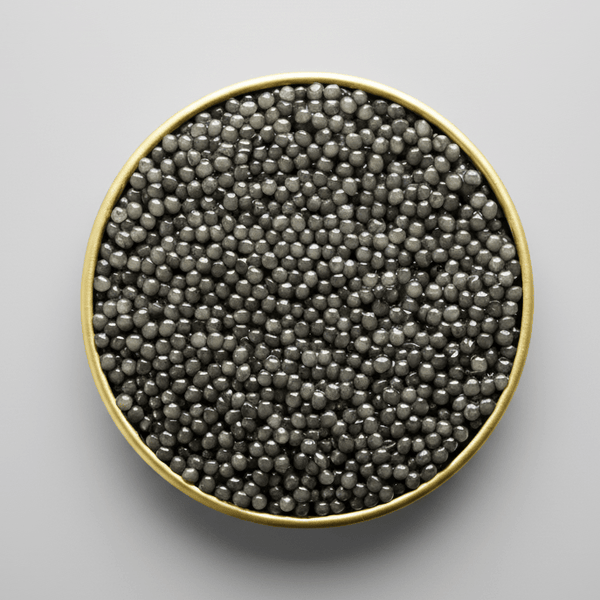
Caviar is salted roe from sturgeon (Acipenseridae family) and is classified by species into Beluga, Osetra, Sevruga, Kaluga, and Sterlet. Following the CITES ban on wild Caspian caviar (2006), virtually all legal caviar comes from controlled aquaculture with a CITES code on the tin. Real price ranges in 2026 vary from €120/100g (Sevruga) to €4,000-€12,000/kg (Beluga Imperial). To choose wisely, look for four verifiable facts: biological species, CITES code, packaging date, and salt percentage (malossol = 3-5%, premium). In this guide, we explain what to pay for, what to avoid, and how to buy caviar online in Spain intelligently, without marketing hype.
What caviar is (and what it is NOT)
Caviar is the salted roe of fish from the Acipenseridae family, commonly known as sturgeon. Since European regulation (EC) No. 865/2006 and its 2010 update, in the EU only products derived from sturgeon roe can be labeled as "caviar". Any other roe — salmon, mullet, trout, lumpfish — must be sold under its real name or as "fish roe", "ikura" or "caviar substitute".
This distinction is not semantic: it changes the price by a factor of 10 to 50. While a 100g jar of "red roe" from salmon costs €12-€30, a 100g jar of real Sevruga is around €100-€180, and a Beluga Imperial can exceed €600. If you find "caviar" for €15 in a supermarket, you are not buying real caviar.
Sturgeon is also a protected species since 2006 by the CITES Convention. Every tin of legal caviar in Europe must carry a 9-12 character CITES code that identifies the country of origin, production plant, year, species, and batch. If the tin doesn't have it, don't buy it — beyond the legal risk, it usually indicates a product outside sanitary control.
To delve deeper into the Acipenseridae family and its 27 species, read our guide on sturgeon, the caviar fish.
Types of caviar by species

There are 27 species of sturgeon, but only five account for virtually all commercial caviar worldwide. Knowing them is the basis for not overpaying and for understanding what you are buying.
| Type | Species | Grain size | Color | Flavor | Price (€/100 g) |
|---|---|---|---|---|---|
| Beluga | Huso huso | 3-3.5 mm | Light gray to almost black | Creamy, buttery, smooth | 400-1,200 |
| Osetra | A. gueldenstaedtii | 2.5-3 mm | Golden brown to olive green | Nutty, complex | 180-450 |
| Sevruga | A. stellatus | 1.5-2 mm | Dark gray | Intense, saline, mineral | 100-200 |
| Kaluga | Huso dauricus | 2.5-3 mm | Medium gray | Buttery (similar to Beluga) | 150-350 |
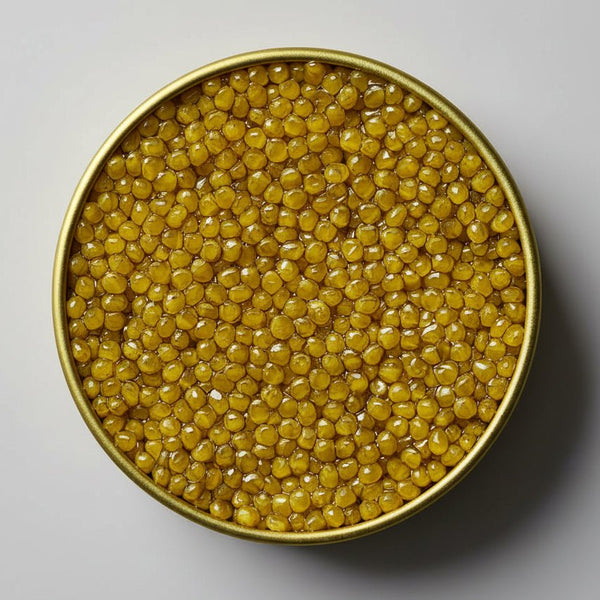
| Sterlet/Imperial | A. ruthenus | 1.5-2 mm | Golden to amber | Smooth, sweet, refined | 250-700 |
The price also depends on the country of origin, the age of the sturgeon at harvest, and the producer's internal grading (00, 000 mark the highest grades in Beluga and Osetra). For a more in-depth explanation, consult our detailed comparison of caviar types.
Beluga Caviar: why it's the most expensive

The Beluga (Huso huso) is the largest sturgeon in the world: it can exceed 7 meters and 1,500 kg. It takes 18-25 years to reach sexual maturity, which explains why its caviar commands prices that few other foods can rationally justify.
Sensory characteristics
- Grain size: the largest on the market (3-3.5 mm).
- Color: pearly light gray to almost black. Grades 00 and 000 indicate lighter shades and are the most sought-after.
- Flavor: buttery, creamy, with notes of fresh hazelnut and a long marine finish. Almost no acidity.
- Texture: firm roe that bursts cleanly. The membrane is thin, with no hard sensation.
Beluga Price 2026 (actual ranges in Spain)
- 30 g (small tin): €90-€180
- 50 g: €220-€380
- 100 g: €400-€1,200
- 1 kg: €4,000-€12,000
Prices can double in department store boutiques or shops like Petrossian. That's why the comparison of real prices in section 8 is one of the most useful parts of this guide.
Osetra Caviar: the flavor-price balance
Osetra (also spelled Oscietra, Acipenser gueldenstaedtii) is the favorite caviar of many professional chefs. The reason is simple: it offers greater aromatic complexity than Beluga at a price that isn't as intimidating.
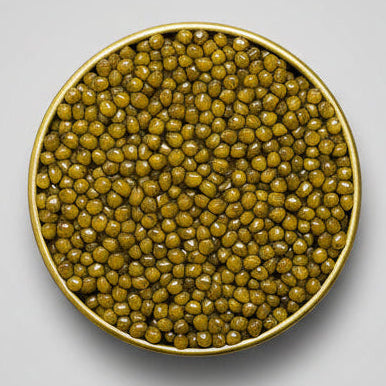
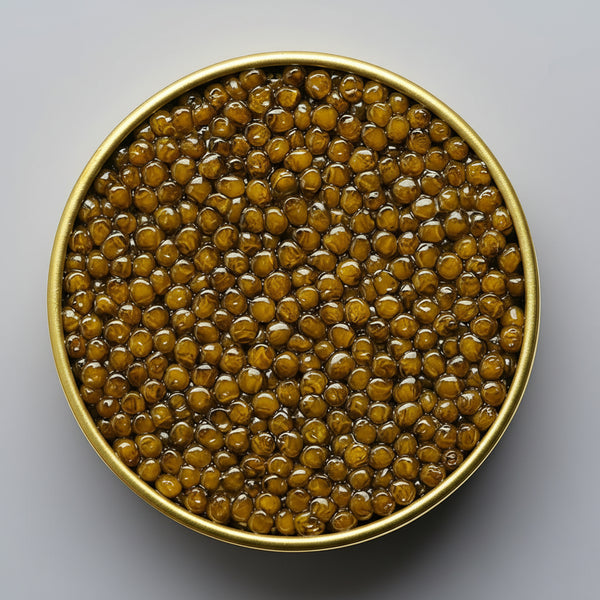
Its roe is medium-sized (2.5-3 mm), with colors ranging from golden brown to dark olive green. The flavor is complex, with notes of dried fruits, cured butter, and a smoky-mineral touch. The texture is firm but less creamy than Beluga.
Osetra Imperial is the most sought-after subcategory: roe from older sturgeon (12-15 years) with a lighter, golden hue. These are served in Michelin-starred restaurants as an accompaniment to refined dishes (oysters, blinis, confit cod loin).
For most premium dinners at home, Osetra offers the best flavor-price ratio on the market. If you've never tried caviar and don't want to spend €200 on a first experience, this is the serious entry point (not a Mercadona substitute).

Also read our detailed guide on Osetra Caviar and why chefs choose it.
Sevruga Caviar: intense and affordable
Sevruga (Acipenser stellatus) is the smallest of the three Caspian classics and has the fastest maturation time (7-10 years). This is why its price is the most accessible within real caviar.
Its roe is small (1.5-2 mm), dark gray to almost black, with an intense, saline, and very mineral flavor. It is the caviar for those who seek a powerful flavor and character — not the balance of Osetra or the creaminess of Beluga.
It works especially well in preparations where caviar needs to stand out over other ingredients: salmon tartare, truffled egg, vichyssoise. It is also the recommended choice for a first caviar experience if your palate prefers potent marine flavors.

Iranian vs. Russian vs. French vs. Spanish caviar: origin and quality
Following the collapse of wild Caspian fishing, the world's commercial caviar today comes from four major origins:
Iranian Caviar (Persian)
Iran maintains a CITES quota for wild caviar and also produces extremely high-quality aquaculture caviar in traditional farms. The Persian brine, with less salt and ancient artisanal techniques, ensures that Iranian caviar maintains its reputation as "the original" — especially for Beluga and Osetra. This is what Bacalalo's Caspian Caviar section offers.
Russian Caviar (and Kazakh)
Historically the main source, today mostly aquaculture caviar. Quality varies widely: big brands produce excellent Osetra and Beluga; but many low-cost Russian products reaching Europe come from industrial farms. Always check the CITES code and the specific producer.
French Caviar
France (Aquitaine, primarily) is the second-largest European producer. Brands like Petrossian (which produces and markets) or Sturia offer consistent caviar, with a focus on sustainable farming. The retail price in Spain often includes a significant markup due to brand and distribution.
Spanish Caviar
Riofrío (Granada) and Caviar Nacarii (Lleida) are the two internationally recognized Spanish organic producers. Both produce Acipenser baerii (Siberian sturgeon) and Acipenser naccarii (native to the Adriatic and reintroduced in Spain), with organic certification. Riofrío caviar was the world's first certified organic caviar.
For the complete guide on Iranian origins, see Why Iranian caviar remains the best in the world.
Riofrío Caviar and Spanish Caviar: national options
If you value close traceability and sustainable production, Spanish caviar is a serious option. Riofrío (Granada) raises sturgeon in spring waters under an organic protocol, without antibiotics or hormones, and obtained the world's first organic caviar certification in 2008. Its prices are in line with premium Iranian caviars: €200-€450/100g.
Caviar Nacarii, raised in Catalonia (Lleida), works with Acipenser naccarii — a species almost extinct in its natural habitat and reintroduced in Spain. Its caviar has nutty notes and a cleaner finish. Prices are similar to Riofrío.
Although we do not directly commercialize Spanish caviar at Bacalalo (we prefer to specialize in Iranian), if your priority is national caviar with organic certification, both are safe bets. Read our guide to Spanish caviar to understand the differences and real prices.
Caviar price 2026: actual ranges and why it costs what it costs
This is the section that causes the most confusion and where we find the most opacity in other stores. Let's lay out the facts.
Table of real prices 2026 (Spain, mid-high range)
| Type | 30 g | 50 g | 100 g | €/g (100 g) |
|---|---|---|---|---|
| Sevruga | 40-65 € | 65-100 € | 100-200 € | 1-2 €/g |
| Osetra | 60-130 € | 100-220 € | 180-450 € | 1.8-4.5 €/g |
| Standard Beluga | 90-150 € | 140-260 € | 270-500 € | 2.7-5 €/g |
| Beluga 00 / Imperial | 120-200 € | 200-380 € | 400-800 € | 4-8 €/g |
| Beluga 000 / Almas | 180-350 € | 350-650 € | 800-2.500 € | 8-25 €/g |
Comparison with Petrossian, El Corte Inglés, and Riofrío (May 2026)
Data verified on websites on May 10, 2026, Beluga ~50 g tin equivalent:
- Petrossian.com (Beluga Tsar Imperial 30 g): ~330 € → 11 €/g
- El Corte Inglés Club del Gourmet (Beluga Per Sé 50 g): ~280 € → 5.6 €/g
- Caviar de Riofrío (Russian Style 50 g): ~210 € → 4.2 €/g
- Bacalalo (Iranian Imperial Beluga 00, 30 g): 90 € → 3 €/g
- Mercadona ("caviar" 50 g): ~6 € → not caviar (dyed capelin roe)
The conclusion is clear: the brand premium can triple the price of the same type of caviar. We are not comparing identical products (each Beluga comes from a different farm), but rather the order of magnitude and sensory category.
For a complete breakdown of the production cost that justifies the price, read our guide on why caviar costs what it costs.

How to choose caviar (4 verifiable criteria)
Forget "premium marketing" and "exclusive selection." To truly choose caviar, check these four pieces of information on the tin or product description:
- Biological species: the scientific name must appear (Huso huso, Acipenser gueldenstaedtii, A. stellatus, A. baerii, A. naccarii). If it only says "caviar" or "selection," be suspicious.
- CITES code: 9-12 characters on the bottom of the tin. Indicates country of origin + production plant + species + year + lot. Without a CITES code, it is not legal caviar.
- Packaging and expiry date: caviar improves slightly between 30 and 90 days after packaging, but its optimal window is 4-6 months. Always buy recent batches.
- Salinity / malossol: 3-5% salt by weight of roe indicates premium quality. Above 5%, the caviar loses nuances and becomes harsh. Ask or read the label.
As an extra (sensory) criterion: when you open the tin, the roe should have a natural shine, not be stuck together, and release very little liquid. If you find a considerable liquid surplus, the caviar has been mishandled or poorly preserved.
See our quick guide How to choose premium caviar for more in-depth information.
How to eat caviar correctly
There are basic rules that serious caviar enthusiasts and chefs respect. They are not snobby protocol: they are techniques to truly enjoy it.
Temperature and serving
- Serve between 4 and 6 °C. Cold but not frozen.
- On a bed of crushed ice, in its own tin (better than in a bowl).
- Remove from the refrigerator 5 minutes before serving for the roe to release its aroma.
Spoon: never metal
Always use a mother-of-pearl, bone, or horn spoon. Metal (especially silver) reacts with caviar and gives it a metallic taste. A small mother-of-pearl spoon costs 8-15 € and should be included with any purchase of premium caviar.
Classic accompaniments
- Warm blinis + crème fraîche + caviar (classic Russian).
- Toasted brioche bread + butter + caviar.
- Chopped hard-boiled egg + chives + caviar (Russian style).
- Pure caviar on the back of the hand (pure tasting, recommended for Beluga and Imperial).
Pairings
- Brut Champagne without sweetness (Blanc de Blancs is ideal).
- Frozen vodka (-18 °C, unflavored).
- Cava brut nature (excellent Spanish alternative).
- Dry mineral white wines (Albariño, Chablis).
Common mistakes to avoid
- Silver or stainless steel spoon.
- Mixing caviar with lemon (breaks down the fat in the roe and oxidizes).
- Spreading it (literally "spreading") on bread: the roe breaks.
- Serving it frozen (-2 °C): it loses nuances.
- Pairing it with tannic or very aromatic wines.
Full details in our guide How to eat caviar correctly and the caviar pairing guide.
How to store caviar
Unopened tin: in the refrigerator, coldest part (0-4 °C, not freezer). Shelf life until the indicated expiry date (usually 4-6 months after packaging for non-pasteurized, up to 12 months for pasteurized).
Opened tin: consume within 2-3 days maximum. Cover tightly with cling film directly touching the roe (prevents oxidation) and return to the coldest part of the refrigerator. Do not reuse the tin for anything else until all the caviar is consumed.
Can it be frozen? Technically yes, but it is not recommended: freezing breaks the membrane of the roe, and upon thawing, a liquid paste with no texture is obtained. Only in an emergency (low-cost caviar like Sevruga that you won't consume within 5 days).
Also consult how to store caviar before and after opening.
Buying caviar online in Spain: what to pay attention to
Caviar is a delicate product: it requires a cold chain during shipping, recent packaging dates, and a seller who knows what they are sending you. Before buying caviar online:
- Cold chain: shipping must be refrigerated (package with gel pack or dry ice) and delivered within 24-48 hours. Avoid standard shipping of 3-5 days.
- Visible batch date: the store should be able to tell you (or show you in the product description) the packaging date of the current batch.
- Identified origin and species: scientific name and country. If the product description only says "premium selection caviar" without a species, do not buy.
- Specialized store: prefer fishmongers, premium delicatessens, or specialized boutiques over generic marketplaces. Expert advice makes a difference.
- Clear incident policy: caviar is perishable. A serious store replaces the product if it arrives outside the cold chain.
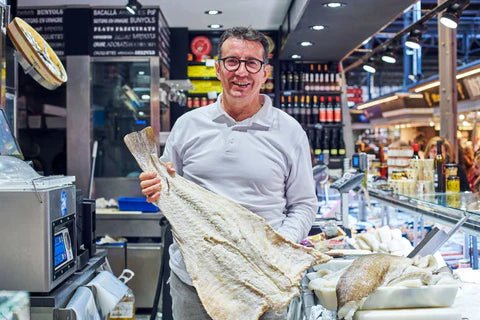
At Bacalalo, we have been working with Iranian Caspian caviar from the Mercat del Ninot in Barcelona since 1990. Each tin is shipped refrigerated, with a readable CITES code and the batch date visible.
For more details, see our guide Buying caviar online in Spain. If you are buying from Barcelona, also where to buy caviar in Barcelona.
Bacalalo Caviar: selected catalog
Our entire selection of Iranian Caspian caviar is available in the Bacalalo caviar collection. Four current references plus a starter pack:
Frequently Asked Questions
What does caviar taste like?
Caviar has a buttery, slightly saline and mineral flavor, with notes reminiscent of nuts, fresh butter, and the sea. Texture is key: the roe should "pop" gently on the palate, not crush. The better the caviar, the cleaner the finish and the longer the persistence. Beluga provides creaminess; Osetra, nutty notes; Sevruga, mineral intensity.
Why is caviar so expensive?
Three reasons. First, biology: it takes a sturgeon 8-20 years to produce roe (Beluga up to 25). Second, CITES regulation since 2006 prohibits wild Caspian caviar outside of quotas, so almost all commercial caviar comes from controlled aquaculture. Third, artisanal handling: bleeding, sieving, and malossol salting are done by hand by master caviar makers. The price reflects years of breeding, not a luxury brand.
Is Mercadona caviar worth it?
It's not real caviar. What Mercadona and other supermarkets sell for €5-15 are substitutes: lumpfish, capelin, or mullet roe dyed with squid ink. They are suitable for decorative canapés, but they do not share the species or process with true caviar (sturgeon roe). If you are looking for authentic introductory caviar, a 30g Sevruga (~€50-60) or the Caviar Starter Assortment (€119.90) are the first real options.
What is the best caviar in the world?
Historically, wild Iranian Caspian Beluga was considered the best due to its grain size (3.5 mm) and creaminess. Today, with wild caviar severely limited by CITES, the benchmarks are: controlled aquaculture Iranian Beluga, Imperial Osetra (Acipenser gueldenstaedtii) from Persian farming, and the white-gold Almas (caviar from centuries-old albino sturgeon, up to €25,000/kg). "Best" depends on palate: some prefer the intensity of Sevruga to the balance of Osetra.
Is there caviar at El Corte Inglés?
Yes. El Corte Inglés sells caviar from brands like Petrossian, Riofrío, and Per Sé, especially in the Club del Gourmet. Prices tend to be among the highest on the online market due to large department store margins. For the same type and origin, a specialized fishmonger/delicatessen like Bacalalo in Mercat del Ninot usually offers 15-25% less with real advice.
Discover our premium selection
Seafood products carefully selected since 1990 in Mercat del Ninot, Barcelona. Refrigerated shipping in 24-48h.
Conclusion: how to buy caviar wisely in 2026
Summary of what matters when buying caviar:
- Buy only sturgeon roe with a legible CITES code.
- Know the species and choose according to your palate: Sevruga (intense), Osetra (balanced), Beluga (creamy).
- Look for a recent packaging date and prefer batches less than 4 months old.
- To start: 30g of Sevruga or Osetra (~€50-130). For a gift: Beluga 30-50g.
- Buy from a specialized store with a real cold chain and advice.
If you have questions or want personalized recommendations for an event, write to us at info@bacalalo.com — we are premium fishmongers at Mercat del Ninot since 1990 and know the catalog batch by batch.
About the author
Lalo González Rodríguez · Specialist in cod and premium seafood products. Since 1990 at Parada Bacalalo in Mercat del Ninot (Barcelona). Works daily with Iranian Caspian caviar, Cantabrian anchovies, and Icelandic cod. Part of the team that personally selects each batch, without intermediaries. This guide is not marketing — these are verifiable criteria.
Related guides
- Beluga Caviar: a complete guide
- Osetra Caviar: flavor, price, and why chefs choose it
- Sevruga Caviar: the most intense and accessible
- Iranian Caviar: varieties, prices, and how to taste it
- Spanish Caviar: Riofrío, Nacarii and other brands
- Caviar price: why it costs what it costs and when it's worth it
- How to eat caviar correctly
- Caviar pairing: champagne, vodka or wine
- How to store open caviar
- Where to buy caviar in Barcelona
All selection available in Bacalalo's Caspian caviar collection.