📖 Complete Guide: If you're looking for an overview of caviar types, 2026 prices, and a Petrossian/Riofrío comparison, read our complete caviar guide 2026.
Summary: When it comes to caviar, the Caspian Sea is the historical reference origin. And the Caspian Sea has two producing coasts: Russian and Iranian. For decades, Iranian caviar was considered among the best in the world, with a history spanning centuries. This guide explains what makes it different, why it costs what it does, and how to enjoy it properly.
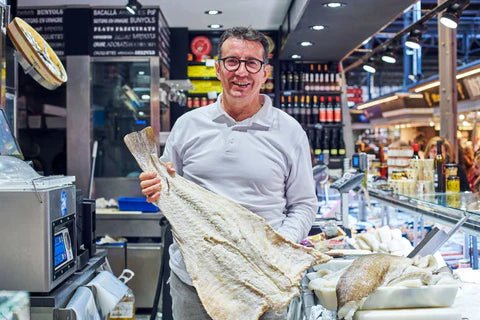
At Bacalalo, since 1990, we have been selecting premium seafood products at Mercat del Ninot in Barcelona, and caviar is one of the products that generates the most questions from customers who want to understand what they are buying.
Table of Contents
The Caspian Sea: The Origin of Reference Caviar
Caviar — salted sturgeon roe — is produced in many countries around the world, but the historical reference point is the sturgeon species of the Caspian Sea: Beluga (Huso huso), Osetra (Acipenser gueldenstaedtii), and Sevruga (Acipenser stellatus).
Iran has approximately 740 km of coastline on the Caspian Sea, in the Gilan and Mazandaran regions. The waters of the southern Caspian have distinct characteristics from those of the north (the coasts of Azerbaijan, Russia, Kazakhstan, and Turkmenistan): slightly different temperature, unique mineral composition, and currents that generate a specific ecosystem for sturgeon.
The Iranian state company that regulated caviar production for decades — SHILAT — established strict quality controls and maintained a reputation for excellence throughout the 20th century. Many experts considered Iranian caviar slightly superior to Russian in terms of flavor subtlety, although this is a discussion that is as subjective as it is objective.
The Three Main Varieties of Iranian Caviar
Beluga (Huso huso) — The largest and rarest
Beluga is the king of caviar. The Huso huso sturgeon can live for over 100 years and reach a weight of 1,000 kg. Females do not mature until 18-25 years old. The caviar they produce is the largest (3-4mm in diameter), the softest in texture, and the most delicate in flavor: creamy, buttery, with a long aftertaste.
The color varies from light gray to almost black dark gray. In the Iranian classification system (which uses fin number), the highest quality Beluga is indicated as "000" (larger, firmer grain) descending to "00" and "0".
Why it's so expensive: Huso huso is on the endangered species list. Wild capture in the Caspian is practically prohibited (CITES Appendix II). Most of the Beluga currently sold comes from fish farms. Iran had one of the most important wild populations but has also largely transitioned to captive production.
Current price: Legitimate Beluga (from aquaculture or the extremely rare legal exceptions of wild-caught) can cost between €2,000 and €10,000 per kilo, depending on the source, quality, and supplier.
Osetra (Acipenser gueldenstaedtii and oscietra) — The perfect balance
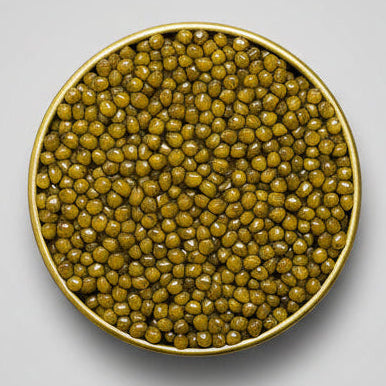
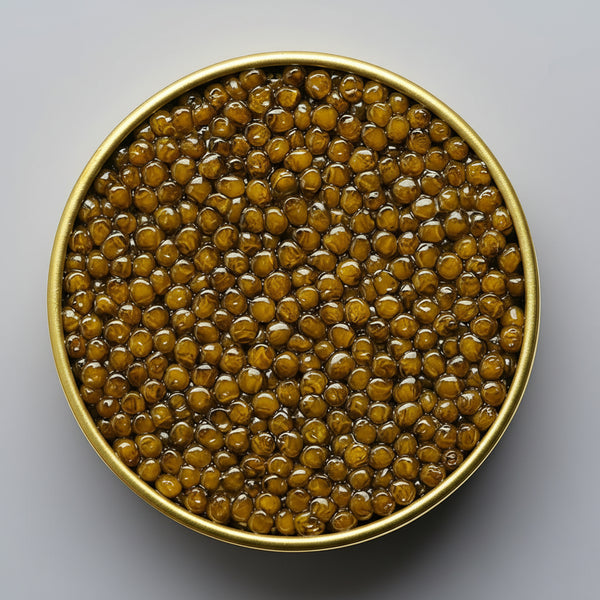
Osetra is the reference caviar for most connoisseurs. The sturgeon lives 50-80 years, produces medium-sized eggs (2-3mm), with colors ranging from olive green to golden brown. It has the most complex flavor of the three varieties: notes of walnut, butter, balanced iodine, persistent aftertaste.
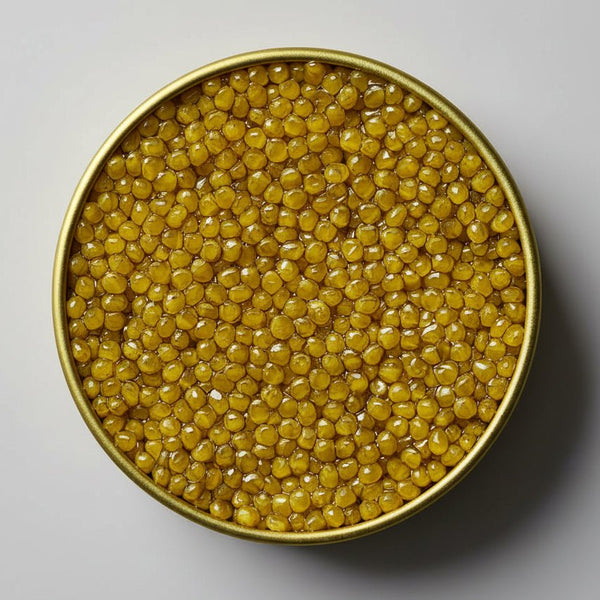
The golden variety of Osetra (Golden Osetra or Imperial Osetra) is the most highly valued: it comes from older females and produces amber or golden caviar, with an exceptionally smooth and concentrated flavor. It is extremely rare and very expensive.
Iranian Osetra caviar was historically known for its balance of grain size, firmness, flavor, and price. Many sommeliers and gourmets consider it the best entry point for high-quality caviar.
Current price: Between €800 and €2,500 per kilo depending on quality and origin. Jars of 30g (a reasonable amount for a tasting) between €30 and €120.
Sevruga (Acipenser stellatus) — The most intense
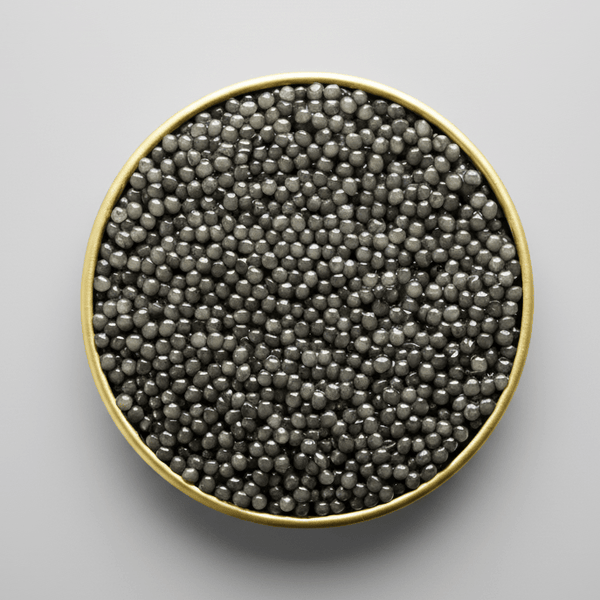
Sevruga is the smallest of the three sturgeon species and has the shortest life cycle (maturing at 7-10 years). Its eggs are the smallest (1.5-2mm), uniformly dark gray, and have the most intense and iodized flavor of the three varieties.
It is the most accessible Caspian caviar in terms of price, though not inferior in quality: it has its passionate defenders. Lovers of intense marine flavors often prefer Sevruga; those who prefer finesse and subtlety opt for Osetra or Beluga.
Current price: Between €500 and €1,200 per kilo. More accessible, and an excellent introduction to Caspian caviar.
Iranian Caviar vs. Russian Caviar: Is There a Real Difference?
This question has an honest answer: the difference is real but subtle, and varies by year, species, supplier, and processing method.
The points where Iranian caviar has historically been differentiated:
Salinity: Iranian caviar tends to be processed with less salt (the "malossol" method taken to the extreme). Lower salinity enhances the flavor of the roe.
Freshness of processing: The proximity of processing facilities to the Iranian Caspian Sea has historically been better than in some parts of the Russian coast, reducing the time between capture/extraction and packaging.
Quality control: The Iranian SHILAT had very strict classification and control standards. Caviar that did not meet the criteria was not exported.
Currently, with the proliferation of quality aquaculture in China, France, Spain, Italy, and other regions, the "Iranian Caspian Sea" origin has somewhat lost its de facto exclusivity, although it remains a benchmark for connoisseurs.
Related Products from Bacalalo


Recommended Products

Mújol Shikrán Selection - Premium Roe with Extr...
€6.95

"The Great Beluga Gift" Assortment
€227.91

Black Mullet Shikrán 550g - Smoked Herring and...
€27.95

Sevruga Caviar
€100.00
Refrigerated delivery in 24-48h throughout the Iberian Peninsula
CITES and Caviar Legality
This point is important and often causes confusion.
CITES (Convention on International Trade in Endangered Species) regulates the trade of wild sturgeon caviar from the Caspian Sea. Since 2008, there has been a de facto moratorium on wild Beluga caviar for export. Other species have strict quotas.
What does this mean for the buyer?
- Wild Caspian sturgeon caviar can be legally purchased in some countries, but regulations and availability are very limited.
- Most of the caviar currently sold — including Iranian — comes from aquaculture. This is not a defect: the best fish farms produce caviar of comparable quality to wild, with greater traceability and sustainability.
- When buying caviar, verify that the jar has a CITES label or equivalent from the country of origin (lot number, species, origin, harvest year). Without this information, the legality and authenticity of the product are doubtful.
At Bacalalo, we only work with caviar of verified origin and legally marketable. If you have doubts about the origin of caviar, ask the supplier for documentation.
If you want to explore our selection of premium caviar, visit Bacalalo — caviar and exclusive seafood products. We select suppliers with full traceability and CITES documentation.
How to Taste it Correctly
Tasting caviar well is a matter of temperature, accompaniments, and attitude. There is a lot of ritual surrounding caviar, some of which has a real basis and some is affectation.
Serving temperature
Caviar should be served cold, between 0°C and 4°C. Not frozen. The most practical way at home is to take the jar out of the refrigerator 5 minutes before serving.
The classic way to maintain temperature: place the jar on ice in a small bowl.
Quantity per person
For a serious tasting (not just a decorative sprinkle): 10-15g per person. For a central appetizer experience: 20-30g. Caviar is one of those products where quantity matters: with less than 10g it is difficult to truly appreciate the flavor.
The spoon: mother-of-pearl or bone spoon
Metal — including silver — oxidizes the flavor of caviar. Contact with metal imparts a metallic taste that interferes. A mother-of-pearl, synthetic ivory bone, ceramic, or wooden spoon is correct. Many premium caviar jars include a mother-of-pearl spoon.
How to eat it
The way to eat caviar that best allows you to appreciate its flavor: place a small amount on the back of your hand (the area between the thumb and forefinger, where the skin is soft and warm). Bring to the mouth. The skin temperature slightly warms the roe, and the gentle movement of the tongue against the palate makes them burst more controlled.
When serving on blinis, toast, or crackers, the key is that the accompaniment does not dominate. Thin buckwheat blinis, or unflavored toast, are the best canvases.
Accompaniments
Classics that work:- Crème fraîche (sour cream softens the saltiness and adds creaminess)
- Buckwheat blinis
- Plain toast
- Hard-boiled egg (the yolk pairs perfectly with the umami of caviar)
- Chopped chives (very mild)
- Directly squeezed lemon (alters the flavor of caviar)
- Strong onion or capers (dominate)
- Intense sauces
Pairing
Purists say only vodka or champagne. Both are technically correct:
Vodka: Cleanses the palate between bites. The neutrality of vodka (especially premium, unflavored ones) makes way for the caviar.
Champagne: The effervescence and acidity complement the saltiness of caviar. Blanc de Blancs (100% Chardonnay) is the most recommended. Avoid heavily dosed champagnes (demi-sec or sec): sugar does not pair well.
Reasonable alternatives: Brut Nature Cava, very cold Txakoli, Chablis Premier Cru.
How to Store Caviar
Unopened: In the refrigerator at 0-4°C, it can last between 4 and 8 weeks if the jar is unopened. Always check the supplier's expiry date.
Once opened: Consume within a maximum of 3-5 days, always refrigerated, tightly sealed. Caviar exposed to air oxidizes and loses quality quickly.
Frozen: It can be frozen, but the texture of the roe suffers (they become softer when thawed). Only as a last resort if it cannot be consumed in time. Thaw slowly in the refrigerator.
Real Caviar Prices in 2026
Prices fluctuate significantly depending on the supplier, harvest, and origin. As a reference:
| Type | Origin | Approximate Price/100g |
|---|---|---|
| Sevruga (aquaculture) | Various | €80-€150 |
| Osetra (aquaculture, medium quality) | Various | €100-€200 |
| Iranian Osetra (high quality) | Iran | €200-€400 |
| Golden / Imperial Osetra | Various | €400-€800 |
| Beluga (aquaculture) | Various | €500-€1,000 |
| Iranian Beluga (if available) | Iran | €800-€2,500+ |
Frequently Asked Questions about Iranian Caviar
1. Is Iranian caviar better than Russian? Historically, it has been considered slightly superior in finesse and lower salinity, but the difference is not absolute. It depends on the year, species, producer, and process. Both come from the same sea and the same species.
2. Is Iranian caviar legal in Spain? Yes, if it comes from aquaculture or has correct CITES documentation. Wild Beluga caviar from the Caspian Sea is virtually impossible to import legally. Always check the labeling.
3. Is the very cheap caviar sold in supermarkets authentic? Real sturgeon caviar (Huso, Acipenser) is expensive by definition. Products sold as "caviar" at very low prices are roe from other fish —lumpfish, salmon, trout— which are not caviar in the strict sense. They are different and perfectly valid products, but they are not sturgeon caviar.
4. How much caviar do I need for a good experience? 20-30g per person for a serious tasting. For a decorative touch on a dish, 5-10g. For a memorable experience as a central appetizer, 30-50g.
5. Can pregnant women eat caviar? It is not recommended. Caviar, even pasteurized, can contain listeria or other microorganisms. Health authorities advise avoiding unpasteurized caviar during pregnancy.
6. What is the difference between fresh and pasteurized caviar? Fresh (unpasteurized, "malossol") caviar has a richer flavor and texture, but a shorter shelf life and more microbiological risks. Pasteurized caviar lasts longer but loses some texture. Experts always prefer fresh when it comes from a reliable source.
7. Is caviar high in sodium? Yes. Caviar is a salted product: approximately 1,500-2,000mg of sodium per 100g. In typical consumption amounts (20-30g), the intake is manageable but significant.
8. How does Osetra caviar visually differ from Sevruga? Osetra has larger grains (2-3mm), more varied colors (olive green, brown, golden), and a smoother, more complex flavor. Sevruga has smaller grains (1.5-2mm), uniform dark gray color, and a more intense, iodized flavor.
9. Can Iranian caviar be bought online in Spain? Yes, there are specialized importers and gourmet online stores with caviar of verified origin. At Bacalalo, we work with suppliers with complete CITES documentation.
10. Is farmed caviar as good as wild caviar? The best fish farms produce caviar of comparable quality. Aquaculture allows for greater control over the sturgeon's diet and living conditions, which is reflected in the consistency of the product. Wild caviar can have more variability (for better or worse).
11. What does "malossol" mean? Malossol is a Russian word meaning "little salt." It is the processing method where caviar is minimally salted (generally less than 5% by weight), better preserving the original flavor of the roe. It is the quality standard for premium caviar.
12. Where to buy quality caviar in Barcelona? At Bacalalo, in Mercat del Ninot, or in our online store. We work with caviar of verified origin and complete documentation. If you have questions about which product to choose for a special occasion, consult us.
Since 1990, Bacalalo has been selecting the best seafood products at Mercat del Ninot in Barcelona. Caviar is the most luxurious product in our catalog, and we treat it with the care it deserves: complete traceability, optimal preservation, personalized advice. Discover our selection of caviar or visit us at Mercat del Ninot for a no-obligation consultation.
Products you might be interested in
Discover our premium selection
Seafood products carefully selected since 1990 at Mercat del Ninot, Barcelona. Refrigerated shipping in 24-48h.