Summary: Iranian caviar is the global benchmark not due to tradition or marketing, but for verifiable reasons: the geology of the southern Caspian, the biology of sturgeon in those specific waters, the rigor of the Iranian quality control system, and the curing process that has remained largely unchanged for centuries. This guide explains each of these reasons with concrete information and compares them with major alternative origins so that consumers understand the real difference.
Table of Contents
- Iranian Caviar: A Tradition Preceding Modern Luxury
- The Geology of the Southern Caspian: Why Water Matters
- Sturgeon in the Iranian Caspian: Optimal Natural Conditions
- The Iranian Quality Control System: IIFRO and its Standards
- The Iranian Malossol Curing Process
- Iran vs. Russia: The Same Sea, Different Results
- Iran vs. European Continental Aquaculture: The Water Difference
- Iran vs. China: The Largest Producer vs. The Best Quality
- How to Identify Authentic Iranian Caviar
- Frequently Asked Questions About Iranian Caviar
Iranian Caviar: A Tradition Preceding Modern Luxury
Updated March 2026. We have been hand-selecting every product since 1990. This guide reflects that experience.
Iranian Caspian caviar did not start as a Western luxury product. Its history is one of a local gastronomic tradition — Iranian coastal populations of the Caspian, especially in the Gilan and Mazandaran provinces, have consumed caviar since times impossible to accurately date — which 19th-century international trade transformed into the luxury we know today.
The first significant exports of Iranian caviar to the European market date back to the late 19th century, when Russian and Armenian traders who managed Caspian trade began bringing the product to European courts. The reputation of Iranian caviar as the highest quality within the Caspian is not a modern marketing invention: it is documented in 19th-century commercial and gastronomic records that distinguish caviar from the Iranian sector from that originating in other Caspian sectors due to its finer flavor, superior texture, and longer preservation.
During the Shah's era, Iran developed a state-controlled caviar industry — the Shilat Company — which established the production and export standards that the Islamic Republic would later inherit. The institutional continuity in the quality control of Iranian caviar, through radical political changes, is itself an indicator of the importance this product holds for the country's economy and cultural identity.
The Geology of the Southern Caspian: Why Water Matters
The Caspian Sea is not a uniform body of water. Its geology, depth, and chemical composition vary significantly between the northern part — Russian and Kazakh coasts, shallow waters with greater fluvial influence from the Volga — and the southern part — Iranian coasts, much deeper waters with a distinct mineral composition.
The southern Caspian has maximum depths of over 1,000 meters, compared to less than 25 meters in the northern Caspian. This depth difference translates into differences in temperature (the bottom of the southern Caspian is much colder), oxygenation, and thermal stratification, which create a different ecosystem for sturgeon.
The mineral composition of the southern Caspian's water has specific concentrations of sulfates, carbonates, and trace elements — a result of the geology of the river basins that feed that part of the sea — which directly influence the chemistry of sturgeon fats and, therefore, the aromatic profile of their roe. This is the biological mechanism by which terroir — a concept that in wine designates the influence of soil and environment on the product — is as relevant to caviar as to any product of natural origin.
Comparative chemical studies between Iranian Caspian aquaculture caviar and European continental aquaculture caviar show measurable differences in fatty acid composition and volatile aromatic compound profile — differences that trained tasters identify as the mineral notes and characteristic creaminess of Iranian caviar vs. the more "neutral" profile of European continental caviar.
Sturgeon in the Iranian Caspian: Optimal Natural Conditions
Sturgeon from the Iranian Caspian feed on a specific ecosystem that does not exist anywhere else on the planet under the same conditions. The bottom of the southern Caspian harbors concentrations of benthic organisms — crustaceans, mollusks, polychaetes, small fish — that make up the natural diet of sturgeon and contribute the compounds that determine the aromatic profile of their roe.
The temperatures of the southern Caspian are colder than those of the north, especially in the deep layers where sturgeon spend much of their lives. Cold favors a slower metabolism which, combined with the Caspian ecosystem's diet, produces a higher fat content and a different fatty acid profile than sturgeon raised in warmer waters.
The Iranian Caspian has classically been the sector of the Caspian where sturgeon reached larger sizes and longer lifespans — which translates into older producing females that produce roe with more complex aromatic profiles. Aged sturgeon have a more developed "internal terroir": their fat and tissues have accumulated the chemical compounds of the ecosystem for decades, and this is reflected in the caviar.
The Iranian Quality Control System: IIFRO and its Standards
The IIFRO (Iranian Fisheries Research Institute) is the body that makes the quality difference of Iranian caviar operational. Its function is not only regulatory — it doesn't just verify that the product meets minimum standards — but it is actively part of the production process: its technicians and scientists work with authorized fish farms in the continuous development of production techniques, broodstock selection, and optimization of the curing process.
The IIFRO quality standard for export caviar includes parameters that are not mandatory in other producing countries: the minimum roe diameter by species, the maximum percentage of broken roe in a batch, the exact permissible salt content in the malossol range, the expected color for each species and category, and the certified storage and transport conditions to the destination. Every batch leaving Iran with an IIFRO label has passed all these controls.
The result of this system is that Iranian caviar has the lowest variability in quality between batches among all major producing countries. When you buy IIFRO-certified Iranian Osetra Imperial, you know precisely what type of product you have. This predictability — which the European and aquaculture caviar market, in general, has not yet uniformly achieved — is itself part of the value of Iranian origin.
The Iranian Malossol Curing Process
Malossol is a Russian term meaning "little salt" — between 3% and 4.5% salt relative to the weight of the caviar — and designates the curing method that best preserves the product's natural aromatic profile. Malossol caviar is the highest quality and spoils faster: the same minimal salt that preserves the flavor reduces the product's shelf life.
The Iranian malossol process has particularities that distinguish it from malossol from other origins. The salt used — Caspian Sea salt or specific salt from northern Iranian deposits with its own mineral composition — provides minerals that interact with the caviar differently than sea salt from other origins. It is a subtle but perceptible effect in blind tastings for experienced tasters.
The curing time, the chamber temperature during the process, and the relative humidity are precisely controlled in IIFRO-certified facilities. The result is a product with salinity integrated into the flavor — not caviar with salt on top, but caviar where the salt is an indistinguishable part of the total aromatic profile.
Iranian caviar masters — many with decades of experience — adjust the amount of salt according to the specific batch of roe, the time of year, and the exact origin of the female. This manual adjustment, based on experience and product knowledge, is what produces the quality consistency that characterizes top-grade Iranian caviar.
Iran vs. Russia: The Same Sea, Different Results
Iran and Russia share the Caspian Sea and the same sturgeon species. The logical question is: if the ecosystem is the same, why does Iranian caviar have the superior reputation?
The reasons are multiple, and none of them have to do with the biology of the sturgeon itself — which is identical in both Caspian sectors — but with the control, production, and distribution systems:
Regulatory stability: Iran has maintained a continuous state-controlled caviar system since the 1970s, adapted but without interruptions. Russia went through the collapse of the post-Soviet control system in the 1990s, which generated a decade of regulatory chaos and proliferation of the black market that damaged both sturgeon populations and the reputation of caviar from the Russian sector of the Caspian.
Caspian distribution: the Russian sector of the Caspian includes the northern Caspian — the shallower part, with greater fluvial influence from the Volga and less optimal conditions for sturgeon — in addition to the central and southern Caspian. The Iranian sector is exclusively the southern Caspian, the deepest part with the best conditions.
Reputation recovery: the international market, after the years of chaos of Russian caviar in the 1990s, established a distinction between "Iranian Caspian caviar" and "Russian Caspian caviar" that remains in the prices and preferences of the premium market to this day. The Russian reputation has partially recovered with specific producers of verified quality, but the price premium for Iranian origin persists.
Iran vs. European Continental Aquaculture: The Water Difference
European sturgeon farms — especially Italian and French ones — produce high-quality caviar. The level of environmental certification and traceability of some of these facilities is comparable to or superior to Iranian ones in terms of transparency for the European consumer. So, why is Iranian caviar still more valued in the premium market?
The answer is water. European continental fish farms use river water or treated water that does not replicate the mineral composition of the Caspian. The result is caviar with a different aromatic profile — not necessarily inferior in all parameters, but without the specific notes that only sturgeon raised in Caspian water produce.
The Caspian is an inland sea with no connection to any ocean, with a unique mineral composition resulting from millions of years of isolated geological evolution. That mineral composition cannot be replicated in a continental fish farm — it's not a question of investment in technology but of water chemistry that does not exist elsewhere. European aquaculture sturgeon produces excellent caviar, but it produces the caviar of its water — not Caspian caviar.
Iran vs. China: The Largest Producer vs. The Best Quality
China has become the world's largest caviar producer by volume in the last decade, mainly with Acipenser baerii (Siberian sturgeon) and Acipenser schrencki, raised in industrial facilities in Sichuan province and other regions. Chinese products occupy the mid-to-low price segment of the global market and have made caviar more accessible globally.
However, Chinese caviar rarely appears on the tasting menus of Michelin-starred restaurants that use caviar as a haute cuisine ingredient. The reasons are the variability in quality between producers — there is no control system equivalent to IIFRO for the Chinese caviar industry — and the flavor profile of Acipenser baerii caviar raised in Chinese continental water, which tasters describe as more "flat" and less complex than Caspian caviar.
For consumers who prioritize price over organoleptic quality, Chinese caviar from brands with verifiable traceability is a legitimate option. For those seeking the benchmark caviar experience, Iranian Caspian origin remains the correct choice.
How to Identify Authentic Iranian Caviar
The demand for Iranian caviar and its price premium in the market lead to attempts at counterfeiting or using the term "Iranian" without the product having the corresponding origin. Verifiable indicators are:
The CITES label with country code IR: IR is the ISO code for Iran. All legally exported Iranian caviar has this code on its CITES label. If the label shows another country code, the caviar is not of Iranian origin.
The IIFRO fish farm code: IIFRO assigns registration codes to each authorized fish farm. This code must appear on the label of certified Iranian caviar. It is verifiable in IIFRO records.
The scientific name of the species: classic Iranian caviar comes from Huso huso (Beluga), Acipenser gueldenstaedtii (Osetra) or Acipenser persicus (Persian Osetra, an Iranian variant of classic Osetra) or Acipenser stellatus (Sevruga). If the labeling indicates other species such as Acipenser baerii or Acipenser transmontanus, the caviar is not of the classic Iranian Caspian type.
The distributor with verifiable responsibility: a distributor who can provide you with the lot number, the origin fish farm, and the extraction date of the caviar they sell you. Opacity regarding this data is a sign that the traceability chain has a problem.
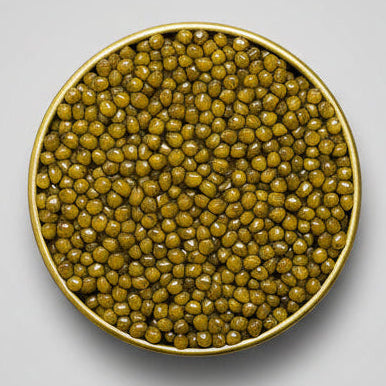
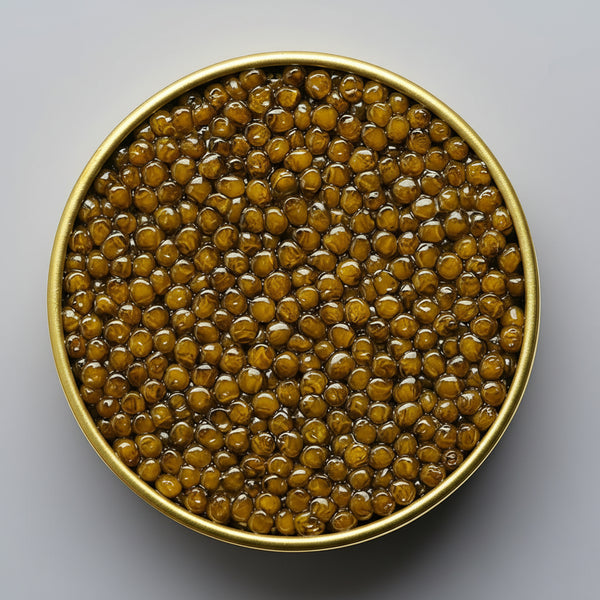
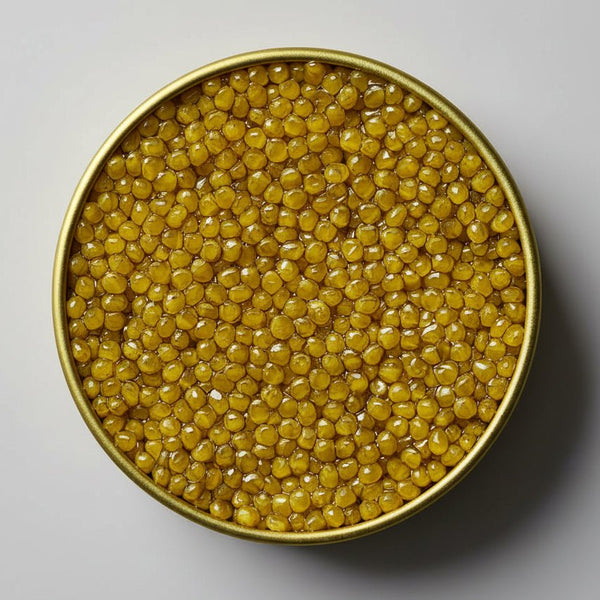
At Bacalalo, we work exclusively with Iranian Caspian suppliers with full IIFRO certification. The Iranian Imperial Osetra Caviar, Iranian Imperial Beluga Caviar, Iranian Beluga Caviar, and Caspian Sevruga Caviar all have complete and available origin documentation.
Iranian Caspian Caviar Collection — Beluga, Osetra, and Sevruga with IIFRO origin certification. The global reference for caviar, available with full traceability from the Caspian to your table.
View Caspian Caviar Collection
Premium Seafood Products — Bacalalo
Since 1990, selecting the best from the sea at Mercat del Ninot, Barcelona. Refrigerated shipping 24-48h.
View Caspian caviar →🛒 Our premium alternative
⭐ 4.9/5 · Cold shipping 24-48h · Since 1990 at Mercat del Ninot
Frequently asked questions about Iranian caviar
Why is Iranian caviar more expensive than other caviars?
The higher price of Iranian caviar has three verifiable components: the cost of production under the conditions of the southern Caspian (more technically demanding than continental aquaculture), the cost of the IIFRO quality control system, and the market premium that the historical reputation of Iranian origin has built over centuries. All three factors are real — it's not just brand perception.
Does Iranian caviar have a valid CITES?
Yes. All legally exported Iranian caviar bears a CITES label with the code IR (Iran), the production type (A for aquaculture), the scientific species, the batch number, and the processing date. The absence of this label on a product presented as "Iranian" indicates irregular marketing.
What is the difference between Iranian Osetra and Persian Osetra?
Classic Osetra is Acipenser gueldenstaedtii. Persian Osetra — or specific Iranian Osetra — may refer to Acipenser persicus, a related species endemic to the southern Caspian that produces roe with a similar profile to classic Osetra, sometimes considered to be of higher refinement due to its smaller diameter and more delicate membrane. Both species are native to the Iranian Caspian and have equivalent levels of protection and quality control under the IIFRO system.
Can Iranian caviar be bought directly from Iran?
The legal export of Iranian caviar requires authorized intermediaries — CITES licensed importers in the destination country — and there is no direct sales channel to the final European consumer from Iran. Authentic Iranian caviar that reaches Spain goes through importers with all regulatory documentation. A "direct sale from Iran" without these intermediaries cannot be a legally exported product.
Is Iranian caviar available in Spain with guarantees?
Yes. Several specialized distributors in Spain import Iranian caviar with IIFRO certification and complete CITES labeling. At Bacalalo, we work with these references in our Caspian caviar collection. When purchasing, always request the origin documentation if it is not included in the packaging.
Does the embargo on Iran affect the availability of Iranian caviar in Spain?
Iranian caviar is subject to the same trade restrictions as other Iranian products in the context of international sanctions. However, caviar certified for legal export to the European Union is generally not included in the categories of goods under embargo — it is a food product with CITES documentation that meets EU import requirements. Availability may vary with geopolitical situations, but the product exists and can be legally imported with the correct documentation.
Discover our premium selection
Carefully selected seafood products since 1990 at Mercat del Ninot, Barcelona. Refrigerated shipping in 24-48h.