📖 Complete Guide: If you are looking for an overview of caviar types, 2026 prices, and Petrossian/Riofrío comparison, read our complete caviar guide 2026.
Summary
When we at Bacalalo started including Spanish caviar in our selection at Mercat del Ninot, many customers were surprised: "Caviar from Spain? Does that exist?" Not only does it exist, but Spanish caviar is... In this guide: History of Spanish caviar: from non-existence to global recognition, Riofrío: the most famous Spanish caviar, Nacarii: Spanish caviar from Girona.
Spanish Caviar: Riofrío, Nacarii and Other Brands
When we at Bacalalo started including Spanish caviar in our selection at Mercat del Ninot, many customers were surprised: "Caviar from Spain? Does that exist?" Not only does it exist, but Spanish caviar has won international awards in recent years and the recognition of some of the most demanding gastronomic guides in the world. This guide covers everything you need to know about Spanish caviar, from farms to prices, so you can choose wisely.
History of Spanish caviar: from non-existence to global recognition
Spain had no tradition of caviar production until relatively recently. The Atlantic sturgeon (Acipenser sturio) historically inhabited the Guadalquivir river and was fished for its roe until its practical extinction in the second half of the 20th century. Today, this species is protected and in the process of recovery, but its caviar is not commercially available.
The Spanish caviar that exists on the market today comes from aquaculture farms that began to develop in the 90s and 2000s, mainly with the species Acipenser naccarii (the Adriatic sturgeon), although other species such as the Russian Osetra (Acipenser gueldenstaedtii) are also worked with. The pioneer was the Riofrío farm in Granada, which has been perfecting its technique for over 30 years and is now a global benchmark for sustainability and quality.
Riofrío: the most famous Spanish caviar
The Piscifactoría de Sierra Nevada, in Riofrío (Granada), is the oldest and best-known Spanish caviar producer. Its facilities are located next to the Frío river, in the Sierra Nevada, where the water flows directly from glacial melt: clean, cold (between 10°C and 14°C throughout the year) and pollutant-free. It is this water that gives Riofrío caviar its particular character.
What distinguishes Riofrío caviar from other Spanish or international caviars:
- Completely organic production: Riofrío was the first certified organic caviar producer in the world. The sturgeon live in conditions as natural as possible, without antibiotics or growth hormones.
- Species Acipenser naccarii: The Adriatic sturgeon, critically endangered in the wild. The farm actively contributes to its conservation with reintroduction programs.
- Particular taste: Riofrío caviar has a milder, slightly vegetal profile than Caspian caviars. Nutty notes are less pronounced and there is more freshness. Some tasters compare it to fresh trout. Price: 300-600 €/kg depending on format.
- Distinctive tin: The black tin presentation with the "Riofrío" seal is immediately recognizable. The company sells directly online and through gourmet stores.
Riofrío caviar is available in 10g, 30g, 50g, 100g and 500g formats. The price of a 30g tin is around 45-60 euros depending on the type (natural, malossol, smoked).
Nacarii: Spanish caviar from Girona
Nacarii is a Catalan company based in Girona that produces Spanish caviar from Acipenser naccarii sturgeon raised in the waters of the Pyrenees. It is one of the Spanish caviar brands with the greatest presence in the national market and one of the most valued by chefs and gourmet stores.
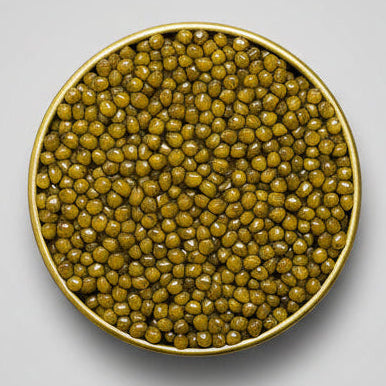
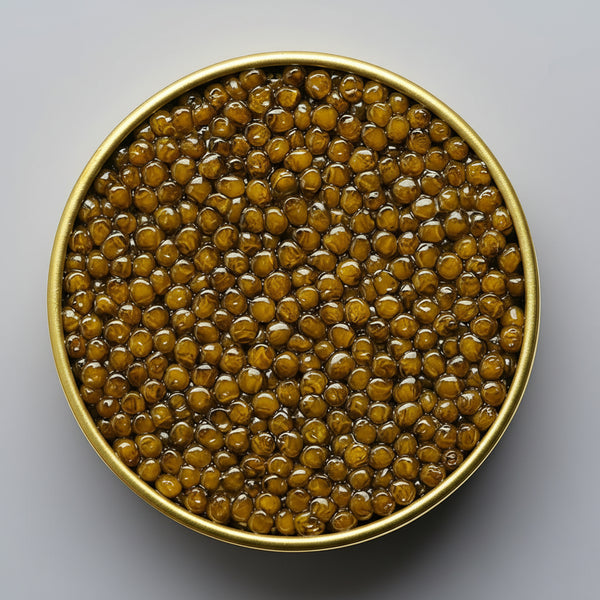
Nacarii caviar has a different flavor profile than Riofrío: more intense, with more pronounced salinity and more evident marine notes, probably due to differences in water quality and fish diet. The roe is dark brown to black with golden reflections.
Nacarii offers several ranges:
- Nacarii Classic: The basic caviar, produced with the malossol technique (low salt). Price: 280-400 €/kg.
- Nacarii Selection: Special batch of the best roe of the season, manually selected. Price: 400-600 €/kg.
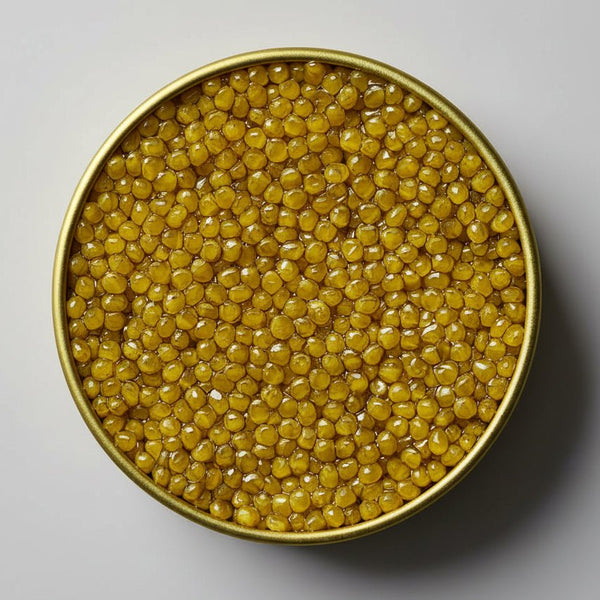
- Nacarii Gold: Gold caviar of very limited production. The golden-amber colored roe is the scarcest and has the mildest, most buttery flavor. Price: 800-1,200 €/kg.
Bacalalo Products

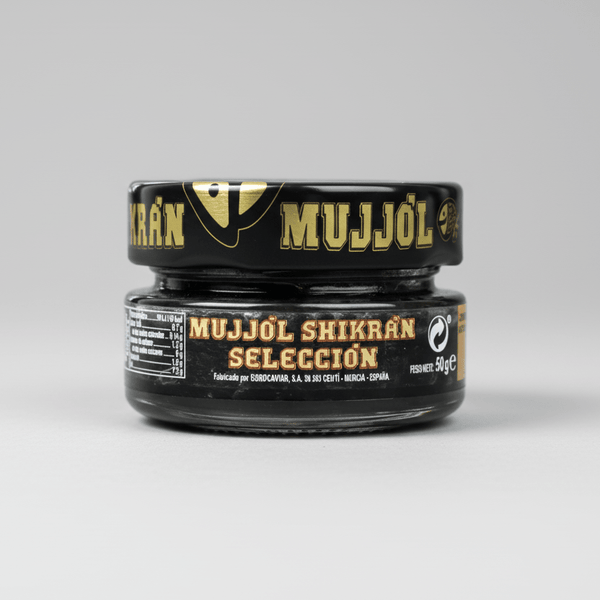
Mújol Shikrán Selection - Premium Roe with Smo...
6,95 €

"The Great Beluga Gift" Assortment
227,91 €

Black Mullet Shikrán 550g - Smoked Herring and...
27,95 €

Sevruga Caviar
100,00 €
Refrigerated shipping 24-48h to the entire Peninsula
Other Spanish caviar brands to know
Spanish caviar goes beyond Riofrío and Nacarii. In the last ten years, new producers have emerged with interesting proposals:
Caviar Pirinea (Huesca)
Aragonese farm in the waters of the Huesca Pyrenees. They work mainly with Russian Osetra (Acipenser gueldenstaedtii) in high-altitude, glacial water conditions. Their caviar has more intense notes and more pronounced salinity than Riofrío's. Distribution is more limited, mainly in Aragon and online. Price: 350-500 €/kg.
Caviar del Ebro
Experimental production in the Ebro basin, less consolidated in the market but with promising projects. Quality is irregular and availability is very limited.
Spanish caviar in the international context
Spanish caviar competes in quality with European productions from France (Kaviari, Prunier, Sturia), Italy and Germany. It does not reach the complexity of the best Iranian Caspian caviars, but it has clear advantages: complete traceability, sustainable production, more competitive prices and the possibility of visiting the farms. Riofrío has won international awards that place it as a benchmark for European production.
Spanish caviar vs. Caspian caviar: an honest comparison
Before buying Spanish caviar, it is important to know how it differs from Caspian caviar, which dominates the collective imagination of this product:
- Complexity of flavor: The best Iranian Caspian caviars are more complex, with more layers of flavor. Spanish caviar is cleaner and more direct, with fewer nuances but easier to appreciate for beginners.
- Price: Spanish caviar is between 30% and 60% cheaper than Caspian caviar of equivalent quality. Riofrío at 400-500 €/kg vs Iranian Osetra at 700-1,200 €/kg.
- Sustainability: Spanish caviar comes from farms with high animal welfare standards and no wild sturgeon extraction. Caspian caviar, although regulated, has a more problematic history of illegal fishing.
- Availability: Spanish caviar can be purchased directly from the producer and in national stores. Top quality Iranian or Russian caviar is more difficult to obtain with guarantees of authenticity.
- Species: Spanish caviar is mainly from Acipenser naccarii, while classic Caspian caviar is from Beluga, Osetra or Sevruga. These are distinct flavors, not necessarily one better than the other.
How to buy Spanish caviar with guarantees
The caviar market has authenticity problems: some brands label products from other origins as Spanish caviar. To buy well:
- Buy directly from the producer (Riofrío and Nacarii sell online with refrigerated shipping).
- Demand complete traceability: species, farm of origin, extraction date.
- Distrust excessively low prices for tins presented as premium Spanish caviar: the production cost does not allow such a margin.
- Legal labeling must include the scientific name of the species and the production method (aquaculture or wild).
- In specialized stores like Bacalalo, you can directly consult the origin before buying.
Bacalalo Products
Mújol Shikrán Selection - Premium Roe with Smo...
6,95 €
"The Great Beluga Gift" Assortment
227,91 €
Black Mullet Shikrán 550g - Smoked Herring and...
27,95 €
Sevruga Caviar
100,00 €
Refrigerated shipping 24-48h to the entire Peninsula
🛒 Products mentioned in this article
⭐ 4.9/5 · Cold shipping 24-48h · Since 1990 at Mercat del Ninot
Frequently asked questions
Is Spanish caviar as good as Iranian caviar?
It depends on the criteria. In terms of complexity and depth of flavor, the best Iranian Caspian caviars have an advantage: they have centuries of tradition, and the waters of the Caspian Sea produce a particular profile that is difficult to replicate. But Spanish caviar from Riofrío and Nacarii has its own merit, with a cleaner and fresher profile, fully sustainable production, and more accessible prices. In blind tastings with experts, Riofrío caviar has ranked among the top multiple times.
How much does Spanish Riofrío caviar cost?
Riofrío caviar is sold in various formats. A 10g tin costs approximately 15-20 euros. The 30g format is around 45-60 euros. The 100g is 130-160 euros. The equivalent price per kilo is between 400 and 600 euros depending on the range. It is significantly cheaper than equivalent quality Iranian Osetra, which can exceed €1,000/kg.
What sturgeon species produces Nacarii caviar?
The name "Nacarii" comes precisely from the species: Acipenser naccarii, the Adriatic sturgeon. This species is critically endangered in the wild, and Spanish farms like Nacarii and Riofrío contribute to its conservation in addition to producing caviar. It is a different species from Beluga (Huso huso), Osetra (Acipenser gueldenstaedtii) or Sevruga (Acipenser stellatus).
Can you visit the Riofrío farm?
Yes. The Sierra Nevada Fish Farm in Riofrío (Granada) organizes guided tours where you can see the entire process of Spanish caviar production, from the ponds with the sturgeon to the extraction and packaging process. It is a highly recommended experience to understand the product and the magnitude of the species conservation project. It is advisable to book in advance.
Is Spanish caviar available in Catalonia?
Yes. Nacarii, based in Girona, has wide distribution in Catalonia and sells directly online. Riofrío caviar is also available in gourmet stores in Barcelona, including sales points in the Mercat del Ninot. Both brands offer refrigerated shipping throughout the Peninsula with delivery in 24-48 hours.
How to store Spanish caviar once purchased?
Spanish caviar should be stored between 0°C and 4°C. Unopened, the tin lasts between 3 and 6 months. Once opened, it should be consumed within a maximum of 48 hours, always covered and in the refrigerator. Never freeze caviar: the roe loses its texture when thawed and the result is unusable. If you are not going to consume it immediately, keep the tin closed until the last moment.
Discover our premium selection
Seafood products carefully selected since 1990 at Mercat del Ninot, Barcelona. Refrigerated shipping in 24-48h.