Summary
One of the most frequent questions we get at Bacalalo, both at the Mercat del Ninot counter and for online orders, is this: "I've bought caviar, how do I store it?" The second, almost al... In this guide: The most important rule: temperature between -2°C and 2°C at all times, Storage before opening: how long unopened caviar lasts, The cold chain in transport: what to check when receiving your order.
How to Store Caviar: Before and After Opening
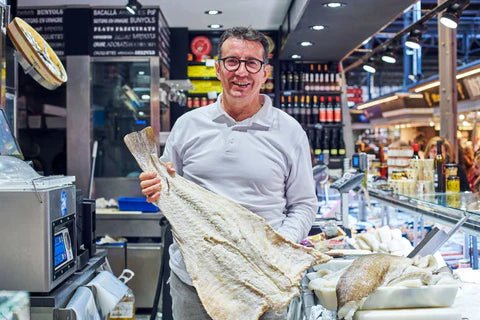
One of the most frequent questions we receive at Bacalalo, both at the Mercat del Ninot counter and for online orders, is this: "I've bought caviar, how do I store it?" The second, almost always, is: "I've opened the tin and haven't finished it, how long will it last?" These are legitimate questions because storing caviar incorrectly can ruin an excellent product in just a few hours. This guide, based on how professional distributors and restaurants do it, answers both questions precisely.
The most important rule: temperature between -2°C and 2°C at all times
Everything that follows in this guide is secondary to this first rule: caviar, of whatever species, whether opened or unopened, must be kept between -2°C and 2°C at all times. This is the temperature at which the roe is kept in aquaculture farms, in distribution warehouses, and in refrigerated transport. Any significant deviation from this range affects the product's quality.
The practical problem is that most domestic refrigerators are set to 4-6°C, not -2°C. The coldest area of a domestic refrigerator is usually the bottom drawer, the area next to the evaporator, or the top shelves, depending on the model. Measuring it with a refrigerator thermometer (available for less than 10€) is a worthwhile investment if you plan to buy caviar regularly.
If your refrigerator doesn't go below 3-4°C in its coldest zone, there are two alternatives:
- Place the tin in an airtight container with crushed ice inside the refrigerator, changing the ice every 12 hours.
- Use a wine or bar service mini-refrigerator, which allows for more precise temperature control. Some models go down to -2°C.
Storage before opening: how long unopened caviar lasts
Unopened caviar, stored correctly between -2°C and 2°C, has these approximate shelf lives depending on the type:
- Fresh malossol sturgeon caviar: 3-6 months from processing date, depending on the producer and salt percentage. Always respect the expiration date indicated on the tin.
- Pasteurized sturgeon caviar: 12-18 months. Pasteurization (brief heating to 60-65°C) significantly extends shelf life but can slightly affect the texture of the grains.
- Caviar substitutes (lumpfish, capelin): 12-24 months. More processed product with higher salt content, much more resistant.
- Fresh salmon or trout roe: 2-4 weeks from packaging if kept at 0-2°C.
A common mistake: buying caviar for a specific date and storing it in a domestic refrigerator at 5°C for weeks. The product may look fine when opened, but its organoleptic qualities will have significantly diminished. If you buy months in advance, make sure you have the correct temperature.
The cold chain in transport: what to check when receiving your order
When you receive an online caviar order, the cold chain during transport is crucial. At Bacalalo, we ship with ice packs in isothermal packaging to guarantee the temperature for 24-48 hours, but there are things you should check when receiving any caviar order:
- Packaging condition: The isothermal packaging must be intact. If it's crushed or open, the temperature may have been compromised.
- Condition of the ice packs: They should still be cold or have some ice. If they arrive completely melted and at room temperature, the caviar may have suffered.
- Tin temperature to the touch: When opening the package, the tin should be distinctly cold, ideally below 10°C. If it's at room temperature, contact the seller immediately.
- Appearance upon opening: If the caviar smells strongly fishy or has widespread broken grains, it may have been exposed to high temperatures during transport.
The return policy for temperature issues varies by distributor. At Bacalalo, we guarantee arrival temperature and resolve any transport incidents.
Bacalalo Products

Mújol Shikrán Selection - Premium Roe with Extra Smoked Herring
€6.95

"The Great Beluga Gift" Assortment
€227.91

Black Mullet Shikrán 550g - Smoked Herring and Mullet Roe
€27.95

Sevruga Caviar
€100.00
Refrigerated shipping 24-48h throughout the Peninsula
How to store caviar once opened: the correct protocol
This is the most critical part. Once the tin is opened, oxygen begins to degrade the product, and the risk of bacterial contamination increases significantly. The protocol for storing opened caviar:
- Never use metal utensils inside the tin: Contact with silver or stainless steel metal can alter the flavor. Always use mother-of-pearl, bone, wood, or food-grade plastic spoons.
- Cover the surface with plastic wrap: Press the plastic wrap directly onto the surface of the caviar, leaving no air gap between the film and the roe. Direct contact minimizes oxidation. A layer of film pressed directly is much more effective than closing the tin with its original lid or covering it with film loosely.
- Close the tin if possible: Some containers have an airtight sealing system that works well for an additional 1-2 days. If the original lid does not close properly, use plastic wrap.
- Return to the coldest part of the refrigerator immediately: Never leave opened caviar out of the refrigerator for more than 30 minutes during service. Even less in summer or hot kitchens.
- Maximum 48 hours: Opened malossol sturgeon caviar should be consumed within a maximum of 48 hours, preferably within 24 hours. After that time, the risk of spoilage is real even if stored correctly.
Signs that caviar has deteriorated
Knowing when caviar has passed its optimal point or has deteriorated avoids health problems and the unpleasantness of serving a spoiled product. Clear signs:
- Strong fishy odor: Fresh caviar smells like clean, briny sea, but not "fishy" in a negative sense. If the smell is intensely fishy or has bitter notes, the product is spoiled.
- Dull or grayish color: Quality sturgeon caviar grains have a natural shine. If they are dull, dry, or have a grayish film, oxidation has progressed too far.
- Soft or pasty texture: Grains should be firm and separate. If the grains flatten easily or have a sticky texture when taking a spoonful, the product has lost quality or has spoiled.
- Excessive liquid in the tin: A little natural liquid (the oil from the roe) is normal. Excess liquid, especially if it is dark or cloudy, indicates spoilage.
- Bitter taste: A pronounced bitter aftertaste that was not present in the first tasting is a sign that the caviar has begun to decompose.
Most common mistakes when storing caviar at home
At Bacalalo, we see these mistakes more often than we'd like:
Storing it in the refrigerator door: The door is the least cold area of the refrigerator and the most exposed to temperature changes every time it is opened. Never store caviar in the door.
Leaving it at room temperature during service: At a gathering or dinner, it's tempting to leave the tin on the table for guests to serve themselves. Limit this time to 20-30 minutes and return the caviar to the refrigerator between servings.
Freezing it to prolong its life: Freezing destroys the membrane of the roe. Upon thawing, the caviar completely loses its texture and becomes a semi-liquid mass without the "pop" that makes it special. Do not freeze sturgeon caviar or salmon or trout roe.
Using metal lids as closures: Many users improvise closures with aluminum foil or metal lids. Metal in contact with caviar can alter its flavor in a few hours. Always use food-grade plastic wrap.
Not reading the expiration date: The date on the tin is calculated for the indicated storage conditions (-2°C to 2°C). At standard domestic refrigerator temperatures (4-6°C), the actual shelf life may be shorter.
Caviar storage in restaurants and hospitality
For those who manage caviar in a professional context, standards are stricter. Michelin restaurants and high-end distributors work with:
- Dedicated service refrigerators precisely regulated to -2°C, separate from the general kitchen refrigerator.
- HACCP (Hazard Analysis and Critical Control Points) control for temperature monitoring throughout the process.
- On-demand tin opening protocol, not preventive. Only what will be served in the next 2-3 hours is opened.
- Discarding any opened caviar that has remained out of the refrigerator for more than 30 minutes.
- Strict FIFO (first-in, first-out) rotation, with opening date labeling on each tin.
These standards are difficult to fully apply at home, but understanding them helps to comprehend why caviar storage instructions are so specific. It's not an exaggeration: the product simply has a very narrow optimal quality window that deserves to be respected.
Bacalalo Products
Mújol Shikrán Selection - Premium Roe with Extra Smoked Herring
€6.95
"The Great Beluga Gift" Assortment
€227.91
Black Mullet Shikrán 550g - Smoked Herring and Mullet Roe
€27.95
Sevruga Caviar
€100.00
Refrigerated shipping 24-48h throughout the Peninsula
🛒 Products mentioned in this article
⭐ 4.9/5 · Chilled delivery 24-48h · Since 1990 at Mercat del Ninot
Frequently asked questions about preserving caviar
Can caviar be frozen to make it last longer?
No. Freezing destroys the membrane of the caviar grains, which is what gives them their characteristic texture. When defrosted, the product completely loses its consistency and becomes pasty. No professional producer or distributor recommends freezing sturgeon caviar, salmon roe, or trout roe.
How long does opened caviar last in the fridge?
Opened malossol sturgeon caviar lasts a maximum of 48 hours at -1°C or 0°C. At standard domestic refrigerator temperatures (4-6°C), the actual time is reduced to 24-36 hours before the quality begins to noticeably decline. Opened salmon or trout roe lasts a bit longer: 48-72 hours at 0-2°C. After these periods, even if the product is not necessarily dangerous, its quality does not justify consumption if the goal was to enjoy it at its best.
Is aluminum foil suitable for covering opened caviar?
No. Aluminum in contact with caviar can alter its flavor due to the reaction between the metal and the components of the roe (the same problem as with silver spoons). Always use clear PVC or food-grade PE cling film, pressed directly onto the caviar surface without leaving air.
How do I know if my refrigerator's temperature is suitable for storing caviar?
Buy a refrigerator thermometer (available in hardware stores and supermarkets for €5-10) and place it in the coldest part of your refrigerator (usually the back of the top or bottom shelf, away from the door). If the temperature does not drop below 3°C in that area, sturgeon caviar will keep, but with a somewhat reduced shelf life compared to ideal conditions. For substitute roe (salmon, trout, lumpfish), 4-6°C is sufficient.
Can I temporarily store caviar out of the fridge during a dinner party?
Yes, with a time limit. In an environment of 20-22°C (normal indoor temperature), caviar can be left out of the fridge for up to 30 minutes without risk to quality. In summer or hot kitchens (above 25°C), reduce that time to 15-20 minutes. The best practice for long dinners is to serve caviar on crushed ice for the entire duration of the appetizer.
Does pasteurized caviar require the same storage care as fresh caviar?
Unopened, pasteurized caviar is more resilient: it lasts 12-18 months at 0-4°C. Once opened, however, the conditions are similar to fresh caviar: a maximum of 48 hours at refrigerator temperature, covered with film. Pasteurization does not make opened caviar indestructible; it only extends its shelf life before opening.
What happens if caviar accidentally freezes (e.g., if the refrigerator gets too cold)?
The freezing point of caviar is approximately -4°C to -5°C (salt lowers the freezing point). If the refrigerator accidentally drops to -3°C or -4°C, the caviar may partially freeze. If thawed slowly (in the refrigerator at 2°C, not at room temperature), it may regain some of its texture if the freezing was brief and superficial. If it was completely frozen, the texture will have been irreversibly damaged.
Products you might be interested in
Discover more
Discover our premium selection
Seafood selected with care since 1990 at Mercat del Ninot, Barcelona. Refrigerated delivery in 24-48h.