Summary
When someone buys caviar from Bacalalo, the question that almost always follows is the same: "And what should I pair it with?" It's a legitimate question, because caviar pairing can either elevate or ruin the experience. In this guide: The logic of caviar pairing: why some work and others don't, Champagne with caviar: the quintessential classic combination, Vodka with caviar: the Russian pairing that makes perfect sense.
Caviar Pairing: Champagne, Vodka, and Beyond
When someone buys caviar from Bacalalo, the question that almost always follows is the same: "And what should I pair it with?" It's a legitimate question, because caviar pairing can either elevate or ruin the experience. At Mercat del Ninot, we've seen for years how a good Sevruga served with oaky white wine goes unnoticed, while the same caviar with ice-cold vodka or a brut champagne transforms into a gastronomic memory the diner won't forget. The key is to understand what caviar does to the palate and what kind of drink complements it without overpowering it.
The logic of caviar pairing: why some work and others don't
Caviar has three characteristics that guide any pairing decision: natural salinity (even in malossol version), fat from the omega-3 oils of the grains, and a delicate texture that breaks on the palate. These three qualities dictate the basic rules:
- Salinity calls for drinks with good acidity, which cleanse the palate and refresh. Flat or sweet wines do not help.
- Fat pairs well with bubbles or clean alcohol, which cut through the richness and prepare the palate for the next grain.
- The delicacy of the flavor requires drinks without tannins, without pronounced wood, and without overly floral or spicy aromas that compete with the marine nuances.
Two main families of drinks meet these three conditions: high-acidity sparkling wines and neutral vodka. This is where the tradition comes from. But there are more options that work, and some surprising ones.
Champagne with caviar: the quintessential classic combination
The caviar pairing with champagne is arguably the most documented in Western luxury gastronomy. And it has a solid technical reason, beyond the image: Brut Nature or Brut Champagne has a tartaric acidity that contrasts perfectly with the amino acids in caviar, creating a combination that tasters describe as an "amplified umami effect."
The best champagne styles for caviar:
- Blanc de Blancs (100% Chardonnay): The most refined choice. Its profile of green apple, citrus, and mineral chalk does not compete with the caviar: it frames it. Dom Pérignon Blanc de Blancs, Krug Clos du Mesnil, or Champagne Taittinger Comtes de Champagne are classic references. Price: €80-300 per bottle.
- Brut Nature or Extra Brut: With no residual sugar or less than 6g/L, the acidity is maximal. Ideal for intense-flavored Sevruga or Osetra.
- Blanc de Noirs (Pinot Noir and/or Meunier): More body, a little more red fruit. Works with Beluga for its smoothness, although overall Blanc de Blancs wins out.
What to avoid: Semi-dry or doux Champagne (with residual sugar), overly fruity rosés, and low-quality sparkling wines with large, aggressive bubbles that destroy the caviar grains on the palate.
A practical note: serve champagne between 7°C and 9°C, not ice cold. Too cold mutes the aromas and makes the drink less expressive for pairing.
Vodka with caviar: the Russian pairing that makes perfect sense
The caviar pairing with vodka is not a cliché: it is the culinary tradition of the regions where caviar originated, and it has impeccable technical rationale. Ice-cold vodka (-18°C to -20°C) is almost neutral in aroma and flavor, meaning it does not compete with caviar in any register. Its function is to cleanse the palate with pure alcohol and prepare it for the next bite.
The best vodkas to accompany caviar on the Spanish market:
- Beluga Noble: The benchmark Russian vodka for caviar. Smooth, almost no alcoholic warmth, with a clean finish. €35-45 per bottle.
- Russian Standard Platinum: More accessible, very neutral. €20-25. Good enough not to ruin the experience.
- Chopin (rye, Poland): Has subtle notes of rye bread that work very well with Osetra. €30-40.
- Grey Goose (France): Popular in the West, more floral than Russian vodkas. A good option for those who are not fans of pure vodka.
Serving protocol: vodka in shot glasses or small glasses, at -18°C or colder if possible. Sip slowly between spoonfuls of caviar. Do not mix or add ice: it dilutes the vodka and loses its purpose.
Bacalalo Products

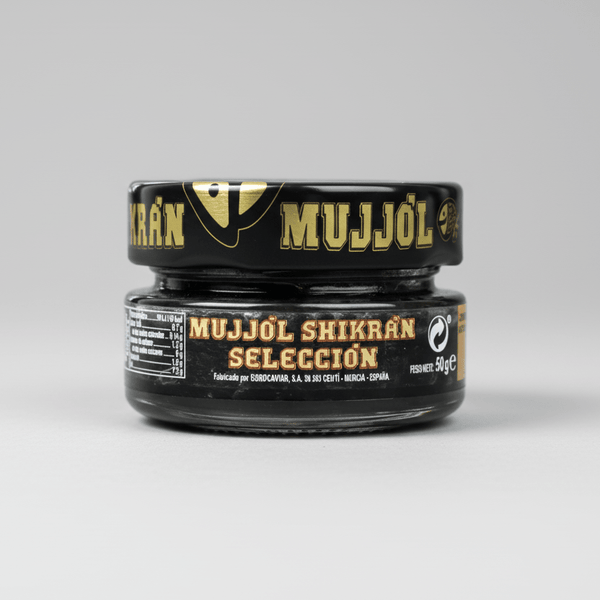
Mújol Shikrán Selection - Premium Roe with Extr...
€6.95

Assortment "The Grand Beluga Gift"
€227.91

Mújol Negro Shikrán 550g - Smoked Herring and M...
€27.95

Sevruga Caviar
€100.00
Refrigerated shipping 24-48h throughout the Peninsula
Cava with caviar: the Spanish alternative that works
For caviar pairing in Spain, cava deserves its own chapter. A quality Cava Brut Nature, with its natural acidity and yeasty notes, can rival champagne in pairing with Spanish aquaculture caviar like Riofrío or Nacarii. The combination of cava and national caviar also offers a coherent and attractive local product narrative.
Recommended cavas for caviar pairing:
- Gramona III Lustros Brut Nature: Long aging (over 5 years on lees), high acidity, toasted notes. Very good with Osetra.
- Recaredo Terrers Brut Nature: From organic viticulture in Penedès. Mineral, elegant. Works with Sevruga.
- Agustí Torelló Mata Kripta Brut Nature: Single-varietal Chardonnay, the closest to the Blanc de Blancs style. Excellent with white sturgeon caviar.
Low-end sparkling cava (under €8-10 per bottle) does not work well with quality caviar: the bubbles are too aggressive and the flavor profile is too simple for an interesting pairing.
Beyond the classic: surprising but effective pairings
Caviar pairing has more possibilities than tradition suggests. These are the ones that have most positively surprised us:
Junmai Daiginjo Sake: Served at 10-12°C, a high-quality sake has the delicacy, controlled acidity, and aromas of rice and white flowers that don't compete with caviar but rather frame it. Japanese chefs working with European caviar have been advocating this pairing for years. It works particularly well with smooth Beluga.
Very cold, unoaked white wine: A Chablis Premier Cru, a Muscadet sur Lie, or a good vintage Albariño, without barrel aging, with high acidity and good minerality. Galician Albariño, in particular, has natural saline notes that create an interesting harmony with national aquaculture caviar. Serving temperature: 6-8°C.
Premium Gin & Tonic: Unorthodox, but it works in the context of an informal aperitif. A high-quality gin with clean juniper notes (without excessive floral or citrus aromas) and a dry tonic, served very cold. The quinine in the tonic provides a slight bitterness that contrasts well with the richness of the caviar. Not suitable for formal tastings, but great for surprising friends at a dinner party.
Very cold lager beer: Nordic tradition has combined fish roe with beer for centuries. A quality lager, very cold, effectively cleanses the palate. It's not the most elegant pairing, but it makes sense for alternative roe or for trout caviar in informal settings.
Pairing by caviar type
Not all caviars call for the same pairing. The ideal caviar pairing varies depending on the species:
- Beluga: A great vintage Blanc de Blancs Champagne, Junmai Daiginjo sake, or very cold premium vodka. Its delicacy demands the utmost elegance in the drink.
- Osetra: Chablis or unoaked Chardonnay, Blanc de Blancs Champagne, long-aged Brut Nature cava. Its nutty notes are well complemented by minerality.
- Sevruga: Russian vodka at -20°C, Brut Nature or Extra Brut Champagne, Brut Nature cava. Its marine intensity calls for drinks with character.
- Spanish aquaculture caviar: Quality cava, unoaked Albariño, good quality vodka. The local product deserves a local accompaniment of equal standing.
- Alternative roes (trout, salmon, mullet): The options are wider: Albariño, Txakoli, basic cava, German wheat beer, even natural Basque cider.
What never works with caviar
Just as useful as knowing what pairing works is knowing what pairing ruins caviar:
- Red wines with tannins: Tannins react with caviar proteins, producing bitter and metallic flavors. A young red with a lot of tannin makes caviar almost unpalatable.
- White wines with a lot of oak: The vanillin from the barrel crushes the marine nuances. A Chardonnay heavily fermented in new oak leaves no room for the caviar.
- Sweet wines: Sugar clashes with the salt and fat of caviar, creating a confusing and heavy combination.
- Cocktails with juices or spices: A Bloody Mary, a Margarita, or any cocktail with pronounced citrus, herbs, or spices directly competes with and overpowers the caviar.
Bacalalo Products
Mújol Shikrán Selection - Premium Roe with Extr...
€6.95
Assortment "The Grand Beluga Gift"
€227.91
Mújol Negro Shikrán 550g - Smoked Herring and M...
€27.95
Sevruga Caviar
€100.00
Refrigerated shipping 24-48h throughout the Peninsula
🛒 Products mentioned in this article
⭐ 4.9/5 · Chilled delivery 24-48h · Since 1990 at Mercat del Ninot
Caviar Pairing FAQs
Is it mandatory to eat caviar with champagne or vodka?
Not at all. These are the most classic and proven combinations, but a good unoaked white wine, a quality cava, or even cold mineral water are perfectly valid options. What doesn't work are red wines with tannins and very oaky white wines. Still mineral water between bites is the option for those who don't drink alcohol and want to appreciate caviar in its purest form.
Does low-priced champagne work with quality caviar?
It works, but it doesn't optimize the experience. A medium-quality sparkling wine (€10-20) with €100 caviar is like serving basic olive oil with acorn-fed Iberian ham: technically edible, but wasting the qualities of the more expensive product. If your budget is limited, choose aged cava over low-end champagne.
Can caviar be paired with rosé wine?
Very dry and pale rosés (Provence style) are a possible option for substitute roe, but they are not ideal for quality sturgeon caviar. Fruitier rosés or those with pronounced red fruit notes compete with caviar in ways that are not harmonious. If you want rosé, it should be very pale, very dry, and very cold.
Which Spanish white wine pairs best with Riofrío or Nacarii caviar?
Unoaked Albariño from Rías Baixas is the most natural national option to pair with Spanish aquaculture caviar. Its saline notes, acidity, and Atlantic character connect well with caviar produced in mountain freshwater in Granada. Manzanilla from Sanlúcar de Barrameda is another less obvious but excellent option: the salinity of the Fino and the biological aging yeast create a very interesting harmony.
How much drink to serve with caviar?
For a caviar appetizer, serve drinks in small quantities: one glass of champagne or cava per person for 20-30g of caviar. The idea is not to drink a lot but to cleanse the palate between bites. Vodka is served in small glasses of 3-4cl (one shot) per person. The goal is for the drink to serve as a pause and reframe, not to compete for attention with the caviar.
Can caviar be eaten with water?
Absolutely. Still mineral water, served cold but not iced, is the option to appreciate caviar in its maximum purity without the influence of other drinks. Among the most recommended brands for this use: Evian or Volvic (neutral) or low-mineral Spanish mineral water such as Font Vella. Avoid highly carbonated waters because the bubbles can interfere with the texture of the caviar.
Products you might be interested in
Discover more
Discover our premium selection
Seafood products carefully selected since 1990 at Mercat del Ninot, Barcelona. Refrigerated delivery in 24-48h.