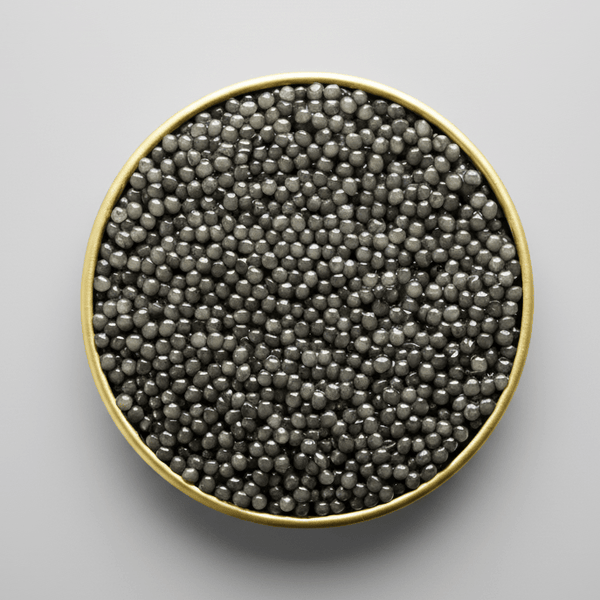
📖 Complete Guide: If you're looking for an overview of caviar types, 2026 prices, and a Petrossian/Riofrío comparison, read our complete caviar guide 2026.
Summary: There are four main types of sturgeon caviar: Beluga (the largest and most expensive), Oscietra (the most versatile and complex), Sevruga (the most intense), and Baeri (the most accessible). Each comes from a different sturgeon species with varying biological characteristics that determine size, flavor, and price. This guide helps you choose the right one for each occasion.
What is caviar (and what is not)
Caviar, strictly speaking, is the salt-cured roe of sturgeon (Acipenseridae family). Nothing more. The roe of salmon, trout, lumpfish, flying fish, or any other fish is not caviar, no matter how loosely some brands use the term. In Spain, legislation allows the use of the term "caviar" only for sturgeon roe. Everything else is "[fish name] roe" or "caviar substitute."
This distinction matters because the market is full of products that play on confusion. "Truffle pearls," "salmon roe caviar style," or "citrus caviar" (finger lime) can be excellent products in their respective categories, but they are not caviar. Mixing them in the same mental category is like comparing Cava with Champagne — technically the same method, but completely different regulation, origin, and market perception.
Within true sturgeon caviar, there are more than 20 species of sturgeon that produce roe. But the market focuses on four main varieties, each from a different species, with very distinct characteristics. Let's look at them.

Beluga Caviar (Huso huso): the undisputed king
Beluga is to caviar what Romanée-Conti is to wine: the absolute benchmark, the most expensive, the rarest, and the one that generates the most debate about whether the price difference justifies the experience difference.
Species: Huso huso, the largest sturgeon in the world. It can reach 5-7 meters and exceed 1,000 kg in the wild. The female takes 18-25 years to mature.
Roe: The largest of all sturgeon, 3-3.5 mm in diameter. Exceptionally thin skin. Color from pearl gray to dark gray (lighter ones are more valued).
Flavor: Creamy, smooth, complex. Notes of butter and walnut with an elegant marine background. Very long finish (20-40 seconds). Low salinity.
2026 Price: €3,500-€10,000/kg depending on origin and classification.
Best for: The texture as it melts in the mouth is a unique and unrepeatable experience with no other variety.
Worst for: The price. And the amount of fraud in the market — much "Beluga" that is actually hybrid.
For a complete guide to this variety, consult our dedicated article on Beluga caviar.
Oscietra Caviar (Acipenser gueldenstaedtii): the chefs' favorite
If you ask a Michelin-starred chef what their favorite caviar is, there's a high probability they'll say Oscietra. Not because it's the most expensive or the largest, but because it has the most complex and defined flavor profile of all varieties.
Species: Acipenser gueldenstaedtii, the Russian sturgeon. A more manageable animal than the Beluga — reaches a maximum of 200 kg. The female matures in 8-12 years.
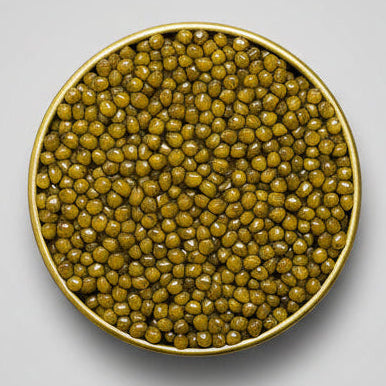
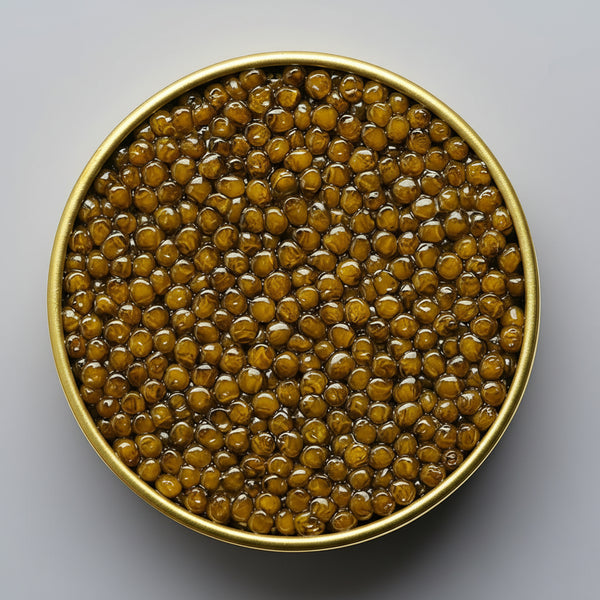
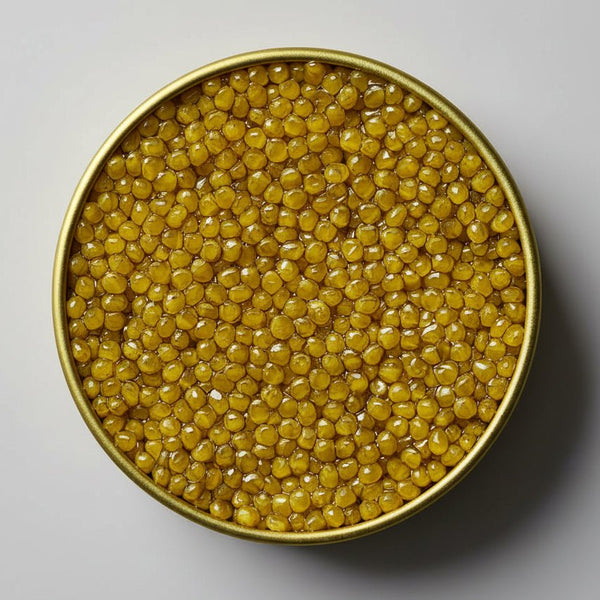
Roe: Medium-large size, 2.5-3 mm. Skin slightly thicker than Beluga, providing a more defined pop when bitten. Extraordinarily variable color: from intense black to golden amber, passing through all grays and browns. It is the variety with the widest chromatic range.
Flavor: The most complex of all varieties. Notes of walnut, toasted hazelnut, sea, and a slightly iodized background. Some Oscietra develop an almost fruity sweet note that does not appear in any other variety. Long finish (15-25 seconds) with clear evolution.
2026 Price: €1,200-€3,500/kg. The best quality-complexity-price ratio on the market.
Best for: The personality of the flavor. A good Oscietra has an identity that is immediately recognizable.
Worst for: Variability. Two tins of Oscietra from the same producer can be notably different in taste and color. That's part of the charm for experts and a source of frustration for novices.
More details in our complete Oscietra caviar guide.
🤩 Our Premium Caviar
Imported directly from the best fish farms. Beluga, Osetra, and Sevruga Caviar available at Bacalalo.com.
View Caviar →Sevruga Caviar (Acipenser stellatus): pure intensity
Sevruga is the third member of the "Caspian trinity" and probably the most undervalued. Its roe is the smallest of the three classic varieties, which has historically placed it lower in price and perception. But in terms of pure flavor, it is the most potent.
Species: Acipenser stellatus, the stellate sturgeon. The smallest of the three Caspian sturgeons — rarely exceeds 25 kg. Matures in 7-10 years.
Roe: The smallest, 1.5-2 mm. Thin but firm skin. Dark gray to black color. Small and uniform grains.
Flavor: The most intense and marine of all varieties. Concentrated flavor, with more perceptible salinity and a very direct "from the sea" character. Less creamy than Beluga, more direct than Oscietra. Dominant mineral and iodized notes. Medium finish (10-15 seconds) but very defined.
2026 Price: €800-€2,500/kg. The most accessible of the Caspian trinity.
Best for: Flavor intensity. It is the caviar that works best in culinary preparations where you need the caviar flavor to cut through other ingredients.
Worst for: The perception of "low-end" due to the small grain size. This is an unfounded prejudice — size does not determine flavor quality.

Baeri Caviar (Acipenser baerii): the accessible revolution
Baeri is not from the Caspian. It is a Siberian sturgeon that has become the most widely farmed species globally, precisely because it matures quickly and adapts well to controlled conditions. It has democratized caviar.
Species: Acipenser baerii, Siberian sturgeon. Medium size — up to 100 kg. Matures in 5-7 years, the shortest cycle of the four main varieties.
Roe: Small-medium size, 2-2.5 mm. Medium-thick skin. Dark gray to black color, quite uniform.
Flavor: Smooth, clean, slightly nutty. The least complex of the four varieties but the most "friendly" for palates not accustomed to caviar. Notes of mild dried fruit with a delicate marine background. Moderate salinity. Short-medium finish (8-12 seconds).
2026 Price: €600-€1,500/kg. The most affordable true sturgeon caviar.
Best for: Accessibility. It is real sturgeon caviar, at a price that allows it to be consumed without being an exceptional event. Ideal as an entry point.
Worst for: It can be a bit bland for palates already accustomed to Oscietra or Beluga. The lack of complexity is noticeable in direct comparison.
In Spain, Nacarii (Lleida) and Riofrío (Granada) are the reference producers of national Baeri. Both offer consistent quality and competitive prices. More details in our guide to Spanish caviar.
Comparison table: the 4 main varieties
- Beluga — Grain: 3-3.5 mm | Maturation: 18-25 years | Flavor: creamy, smooth, long | Price: €3,500-€10,000/kg | For: exceptional experiences
- Oscietra — Grain: 2.5-3 mm | Maturation: 8-12 years | Flavor: complex, nutty, marine | Price: €1,200-€3,500/kg | For: connoisseurs, the best balance
- Sevruga — Grain: 1.5-2 mm | Maturation: 7-10 years | Flavor: intense, marine, direct | Price: €800-€2,500/kg | For: lovers of powerful flavors
- Baeri — Grain: 2-2.5 mm | Maturation: 5-7 years | Flavor: smooth, clean, nutty | Price: €600-€1,500/kg | For: starting with real caviar

Other types of caviar: white, Kaluga, Schrenckii
Beyond the four main varieties, the market offers additional options worth knowing about.
White caviar (Almas): comes from albino sturgeon, mainly Oscietra or Beluga. It is extraordinarily rare — it is estimated that only 1 in 10,000-20,000 sturgeon produce albino roe. The price can exceed €25,000/kg. It is more of a collector's item and display of ostentation than a gastronomically superior variety. The flavor is similar to that of the base species, slightly milder.
Kaluga Caviar (Huso dauricus): the "Beluga of the Amur River." It is a sturgeon related to the Beluga that inhabits the Amur River basin, between Russia and China. It produces large roe (2.5-3.5 mm) with a creamy flavor similar to Beluga but with more earthy notes. It is the Chinese alternative to Caspian Beluga and is priced in the range of €1,500-€4,000/kg. Quality has improved enormously with modern Chinese aquaculture.
Schrenckii Caviar (Acipenser schrenckii): another sturgeon from the Amur River, smaller than Kaluga. Medium roe, flavor closer to Oscietra than Beluga. Primarily Chinese production. Price: €800-€1,800/kg. An interesting option in terms of value for money if you find a reliable producer.
Hybrids: modern aquaculture has produced crosses such as Bester (Beluga x Sterlet), Oscietra x Baeri, and others. Hybrids seek to combine the best characteristics of each species — for example, the roe size of Beluga with the maturation cycle of Baeri. The results are variable but some hybrids offer excellent value for money. The key is that the labeling is honest and does not sell a hybrid as a pure species.
Which to choose for each occasion
The correct variety depends on the context. There is no "best" in the abstract — there is a best for each situation.
First time with caviar: Baeri from a Spanish producer (Nacarii, Riofrío). Accessible flavor, reasonable price, zero risk of disappointment. If you like it, the next step is an Oscietra.
Special dinner for two: Medium-high range Oscietra. 30g for €50-€80. The complexity of the flavor makes for conversation, and the price won't ruin the evening.
Exceptional celebration (anniversary, New Year's Eve): Premium Oscietra or Beluga. If the budget allows, 50g of Italian Beluga (€80-€120) is a statement of intent.
In cooking, as an ingredient: Sevruga or Baeri. Sevruga if you need the flavor to penetrate (sauces, tartare), Baeri if it's a decorative topping where the flavor of the main dish dominates.
For gifting: Oscietra in a 30g format. It is the caviar that generates the most consensus — neither too mild nor too intense, with an image of sophistication that justifies the gift.
Explore our complete selection in the Caspian caviar collection at Bacalalo.com. For more details on prices, consult our 2026 price guide. And if you want to know how to taste it correctly, read the caviar tasting guide.
🛒 Our premium alternative
⭐ 4.9/5 · Cold shipping 24-48h · Since 1990 in Mercat del Ninot
Frequently asked questions
How many types of caviar are there?
There are over 20 species of sturgeon that produce caviar, but the market focuses on four main varieties: Beluga (Huso huso), Oscietra (A. gueldenstaedtii), Sevruga (A. stellatus), and Baeri (A. baerii). In addition, there are hybrids and varieties such as Kaluga and Schrenckii.
What is the best type of caviar?
There is no universal "best." Beluga is the largest and creamiest, Oscietra is the most complex in flavor, Sevruga is the most intense, and Baeri is the most accessible. The best variety depends on your palate, your budget, and the occasion.
What is the difference between Beluga and Oscietra caviar?
Beluga has larger grains (3-3.5 mm vs 2.5-3 mm), a creamier texture, and a milder, longer-lasting flavor. Oscietra has slightly smaller grains but a more complex flavor profile, with nutty and hazelnut notes that Beluga lacks. Beluga costs 2-3 times more than Oscietra.
Is salmon caviar actually caviar?
No. Salmon roe is salmon roe, not caviar. The term caviar is exclusively reserved for sturgeon roe. Salmon roe is an excellent product but belongs to a different category.
What is Malossol caviar?
Malossol means "lightly salted" in Russian (less than 3% salt). It is not a variety of sturgeon but a processing method. Malossol caviar has a purer, more delicate taste because the salt does not mask the roe's natural flavor. Most high-quality caviar is Malossol.
Is there vegan caviar?
There are caviar substitutes made from seaweed (mainly kelp), oil, and flavorings that imitate the texture and appearance of caviar. They are not caviar, do not taste like caviar, and do not have the same nutritional composition. They are a legitimate alternative product for those who do not consume animal products, but comparing them to sturgeon caviar is like comparing a veggie burger to a steak.
Have we helped you choose? At Bacalalo.com you can find the varieties we recommend, selected with the same criteria we have applied to everything since 1990 in Mercat del Ninot.
🎁 Caviar Tasting Pack
Discover the nuances of each type of caviar with our tasting packs. 24h refrigerated shipping.
Explore Packs →