


📖 Complete Guide: if you're looking for an overview of caviar types, 2026 prices, and a Petrossian/Riofrío comparison, read our complete caviar guide 2026.
Summary: Beluga caviar comes from the Huso huso sturgeon, the largest freshwater fish in the world. Its roe is the largest (3-3.5 mm), scarcest, and most expensive on the market. This guide covers everything you need to know: biology, origin, varieties, prices, and how to distinguish authentic Beluga from an imposter. Verifiable facts, zero exaggeration.
What is Beluga Caviar
Beluga caviar is, unequivocally, the most prestigious and most expensive caviar in the world. It comes exclusively from the roe of the Beluga sturgeon (Huso huso), a species that has been swimming in the world's seas for over 200 million years — longer than dinosaurs. It's not a marketing title. It's a direct consequence of the animal's biology.
Beluga roe is distinguishable at a glance: it's the largest of all sturgeon, with a diameter of 3 to 3.5 millimeters (compared to 2-2.5 mm for Oscietra or 1.5-2 mm for Sevruga). It has an extraordinarily fine skin that melts on the palate with minimal pressure, releasing a creamy, long, and complex flavor that has no equivalent in any other caviar variety.
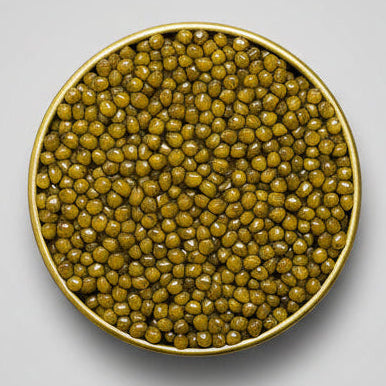
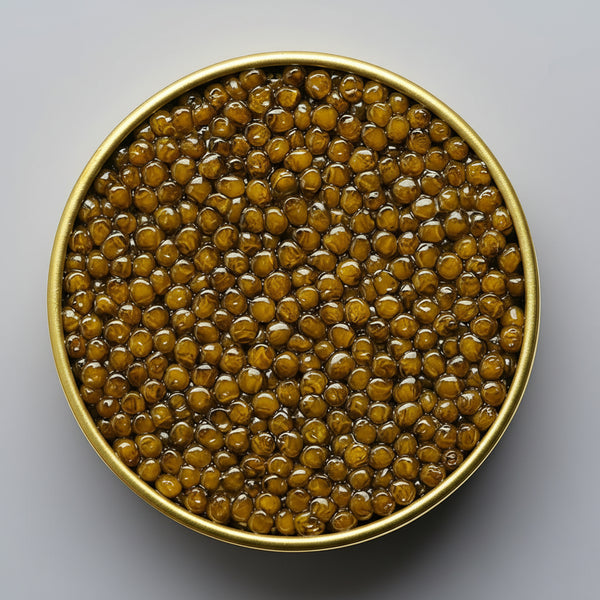
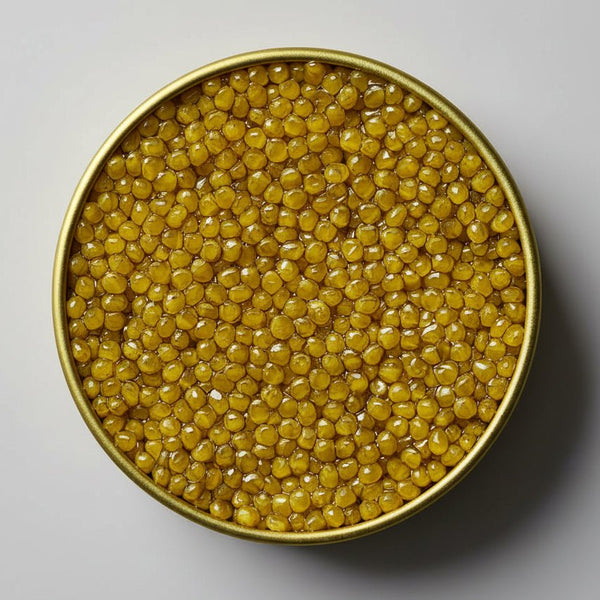
The color varies from light pearl gray to dark anthracite gray. Contrary to what logic suggests, lighter grains are the most valued (and most expensive), because they come from older females — a Beluga producing light roe is usually over 20 years old, compared to 15-18 years for dark roe. Color grading uses a zero system: 0 (dark gray), 00 (medium gray), and 000 (light gray to golden), with 000 being the most exclusive and expensive.
The Beluga sturgeon: biology and habitat
Huso huso is the largest freshwater fish in the world. Historical specimens reached 7 meters in length and over 1,500 kg in weight. Current specimens are significantly smaller — aquaculture catches rarely exceed 200 kg — but it remains an impressive animal.
Its natural habitat is the Caspian Sea and, to a lesser extent, the Black Sea and the Sea of Azov. It is an anadromous species: it lives in the sea but travels up rivers to spawn. The Volga, Ural, Kura, and Sefid-Rud rivers have historically been its main spawning routes. Overfishing in the 20th century and the construction of dams blocking migratory routes brought the species to the brink of extinction.
The biological characteristic that explains the price of Beluga is its reproductive cycle. A female Beluga needs between 18 and 25 years to reach sexual maturity. Compared to 7-12 years for Oscietra or 5-7 years for Baeri, Beluga requires an enormous time investment for any producer. Each additional year means feeding, space, health monitoring, and natural mortality. A Beluga sturgeon that dies at 15 years old due to disease represents a total loss of investment with no return.
The caviar yield, however, is exceptional once the female matures. A single specimen can produce between 12% and 18% of its body weight in roe. A 150 kg Beluga can yield between 18 and 27 kg of caviar — an enormous volume, but one that has taken two decades to arrive.

Iranian Beluga Caviar: The Caspian Benchmark
Iran is, along with the republics of the former Soviet bloc (Russia, Kazakhstan, Azerbaijan), the country historically associated with top-quality Beluga caviar. And there are objective reasons for this that go beyond tradition.
The southern coast of the Caspian Sea, under Iranian jurisdiction, has unique conditions. The depth is shallower than on the northern coast, the water is warmer, the salinity is specific (around 12-13 ppt, one-third of the ocean's), and the presence of natural nutrients is optimal. Beluga sturgeon feeding in these waters develop a flavor profile that aquaculture producers try to replicate but, according to expert tasters, have not fully matched.
Iran maintains a state sturgeon conservation program managed by SHILAT (the Iranian fisheries organization). Catch quotas are limited and strictly controlled, which has allowed Iranian Beluga populations to remain more stable than those on the northern Caspian coast, where illegal fishing remains a serious problem.
Iranian Beluga caviar reaches the European market through specialized distributors with CITES certification. In Spain, our Caspian caviar collection includes directly selected Iranian caviar. The price reflects its true scarcity: between €5,000 and €10,000/kg depending on color grading and production year.
A fact that few stores share: "Iranian caviar" is not an automatic guarantee of quality. Iran also produces aquaculture caviar of various qualities, and some brands use "Iranian" as a claim without specifying whether the caviar is wild (limited quota) or farmed. Always ask for the exact specification.
Caspian Caviar — Premium Selection
Iranian Beluga 000, Oscietra, Sevruga. Refrigerated 24-48h shipping to any point in the Peninsula. Since 1990 in Mercat del Ninot.
View Caviar →Aquaculture Beluga: The New Reality
The international ban on wild Caspian Beluga caviar trade (CITES, 2006 with progressive restrictions since 1998) forced the industry to reinvent itself. Beluga aquaculture is now a reality in several European countries, with results that have evolved enormously in the last decade.
Italy is the European leader, with Calvisius (Agroittica Lombarda) as the benchmark. Their aquaculture Beluga is produced in Brescia, with specimens maturing in 18-20 years in large tanks. The result is high-quality, consistent caviar at a more accessible price than Iranian caviar: €3,500-€5,000/kg.
Germany (Desietra) and France (Kaviari, Sturia) also produce aquaculture Beluga, each with its own nuances. German aquaculture caviar is reputed to be "cleaner" in flavor, with less complexity but greater uniformity. French caviar seeks an identity closer to the Iranian profile.
Spain is beginning to produce Beluga, although established farms (Riofrío, Nacarii) mainly work with Baeri and Oscietra. The first Spanish Belugas are maturing now, and the first results are expected in the coming years.
The question everyone wants you to answer: is aquaculture Beluga comparable to wild Beluga? The honest answer is that it comes very close but is not identical. A high-end Italian aquaculture Beluga is exceptional caviar — better than many Oscietra or Sevruga of any origin. But in a direct tasting against a quota Iranian Beluga, most expert tasters detect differences in aromatic complexity and the duration of the flavor on the palate. Whether those differences justify paying double is a personal decision.
How to Recognize Authentic Beluga
The caviar market has a serious fraud problem. Independent studies have found that between 20% and 30% of caviar labeled as "Beluga" on the world market does not actually come from Huso huso. The species most commonly used for substitution are hybrids of Beluga x Baeri or Beluga x Oscietra, which produce large roe but with a different genetic (and flavor) profile.
Authenticity indicators you can verify:
- CITES Certification: All legal caviar must bear a CITES label with a code that identifies the species, country of origin, year of production, and farm or catch area. The code for Huso huso begins with "HUS". If there is no CITES label, the caviar is illegal or not what it claims to be.
- Grain Size: Beluga grains measure 3-3.5 mm. If the grains are significantly smaller, it is not pure Beluga.
- Texture: The skin of the Beluga grain is exceptionally fine. It melts with the pressure of the tongue against the palate without needing to chew. If it requires biting, the skin is too thick to be Beluga.
- Price: Authentic Beluga does not go below €3,000/kg through any legitimate channel. If you find "Beluga" at €1,500/kg, it is a hybrid or a substitution.

Beluga Flavor Profile and Tasting
Beluga has a flavor profile that differs from other varieties not so much in intensity as in complexity and duration. A good Beluga does not hit with a strong marine flavor — that's more characteristic of Sevruga. Beluga envelops.
The dominant notes in quality Beluga are: butter, cream, soft nut, a mineral hint and an elegant marine background that lacks the aggressiveness of saltier caviar. The finish on the palate is extraordinarily long — 20, 30, even 40 seconds in the best specimens — and it evolves: it starts creamy, develops umami, and ends with a clean, almost citrusy note.
To properly taste Beluga:
- Temperature: between 4°C and 8°C. Take it out of the fridge 5 minutes before serving, no more. Unlike anchovies that are served at room temperature, caviar needs to be cold to maintain its grain structure.
- Spoon: mother-of-pearl, bone, glass or plastic. Never metal, which transfers metallic flavors to the caviar.
- Base: back of the hand (pure flavor, no base), blini with crème fraîche or unsalted brioche toast. Avoid accompaniments that compete with the caviar: onion, hard-boiled egg, capers — these were necessary with low-quality caviar to mask defects, not with Beluga.
- Drink: very cold vodka, brut or brut nature champagne, or a mineral Chablis. The acidity of champagne and the neutrality of vodka cleanse the palate between bites.
Beluga Caviar Prices in 2026
Table of indicative prices in the Spanish market, March 2026:
- Iranian Beluga (wild quota): €7,000-€10,000/kg | €220-€350 per 30g
- Iranian Beluga (aquaculture): €4,500-€7,000/kg | €150-€220 per 30g
- Italian Beluga (Calvisius): €3,500-€5,000/kg | €110-€160 per 30g
- German Beluga (Desietra): €3,500-€4,500/kg | €110-€140 per 30g
- Hybrid Beluga (Bester): €1,200-€2,500/kg | €40-€80 per 30g
Bester (Beluga x Sterlet hybrid) deserves special mention: it is not pure Beluga but produces large roe with an interesting flavor at a much more accessible price. Some producers market it as "Beluga hybrid" — it's an honest option if correctly labeled. The problem is when it's sold as "Beluga" outright.
For an updated price reference of our caviar, visit the Caspian caviar collection at Bacalalo.com. You may also be interested in our complete caviar price guide 2026 with all varieties compared.

Beluga vs. Oscietra: Is the Difference Worth It?
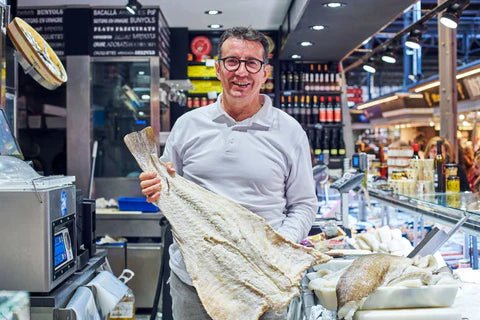
This is the question we get asked most often at the Ninot counter. And the answer is not a resounding yes.
A high-end Oscietra (Iranian or premium aquaculture, €80-€120 for 30g) offers 85-90% of the Beluga experience at one-third of the price. Oscietra has its own complexity — more pronounced nutty notes, a more "marine" character — and many experts prefer it precisely for its more defined personality.
Beluga is superior in three specific aspects: grain size (more visually and texturally impactful), fineness of the skin (the melting texture is unique), and flavor duration (the finish on the palate is longer). Whether these three factors justify tripling the price depends on your palate, your budget, and the context.
Our recommendation: if you've never tried quality caviar, start with a good Oscietra. Develop your palate. And when you're ready, try a Beluga — you'll appreciate the difference much more with a frame of reference.
Caspian Caviar — Premium Selection
Iranian Beluga 000, Oscietra, Sevruga. Refrigerated 24-48h shipping to any point in the Peninsula. Since 1990 in Mercat del Ninot.
View Caviar →🛒 Recommended Products in this Guide
⭐ 4.9/5 · Cold shipping 24-48h · Since 1990 in Mercat del Ninot
Frequently Asked Questions
What does Beluga mean in caviar?
Beluga refers exclusively to caviar produced by the Huso huso sturgeon. It should not be confused with the Beluga whale (Delphinapterus leucas), which is an unrelated marine mammal. The name comes from the Russian "beliy" (white), in reference to the light color of the sturgeon's belly.
Is Beluga caviar forbidden?
Wild Beluga caviar has been banned from import into the United States since 2005 and severely restricted in the EU by CITES. Certified farmed Beluga caviar is completely legal and accounts for almost all Beluga available on the European market. Iran maintains authorized limited wild catch quotas.
How much does a tin of Beluga caviar cost?
It depends on the size and origin. A 30g tin of European farmed Beluga costs between €110 and €160. A 30g tin of premium Iranian Beluga can exceed €300. A 10g tin for tasting ranges from €40 to €120.
What does Beluga caviar taste like?
Beluga has a creamy, smooth and complex flavor, with notes of butter, nut and an elegant marine background. It is not an aggressive or overly salty taste — it is subtle and long on the palate. The grain's skin is so fine that it melts with the pressure of the tongue, releasing a flavor that evolves for 20-40 seconds.
How to store Beluga caviar?
Unopened, between -2°C and +2°C (the coldest part of the refrigerator or a specific compartment). An unopened tin retains its quality for 3 to 6 months from the production date. Once opened, consume within 24-48 hours maximum, always refrigerated and covered with plastic wrap in direct contact with the caviar surface to prevent oxidation.
What is the difference between Beluga 0, 00 and 000?
It is a classification by grain color: 0 = dark gray, 00 = medium gray, 000 = light gray to golden. Lighter grains come from older females and are scarcer, so they fetch a higher price. In taste, the differences are subtle — the advanced age of the female tends to produce a creamier caviar with a longer finish, but the overall quality depends more on processing than on color.
Want to try authentic Beluga caviar? At Bacalalo.com we work with hand-picked Caspian caviar. Guaranteed refrigerated shipping. Since 1990 at Mercat del Ninot, Barcelona. Also check out our Iranian caviar guide and caviar types comparison.
Discover our premium selection
Carefully selected seafood products since 1990 at Mercat del Ninot, Barcelona. Refrigerated shipping in 24-48h.



![¿Cuánto Cuesta el Caviar? Guía de Precios por Tipo [2026]](http://bacalalo.com/cdn/shop/articles/caviar-beluga-imperial-irani-4723678_bd3d4d30-a8d3-462c-864d-1c216f60156c.webp?v=1774815835&width=480)

