📖 Complete Guide: If you're looking for an overview of caviar types, 2026 prices, and a comparison of Petrossian/Riofrío, read our complete caviar guide 2026.
Summary: Oscietra caviar (also Osetra or Ossètre) comes from the Russian sturgeon (Acipenser gueldenstaedtii). It is the preferred variety for most Michelin-starred chefs due to its unique flavor profile: notes of nut, toasted hazelnut, and sea with a complexity that surpasses even Beluga. With prices between €1,200 and €3,500/kg, it offers the best value for money in the caviar market.
Why Chefs Choose Oscietra
Ask ten Michelin-starred chefs what their favorite caviar is. Six or seven will say Oscietra. It's no coincidence. Oscietra offers something Beluga does not: its own personality.
Beluga is creamy, smooth, long — but its flavor is relatively neutral. It is a blank canvas of the highest quality. Oscietra, on the other hand, has a defined character that stands out: notes of toasted hazelnut, walnut, a hint of iodine, sometimes an almost fruity sweetness that appears and disappears. It is a caviar that tells a story with every bite.
For chefs, that personality is a tool. Oscietra added to a dish not only brings luxury — it brings a specific flavor that can complement, contrast, or amplify other ingredients. Beluga decorates. Oscietra dialogues with the dish.
The price factor also plays a role. In a Michelin-starred restaurant, where a dish with caviar might contain 10-15g of roe, the difference between using Oscietra (€1,200-€2,000/kg) and Beluga (€3,500-€8,000/kg) is significant. Oscietra allows caviar to be included in tasting menus without the food cost being prohibitive.
And there is an additional factor that professionals know well: the consistency of Oscietra. Within the inevitable variability of a natural product, a good Oscietra supplier offers a batch-to-batch quality consistency that few Beluga producers can match. For a restaurant that needs to serve 50 portions a day to the same standard, that predictability is worth its weight in gold.
The Russian Sturgeon: Origin and Biology
The Acipenser gueldenstaedtii — which everyone calls the Russian sturgeon even though it lives throughout the Caspian, Black, and Azov Sea basins — is a fish with an evolutionary history of over 200 million years. It predates the dinosaurs. And its biology explains why it produces such special caviar.
Unlike Beluga, which is an open-water predator, the Russian sturgeon feeds on the bottom: mollusks, crustaceans, marine worms, larvae. This benthic (bottom-dwelling) diet is directly responsible for the mineral and nutty profile of Oscietra caviar. The roe reflects what the animal has eaten throughout its life — just as the milk of a grass-fed cow tastes different from that of a grain-fed one.
The female Russian sturgeon matures in 8 to 12 years, depending on water conditions (temperature, food, space). In aquaculture, with optimized feeding and controlled temperature, it can mature around 8-9 years. In the wild, the cycle was longer.
A key fact: the Russian sturgeon does not spawn every year. After a first laying, it needs 2-3 years to produce quality roe again. This limits production even on farms with hundreds of specimens. You cannot simply "speed up" Oscietra production — the fish sets the pace.
The Russian sturgeon reaches a maximum size of 150-200 kg and can live for more than 50 years. Its caviar yield is 10-15% of its body weight — a 100 kg specimen can yield 10-15 kg of roe in one extraction. A lower yield than Beluga in proportion, but with a maturation cycle more than twice as fast.

Oscietra Flavor Profile: What to Expect When Tasting It
Oscietra has the most complex and multidimensional flavor profile of all caviar varieties. While Beluga is a simple and perfect chord (creamy + smooth + long), Oscietra is a melody with several layers that unfold in sequence.
First contact (0-3 seconds): the grain bursts in the mouth with a more defined pop than Beluga. The skin of Oscietra is slightly thicker, giving it a more "chewy" texture — some tasters describe it as a gentle resistance before the flavor is released. This is not a defect: it is a characteristic that experienced professionals and connoisseurs prefer.
Main flavor (3-10 seconds): the dominant notes emerge. Walnut (macadamia nut rather than English walnut), toasted hazelnut, a clean marine background without aggressiveness. Some batches develop an almost fruity note — subtle prune — which is highly valued. Salt is present but integrated, never dominant.
Finish (10-25 seconds): the aftertaste evolves towards more mineral and iodized notes, with a hint of butter vaguely reminiscent of Beluga but with more definition. The finish is long but not as endless as Beluga.
The variability of Oscietra is one of its hallmarks. Two tins from the same producer, from the same harvest, can have slightly different nuances because each individual female produces roe with its own profile. In the wine world, this would be called terroir; in caviar, there is no equivalent term but the concept is the same.
Caspian Caviar — Premium Selection
Iranian Beluga 000, Oscietra, Sevruga. Refrigerated delivery within 24-48h to any point on the Peninsula. Since 1990 at Mercat del Ninot.
View Caviar →The Mystery of Oscietra Colors
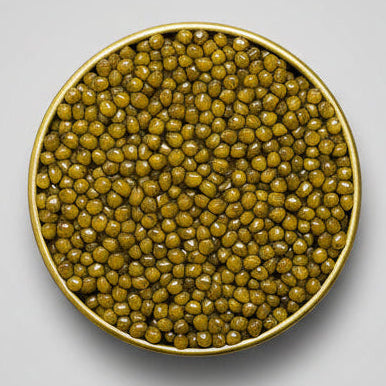
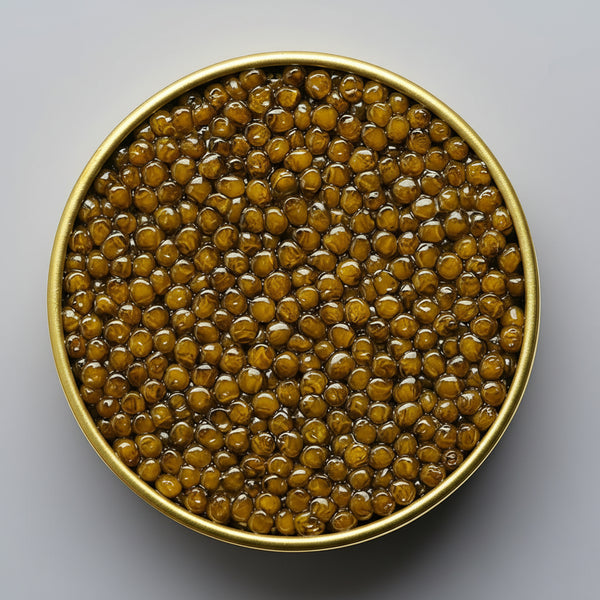
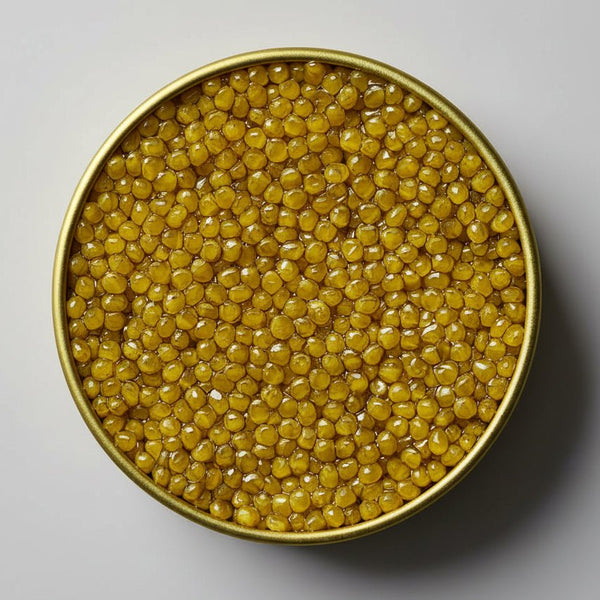
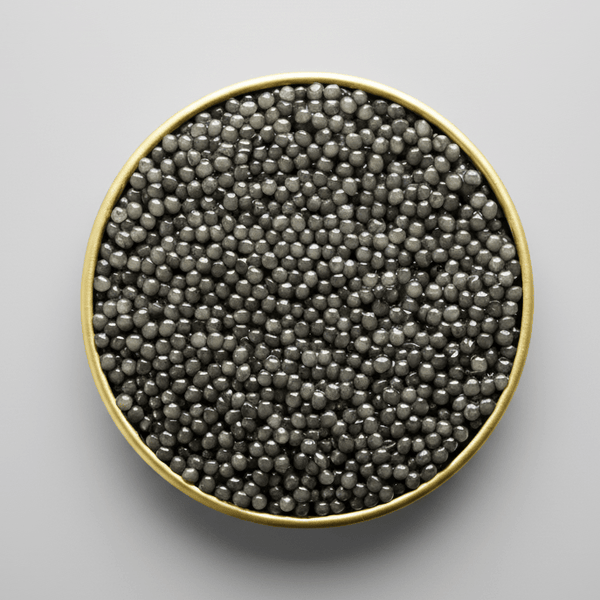
No other caviar variety displays such a wide chromatic range as Oscietra. The roe can be:
- Intense black: most common, from young females (first spawn, 8-10 years)
- Dark brown to medium brown: medium maturity females (10-14 years)
- Golden gray: older females (15-18 years)
- Golden amber (Imperial or Royal): females over 18-20 years old, extremely rare
The market rewards lighter roe with higher prices, sometimes 50-100% over darker ones. But the question everyone wants answered is: are lighter ones really better?
The honest answer, based on professional blind tastings: the differences are subtle. Golden roe tends to be slightly creamier with a longer finish, possibly because older females have accumulated more fat in the roe. But a black Oscietra from an excellent producer easily surpasses a golden Oscietra from a mediocre producer.
Color is a secondary factor. What matters is the producer, the sturgeon's diet, the timing of extraction, and the speed of processing. Don't pay an excessive premium just for color unless you are sure that all other quality factors are comparable.
Iranian vs. European vs. Chinese Oscietra: Does Origin Matter?
Yes, it matters, but less than the industry wants you to believe.
Iranian Oscietra (Caspian): the historical benchmark. Wild Caspian Sea sturgeon produced Oscietra with a complexity of flavor considered unsurpassed. Today, most Iranian Oscietra comes from SHILAT-controlled aquaculture, with excellent results but not as differentiated from European as before. Price: €2,000-€3,500/kg.
European Oscietra (Italy, France, Germany, Spain): European aquaculture has reached a remarkable level of quality. Italy (Calvisius, Giaveri) and France (Kaviari, Petrossian) produce Oscietra that in blind tastings competes directly with Iranian. Water, feeding, and processing protocols are more controlled than in many Iranian farms, leading to greater batch-to-batch consistency. Price: €1,200-€2,500/kg.
Chinese Oscietra: China now produces over 60% of the world's caviar. Quality varies enormously — from low-quality industrial products to premium Oscietra from farms like Kaluga Queen that have won international awards. The problem is traceability: verifying the species, exact origin, and processing is more difficult with Chinese caviar. Price: €800-€1,800/kg.
At Bacalalo.com, we work with producers whose origin and process we can directly verify. Traceability is not a marketing argument — it is the only way to guarantee that what you sell is what you say you sell.

How to Taste Oscietra Correctly
Oscietra is the caviar that most rewards careful tasting. If you are going to invest €50-€100 in 30g of caviar, it is worth taking five minutes to do it right.
Step 1: temperature. Take the tin out of the fridge 5-7 minutes before opening it. The ideal tasting temperature is 6-8°C. Too cold, and the aromas are compressed. Too warm, and the fat becomes dominant.
Step 2: open the tin. Observe the caviar before touching it. The grains should be individualized, shiny, without crushing or excessive liquid at the bottom. A slight oily sheen is normal and desirable.
Step 3: first taste without anything. Take a small spoon (3-4g) with a mother-of-pearl, bone, or glass spoon — never metal. Place it on the back of your hand, between your thumb and forefinger, and bring it to your mouth. Body temperature will slightly warm the caviar and release the aromas. Press the grains against the palate with your tongue. Do not chew — let them melt. Pay attention to the sequence of flavors.
Step 4: with a base. Now try it with a warm blini with a pinch of crème fraîche, or on a slice of unsalted brioche toast. The fat from the crème fraîche amplifies Oscietra's nutty notes. The bread adds a contrasting texture that enhances the pop of the grain.
Step 5: with a drink. A sip of brut nature champagne or iced vodka between bites cleanses the palate and allows you to appreciate each spoonful as if it were the first.
For a complete guide to serving and etiquette, read our article on how to eat caviar.
Oscietra Prices in 2026
Oscietra is the variety with the widest price range on the market, precisely because the variability in quality is enormous.
- Premium Iranian Oscietra (Royal/Imperial): €2,500-€3,500/kg | €80-€120 for 30g
- Standard Iranian Oscietra: €2,000-€2,500/kg | €65-€80 for 30g
- Premium European Oscietra (Calvisius, Kaviari): €1,800-€2,500/kg | €55-€80 for 30g
- Standard European Oscietra: €1,200-€1,800/kg | €40-€55 for 30g
- Chinese Oscietra (high-end): €1,000-€1,800/kg | €35-€55 for 30g
For a first purchase of Oscietra, the range of €50-€70 for 30g provides access to a serious quality product without paying the premium for brand or Iranian origin. At that price, you are buying caviar that a Michelin-starred restaurant would serve you at €40-€60 for 10g.
Consult our complete caviar price guide 2026 to compare with other varieties.

Oscietra in Professional Cooking
Oscietra is the working caviar of haute cuisine due to its versatility. Some uses that chefs have perfected:
Beef or tuna tartare with Oscietra: Oscietra's nutty flavor complements raw meat exceptionally well. The grains are placed on top of the tartare like a crown, adding texture (the pop) and deep umami. 5-8g per serving.
Slow-cooked egg with Oscietra: the modern classic. A poached egg at 63°C on a bed of mashed potato, topped with a generous spoonful of Oscietra. The liquid yolk and the creaminess of the caviar create an extraordinary synergy.
Pasta with butter, lemon and Oscietra: an elevated version of pasta al limone. The noisette butter brings toasted notes that reinforce Oscietra's nutty character. The lemon cuts through the fat and adds acidity. The caviar is added cold to the served pasta, never hot.
Oysters with Oscietra: sea on sea. A fine de claire oyster with a teaspoon of Oscietra on top is one of gastronomy's purest and most effective pairings. The minerality of the oyster and the caviar reinforce each other.
The golden rule in cooking: caviar is never cooked. It is added at the last moment, always cold or at room temperature, on top of the already plated dish. Heat destroys the texture and impoverishes the flavor.
Caspian Caviar — Premium Selection
Iranian Beluga 000, Oscietra, Sevruga. Refrigerated delivery within 24-48h to any point on the Peninsula. Since 1990 at Mercat del Ninot.
View Caviar →🛒 Recommended products in this guide
⭐ 4.9/5 · Cold shipping 24-48h · Since 1990 at Mercat del Ninot
Frequently Asked Questions
What does Oscietra mean?
Oscietra (also Osetra, Ossetra, Ossètre) is the transliteration of the Russian name for the sturgeon Acipenser gueldenstaedtii. The multiple spellings are due to Russian being transliterated differently into English, French, and Spanish. All refer to the same product.
What is the difference between Oscietra and Osetra?
None. They are different transliterations of the same Russian name. Oscietra is more common in the continental European market; Osetra in the Anglo-Saxon market. The product is identical.
Is Oscietra better than Beluga?
It depends on what you value. Oscietra has a more complex flavor profile (notes of walnut, hazelnut, sea). Beluga has a creamier texture and larger grains. Many expert tasters and chefs prefer Oscietra for its more defined personality. Beluga wins in texture and sensory experience. There is no universal answer.
How much does Oscietra caviar cost?
Between €1,200 and €3,500/kg depending on origin and quality. In 30g format, that translates to €40-120 per tin. A good quality European Oscietra is priced at €50-70 per 30g.
What does Oscietra taste like?
Notes of walnut (macadamia), toasted hazelnut, clean marine background and sometimes a subtle fruity note. Integrated salinity, never dominant. Finish of 15-25 seconds with a mineral evolution. It is the caviar with the greatest aromatic complexity.
Does the color of Oscietra indicate quality?
The color varies from black to golden amber. Lighter roe (from older females) are sold at a higher price due to scarcity, but in blind tastings, the flavor differences are subtle. An excellent black Oscietra from a good producer surpasses a golden one from a mediocre producer. Color is secondary to the producer and processing.
Want to try quality Oscietra? Visit our caviar collection at Bacalalo.com. Direct selection, cold shipping, Mercat del Ninot's expertise since 1990. Also discover our Beluga guide and the caviar types comparison.
Discover our premium selection
Seafood products selected with expertise since 1990 at Mercat del Ninot, Barcelona. Refrigerated shipping in 24-48h.