Summary: The sturgeon is one of the oldest fish on the planet — it has been on Earth for over 200 million years. It is the source of caviar, the most expensive food in the world, and today most of its 27 species are endangered. In this article, we explain the main species, why their price is so high, how the aquaculture that keeps them alive works, and how to properly consume the caviar they produce.
| Fact | Detail |
|---|---|
| Family | Acipenseridae (27 species) |
| Antiquity | +200 million years |
| Main habitat | Caspian Sea, Black Sea, European and Asian rivers |
| Conservation status | CITES Appendix II — most critically endangered |
| Time to first harvest | 7 to 20 years depending on species |
| Caviar price | From €1,500/kg (Sevruga) to +€10,000/kg (Iranian Beluga) |
What is sturgeon: a fish that has been on Earth for 200 million years
Sturgeon belongs to the family Acipenseridae, a group of bony fish that appeared in the Triassic period, even before the dinosaurs. It is, literally, a living fossil. Its elongated body, covered with bony plates instead of scales, has not significantly changed in over 200 million years.
There are 27 recognized species of sturgeon spread across the northern hemisphere. Most are anadromous: they are born in freshwater rivers, migrate to the sea to feed, and return to the river to reproduce. Some, like the Siberian sturgeon, spend their entire lives in fresh water.
What makes sturgeon unique is not just its antiquity. It is the only fish from which authentic caviar is extracted — the roe of any other fish is a substitute, no matter how well it is sold. If the label does not say "sturgeon" (or its scientific name Acipenser or Huso), it is not caviar.
Since 1990, at Mercat del Ninot in Barcelona, we have seen how the caviar market has radically changed: from an almost exclusive product of the Caspian to a global aquaculture industry. But the fish remains the same prehistoric animal.
The 5 main species of sturgeon and their caviar
Not all sturgeons are the same. The species determines the size of the fish, the maturation time, the color of the roe, and, of course, the price. These are the five species that dominate the global caviar market.
Beluga (Huso huso) — the king of caviar
The beluga is the largest sturgeon in existence. It can exceed 100 kg in weight, reach 5 meters in length, and live for over 100 years. Its roe is the largest (3-3.5 mm in diameter), with a color ranging from pearl gray to dark gray and a creamy texture that melts in the mouth.
It is the most expensive caviar in the world. A beluga female does not sexually mature until 18-20 years of age, which means almost two decades of feeding and care before the first harvest. This wait is the main reason for its price.
The Iranian Imperial Beluga caviar we work with comes from farms in the southern Caspian, where water conditions replicate the species' natural habitat. There are no shortcuts: 20 years of investment for each fish.
Osetra (Acipenser gueldenstaedtii) — perfect balance
Osetra is probably the species with the best balance between quality, availability, and price. It reaches between 30 and 80 kg, matures in 10-14 years, and produces medium-sized roe (2.5-3 mm) with a characteristic nutty flavor and marine nuances that many experts consider the most complex of all caviars.
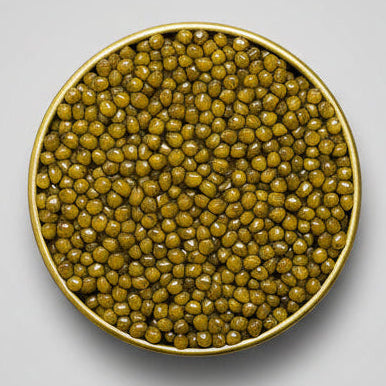
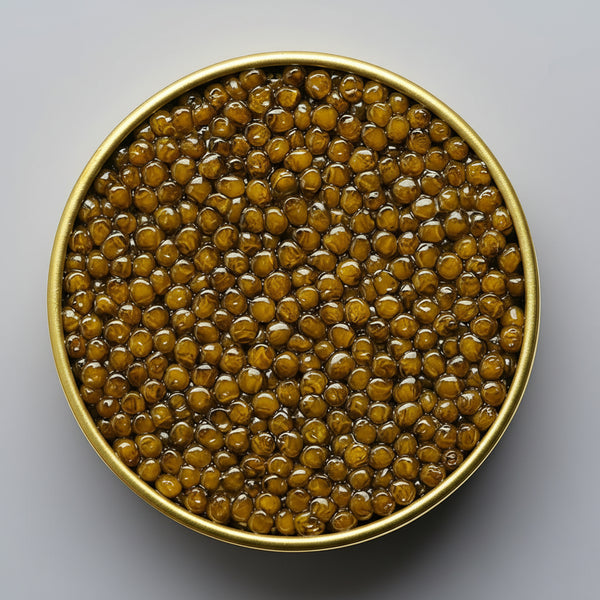
The color of the roe varies greatly: from dark brown to golden. The lighter it is, the more prized it is — golden Osetra caviar (known as Golden Osetra) comes from older specimens and fetches a premium price.
For many of our customers, Iranian Imperial Osetra caviar is the gateway to real quality caviar. Intense but not aggressive, with a texture that bursts cleanly on the palate.
Sevruga (Acipenser stellatus) — intense and accessible
Sevruga is the smallest of the three classic Caspian sturgeons. It rarely exceeds 25 kg, but it has an advantage: it matures earlier, around 7-9 years. Its roe is small (1.5-2 mm), dark gray, and has the most intense and iodized flavor of the three.
Historically, it was the "people's" caviar in Russia and Iran — more abundant and cheaper than Beluga or Osetra. Today, it remains the most accessible option within authentic Caspian caviar, without sacrificing quality.
The Caspian Sevruga caviar we offer is ideal for those seeking a powerful and defined flavor. It needs no introduction.
Sterlet (Acipenser ruthenus) — the smallest
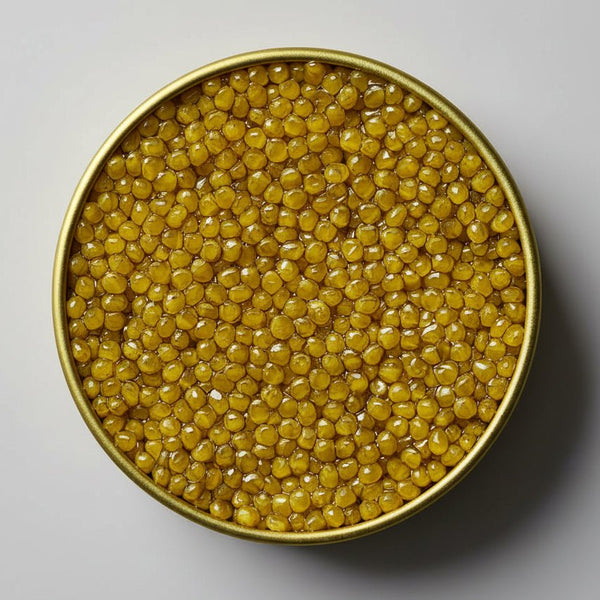
The sterlet is the smallest sturgeon, rarely exceeding 10 kg. Historically, it was the caviar reserved for the court of the Russian tsars — the so-called imperial golden caviar. Its roe is very small, light golden in color, with a delicate and buttery flavor.
Today it is a less common species on the market, but some European farms produce it on a small scale. Its interest is more historical and gastronomic than commercial.
Siberian (Acipenser baerii) — the engine of aquaculture
The Siberian sturgeon is, by far, the most cultivated species in the world. It adapts well to captivity, tolerates cold water, matures in 7-10 years, and produces consistent medium-sized roe with a mild flavor and earthy notes.
Most of the caviar sold in supermarkets and mid-range restaurants comes from this species. France, Italy, Spain, Uruguay, and China are the main producers. It is a decent caviar, but it does not reach the complexity of Osetra or the creaminess of Beluga.
Comparison of sturgeon species
| Species | Adult weight | Maturation | Roe size | Flavor | Estimated price/kg |
|---|---|---|---|---|---|
| Beluga | 60-100+ kg | 18-20 years | 3-3.5 mm | Creamy, buttery | €5,000-10,000+ |
| Osetra | 30-80 kg | 10-14 years | 2.5-3 mm | Nutty, marine, complex | €2,500-5,000 |
| Sevruga | 10-25 kg | 7-9 years | 1.5-2 mm | Intense, iodized | €1,500-3,000 |
| Sterlet | 3-10 kg | 6-8 years | 1-1.5 mm | Delicate, buttery | €2,000-4,000 |
| Siberian | 15-30 kg | 7-10 years | 2-2.5 mm | Mild, earthy | €1,000-2,500 |
Sturgeon habitat: from the Caspian Sea to the extinction crisis
Sturgeon has historically lived in the waters of the northern hemisphere: the Caspian Sea, the Black Sea, the Sea of Azov, the Adriatic, major European rivers (Danube, Volga, Ural, Rhine) and the rivers of North America and Siberia.
The Caspian Sea has been, for centuries, the global epicenter of caviar. Iran and what are now Russia, Kazakhstan, Turkmenistan, and Azerbaijan controlled virtually all production. The cold, nutrient-rich waters of the Caspian produced sturgeons of unsurpassed quality.
But the history of sturgeon in the 20th century is a story of destruction:
- Massive overfishing: Between 1950 and 2000, industrial fishing and poaching reduced Caspian populations by over 90%.
- Dams and reservoirs: Large dams on the Volga, Ural, and Danube cut off spawning migration routes. Without access to rivers, sturgeon cannot reproduce.
- Pollution: Industrial discharges, agricultural pesticides, and oil extraction in the Caspian degraded the habitat to make it incompatible with the survival of many populations.
- Collapse of the USSR (1991): The disappearance of Soviet state control unleashed a wave of illegal fishing that decimated the remaining populations.
The result: 23 of the 27 sturgeon species are now classified as threatened or critically endangered by the IUCN. International trade in wild caviar is regulated (and in many cases prohibited) by the CITES Convention, Appendix II.
Sturgeon aquaculture: the solution that requires 20 years of patience
If you can buy legal caviar today, it is almost exclusively thanks to aquaculture. Sturgeon farms have become the only sustainable source of caviar in the world. But it's not a business for the impatient.
The process works like this:
- Broodstock selection: Individuals with proven genetics are chosen, often imported from conservation programs.
- Incubation and fry rearing: Fertilized eggs are incubated in the laboratory. Fry spend the first few months in controlled tanks.
- Growth (years 1-5): Fish grow in ponds or recirculating aquaculture systems (RAS). They are fed specific, protein-rich feeds.
- Sexing (year 3-5): Sex is determined by ultrasound. Males are destined for meat; only females continue on the caviar path.
- Maturation (years 5-20): Females continue to feed and grow until their roe reaches optimal size and maturity. This takes between 7 years (Sevruga, Siberian) and 20 years (Beluga).
- Harvest: The roe is extracted, washed, salted using the malossol method (less than 3-5% salt), and packaged in the characteristic vacuum tins.
The cost of keeping a fish alive for 20 years before obtaining a single gram of product is the fundamental reason why caviar is expensive. There's no trick, no shortcut. It's biology and time.
The main aquaculture producing regions are:
- Iran: Farms in the southern Caspian, inheritors of the Persian tradition. They produce Beluga, Osetra, and Sevruga of the highest quality.
- Italy: Brescia is the European epicenter. Calvisius and other brands mainly produce Osetra and Siberian.
- France: Aquitaine, with a tradition since the 90s. Mostly Siberian (Baerii).
- Spain: Riofrío (Granada) produces organic Siberian caviar. Small but recognized production.
- China: The world's largest producer by volume. Variable quality, from industrial to high-end (Kaluga Queen).
Why caviar is so expensive: the 7 real factors
The price of caviar is not a market whim. It is a direct consequence of verifiable factors that any producer will confirm:
- Extreme maturation time: Between 7 and 20 years of feeding and care for each female. No other food product requires a comparable time investment.
- Only females produce: 50% of the fry (males) will never generate caviar. They are destined for meat, but the return is much lower.
- Accumulated mortality: In 20 years of farming, losses due to disease, stress, or technical failures are inevitable. Every fish that dies before harvest is a total loss.
- Costly feeding: An adult beluga sturgeon consumes several kilograms of specialized feed daily for years.
- Artisanal salting process: Malossol requires caviar masters with decades of experience. The exact amount of salt (3-5%) is adjusted by hand according to each batch of roe.
- Uninterrupted cold chain: From extraction to your table, caviar must be kept between -2°C and +2°C. Any break in the chain ruins the product.
- Real scarcity: Global aquaculture caviar production is around 300-400 tons annually. It is a genuinely scarce product, not artificially limited.
When someone says caviar is expensive "because it's a luxury," they are oversimplifying. It's expensive because producing it costs a lot of time, a lot of money, and a lot of risk. It's not marketing — there are verifiable factors.
How to eat caviar correctly
After 20 years of investing in a fish, the least you can do is not ruin the product in the last step. These are the basic rules we have shared with our customers since 1990 at Mercat del Ninot:
Serving temperature
Caviar is served cold, between 4°C and 8°C. Take it out of the refrigerator 5-10 minutes before serving. Too cold and the aromas are suppressed; too warm and the texture degrades. Ideally, place the tin on crushed ice.
To store caviar correctly in the refrigerator, keep it in the coldest part (0-4°C) and consume it within 3-4 weeks if unopened, or 2-3 days once opened.
The spoon: mother-of-pearl, bone, or glass (never metal)
Caviar is eaten with a mother-of-pearl, bone, wood, or glass spoon. Never with metal — especially silver or other reactive metals. Metal oxidizes the roe and creates an unpleasant metallic aftertaste that masks the nuances of the product.
If you don't have a mother-of-pearl spoon, a plastic spoon is a better option than a silver one. It's not elegant, but it's functional.
Amount per person
As a tasting, between 10 and 15 grams per person is enough to appreciate the product. As a generous main course or starter, between 25 and 30 grams. More than 50 grams per diner enters serious celebration territory.
Accompaniments
The rule is simple: the better the caviar, the less it needs. Quality Beluga and Osetra are eaten alone, directly from the spoon, or at most on a warm blini with a touch of crème fraîche.
What to avoid:
- Raw onion (kills the nuances)
- Lemon (acidity alters the flavor)
- Chopped hard-boiled egg (more filling than accompaniment)
- Very crispy toasts (the texture competes with the roe)
Traditional Russian accompaniments (blinis, crème fraîche, iced vodka) work well because they don't interfere. Brut champagne is also a classic and correct pairing.
Caviar and Sturgeon in Spain: Market and Reality
Spain has a growing relationship with caviar. National production (especially Riofrío, in Granada) is small but internationally recognized for its quality. However, most of the premium caviar consumed in Spain is imported: Iran for Beluga and Osetra from the Caspian, Italy and France for European Siberian.
In our caviar collection, we work exclusively with Iranian Caspian origin for the classic varieties. This is not a marketing decision — it's a product decision. The waters of the Caspian, the genetics of Iranian sturgeons, and centuries of Persian production tradition create a caviar that simply tastes different.
The Spanish market has matured in recent years. More and more restaurants and private consumers understand the difference between a mid-range Siberian aquaculture caviar and a 14-year-old Iranian Osetra. The price reflects that difference, and the palate confirms it.
Premium Seafood Products — Bacalalo
Since 1990, selecting the best from the sea at Mercat del Ninot, Barcelona. Refrigerated shipping 24-48h.
View Caspian Caviar →🛒 Products mentioned in this article
⭐ 4.9/5 · Chilled shipping 24-48h · Since 1990 at Mercat del Ninot
Other names for sturgeon: sollo and common sturgeon
In Spain, sturgeon is also known as sollo, especially in Andalusia, where the native species Acipenser sturio (common sturgeon or Atlantic sturgeon) historically migrated up the Guadalquivir River. This is where the scientific name sturio comes from, also the root of the English term sturgeon and the German Stör. All sturgeons belong to the family Acipenseridae, which groups the genera Acipenser and Huso (that of the beluga).
Sturgeon meat: what is done with the fish besides caviar
A frequent question about sturgeon is what happens to the animal once the roe has been extracted, and what is done with the males — which never produce caviar. The answer is that sturgeon meat is edible and highly prized.
It is a white, firm meat with hardly any bones (sturgeon has a cartilaginous, not bony, skeleton), with a mild flavor reminiscent of sea veal or swordfish. It is consumed in various ways:
- Smoked: this is the most common and valued preparation. Smoked sturgeon has a silky texture similar to smoked salmon but denser.
- Grilled or baked: its firmness holds up well to heat without falling apart, unlike more delicate fish.
- In stews and grilled: traditional in Guadalquivir and Eastern European cuisine.
In modern aquaculture, nothing is wasted: females provide caviar and males are destined for meat, which improves the economic viability of farms that keep sturgeon alive for decades.
Sturgeon in Spain: from the Guadalquivir to the Granada farms
The common sturgeon (Acipenser sturio) was a native species of Spain. Until the mid-20th century, it migrated up the Guadalquivir to spawn, and in Coria del Río there was a caviar factory that produced the famous "Guadalquivir caviar" tins. The construction of dams and overfishing ended the wild population: today it is considered practically extinct in the wild in Spanish waters.
Current sturgeon production in Spain is from aquaculture. The benchmark is Riofrío (Granada), which raises Siberian sturgeon in spring water and produces internationally recognized organic caviar. It is a small but quality production.
For premium Caspian caviar —Beluga, Osetra, and Sevruga— the reference remains Iranian origin. You can see the classic varieties in our Caspian caviar collection: the natural destination for sturgeon when we talk about real quality.
Frequently asked questions about sturgeon
Is sturgeon an endangered species?
Yes. 23 of the 27 sturgeon species are threatened or critically endangered according to the IUCN. The trade of wild sturgeon and caviar is regulated by CITES (Appendix II). Virtually all legal caviar on the market comes from aquaculture.
How long does a sturgeon live?
It depends on the species. A beluga (Huso huso) can live over 100 years in the wild. Osetra reaches 50-60 years and Sevruga between 25 and 30 years. In captivity, the numbers are lower but still remarkable.
How long does it take for a sturgeon to produce caviar?
Between 7 and 20 years, depending on the species. Sevruga and Siberian mature in 7-10 years. Osetra needs 10-14 years. Beluga, between 18 and 20 years. It is the food with the longest production time in the world.
Is the sturgeon killed to extract caviar?
In traditional production and in most farms, yes — the fish is sacrificed to extract the roe intact. There is an alternative technique called stripping (or "cesarean section") that allows the roe to be extracted without killing the fish, but the result is usually of lower quality because the roe is not at its optimal maturity. Some farms use it to preserve genetically valuable females.
What is the difference between caviar and fish roe?
Caviar is exclusively sturgeon roe. Salmon, trout, lumpfish, or any other fish roe are substitutes — they can be valid products, but they are not caviar. If the label does not indicate the sturgeon species, be suspicious.
Why is Iranian caviar more expensive than Chinese caviar?
Three factors: genetics (Iranian sturgeon from the Caspian have access to the original strains), water (the natural conditions of the Southern Caspian are optimal), and tradition (Iran has been producing caviar for centuries, with master caviar makers adjusting the salting by hand). China produces in volume; Iran produces in quality. Both models are legitimate, but the result is different.
Can sturgeon be farmed at home?
Technically, sturgeon can live in private ponds if the water is cold (12-18°C), oxygenated, and clean. But raising a sturgeon for caviar requires 7-20 years of specialized feeding, veterinary control, and technical equipment. It is not viable outside of a professional facility.
How much did the largest sturgeon ever caught weigh?
The historical record is a female beluga caught in the Volga River in 1827 that weighed approximately 1,571 kg and from which about 150 kg of caviar were extracted. Today, specimens of that size are practically non-existent due to overfishing in the 20th century.