

📖 Complete Guide: if you're looking for an overview of caviar types, 2026 prices, and Petrossian/Riofrío comparison, read our complete 2026 caviar guide.
Summary
There is one caviar that experts ask for when they want real flavor and not just prestige: Sevruga caviar. In this guide: What is Sevruga caviar: origin and species, Flavor and characteristics of Sevruga caviar: what to expect, Price of Sevruga caviar in Spain.
Sevruga Caviar: The Most Intense and Accessible
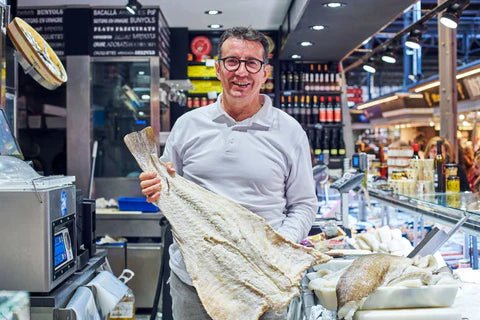
There is one caviar that experts ask for when they want real flavor and not just prestige: Sevruga caviar. At Bacalalo, from Barcelona's Mercat del Ninot, we know it well because it's the one that most surprises those new to caviar. Small grain, intense black color, powerful marine flavor, and a more contained price than its Beluga cousin. It's the caviar that turns novices into serious aficionados.
What is Sevruga Caviar: Origin and Species
Sevruga caviar comes from the sturgeon Acipenser stellatus, known in Russian as "sevruga" or "starry" for the spots that adorn its skin. It is one of the three great traditional caviars of the Caspian Sea, along with Beluga (Huso huso) and Osetra (Acipenser gueldenstaedtii). Of the three, Sevruga is the smallest fish, the one that matures earliest, and consequently, the one that produces the smallest roe.
An adult Sevruga sturgeon weighs between 7 and 25 kg and reaches sexual maturity at 7-10 years, much earlier than Beluga (which can take 20-25 years). This shorter lifespan and faster reproduction rate mean it has historically been the most fished in the Caspian and, by extension, the most available on the market.
Russia, Iran, Azerbaijan, and Kazakhstan were for centuries the main producers of wild Sevruga. With the CITES quotas implemented from 2006, wild caviar production drastically reduced. The best Sevruga now reaching the European market comes mainly from controlled Iranian aquaculture or specialized farms in Europe.
Flavor and Characteristics of Sevruga Caviar: What to Expect
Sevruga caviar has an unmistakable flavor profile. Where Beluga is smooth and creamy, and Osetra is complex and fruity, Sevruga is direct, marine, and intense. For those coming from the world of seafood and preserves, it is the most intellectually accessible because its taste of the sea is immediate and recognizable.
The physical and organoleptic characteristics of good Malossol Sevruga:
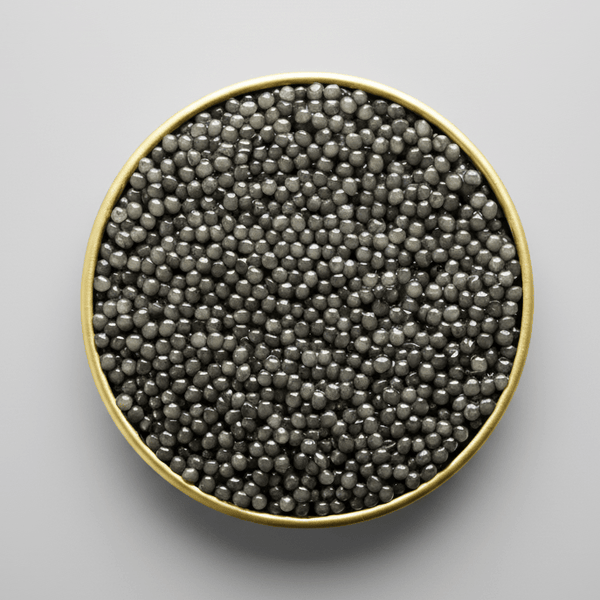
- Grain size: 1-2mm in diameter, the smallest of the big three. Sometimes described as "granular" compared to Beluga.
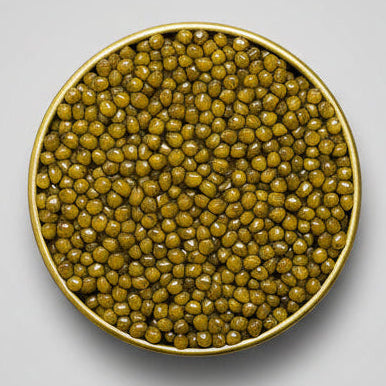
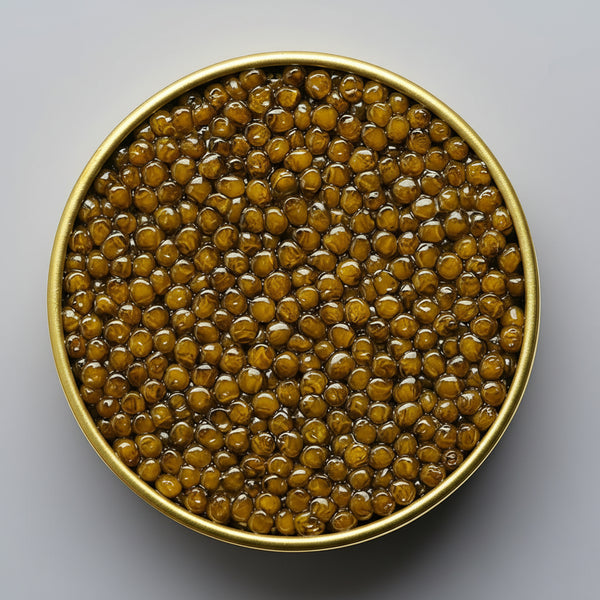
- Color: Intense black, almost jet black. No golden or brownish variations like Osetra.
- Texture: Firm grains with a characteristic "pop" on the palate. The skin is somewhat thinner than Osetra's, causing them to burst with less pressure.
- Aroma: Intensely marine, with iodine notes and a slightly smoky background. More pronounced than Beluga or Osetra initially.
- Flavor: Powerful, naturally saline (even in Malossol version), with a prolonged aftertaste. Some tasters detect nuances of seaweed, deep ocean, and marine nuttiness.
Sevruga's intensity is its greatest virtue and, for some, its only drawback. Those seeking subtle and delicate caviar prefer Osetra. Those who want immediate impact and genuine oceanic flavor will not be disappointed by Sevruga.
Price of Sevruga Caviar in Spain
Sevruga caviar is, of the three classic sturgeon caviars, the most economically accessible. However, "accessible" is relative in the world of quality caviar. Indicative price ranges for the Spanish market in 2025-2026:
- Aquaculture Sevruga (30g): 80-120€ from specialized online distributors
- Aquaculture Sevruga (50g): 120-180€
- Certified Iranian Sevruga (30g): 150-250€ depending on the supplier and harvest
- Royal or Imperial Sevruga (extra selection, 30g): 200-350€
To put it in context: equivalent quality Osetra costs 40-60% more, and Beluga can multiply Sevruga's price by three or four. At Bacalalo, you'll find our Caspian Sevruga Caviar for 100€, a direct reference without unnecessary intermediaries.
Bacalalo Products

Mújol Shikrán Selection - Premium Roe with Smo...
€6.95

Assortment "The Great Beluga Gift"
€227.91

Mújol Negro Shikrán 550g - Smoked Herring and ...
€27.95

Sevruga Caviar
€100.00
Refrigerated shipping 24-48h to all of the Peninsula
Sevruga vs Osetra vs Beluga: Comparative Table
To place Sevruga caviar in the broader context, it's useful to compare it directly with its two great companions in the category:
- Grain size: Sevruga 1-2mm / Osetra 2-3mm / Beluga 3-4mm
- Color: Sevruga black / Osetra golden to brown / Beluga pearl gray to black
- Flavor: Sevruga marine and intense / Osetra complex and fruity / Beluga smooth and creamy
- Relative price: Sevruga base / Osetra x1.5-2 / Beluga x3-5
- Fish maturity: Sevruga 7-10 years / Osetra 12-15 years / Beluga 20-25 years
- Availability: Sevruga higher / Osetra medium / Beluga very limited
This comparison makes it clear that Sevruga is not a lesser caviar: it is simply different. In a blind tasting among connoisseurs, Sevruga wins in personality and immediate recognition. Beluga wins in delicacy and selling price.
Pairing Sevruga Caviar: What to Serve it With
The intensity of Sevruga caviar requires drinks and accompaniments that can handle its character without overwhelming it:
Vodka: The classic Russian pairing makes sense with Sevruga. Vodka at -18°C cleanses the palate between spoonfuls without adding its own flavor. Brands like Beluga, Russian Standard, or a quality Polish rye vodka work very well.
Blanc de Blancs Champagne: A 100% Chardonnay Champagne, with its high acidity and citrus notes, creates a perfect counterpoint to Sevruga's salinity. Avoid rosés or Blanc de Noirs, which compete in power.
Cava Brut Nature: For those who prefer national products, a Cava Brut Nature from the DO Cava, especially made from Xarel·lo grapes, works surprisingly well with Sevruga thanks to its acidity and yeast notes.
Junmai Daiginjo Sake: A less conventional option but recommended by several sommeliers and Japanese chefs. High-end sake, served cold, is delicate enough not to overpower Sevruga and offers a different complexity.
What doesn't work: tannic red wines, heavily oaked whites, dark beer. Tannin irreparably crushes Sevruga's marine flavor.
How to Serve Sevruga Caviar at Home
Serving Sevruga caviar at home doesn't require Tsarist porcelain, but it does require a few minimums that make the difference between enjoying the product and wasting it:
- Remove the tin from the refrigerator 5 minutes before serving. No longer, as Sevruga is sensitive to heat.
- Open the tin with the included spatula (or a gentle can opener), without pressing the grains.
- Serve directly from the tin over crushed ice or place the tin on a bowl of ice.
- Use mother-of-pearl or bone spoons. Silver metal reacts with caviar and adds a metallic taste.
- For a first tasting, try Sevruga alone first, on the back of your hand (the warmth of your palm will temper it slightly). Then on a small blini with a dollop of sour cream.
- Calculate 20-30g per person for an appetizer, 10-15g for a comparative tasting.
Where to Buy Guaranteed Sevruga Caviar
Buying Sevruga caviar requires more care than other foods because the cold chain is crucial. Sevruga that has traveled without proper refrigeration loses texture, develops bitter flavors, and can be unpleasant even if the tin is correctly sealed.
The criteria for choosing a reliable supplier are: guaranteed cold chain in shipping (between 0°C and 4°C), complete product traceability (species, origin, processing date), information on salt content, and a return policy in case of temperature problems. At Bacalalo, we ship all caviar orders in refrigerated packaging with cold packs to ensure the temperature for 24-48 hours anywhere on the Peninsula.
Bacalalo Products
Mújol Shikrán Selection - Premium Roe with Smo...
€6.95
Assortment "The Great Beluga Gift"
€227.91
Mújol Negro Shikrán 550g - Smoked Herring and ...
€27.95
Sevruga Caviar
€100.00
Refrigerated shipping 24-48h to all of the Peninsula
🛒 Products mentioned in this article
⭐ 4.9/5 · Chilled delivery 24-48h · Since 1990 at Mercat del Ninot
Frequently asked questions about Sevruga caviar
Is Sevruga caviar good for caviar beginners?
It depends on the diner's profile. If you like powerful marine flavors and fish in general, Sevruga is an excellent entry point because its character is direct and easy to identify. If you prefer milder, more delicate flavors, a Spanish farmed Osetra might be a better starting point.
Is Sevruga caviar real caviar or a substitute?
It is real caviar. Sevruga is one of the three classic sturgeon species from which genuine caviar is obtained. It has nothing to do with lumpfish, salmon, or capelin substitutes sold as "red caviar" or "imitation caviar."
How much Sevruga caviar do I need for an appetizer for 6 people?
Between 150g and 200g for a generous appetizer for 6 people. This amounts to about 25-30g per person, enough for 4-5 teaspoons each with blinis or toast. If it's the main course of a tasting, increase to 30-50g per person.
Does Sevruga have fewer calories than other caviars?
The caloric differences between caviar species are minimal. Caviar in general provides about 250-270 kcal per 100g, with high content of protein (25-28g), omega-3 fats (18-20g), and vitamins B12, D, and A. Sevruga has a nutritional profile practically identical to Osetra or Beluga.
Can Sevruga caviar be frozen?
It is not recommended. Freezing breaks the grains and destroys the texture, which is one of the main attributes of fresh caviar. Unopened Sevruga, stored at -1°C or -2°C (the coldest part of the refrigerator or in a small dedicated mini-fridge), maintains its quality for 3-5 months.
Is Caspian Sevruga caviar sustainable?
Yes, if it comes from controlled aquaculture. Wild sturgeon fishing in the Caspian Sea has been severely restricted by CITES since 2006. Sevruga legally marketed in Europe comes from farms with veterinary and animal welfare controls. Always look for supplier traceability and the corresponding CITES certificate.
What is the difference between Sevruga caviar and lumpfish caviar?
The difference is huge: they are completely different products. Lumpfish (Cyclopterus lumpus) is a fish that is not a sturgeon, and its roe has no relation to real caviar in taste, texture, or gastronomic value. Lumpfish caviar is dyed black or red, has an intensely salty taste, and a very different texture. It is an inexpensive substitute, not caviar.
Discover our premium selection
Seafood products selected with care since 1990 at Mercat del Ninot, Barcelona. Chilled delivery in 24-48h.