Summary: Cod cheeks (kokotxas in Basque) are the most prized and scarce part of the cod: a small gelatinous muscle located under the fish's chin, from which only two per specimen are obtained. In this comprehensive guide, we explain exactly what they are, why their price is so high, the differences between fresh, salted, and frozen, how to prepare them "al pil pil," in green sauce, and battered, where to buy them, and everything you need to know to enjoy this delicacy.
What are cod cheeks: anatomy of the cod
Cod cheeks — kokotxas in Basque — are a small, oval-shaped muscle located on the underside of the cod's head, specifically between the lower jaw and the throat. This muscle is responsible for gill movement, and due to its constant activity during the fish's life, it develops an extraordinary concentration of collagen and gelatin.
Each cod only has two cod cheeks, one on each side of the chin. They are small pieces weighing between 20 and 40 grams each, depending on the size of the specimen. Their shape is oval, slightly flattened, with one smooth side and another with a thin, gelatinous membrane. When raw, they are firm but elastic; when cooked, they transform into extraordinarily tender, juicy, and unctuous bites.
What makes cod cheeks unique is not only their flavor — intense, concentrated, and marine — but their gelatinous texture. No other part of the cod, or any other fish, offers this combination of tenderness and collagen. It is precisely this collagen that makes them the perfect ingredient for pil pil: the gelatin they release when cooked emulsifies with oil almost spontaneously, creating a sauce that, with cod loins, requires much more work and patience.
Why cod cheeks are so expensive
The price of cod cheeks ranges from 40 to 80 euros per kilo depending on the format (fresh, salted, or frozen) and the season. For those unfamiliar with them, this price may seem exorbitant. But it has a logical explanation based on five factors:
- Mathematical scarcity: a 5-6 kg cod produces barely 40-80 g of cod cheeks. To serve a 400 g dish (4 diners), you need the cod cheeks from 10 to 20 cods. The ratio between usable product and raw material is minimal.
- Manual extraction: cod cheeks are extracted by hand from the cod's head, one by one. It is an artisanal task that cannot be mechanized and requires skill not to damage the piece.
- Irreplaceable texture: there is no substitute. No other part of any fish replicates the combination of gelatin, tenderness, and flavor of cod cheeks. This gives them an exclusive value.
- High cuisine demand: Michelin-starred restaurants in the Basque Country, Cantabria, and Navarra compete for the best cod cheeks. This professional demand constantly pushes prices up.
- Concentrated flavor: being a small but very active muscle (cod uses it continuously to breathe), it concentrates more flavor per gram than any other part of the fish. It is pure flavor, without water or filler fiber.
However, the perspective changes when you calculate the cost per diner. With 400 g of cod cheeks (about 25-35 euros), you prepare a main course for 4 people that in a Basque restaurant would cost between 30 and 50 euros per diner. At home, the real cost per person is around 7-9 euros for a dish of superior gastronomic category.
Cod cheeks vs hake cheeks
Hake cheeks are the other great reference for this cut in Spanish cuisine. Both have their virtues, but they are different products that behave differently in the kitchen.
| Characteristic | Cod Cheeks | Hake Cheeks |
|---|---|---|
| Texture | Very gelatinous, firm, unctuous | More delicate, tender, less gelatin |
| Flavor | Intense, saline, deep | Subtle, smooth, more neutral |
| Collagen | Very high (ideal for pil pil) | Moderate (pil pil more difficult) |
| Size | 20-40 g per unit | 15-30 g per unit |
| Formats | Fresh, salted, frozen | Fresh, frozen (rarely salted) |
| Price/kg | 40-80 euros | 30-60 euros |
| Best preparation | Pil pil (emulsifies itself) | Green sauce, battered |
| Availability | All year (salted and frozen) | Seasonal (fresh) or frozen |
For pil pil, cod cheeks are clearly superior: their high collagen content makes the sauce emulsify almost by itself. Hake cheeks produce a paler and less dense pil pil. However, for battering or grilling, hake cheeks are excellent due to their delicacy. They are not interchangeable; they are complementary.
Related Cod Products


Recommended Products

Natural Cod Liver Foie Gras - 120g | Smoked C...
3,90 €

CHATKA Wild King Crab 60% Legs 40% Shredded | ...
95,00 €

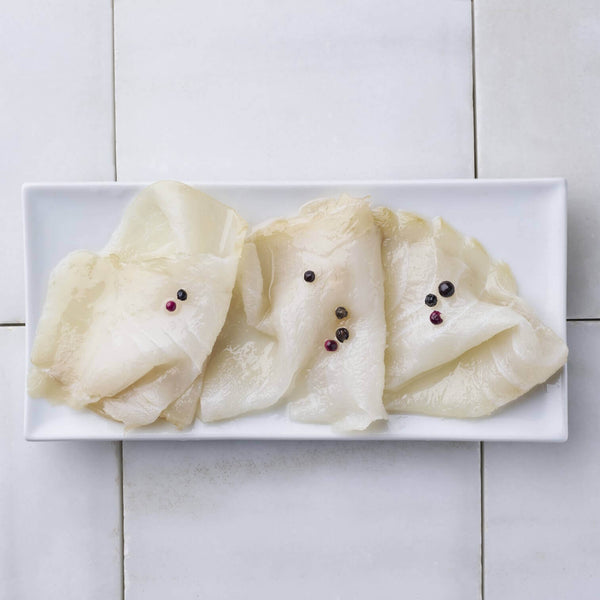
Artisanal Smoked Cod Carpaccio | 1 Tray Pack
15,90 €

Dried Cod Cheeks (1 tray) - 500g
19,95 €
Refrigerated shipping 24-48h throughout the Peninsula
Fresh, salted, and frozen: which to choose
Cod cheeks are marketed in three formats, and each has its advantages depending on the preparation you plan to make:
Fresh cod cheeks: come directly from the fish market, without any preservation treatment. They have a delicate flavor and a particularly tender texture. They are the hardest to find because their freshness window is very short (2-3 days from extraction). Best for battering or grilling, where their delicacy shines.
Salted cod cheeks: cured in salt like cod itself. The salting concentrates the flavor, increases firmness, and most importantly, intensifies the release of gelatin during cooking. They are ideal for pil pil and green sauce. They require prior desalting for 12-16 hours in cold water. Bacalalo's salted cod cheeks are the most authentic format for traditional Basque recipes.
Frozen cod cheeks: flash-frozen after capture to preserve their freshness. They are the most accessible format and available all year round. They work for any preparation, although they release slightly less gelatin than salted ones. To thaw them, transfer them from the freezer to the refrigerator 12 hours before cooking. Never thaw them in the microwave or in hot water.
Season and availability
The availability of cod cheeks varies according to format and species:
- Salted cod cheeks: available all year round. Salting is a preservation method that allows for permanent stock. It is the most reliable format if you want to cook cod cheeks at any time.
- Fresh cod cheeks: the cod fishing season in the North Atlantic runs from January to April (main season) and from September to November (secondary season). Outside these windows, finding fresh cod cheeks is very difficult.
- Fresh hake cheeks: more regularly available in the markets of northern Spain, especially between October and March. In the rest of Spain, they appear sporadically.
- Frozen cod cheeks: available all year round, both cod and hake. It is the most practical option for those living far from the coast or specialized markets.
Practical advice: if you see fresh cod cheeks at your market, buy them. They are not a product you can decide to buy tomorrow, because tomorrow they will probably be gone. If you plan a recipe in advance, salted or frozen are the safe choice.
Recipe: cod cheeks al pil pil
Ingredients for 4 people
- 400 g cod cheeks (desalted if salted, thawed if frozen)
- 250 ml mild extra virgin olive oil (Arbequina or similar)
- 4 cloves garlic thinly sliced
- 1 dried chili pepper (optional, for a subtle spicy touch)
Step-by-step preparation
- Desalt the cod cheeks (if salted): submerge them in cold water for 12-16 hours, changing the water 2-3 times. Cod cheeks, being small pieces, desalt faster than loins. Test one by biting an end: it should be salty but not aggressive. Dry them thoroughly with paper towels.
- Confit the garlic: in a clay pot (essential for maintaining temperature) or a thick-bottomed pan, pour the oil and add the sliced garlic and chili. Heat over very low heat until the garlic is lightly golden, 5-6 minutes. Do not burn them: bitter garlic ruins the entire dish. Remove the garlic and chili with a slotted spoon and set aside.
- Cook the cod cheeks: with the flavored oil over minimum heat (it should not bubble), place the cod cheeks in a single layer without overlapping. Cook for 3-4 minutes per side. You will see them release an abundant whitish gelatin: this gelatin is the base of the sauce. Do not increase the heat; gelatin is released with gentle heat.
- Remove the cod cheeks: take them out with a slotted spoon onto a plate and set aside. In the pot remains the oil loaded with gelatin: this is the gold of the dish.
- Emulsify the pil pil sauce: remove the pot from the heat. Begin to move it with circular and back-and-forth motions, as if shaking a sieve. The emulsion forms when the gelatin dissolved in the oil binds with the movement. With cod cheeks, the pil pil emulsifies much faster than with loins: in 3-5 minutes you should have a dense, creamy, and white-yellowish sauce.
- Return the cod cheeks to the sauce: once emulsified, put the cod cheeks back into the pot, place the golden garlic on top, and coat everything with the sauce. If the sauce is too thick, add a few drops of warm water and stir again.
Total time: 25-30 active minutes (not counting prior desalting). Serve immediately, directly in the clay pot, with crusty bread for dipping. The bread for the leftover sauce is almost as important as the cod cheeks themselves.
Other Preparations: Salsa Verde, Battered, and Grilled
Cocochas in salsa verde: the other great Basque recipe. Unlike pil pil, which only uses oil, garlic, and the fish's own gelatin, salsa verde incorporates parsley, white wine, and sometimes peas and clams. The procedure is similar to cod in salsa verde, but with the advantage that cocochas release more gelatin and the sauce thickens more easily. Add a tablespoon of flour to the oil before the white wine, then add 100 ml of dry white wine, a glass of fish stock, and the peas. Cook the cocochas for 3-4 minutes per side and finish with plenty of fresh chopped parsley.
Battered Cocochas: a classic of Basque cider houses. Dry the cocochas well, dredge them in flour and beaten egg, and fry them in hot oil (180 C) for 2-3 minutes. The batter should be thin so that the gelatinous interior texture can be appreciated. It is the simplest and one of the most gratifying preparations: crispy on the outside, melting on the inside. Serve them with a very cold txakoli.
Grilled Cocochas: the minimalist option. In a very hot griddle or pan with a drizzle of oil, sear the cocochas for 1-2 minutes per side. Season with Maldon salt and a drizzle of extra virgin olive oil. The result is intense, direct, and requires top-quality cocochas. Only recommended with fresh or premium frozen cocochas.
Tips for Thickening Pil Pil with Cocochas
Cocochas pil pil is easier to thicken than loin pil pil, but there are still tricks that make a difference:
- Always minimum heat: gelatin is released best at low temperatures. If the oil bubbles, the proteins denature and do not emulsify correctly.
- Clay pot: retains heat evenly and allows the emulsion to form gradually. A stainless steel pan cools too quickly.
- Do not use a spatula: the sauce thickens by moving the pot, not stirring with a spoon. The movements should be circular, back and forth, and gentle. It's a swaying, not a stirring.
- If it doesn't thicken, add a few drops of warm water: water helps the emulsion. Not hot, not cold: warm. A few drops, not a splash.
- Patience between batches: if you cook many cocochas, do it in two batches in the same pot. The first batch will fill the oil with gelatin; the second will benefit from already enriched oil.
- Salted cocochas thicken better: salt curing breaks down collagen fibers and facilitates their release. If you are looking for the densest and creamiest pil pil, salted cocochas are the right choice.
Where to Buy Quality Cod Cocochas
Finding cod cocochas is not like buying a hake fillet at the supermarket. They are a niche product that requires searching in the right channels:
- Specialized cod fishmongers: Bacalalo's salted cod cocochas are available all year round and arrive with refrigerated shipping in optimal condition. It is the most convenient and reliable option for those who do not live near a physical cod fishmonger.
- Northern municipal markets: the cod stalls at Mercado de la Ribera (Bilbao), Mercado de la Bretxa (San Sebastián), or Mercado de la Esperanza (Santander) usually have salted cocochas regularly. In markets in the rest of Spain, availability is more irregular.
- Specialized online purchase: the main advantage of buying online is the guarantee of availability and product traceability. You don't depend on the luck of your local market having them that day.
Be wary of excessively cheap cocochas (below 30 euros/kg): they may be from inferior fish or of dubious origin. Authentic cod cocochas, especially those from North Atlantic cod (Iceland, Norway, Faroe), have a price that reflects their quality and scarcity.
Storage and Handling
Cocochas require careful handling due to their high gelatin content and small size:
- Salted cocochas (undesalted): store in the refrigerator for up to 3 months in their original packaging, covered in salt. Salt acts as a natural preservative.
- Desalted cocochas: once desalted, consume within 24 hours. Desalting removes the protective preservative of salt, and the piece begins to deteriorate quickly.
- Fresh cocochas: maximum 2-3 days in the refrigerator, at 0-4 C, covered with cling film. The smell should be of clean sea, never ammonia.
- Frozen cocochas: always thaw in the refrigerator (12 hours). Once thawed, do not refreeze.
- Cooked cocochas: consume immediately. The gelatinous texture of cocochas suffers greatly from reheating and waiting. Pil pil, especially, does not tolerate reheating.
Cocochas in Basque Haute Cuisine
Cocochas are not just a domestic ingredient: they are protagonists on the menus of the most prestigious restaurants in the Basque Country and throughout Spain. Their gelatinous texture, concentrated flavor, and versatility make them a perfect canvas for culinary creativity.
In Michelin-starred restaurants in the Basque Country, cocochas appear in preparations ranging from the most traditional pil pil to avant-garde interpretations using modern cooking techniques. Arzak's kokotxas al pil pil, Mugaritz's cocochas with parmentier, Martin Berasategui's candied kokotxas, or Eneko Atxa's crispy kokotxas are dishes that have defined tasting menus for decades.
What makes cocochas special in haute cuisine is that they are a humble ingredient elevated to excellence. For centuries, cod heads (from which cocochas are extracted) were considered a byproduct of lesser value. It was Basque chefs who recognized the treasure they held and transformed them into one of the most coveted pieces of Spanish gastronomy. It is a perfect example of cucina povera transformed into haute cuisine.
Frequently Asked Questions
What is the difference between cocochas and kokotxas?
They are exactly the same product. "Kokotxa" is the original term in Euskera (Basque language), while "cococha" is the phonetic Castilianization that has spread to the rest of Spain. In the Basque Country, Navarre, and parts of the Cantabrian coast, both terms are used interchangeably. In haute cuisine restaurants, "kokotxas" is more frequently seen on menus, out of respect for the Basque origin of the term and culinary tradition.
Can hake cocochas be made into pil pil?
Yes, it's possible, but the result is different. Hake cocochas have less collagen and gelatin than cod cocochas, which means the pil pil sauce thickens with more difficulty and is less dense. You'll need more patience, longer movements, and the sauce likely won't achieve the thick creaminess of cod pil pil. For a first attempt at pil pil, cod cocochas are always more forgiving.
How long should cod cocochas be desalted?
Salted cocochas need between 12 and 16 hours of desalting in cold water, changing the water 2-3 times during the process. Being much smaller pieces than cod loins or chunks, they desalinate significantly faster. The ultimate test is to bite into one end of a raw cococha: it should have a pleasant but not aggressive salty taste. If it stings or is excessively salty, it needs more time.
Can cooked cocochas be frozen?
It is not recommended at all. The gelatinous and tender texture of cocochas seriously deteriorates with freezing once cooked: they lose their juiciness, become rubbery, and the pil pil sauce breaks when thawed. Cocochas are a dish to be prepared and consumed immediately. If you have leftover raw cocochas, freeze them before cooking, not after.
How many cod cocochas should I serve per person?
As a main course, estimate 100g per person, which is approximately 4-6 cocochas depending on their size. As a starter or tapa, half (50g, 2-3 cocochas) is sufficient. With 400g of cocochas, you can prepare a generous main dish for 4 people. Keep in mind that cocochas are very filling due to their gelatin content, so it's better to underestimate than overestimate.
Why are cod cocochas so expensive?
The fundamental reason is scarcity: each cod has only 2 cocochas, which is barely 40-80 grams of product per 5-6 kg specimen. The extraction is manual and artisanal. Added to this is increasing demand from high-end restaurants. The combination of extremely limited supply and high demand means the price reflects a market reality, not speculation.
What wine should I pair with cocochas al pil pil?
Txakoli is the quintessential pairing: its vibrant acidity and natural bubbles cleanse the palate of the richness of the pil pil. An Albariño from Rías Baixas or a Verdejo from Rueda also work well. If you prefer red, a young Rioja with little oak can accompany without overpowering. What you should avoid are heavily oaked wines, sweet wines, or full-bodied rosés, which would clash with the delicacy of the dish.
Can I cook cocochas in a regular pan instead of a clay pot?
You can, but a clay pot offers significant advantages. Clay retains heat gradually and uniformly, which favors slow cooking and the release of gelatin. Additionally, it allows you to thicken the pil pil by moving the pot directly, which is more awkward with a long-handled pan. If you use a pan, choose one with a thick bottom and compensate with an even lower heat to emulate the thermal inertia of clay.
What if my pil pil doesn't thicken?
Cocochas pil pil is much easier to thicken than loin pil pil, but if it doesn't emulsify, try these rescues: add a few drops of warm water and continue moving the pot in circular motions. Make sure the pot is off the heat while thickening. If the oil is too hot, the emulsion will not form. Another option is to add a raw cococha to the oil to release additional gelatin and try again.
Do cocochas have bones?
No. Cocochas are a clean muscle, without bones, scales, or spines. This is one of their great advantages as an ingredient: they require no cleaning work beyond desalting if they are salted. They are clean pieces ready to cook, which makes them especially convenient and safe even for serving to children or people who fear fish bones.
Can cocochas be baked?
They can, but it is not the most common preparation nor the one that suits them best. When baked, cocochas tend to lose their gelatin without it integrating into a sauce, and the final texture can be drier than with other techniques. If you want to try, place them in a dish with oil, sliced garlic, and a splash of white wine at 180 C for 10-12 minutes. The result is acceptable but does not reach the level of pil pil or salsa verde.
Where can I buy cod cocochas online?
Salted cod cocochas are available at Bacalalo with refrigerated shipping throughout Spain. When buying online from a specialized cod fishmonger, you have the guarantee that the product is authentic North Atlantic cod, with full traceability and in correct storage conditions. Avoid general marketplaces where origin and cold chain are not always guaranteed.
Related Guides
- Cod al pil pil: traditional Basque recipe step by step
- Cod in green sauce with parsley and clams
- Cod a la bilbaína: Club Ranero's recipe
- How to desalinate cod quickly and well at home
- Where to buy quality salted cod online
- Recipes with desalted cod: quick and easy ideas
- Cod with chickpeas: traditional stew
Buy premium cod cocochas for your next pil pil and discover why it's the favorite part of Basque chefs. Refrigerated shipping throughout Spain.
Products you might be interested in
Discover our premium selection
Seafood products carefully selected since 1990 at Mercat del Ninot, Barcelona. Refrigerated shipping in 24-48h.