Summary: Some dishes seem simple but require understanding to work. Cocochas al pil-pil is one of them. The ingredient list is extremely short: cod kokotxas, olive oil, garlic. What makes the recipe memorable, or makes it fail spectacularly, is what's not seen: the exact oil temperature, the correct movement of the saucepan, and the patience to let the cod's gelatin do its job.
In this guide, we explain the traditional cocochas al pil-pil recipe with all the details that make a difference: ingredients, technique, common mistakes, and variations. If you've tried it before without success, or if it's your first time, this article has what you need.
Contents
Ingredients for 4 people
For the basic cocochas al pil-pil recipe:
- 600-700 g of desalted cod kokotxas (or approximately 150-175 g per person)
- 200 ml extra virgin olive oil (generous, good quality)
- 4 cloves of garlic (thinly sliced)
- 1 cayenne pepper (optional, for those who like Basque spice)
- Salt (only if necessary — properly desalted kokotxas usually don't need it)
- Fresh parsley (for garnish, optional)
- Clay pot (most recommended) or thick-bottomed saucepan
- Silicone spatula or wooden handle to move the saucepan
The desalting process: starting 48 hours in advance
If you have salted kokotxas (the most common format), the desalting process starts long before cooking. Don't leave it until the last minute.
Cocochas desalting process:- Place the kokotxas in a large container, skin side up (salt falls by gravity)
- Cover them completely with cold (not lukewarm) water
- Place the container in the refrigerator
- Change the water every 6-8 hours
- For medium-thickness kokotxas, they need between 36 and 48 hours
- Taste a thin piece before cooking: it should have the saltiness of a normal seasoned dish
Insufficient desalting ruins the dish. If they are still very salty when you taste them, continue soaking.
Cocochas al pil-pil recipe: step by step
Step 1: Dry the cocochas (important)
Remove the cocochas from the desalting water and dry them thoroughly with paper towels. Excessive moisture is the enemy of pil-pil: if there is too much water in the saucepan, the sauce won't emulsify well and will remain liquid. Let the cocochas rest on paper for 10-15 minutes to drain properly.
Step 2: Prepare the oil with garlic
Pour the oil into the clay pot over low-medium heat. Add the sliced garlic and the chili (if using). The goal is to infuse the oil with the garlic flavor, not to fry them.
The garlic should brown slowly, without burning. When it is lightly golden (about 5-7 minutes over low heat), remove it with a slotted spoon and set aside. The oil will be flavored and ready for the next step.
Oil temperature: This is the most critical point of the recipe. The oil should not smoke or boil aggressively. If you dip your finger (carefully) about 5 cm from the surface and feel intense heat but no burning, you are in the correct range: approximately 70-80°C. Above 90°C, the gelatin from the kokotxas will be destroyed, and the pil-pil will not set.
Step 3: Add the cocochas
With the oil at low-medium temperature and without the garlic, add the kokotxas skin side up. Begin cooking.
The kokotxas will start releasing a kind of white, gelatinous foam: this is the dissolved collagen which, mixed with the oil and the movement of the saucepan, will form the pil-pil sauce. Do not remove it. It's exactly what you need.
Step 4: The circular motion (the key to pil-pil)
This is the step that determines whether the pil-pil turns out well or not. With the saucepan over low heat, begin moving it in a circular motion, as if spinning a plate. Do not hit or shake: the movement should be gentle, continuous, and circular.
What is happening: the gelatin released from the kokotxas is being incorporated into the oil, creating an emulsion similar to mayonnaise. The gentle heat maintains the emulsion; the movement stabilizes it.
Every so often (every 3-4 minutes), remove the saucepan from the heat and continue the circular motion off the heat. This prevents the oil from exceeding 80°C. The kokotxas should be in the saucepan for 15 to 20 minutes in total.
Step 5: Check the consistency of the sauce
As cooking progresses, the sauce should thicken. If after 15 minutes the sauce is still very liquid:
- Verify that the heat is low (you might have the heat too high and the gelatin may have been destroyed)
- Continue moving more persistently off the heat
- You can add a tablespoon of cold water and continue moving: the temperature change helps stabilize the emulsion
If the sauce is too thick and doesn't flow, add a few drops of cold water and stir: it will lighten up.
Step 6: Add the reserved garlic and plate
When the sauce has the desired consistency (it should coat a spoon well), add the golden garlic you set aside. Cook for 2 more minutes over very low heat.
Serve directly from the clay pot (it retains heat better than any dish) with fresh chopped parsley on top.
Related Cod Products


Recommended Products

Natural Cod Liver Foie Gras - 120g | Smoked Cod...
3,90 €

CHATKA Wild King Crab 60% Legs 40% Shredded | L...
95,00 €

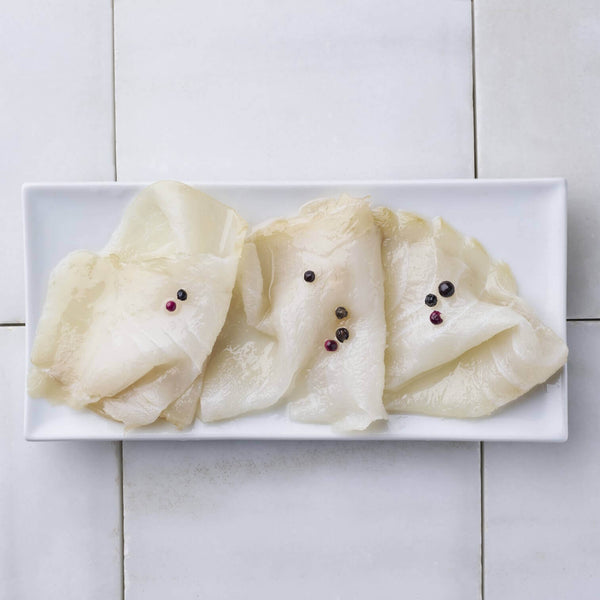
Smoked Cod Carpaccio Artisanal Cut | 1 Tub Pack
15,90 €

Dried Cod Kokotxas (1 tub) - 500g
19,95 €
24-48h refrigerated shipping to all of mainland Spain
Common mistakes when making cocochas al pil-pil
Mistake 1: Oil too hot
This is the most frequent mistake. If the oil boils or smokes, the gelatin in the kokotxas will coagulate instead of emulsifying. The pil-pil will be liquid and lack body. Solution: always keep the temperature low, no more than 80°C.
Mistake 2: Not drying the cocochas
If the cocochas are wet, the water interferes with the emulsion and the oil splatters. Drying them thoroughly before adding them is essential.
Mistake 3: Wrong movement
Shaking movement (side to side) doesn't work as well as circular movement. Circular movement creates a current that envelops the kokotxas and emulsifies more efficiently.
Mistake 4: Impatience
Pil-pil is not made in 5 minutes. The emulsification process requires between 15 and 25 minutes of continuous or semi-continuous movement. If you try to rush it by increasing the heat, you will destroy the gelatin.
Mistake 5: Poorly desalted or low-quality cocochas
If the raw material is not good or is poorly desalted, the result will always be disappointing. Pil-pil magnifies both the quality and the flaws of the product.
Variations of the cocochas recipe
Cocochas in green sauce
Green sauce adds parsley, garlic, fish stock, and peas to the base of the cocochas. It is a more elaborate and wetter preparation than pure pil-pil. The key is to add the parsley only at the end of cooking so it doesn't lose its color or aroma.
Additional ingredients for green sauce:- 1 small glass of txakoli or dry white wine
- 200 ml fish stock
- Generous bunch of fresh parsley
- 1 handful of peas (can be frozen)
Cocochas with clams
The combination of cod kokotxas with clams is one of the most popular preparations in Basque restaurants. The clams provide their own gelatin and a more marine flavor that perfectly complements the cod.
Add the clams in the last 5 minutes of cooking, covered, until they open. The liquid they release integrates into the sauce, enriching it.
Cocochas a la Bilbaína
A more elaborate version with choricero pepper (ñora or dried Basque pepper). The pepper adds a sweet and slightly smoky flavor. A preliminary sofrito is prepared with garlic, onion, and rehydrated choricero pepper, and the cocochas are then incorporated into this sofrito.
Serving and pairing tips
Serving temperature: Cocochas al pil-pil should be served very hot, freshly made. Pil-pil sauce loses texture when it cools and doesn't recover as well when reheated.
Bread: Country bread or crusty bread. Pil-pil sauce is, in part, for dipping. It's almost mandatory.
Wine: The classic pairing is txakoli (a light, slightly sparkling Basque white wine). An Albariño from Rías Baixas or a Manzanilla from Sanlúcar also works very well. Avoid red wines: the tannins clash with the gelatin and make the sauce bitter.
Garnish: Simple boiled potatoes or bread are enough. Don't overload the dish: cocochas al pil-pil doesn't need competition.
Frequently asked questions about cocochas al pil-pil
Why doesn't my pil-pil emulsify and remain liquid?
The most common causes are: oil too hot (destroys the gelatin), very wet cocochas (water interferes with the emulsion), or lack of continuous circular motion. Check the temperature first: it should be very low, between 60 and 80°C. If the oil has boiled, that batch of pil-pil is beyond saving.
Can I make pil-pil with hake kokotxas?
Yes, although the resulting sauce has less body than with cod kokotxas. Hake has less collagen, so the emulsion is lighter. The result is good but different: less unctuous and with a milder flavor.
Can I make pil-pil with cod loin instead of kokotxas?
Technically yes, cod in general has some collagen, but the loin has much less than the kokotxa. The resulting sauce will be lighter and less thick. Kokotxas are the cut that makes the best pil-pil because they have the highest concentration of natural collagen.
How long do cocochas al pil-pil last in the fridge?
Cocochas al pil-pil last 1-2 days in the fridge, but the sauce loses texture. When reheating, do so over very low heat with gentle movement: the emulsion can be partially recovered, but it won't be the same as freshly made.
Can pil-pil be made in a Thermomix or similar?
Yes, some people do. The machine agitates at a controlled speed and temperature that can emulsify the sauce. The result is technically correct but lacks the satisfaction of the traditional method. For a first time or to ensure the result, it can be an option.
Can the used oil be reused later?
The oil in which the cocochas have been cooked has a lot of cod flavor and gelatin. It can be used to flavor other cod dishes (such as boiled potatoes or a vegetable stir-fry with cod), but not for other neutral uses. Store it in the fridge if you don't use it right away.
What do I do if I have leftover pil-pil?
Leftovers are perfect for a pintxo: place the cocochas with their sauce on a slice of toasted country bread, sprinkle with parsley, and serve. Cold pil-pil also works mixed with pasta or as a sauce for fish rice dishes.
How much olive oil is exactly needed?
Generosity with oil is part of the recipe. With 600-700 g of cocochas, between 180 and 220 ml of extra virgin olive oil is typical. If you use less oil, the sauce will be too dense; if you use too much, it will be too liquid. The approximate ratio is 30 ml of oil per 100 g of cocochas.
Can I make cocochas al pil-pil without an earthenware pot?
Yes. A heavy-bottomed pot (stainless steel or cast iron) works well. The earthenware pot is preferred because it distributes heat more gently and retains it better, making it easier to maintain a constant low temperature. In a thin metal pot, temperature control is more difficult.
How many cocochas per person?
As a main course, between 150 and 200 grams of desalted cocochas per person. If they are the only dish, aim for 200 grams. As a second course in a larger menu, 120-150 grams is sufficient.
What other dish can I combine with cocochas al pil-pil?
As a starter, a tomato salad with anchovies or a garlic soup. As a side dish, simple boiled potatoes are the most traditional. Avoid strong-flavored garnishes that compete with the subtlety of the pil-pil.
Is it better to use fresh or preserved garlic?
Always fresh. Preserved garlic has a flatter flavor and sometimes adds acidity that doesn't help. Fresh garlic in thin slices, cooked slowly in oil, gives the best result.
Is chili pepper mandatory?
No. The most classic and widespread version of pil-pil does not include chili pepper. It is an addition for those who enjoy a light spice. If you are cooking for people who do not tolerate spice, omit it without problem: the recipe is still perfect.
The history of pil-pil: from utilization to haute cuisine
Pil-pil was not born in a Michelin-starred restaurant. It was born in the kitchens of Basque fishermen and in the gastronomic societies of the Basque Country, those places where men gathered to cook and eat in an atmosphere of collaboration and experimentation.
The technique of emulsifying oil with the gelatin from cod was, originally, a way to make the most of an abundant ingredient that required preparation: salted cod that arrived from fishing campaigns in the North Atlantic.
Over time, from the simplicity of the technique emerged a recipe that today appears in the best Basque restaurants and has crossed borders to become one of the emblems of Spanish cuisine internationally. Great Basque chefs such as Juan Mari Arzak or Martín Berasategui have reinterpreted pil-pil in haute cuisine contexts, but the homemade version, made in an earthenware pot with patience and generous oil, remains unsurpassed.
At Bacalalo, we have seen many cocochas seasons come and go. If you have questions about the product or technique, our team at Mercat del Ninot in Barcelona is available to advise you.
Want to know more about cocochas? Read our complete guide on what cod cocochas are.