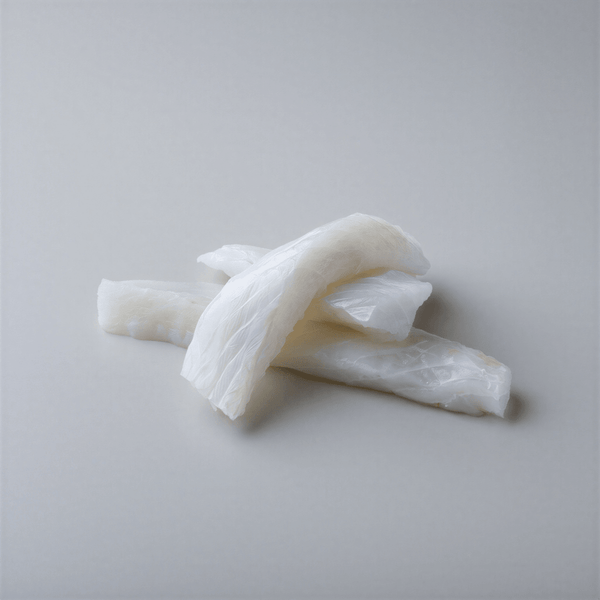
Summary: When you buy a dried cod loin from a bacallaneria, you are holding the result of a journey of over 3,000 kilometers and a process that takes weeks. From the icy waters of the North Atlantic to your kitchen, every stage matters. This is the complete journey.
When you buy a dried cod loin from a bacallaneria, you are holding the result of a journey of over 3,000 kilometers and a process that takes weeks. From the icy waters of the North Atlantic to your kitchen, every stage matters. This is the complete journey.
Stage 1: The Sea — Fishing in Icelandic Waters
Why Iceland
Iceland is the most valued origin for salted cod consumed in Spain. And it's no coincidence:
- Cold waters (2-8°C): Gadus Morhua cod grows slower in cold waters, developing firmer fibers and a higher natural gelatin content
- Nutrient-rich currents: the confluence of warm Gulf currents and cold Arctic currents creates an exceptionally productive marine ecosystem
- Pure species: the Gadus Morhua from the North Atlantic is genetically distinct from the Gadus macrocephalus from the Pacific. More flavor, better texture, more versatility in cooking
Fact: Spain absorbs 80% of Iceland's salted cod production. We are, by far, their biggest customer.
How it's Fished: Hook by Hook
Quality Icelandic cod is fished with longline: long strips of thick cord from which, every half meter, a baited hook hangs. It's selective fishing, piece by piece.
Why does the method matter?
- No stress to the fish: cod caught with a hook suffers less damage than trawled cod, which translates to better meat texture
- No bycatch: the target species is caught, not everything that passes through the net
- Size selection: hooks are calibrated to catch adult cod, respecting juveniles
The Icelandic Quota System
Iceland has one of the most advanced fisheries management systems in the world. It works like this:
- Scientists from the Marine Research Institute assess the stock each year
- The government sets the maximum catch quota based on scientific data
- Fishermen have individual transferable quotas
- Discard prohibited: everything caught is used
- Restricted areas: areas are closed when excesses of juveniles are detected
This system has been working for decades and has allowed the Icelandic cod population to remain stable, unlike what happened with the Grand Banks (collapsed in the 90s).
Stage 2: The Ship — Immediate Gutting
As soon as the cod is brought on board, the clock starts ticking. Freshness determines the final quality of the salted product.
If you are interested in trying other cuts, you can find whole cod catalog in our online catalog: loins, supremes, flakes, belly, cheeks, smoked, and brandade.
- Gutting on deck: entrails are removed immediately after capture
- Washing with seawater: complete cleaning of the abdominal cavity
- Ice on board: gutted cod is kept on ice until it reaches port
- Maximum time: Icelandic longline vessels go on short trips (3-7 days), ensuring that the fish arrives fresh for processing
Stage 3: The Plant — Salting and Curing
Once on land, the cod enters the phase that defines its character: salting.
The Traditional Process
- Classification: separated by size and quality. Thick loins, flanks, cheeks — each piece has a destination
- Opening and cutting: the cod is butterflied (or divided into specific cuts depending on the destination market)
- Salting: sea salt is applied in layers, alternating fish and salt. The ratio and time depend on the size of the piece
- Pressing: piles of cod are pressed to extract moisture and promote salt penetration
- Maturation: the complete salting process takes approximately one month
What the Spanish Market Prefers
Spain has specific preferences within the salted cod market:
- Loins and flanks: the most demanded cuts for dishes like bacalao al pil-pil or a la llauna
- Moderate saltiness: Spanish consumers prefer cod that does not require excessive desalting. Modern controlled brine techniques allow for a more homogeneous product
- Whole piece available: traditional bacallanerias still buy whole pieces to cut according to the customer's needs
Related Products from Bacalalo


Stage 4: Transportation — 3,000 km in Cold Storage
From the Icelandic processor to the wholesaler or bacallaneria in Spain, cod travels in refrigerated containers:
- Sea route: Reykjavik/Icelandic ports → Spanish ports (Valencia, Barcelona, Bilbao)
- Controlled temperature: between 0°C and 4°C throughout the journey
- Transit time: 5-8 days by sea
- Documentation: health certificates, batch traceability, origin certification
Historical suppliers maintain relationships of over 30 years with Icelandic processors. This is not a minor detail: trust and mutual knowledge ensure that each shipment maintains the standard.
Stage 5: The Bacallaneria — Selection, Desalting, and Cutting
This is where the raw product becomes what reaches your kitchen. And it's where the difference between a specialist and a generic intermediary becomes evident.
What a Real Bacallaneria Does
- Selection upon receipt: each piece is checked. Color, firmness, smell, salt thickness. Pieces that do not meet the standard are rejected
- Controlled desalting: the cod is submerged in cold water with regular changes for 24-48 hours (depending on thickness). The goal is to reach the exact salt point for each use: not too much salt for a main course, a little more for a stew that uses broth
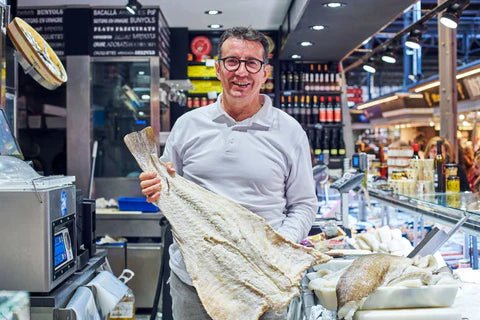
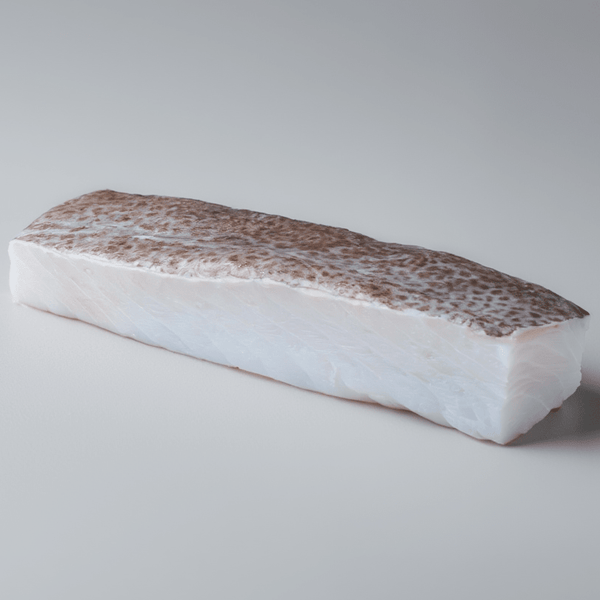
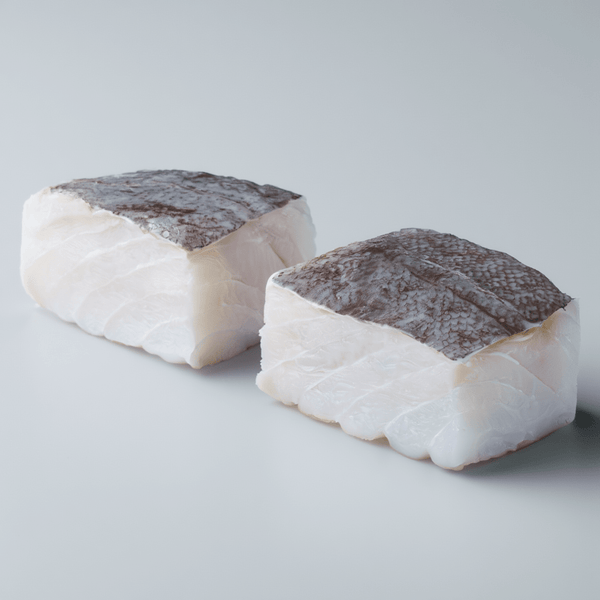
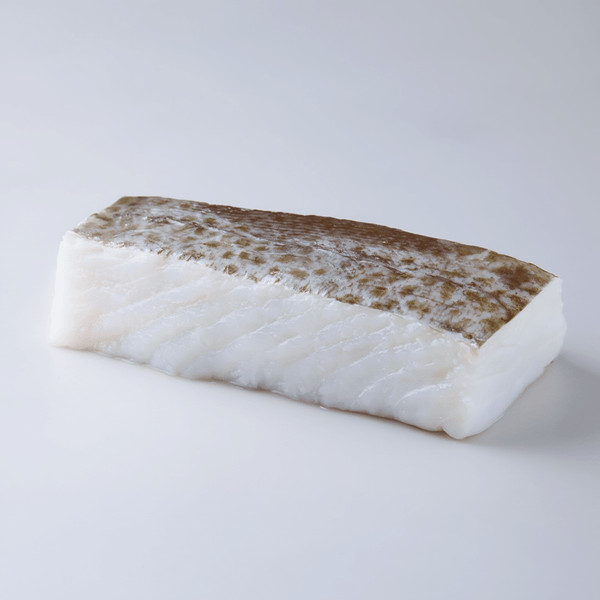
- Custom cutting: loins, flanks, cheeks, snouts, tails, flakes — each cut has its application. In a bacallaneria, the cut is made on the spot according to what the customer requests
- Preparation of elaborations: fritters, esqueixada, brandade — dishes that require knowledge of the product and the traditional recipe
At Bacalalo, in the Mercat del Ninot in Barcelona, we have been doing this process every day since 1990. We select Gadus Morhua by season and size, control the salt level piece by piece, and hand-cut according to each customer's needs.
Stage 6: Your Kitchen — The Last Step
When the cod arrives at your home, it has already been on a journey of weeks and thousands of kilometers. What you do in the last 30 minutes matters more than you think:
If you buy dried (salted) cod
- Desalt in cold water for 24-48 hours, changing the water every 8 hours
- Keep in the refrigerator during desalting (never at room temperature)
- Taste for saltiness before cooking — if you need more detail, we have a complete desalting guide
If you buy desalted cod (ready to cook)
- Consume within 2-3 days maximum (refrigerated)
- Do not refreeze: the texture deteriorates
- Dry well with paper towels before cooking to achieve perfect browning
The Fact That Summarizes the Entire Journey
From the moment a Gadus Morhua cod bites the hook in Icelandic waters until it reaches a bacallaneria like ours in Barcelona, between 5 and 8 weeks pass. Every day of that process — the salt, the temperature, the humidity, the transport — affects the final product.
That's why buying cod from just anywhere is not the same. A well-selected, well-salted, well-transported, and well-desalted dried cod from Iceland is a product with a depth of flavor that no other fish offers. It is the result of centuries of fishing tradition, a privileged marine ecosystem, and a trade — that of the bacallaner — that combines technical knowledge with artisanal instinct.
🛒 Products mentioned in this article
⭐ 4.9/5 · 24-48h refrigerated shipping · Since 1990 at Mercat del Ninot
Conclusions
- Stage 1: The Sea — Fishing in Icelandic Waters: Iceland is the most valued origin for salted cod consumed in Spain.
- Stage 2: The Ship — Immediate Gutting: As soon as the cod is brought on board, the clock starts ticking.
- Stage 3: The Plant — Salting and Curing: Spain has specific preferences within the cod market.
- Stage 4: Transportation — 3,000 km in Cold Storage: Historical suppliers maintain relationships of over 30 years with Icelandic processors.
- Stage 5: The Bacallaneria — Selection, Desalting, and Cutting: At Bacalalo, in the Mercat del Ninot in Barcelona, we have been doing this process every day since 1990.
- The Fact That Summarizes the Entire Journey: That's why buying cod from just anywhere is not the same.
Frequently Asked Questions
Where does the cod sold in Spain come from?
85% is imported, mainly from Iceland, Norway, and the Faroe Islands. Spain is the largest global buyer of Icelandic salted cod, absorbing 80% of its production.
How is cod fished in Iceland?
With longlines: individual hooks with bait, piece by piece. It is a selective method that guarantees fish quality and minimizes environmental impact. Discarding is not allowed.
How long does the cod salting process take?
Approximately one month. The cod is salted in layers, pressed, and allowed to mature until it reaches the optimal curing point. The exact time depends on the thickness of the piece.
What is the difference between bacallaneria cod and supermarket cod?
In a bacallaneria, the cod is Gadus Morhua selected at the source, hand-cut, and desalted with controlled salt levels. In supermarkets, Gadus macrocephalus (Pacific) is often sold pre-packaged, with less control over the process and freshness. The texture and flavor are notably different.
Is Icelandic cod sustainable?
Yes. Iceland has one of the most rigorous fisheries management systems in the world: individual quotas based on science, discard prohibition, rotating closed areas, and continuous stock monitoring. The Icelandic cod population has remained stable for decades.
How much does Icelandic cod cost?
Dried Icelandic cod (Gadus Morhua) ranges between €25 and €45/kg depending on the cut. It is more expensive than Pacific cod (€8-15/kg), but the gastronomic quality is incomparable. Check the updated prices here.
Article prepared by Bacalalo, a bacallaneria in the Mercat del Ninot (Barcelona) since 1990. More than 30 years selecting Gadus Morhua cod from Iceland for individuals and professionals.
Where is the best cod in the world?
According to Berglund, the best cod in the world is the skrei that lives in the northern Barents Sea, almost closer to the North Pole than the northernmost tip of continental Europe, and which we will discuss later.
What is Gadus morhua?
Gadus morhua is a fish with a wide presence. It is found off the coast of North America, the south coast of Greenland, Ireland, and coastal areas of Europe, especially in the North Sea, the Norwegian Sea, and the Barents Sea. It is the most heavily fished fish in Northern Europe.
Is Icelandic cod good?
#DidYouKnow that authentic Gadus morhua, Icelandic Cod, is healthy... and delicious too? It provides calcium, potassium, and phosphorus, making it good for osteoporosis, the heart, and the brain. Thanks to feeding on plankton, cod provides many vitamins.
→ See our selection of desalted Icelandic cod
Discover more