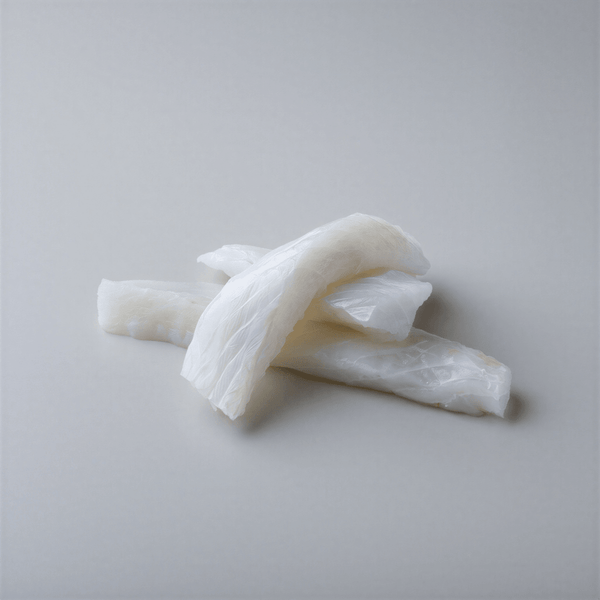
Summary: The word "bacalada" sounds ancient, almost from another time. And to some extent, it is: it refers to a preservation technique that has more than five centuries of history and fed all of Europe in times when there was no cold chain. But bacalada is not just history. Today, it remains the most common way to consume cod in Spain, and the one that brings the greatest complexity of flavor to cooking.
At Bacalalo, since 1990 in Barcelona's Mercat del Ninot, we work with salted cod daily. This guide explains exactly what it is, how it differs from fresh cod, and what varieties exist.
Table of Contents
- What is salted cod (bacalada)
- Differences between salted cod and fresh cod
- Types of salted cod by cut
- Salted cod in Catalonia: "bacallà salat"
- Salted cod in the Basque Country: Basque cured cod
- How to prepare salted cod: desalting
- 10 Frequently Asked Questions about Salted Cod
- Discover salted cod at Bacalalo
What is salted cod (bacalada)
Definition
"Bacalada" is cod (Gadus morhua) cured by dry salting: the fish, whole or in pieces, is abundantly covered with coarse salt and left to mature for weeks or months. The salt extracts moisture from the muscle, inhibits bacterial growth, and triggers enzymatic changes that profoundly transform the fish's texture and flavor.
The result is a long-lasting preserved product—under proper conditions, it can last months or years—with an organoleptic profile radically different from fresh cod: more concentrated, more intense, with a depth of flavor that only slow curing can generate.
"Bacalada" = "bacallà" in Catalan
In Catalonia, the term "bacallà" (pronounced "bah-cah-YAH") refers to both salted cod and cod in general. When "bacallà" is mentioned in a Catalan restaurant or market, it is almost always understood to mean "bacallà salat" —salted cod—, not fresh. Fresh cod is specified as "bacallà fresc."
This linguistic distinction reflects culinary reality: in Catalonia, the gastronomic tradition of cod was built on salting, not on the fresh product. The great Catalan recipes —l'esqueixada, bacallà amb mongetes, brandada, bacallà a la llauna— are made with desalted cod, not fresh cod.
History: preservation since the 15th century
Salted cod has its roots in the 15th-century Basque and Portuguese fishing campaigns, when both maritime traditions discovered the great cod banks of the North Atlantic —in the Grand Banks of Newfoundland, in Iceland, on the Norwegian coasts— and developed the technique of onboard salting to be able to transport the fish back to Europe in good condition.
The process was simple in concept but demanding in execution: open the fish butterfly-style, remove the head (in some methods), salt generously, and stack. During weeks of travel, the salt did its work. Upon arrival in port, salted cod could be stored for months and distributed inland, reaching areas far from the sea that otherwise would never have had access to fish.
This capacity for preservation and distribution made cod a fundamental food during Lent and days of meat abstinence for centuries of European history. This is why it is so deeply rooted in the cuisines of Mediterranean countries —Spain, Portugal, Italy, Greece— which are far from the original fishing grounds.
Differences between salted cod and fresh cod
The differences between the two products are profound and affect all aspects of consumption:
| Characteristic | Salted Cod (Bacalada) | Fresh Cod |
|---|---|---|
| Flavor | Intense, concentrated, complex | Mild, delicate, marine |
| Texture | Firmer, in well-defined flakes after desalting | Tenderer, easily crumbles |
| Preparation | Requires desalting (12-48h) | Ready to cook |
| Preservation | Months or years in salt | 1-2 days in the fridge |
| Price | Generally higher per net kg | More variable, depends on season |
| Use in cooking | Stew, pil-pil, Vizcaína style, brandade, esqueixada | Grilled, baked, battered, raw |
| Availability | Year-round | Seasonal (mainly autumn-winter) |
Why salted cod has a more concentrated flavor
The salting process is not limited to dehydrating the fish. Salt activates proteolytic enzymes inherent in the cod muscle that break down proteins into simpler peptides and amino acids. This process —called enzymatic proteolysis or autolysis— is the same mechanism responsible for flavor development in curing hams, cheeses, and sausages.
The result is a concentration of flavor compounds —glutamates, inosinates— that does not exist in fresh fish. This is why bacalada has that full, deep, and persistent flavor that fresh cod, however fresh, cannot match.
When to use salted cod vs. fresh cod
- Use bacalada when: the recipe requires intense flavor (pil-pil, Vizcaína, brandade, esqueixada, bacallà amb mongetes); when you want a product available all year round; when the flaked texture is important.
- Use fresh cod when: you are looking for delicacy and subtlety; the preparation is quick (grilled, steamed); you want a marine flavor without the intensity of salting; you are cooking in season and the price is competitive.
Types of salted cod by cut
Salted cod is not a uniform piece. There are several formats depending on the cut applied before or after salting:
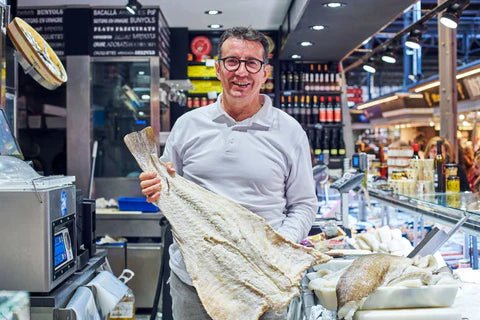
Whole salted cod (with or without head)
The most traditional form: cod opened butterfly-style, with the central bone, salt-cured. It can be presented with the head —for a more complete and traditional product sale— or without it.
Whole salted cod is the reference format for traditional markets like Mercat del Ninot: it allows you to see the size and quality of the entire piece, and the fishmonger can cut exactly the portion you need.
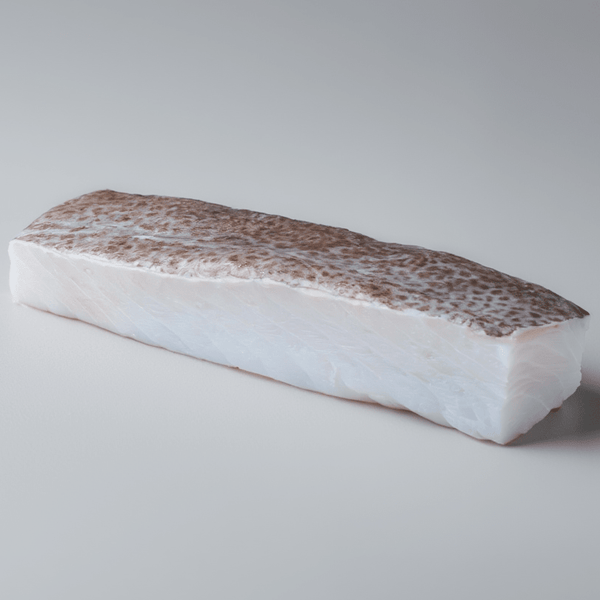
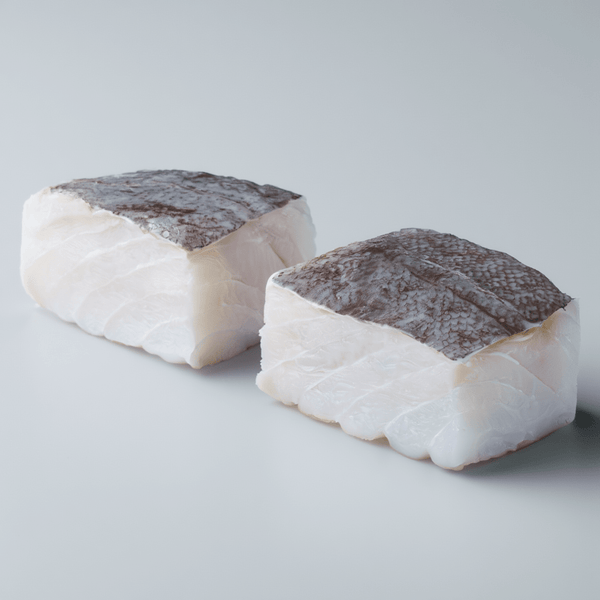
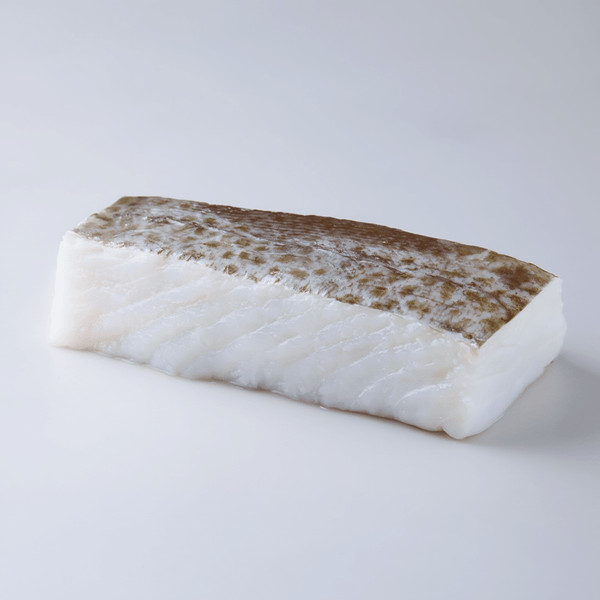
Salted loins (boneless)
Pieces of dorsal loin, already deboned, salt-cured. This is the most convenient format for home use because it eliminates the work of deboning and allows for more controlled desalting as the pieces are of uniform size.
Salted loin is the best-selling cut in the gourmet and online segment, where ease of use is as important as quality.
Flaked salted cod
Flaked salted cod is the most economical part of the production process: these are the pieces and flakes that result from cutting larger pieces, salted and packaged. Ideal for brandade, croquettes, empanadas, or any preparation where cod will be integrated into a mixture and the shape of the piece is not relevant.
Its price is significantly lower than loin, with practically the same flavor quality once desalted.
Differences in price and use
| Format | Relative Price | Best Use |
|---|---|---|
| Whole Salted Cod | Medium (per gross kg) | Market, large family recipes |
| Salted Loins | High | Pil-pil, grilled, baked, gifts |
| Flaked Salted Cod | Low | Brandade, croquettes, empanadas |
Related Products from Bacalalo


Recommended Products

Natural Cod Liver Foie Gras - 120g | Smoked I...
€3.90

CHATKA Wild King Crab 60% Legs 40% Flaked | La...
€95.00

Artisan Cut Smoked Cod Carpaccio | 1 Tray Pack
€15.90

Dried Cod Cheeks (1 tray) - 500g
€19.95
Refrigerated shipping 24-48h throughout the Iberian Peninsula
Salted cod in Catalonia: "bacallà salat"
Catalan culinary tradition
Salted cod holds a place in Catalan cuisine comparable to that of pork in Castilian cuisine or lamb in Aragonese cuisine: it is a structural ingredient, not an occasional one. It is present in everyday recipes and the most important celebrations.
The great Catalan cod recipes all use desalted cod:
- L'esqueixada de bacallà: Cold salad of desalted and raw flaked cod (uncooked), with tomato, onion, black olives, and peppers. It is the quintessential summer dish in Catalonia.
- Bacallà amb mongetes: Cod with white beans, a classic of popular Catalan cuisine that combines protein from the sea with that from legumes.
- La brandada de bacallà: Creamy emulsion of cod with olive oil and garlic, served hot as an appetizer or first course. In Catalonia, the version with potato is especially popular.
- Bacallà a la llauna: Floured cod cooked in a tin pan with garlic, paprika, and oil. One of the simplest and most flavorful recipes in Catalan cuisine.
The importance of salted cod in Catalan gastronomy
The deep roots of cod in Catalonia have historical origins: medieval Catalonia had an active fishing and commercial fleet in the Mediterranean, and salted cod was one of the most valued products for its preservation and versatility. Catalan merchants have imported salted cod from Nordic countries for centuries.
Mercat del Ninot as the epicenter of cod in Barcelona
Mercat del Ninot, in Barcelona's Eixample district, is one of the municipal markets with the longest tradition in cod sales in the city. At Bacalalo, we have been working in this market since 1990, offering personally selected salted cod from Iceland and the Cantabrian Sea.
The traditional market remains the best place to buy salted cod: you can see the piece, ask about its origin, request the exact cut, and get advice on desalting. It is a shopping experience that no online platform can fully replicate, although at bacalalo.com we strive to bring it closer.
Salted cod in the Basque Country: Basque cured cod
The Basque tradition of salted cod is parallel to the Catalan one but has its own peculiarities. Basque fishermen were among the first to reach the great banks of Newfoundland and Terranova in the 15th century, and they developed their own salting techniques on board fishing vessels.
Basque cod cuisine is perhaps the most technical and elaborate in Spain: cod al pil-pil, cod a la Vizcaína, and cod Club Ranero are preparations that require a deep understanding of the texture and behavior of desalted cod. Basque cod is mainly prepared in large loin pieces, with skin, to take advantage of the surface collagen necessary to bind sauces.
While the Catalan tradition tends towards esqueixada (raw) and more Mediterranean recipes, the Basque tradition is oriented towards long cooking, emulsified sauces, and highly demanding techniques. Both are complementary and reflect the richness of Spanish gastronomic culture around this fish.
How to prepare salted cod: desalting
Desalting is the essential preliminary process for cooking salted cod. It involves removing excess salt by submerging the pieces in cold water and changing the water periodically.
Basic desalting steps:
- Cut the salted cod into pieces of the size you are going to use (if it doesn't already come cut)
- Place the pieces in a large container with the skin facing up (salt falls by gravity)
- Cover with plenty of cold water and put in the fridge
- Change the water approximately every 8 hours
- Total time depends on thickness: thin pieces (flaked) 12-18h; medium loins 24-36h; thick loins 36-48h
The correct salt point is personal: some prefer salted cod with a bit more salt, others desalt it completely. To check, taste a small piece before cooking.
For more information and tips on how to desalt cod at home, check out our complete guide at bacalalo.com.
🛒 Products mentioned in this article
⭐ 4.9/5 · 24-48h refrigerated delivery · Since 1990 at Mercat del Ninot
10 Frequently Asked Questions about Salt Cod
1. Are "bacalada" and "bacalao" the same thing?
"Bacalao" is the fish (Gadus morhua). "Bacalada" is cod cured in salt. Colloquially in many areas of Spain, they are used as synonyms, but technically they are different products: one is fresh and the other is cured.
2. Does salt cod have more calories than fresh cod?
Not necessarily. Salt cod has much less water (the salt has extracted it), so it has more protein and minerals per gram of dry product. But when desalted, it rehydrates, and the caloric content per cooked serving is comparable to that of fresh cod. What is higher is the sodium content, which must be taken into account.
3. Why was my salt cod too salty after desalinating it?
It probably needed more desalting time or the water changes were not sufficient. Remember: cold water (not hot tap water), always in the fridge, and change the water at least 3 times in 36 hours. If you have purchased a very thick piece, it may need 48 hours.
4. Can salt cod be eaten uncooked?
Yes. Catalan "esqueixada" is the best-known example: desalted cod, shredded raw, without any cooking. There is also "bacallà en remull" which is consumed directly after desalting in some traditional recipes.
5. How long does unopened salt cod last?
Properly cured salt cod stored in a cool, dry place can last for months. Vacuum-packed pieces have an expiration date indicated by the producer. Once opened or desalted, consume within 2-3 days.
6. What is the difference between Norwegian and Icelandic salt cod?
Both are Gadus morhua, the same cod. The differences are subtle: Norwegian is reputed to be slightly saltier and firmer; Icelandic is usually milder and has a somewhat more delicate texture. At Bacalalo, we work with both origins depending on availability and harvest quality.
7. Is salt cod the same as dried cod (klippfisk)?
Norwegian klippfisk is cod cured in salt and also air-dried, resulting in an even more dehydrated and concentrated product. Traditional Spanish salt cod generally has less drying than Nordic klippfisk, although different levels of moisture can be found on the market.
8. Where can I buy quality salt cod in Barcelona?
At Mercat del Ninot or in our online store bacalalo.com, with refrigerated shipping throughout Spain. Since 1990, we personally select each piece.
9. Can desalted cod be frozen?
Yes. Once desalted, you can freeze the pieces, well wrapped in film and in an airtight container, for up to 3 months. Always defrost in the refrigerator, never at room temperature.
10. Is "bacalada" the same product as English "salt cod" or Portuguese "bacalhau"?
Yes, it's the same product with different names: salt cod (English), bacalhau (Portuguese), baccalà (Italian), morue (French). All are cod (Gadus morhua) cured in salt. The differences between countries are in the process (curing time, drying level) and culinary use, not in the basic product.
Discover salt cod at Bacalalo
At Bacalalo, we have been working with salt cod since 1990 at Mercat del Ninot, just as it has always been done: with personal selection of suppliers, attention to origin, and direct customer advice. If you have any doubts about which type of salt cod best suits your recipe, you can ask us at the market or through bacalalo.com.
We also recommend our guide on cod cuts and the falsilla if you want to delve deeper into specific cod pieces and their culinary uses.
Salt cod is the beginning of everything. Start with the best.
Discover more