

Summary: If you've ever looked at the side of an anchovy can and seen "000", "00", or a single "0" and wondered what exactly it means, you're not alone. This classification appears on many gourmet products on the market and creates more confusion than clarity. The reason is simple but surprising: the zero-based classification of anchovies is not officially regulated by any European or national body. It is an industry standard, a convention among producers that each company interprets in its own way.
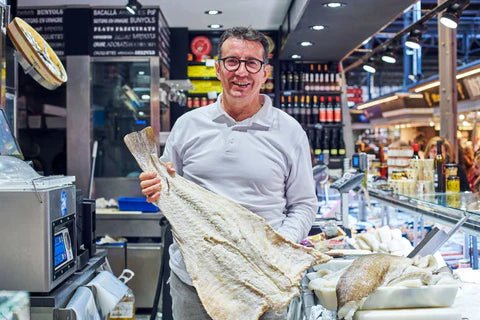
That doesn't mean it's irrelevant. Knowing how to read that label—along with other key indicators—can make the difference between an extraordinary quality anchovy and one that is merely good. At Bacalalo, since 1990 in the Mercat del Ninot, we have spent decades personally selecting anchovies with trusted suppliers. Here, we share everything we've learned.
Contents
The Anchovy Classification System (0, 00, 000)
What Each Category Means
The zero-based classification primarily refers to the calibre or size of the anchovy before processing:
- 0 (one zero): Standard size anchovies, generally between 12 and 15 cm in length. These are good anchovies, suitable for everyday use.
- 00 (two zeros): Medium-large anchovies, approximately between 15 and 18 cm. More flesh, more pronounced flavor.
- 000 (triple zero): The largest anchovies, exceeding 18-20 cm. Higher muscle-to-bone ratio, firmer flesh, and more intense flavor.
Size matters because the larger the anchovy, the larger the resulting anchovy fillet after cleaning, and generally the higher the quality of the curing process. A large anchovy has had more time to develop in the sea, which translates into a higher concentration of fatty acids and a richer organoleptic profile.
However, size is only part of the equation. The zero-based classification does not in itself guarantee the quality of the final product, because each producer applies their own selection criteria.
Why It's Not Regulated and What the Label Guarantees
Unlike extra virgin olive oil, PDO cheese, or Iberian ham, anchovies do not have a European or Spanish regulation that defines exactly what a "triple zero" is. This means that a manufacturer can put "000" on its label following different criteria than those of the competition.
What is regulated is the mandatory information on the label: species, country of origin of the fish, catch area, net weight, drained weight, allergens, and best-before date. These data are what truly allow for the evaluation of an anchovy's quality, regardless of the zeros that appear on the lid.
What Makes an Anchovy Top Quality (Beyond 000)
Species: Engraulis encrasicolus, the European Anchovy
The European anchovy, scientifically named Engraulis encrasicolus, is the benchmark species for premium anchovies in the Spanish market. It is primarily fished in the Cantabrian Sea, the Mediterranean, and the Adriatic, and its composition of omega-3 fatty acids, texture, and flavor clearly differentiate it from other species of the genus Engraulis caught in Pacific waters.
Peruvian anchovy (Engraulis ringens), for example, is widely used in the fishmeal industry and also in some mid-to-low-range salted products. The organoleptic difference with European anchovy is notable: the flesh is more fibrous, the taste more metallic, and the aroma less delicate.
When buying premium anchovies, check that the species indicated on the label is Engraulis encrasicolus. If the label only states "anchovy" or "boquerón" without specifying the species, it's a sign of less transparency.
Fishing Area: Cantabrian Sea vs. L'Escala, Adriatic, and Pacific
The catch area directly influences the product's characteristics:
- Cantabrian Sea (FAO 27, zones IXa and VIIIc): The cold, nutrient-rich waters of the Bay of Biscay produce anchovies with a higher intramuscular fat content, which results in a tastier, more tender anchovy with more uniform curing. The traditional fishing season is from March to June, when anchovies arrive at the coast rich in fat after winter.
- Adriatic (FAO 37): Adriatic anchovies are generally smaller and have a different flavor profile. They are widely used in the Italian industry and in Mediterranean preparations. They are not inferior, but they are distinct.
- L'Escala (North Sea, FAO 27): Lower volume fishing, mainly used in Northern Europe.
- Pacific / Peruvian anchovy: As mentioned, a different species with lower gastronomic value in the premium segment.
"Cantabrian Anchovy" is the most valued denomination in the Spanish market and in high-end international markets.
Curing Time in Salt: The Secret Few Mention
Curing is the process that transforms a fresh anchovy into an exceptionally high-quality anchovy. The fish is arranged in layers alternating with coarse salt and subjected to a controlled curing process that can last between 8 and 24 months.
- Minimum 8 months: Decent anchovies, with developed flavor but lacking the complexity of longer curing.
- 12 months: The quality standard for high-end anchovies. The protein has been completely transformed through enzymatic autolysis, resulting in a silky texture and pronounced umami.
- 18-24 months or more: Luxury anchovies, with an extraordinarily complex flavor profile. Some artisanal preparations can exceed two years of curing.
Insufficient curing time produces more fibrous anchovies, with a more aggressive and less elegant flavor. The label rarely indicates the exact curing time, so one must trust the producer or ask directly.
Cleaning Process: Manual vs. Industrial
After curing, the anchovies are cleaned to remove the central bone, fins, and skin residues. Here, the difference between artisanal and industrial processing is enormous:
- Manual cleaning: Each anchovy is individually handled by expert hands. The shape of the piece is preserved, less presentable parts are removed, and a uniform filleting with minimal breakage is achieved.
- Industrial cleaning: High-performance machinery. Faster and cheaper, but produces less uniform pieces, with more breakage and greater variability in the final result.
Hand-cleaned anchovies have a more regular appearance, a more consistent texture, and generally a cleaner taste because the process does not generate as much oxidation.
How to Read an Anchovy Label
What the Origin Indicates: Reference Zones
Provenance is the first piece of information to look for on the label. The reference denominations in the Spanish market are:
- Cantabrian / Cantabrian Sea: Anchovies caught in the Bay of Biscay. Reference ports: Santoña, Laredo, Castro Urdiales, Ondarroa, Bermeo, Fuenterrabía (Hondarribia).
- L'Escala (Girona): The quintessential Mediterranean anchovy in Catalonia. Smaller than the Cantabrian but with centuries of artisanal tradition. It has its own Protected Geographical Indication.
- Adriatic: Italian or Croatian origin. A distinct product, valid in its context but different.
- No specific origin: The anchovy comes from any area and has been processed at the indicated location. It is not necessarily bad, but there is less transparency.
What to Look For: Species, Net Weight vs. Drained Weight, Format
- Species: Must indicate Engraulis encrasicolus for European anchovy.
- Net weight vs. drained weight: Net weight includes the oil. Drained weight is the actual anchovy you're paying for. Always compare the price per gram of drained weight.
- Covering oil: Extra virgin olive oil as a preservative is the superior quality standard. Sunflower oil is more neutral and cheaper. Olive oil (without "extra virgin") is in an intermediate position.
- Salt: Well-prepared anchovies require little salt added to the oil because they have already absorbed the necessary amount during curing. Too much salt can mask defects in the process.
The "in extra virgin olive oil" format as a quality indicator
It's not an infallible criterion, but it is a relevant sign: producers who invest in quality raw material usually also pay attention to the detail of the covering oil. Using extra virgin olive oil costs more than sunflower oil, and a manufacturer who has cured their anchovies for 12-18 months is unlikely to cover them with second-rate oil.
Related products from Bacalalo


Recommended Products

Cantabrian Anchovies in Olive Oil - 50g...
€3.95

"Cantabrian Deluxe" Assortment
€67.00

Artisan Cantabrian Anchovy Gilda, Hand-Prepare...
€9.90

Northern White Tuna Belly in Olive Oil - 190 ...
€16.95
Refrigerated shipping 24-48h to the entire Peninsula
Cantabrian Anchovies vs. L'Escala vs. Other Origins
Objective Organoleptic Differences
| Characteristic | Cantabrian | L'Escala | Adriatic |
|---|---|---|---|
| Size | Large (suitable for 000) | Medium | Variable |
| Texture | Meaty, silky | Firm, somewhat drier | Variable |
| Flavor | Pronounced umami, balanced saltiness | Saltier, intense | Variable |
| Fat | High | Medium | Low-medium |
| Price | High | Medium-high | Medium |
Why the Cantabrian Sea has a premium reputation
The Bay of Biscay is one of Europe's richest fishing grounds in terms of nutrients and biodiversity. The cold waters promote the slow growth of anchovies, resulting in a higher intramuscular fat deposit. This fat is what transforms during curing into the compounds that give Cantabrian anchovies their characteristic deep and complex flavor.
Furthermore, the artisanal tradition of preserves in northern Spain—especially in Santoña and the Basque Country—has developed over generations a know-how that is difficult to replicate industrially.
L'Escala as a High-Quality Alternative
L'Escala anchovies, from Alt Empordà in Girona, boast a Protected Geographical Indication recognized by the European Union. Although smaller than Cantabrian anchovies and with a different flavor profile—saltier, more "Mediterranean"—it is a product of proven quality with a history dating back to the 18th century.
At Bacalalo, we work with both traditions because we believe that excellence has no single origin. What matters is the quality of the process, not the flag.
Fair Price for Premium Anchovies
Indicative Price Ranges by Category
The retail price of anchovies varies enormously:
- Entry-level: €3-6 per 50-60g can (standard anchovy, possibly uncertain origin, sunflower oil)
- Mid-range: €6-12 per 50g can (Cantabrian or L'Escala anchovy, olive oil, 8-12 months curing)
- High-end: €12-25 per 50g can (000, Cantabrian, 12-18 months curing, manual cleaning, EVOO)
- Exceptional range: Over €25 per can (very limited productions, aging over 18 months, special formats)
When it's worth paying more
Paying more for quality anchovies makes sense when:
- The anchovy will be the star of the dish (on toast with butter, on a board, on an unseasoned salad)
- You are giving the product as a gift and want to convey quality
- You are seeking gastronomic pleasure itself
If the anchovies are going to be integrated into a sauce, a pizza with many ingredients, or a stew with strong flavors, the difference between a mid-range and a high-end product becomes blurred. Quality must be justified by its use.
15 Frequently Asked Questions about 000 Anchovies
1. Are 000 anchovies always better than 00 or 0?
Not necessarily. Caliber is only one of the quality factors. A 000 anchovy with short maturation, industrial cleaning, and sunflower oil can be inferior to a handmade 00 anchovy with 18 months of curing and EVOO.
2. Is there a real difference between a 00 and a 000 anchovy?
In terms of size, yes: the 000 is larger. In terms of flavor, the difference depends more on the curing process and the raw material than on the caliber itself. In practice, many superior quality anchovies are marketed as 00 or even without numerical classification.
3. Which anchovies should I buy for a cheese or charcuterie board?
For a board where flavors compete, a Cantabrian 00 or 000 anchovy in EVOO with an intense but balanced flavor is best. It can be served directly from the can or drained and placed on kitchen paper a few minutes beforehand.
4. Can anchovies in oil be refrozen?
Anchovies in oil are a preserve and do not require refrigeration before opening. Once opened, they can be stored in the refrigerator covered with oil for 1-2 weeks. Freezing is not recommended: the texture deteriorates upon thawing.
5. What is "mortar oil"?
Mortar oil is the oil left in a can of quality anchovies, imbued with the flavors and aromas of the fish. Instead of discarding it, chefs use it to dress salads, prepare vinaigrettes, add to sauces, or spread on bread. It is an intensely flavored ingredient and minimizes waste for a premium product.
6. Do Cantabrian anchovies have PGI or PDO?
Currently, there is no specific PGI or PDO for "Cantabrian Anchovy" at the European level, although there are sector initiatives to obtain it. L'Escala anchovies do have PGI recognized by the EU.
7. Why are some anchovies very red and others paler?
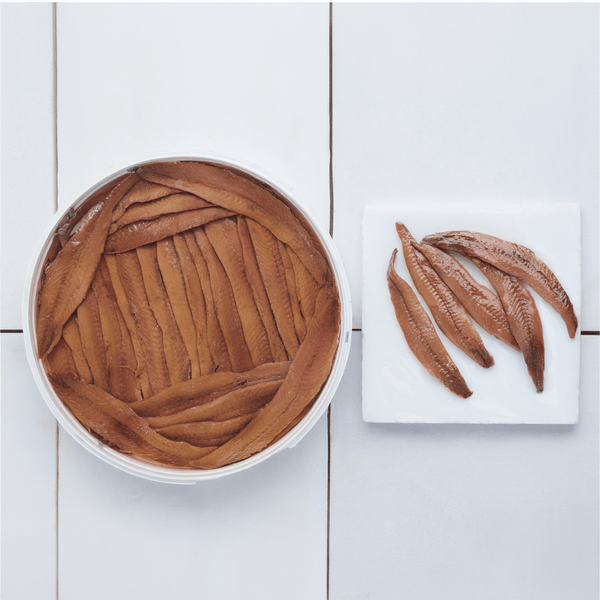
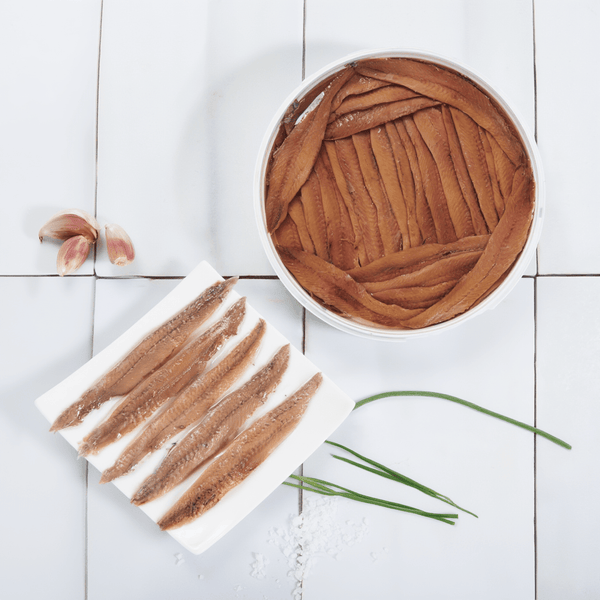
The reddish-mahogany color is typical of well-matured anchovies, where the fish's hemoglobin has transformed during curing. Paler anchovies have had a shorter maturation time or have been processed with less time in salt. The ideal color is a uniform amber-red without grayish spots.
8. What is the difference between an anchovy and a boquerón?
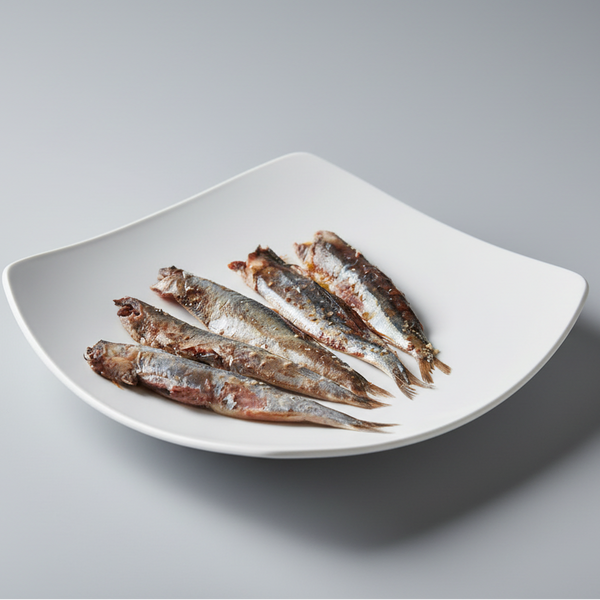
They are the same fish (Engraulis encrasicolus) processed differently. Boquerón is generally consumed in vinegar (marinated anchovies) or fresh fried. Anchovy is the boquerón cured in salt and preserved in oil. The salting and maturation process is what creates the characteristic flavor of the anchovy.
9. Do anchovies have a lot of sodium? Are they suitable for low-sodium diets?
Anchovies have a high sodium content due to the salting process. They are not the most suitable food for very strict low-sodium diets. However, consumed in usual amounts (2-4 fillets per serving), the contribution is manageable in the context of a varied diet.
10. How do you know if an anchovy is bad?
A bad anchovy will have a rancid or very acidic smell (different from the intense but clean smell of a good anchovy), a grayish or greenish color, and a mushy or sticky texture. If the can is bulging or the oil looks cloudy, discard it without hesitation.
11. Is it better to buy anchovies in a can or a glass jar?
Glass allows you to see the product before buying it, which is an advantage. The can better protects against light, which is one of the factors that accelerates fat oxidation. Both formats are valid if the production process is good. Glass is usually associated with gourmet and gift presentations.
12. How long do unopened anchovies last?
It depends on the format and the process. A well-made can of anchovies can last between 3 and 5 years unopened under proper conditions (cool, dry, dark place). Some artisanal producers indicate shorter dates depending on the salt level and process.
13. Are anchovies suitable for pregnant women?
Anchovies are small, short-lived fish, so they accumulate less mercury than large predators. They are not on the list of fish to avoid during pregnancy according to AESAN. However, given their high sodium content, they should be consumed in moderation. Always consult with your doctor for personalized recommendations.
14. Can canned anchovies be used to cook pasta alla puttanesca or pizza?
Yes, and they are perfect for that. In hot sauces, anchovies melt and add umami without being noticeable as individual pieces. For these preparations, a mid-range anchovy is sufficient; it is not necessary to use artisanal 000 anchovies, which are best enjoyed cold.
15. Which wine pairs best with quality anchovies?
Anchovies call for wines with good acidity and some minerality to balance their saltiness: a Galician Albariño, a Basque Txakoli, a Manzanilla or Fino sherry, or a Cava Brut Nature are classic options. Avoid very tannic wines or those with a lot of wood, which clash with the fish's umami.
Where to buy highest quality anchovies
At Bacalalo, since 1990 in the Mercat del Ninot in Barcelona, we personally select our anchovies with suppliers from the Cantabrian Sea and the Mediterranean. Each product reaches you with guaranteed cold chain logistics, maintaining the cold chain from origin to your door.
Our selection of premium anchovies and preserves is available at bacalalo.com. If you have questions about which anchovy best suits your use, you can ask us directly at the Mercat del Ninot or through our website.
The best anchovy is the one you know where it comes from. We help you choose.