![Anisakis en el Pescado: Qué Es, Síntomas y Cómo Evitarlo [2026] - Bacalalo](http://bacalalo.com/cdn/shop/articles/anisakis-en-el-pescado-que-es-sintomas-y-como-evitarlo-2026-4301044.jpg?v=1772706843&width=480)
Summary: Anisakis is a parasite present in many species of wild fish that can cause allergic reactions and severe digestive problems. In this complete guide, we explain exactly what it is, what symptoms it causes, which fish it is found in, how to eliminate it by freezing or cooking, and what Spanish legislation says about it. We also tell you why properly processed salted cod, canned goods, and smoked salmon are safe options.
What is anisakis?
Anisakis (Anisakis simplex) is a nematode or parasitic worm that lives in the digestive tract of numerous species of fish and marine cephalopods. In its larval form, it measures between 2 and 3 centimeters in length, is whitish or slightly translucent, and is usually found coiled in a spiral shape in the abdominal cavity or in the musculature of the fish.
According to data from the Spanish Agency for Food Safety and Nutrition (AESAN), Spain is the second country in the world with the highest incidence of anisakiasis after Japan, mainly due to our tradition of consuming raw or lightly cooked fish: pickled anchovies, sushi, ceviches, cold escabeches, and marinated preparations.
The problem is not just the parasitic infection itself. Even dead anisakis larvae can trigger allergic reactions in sensitized individuals, ranging from a simple rash to anaphylactic shock. Therefore, it is essential to understand this parasite well and know how to prevent it if you habitually consume fish.
Life cycle of the parasite
Understanding how anisakis gets to your plate will help you better understand prevention methods. Its biological cycle goes through several phases:
- Marine mammals (definitive host): Cetaceans such as dolphins and whales harbor adult anisakis in their stomachs. Eggs are expelled into the sea through feces.
- Seawater: The eggs hatch, and the larvae float freely in the ocean.
- Small crustaceans (first intermediate host): Krill and other small crustaceans ingest the larvae.
- Fish and cephalopods (second intermediate host): By feeding on these crustaceans, fish such as hake, fresh cod, sardines, or anchovies incorporate the larvae, which migrate from the digestive tract to the fish's musculature.
- Humans (accidental host): When we consume raw or insufficiently cooked parasitized fish, the larvae try to penetrate the gastric or intestinal mucosa, causing anisakiasis.
An important fact: anisakis only completes its life cycle in marine mammals. In humans, it cannot develop, but it does cause damage by trying to perforate the stomach or intestinal wall.
Symptoms of anisakiasis
Symptoms of anisakis infection usually appear between 1 and 12 hours after ingesting contaminated fish, although in some cases, they can take several days. Anisakiasis manifests in two main forms:
Gastrointestinal anisakiasis
- Intense abdominal pain, often in the stomach area (epigastrium)
- Nausea and vomiting
- Diarrhea or constipation
- Abdominal distension
- In severe cases, it can mimic appendicitis, a perforated ulcer, or even intestinal obstruction
Allergic anisakiasis
- Urticaria (hives on the skin with intense itching)
- Angioedema (swelling of lips, eyelids, hands, or feet)
- Respiratory distress (glottis edema, bronchospasm)
- Anaphylactic shock in the most severe cases
People allergic to anisakis can react even to well-cooked fish if the allergenic proteins of the parasite remain in the fish tissue. These proteins are thermoresistant: they resist both freezing and cooking. If you suspect you may have an anisakis allergy, consult an allergist to undergo the corresponding tests (prick test, specific IgE).
Which fish have anisakis?
Not all fish present the same risk. The prevalence of anisakis varies enormously depending on the species, the fishing area, and whether the fish has been eviscerated (cleaned of entrails) immediately after being caught. The species with the highest incidence are:
- Hake: Up to 80-100% of specimens from the Cantabrian Sea and Atlantic contain anisakis larvae.
- Fresh anchovies: Very high prevalence, especially concerning because they are consumed in vinegar (raw).
- Fresh cod: High percentage of parasitization in North Atlantic specimens.
- Sardine: Moderate-high prevalence, variable depending on the fishing area.
- Wild salmon: Very common in wild-caught specimens.
- Horse mackerel: High incidence, similar to hake.
- Mackerel: High prevalence, especially in the Atlantic.
- Monkfish: Moderate prevalence.
- Bonito and tuna: Low prevalence in the musculature, although it can be found in viscera.
- Cephalopods: Squid and cuttlefish can contain larvae, though less frequently.
The general rule is: any wild marine fish or cephalopod can contain anisakis. If you consume any of these species, always apply the preventive measures explained later.
Which fish do NOT have anisakis?
There are several groups of seafood products that are free of anisakis or whose risk is practically nil:
- Bivalve molluscs: Mussels, clams, oysters, cockles, razor clams, and scallops. Due to their filter-feeding system, they do not ingest anisakis larvae.
- Freshwater fish: River trout, carp, pike. Anisakis is an exclusively marine parasite (note: salmon, although it swims up rivers, feeds in the sea).
- Aquaculture fish: Gilthead bream, sea bass, turbot, trout, and farmed salmon. Controlled feed prevents infection. According to EFSA (European Food Safety Authority), the risk of anisakis in aquaculture is practically non-existent if the fish has been raised with controlled feeding.
- Crustaceans: Lobster, crawfish, shrimp, prawns, Norway lobster, spider crab, and velvet crab. They are not intermediate hosts of the L3 larva that affects humans.
- Semi-preserved and canned goods: Products that have undergone industrial heat treatment (sterilization in an autoclave) are free of viable larvae.
How to kill anisakis
There are two reliable and scientifically proven methods to eliminate anisakis larvae from fish. Both are based on extreme temperatures maintained for a sufficient time:
Freezing
It is the safest method for raw or lightly cooked preparations. European regulations (EC Regulation 853/2004) and Spanish legislation (RD 1420/2006) establish:
- -20 C for at least 24 hours: This is the legal standard in Spain for restaurants and establishments that serve raw fish or preparations where sufficient cooking temperature is not reached.
- -35 C for at least 15 hours: Faster industrial method.
- -20 C for 7 days: AESAN recommendation for domestic freezers (three stars or higher), as they may not reach -20 C uniformly in the center of the piece.
Attention: Freezers with less than three stars (marked with one or two snowflakes) do not guarantee reaching -20 C. If your freezer is of this type, AESAN recommends buying industrially frozen fish.
Cooking
Heat also destroys anisakis larvae, provided that a sufficient temperature is reached in the center of the product:
- 60 C in the center of the piece for at least 1 minute: This is what the legislation establishes. In practice, cooking at 70 C or more for 2 minutes guarantees total destruction.
- Preparations grilled, baked, fried, or boiled that reach this temperature are safe.
- Microwaves can leave uneven cold spots, so homogeneous cooking must be ensured.
Table: freezing vs. cooking
| Method | Temperature | Minimum time | Indicated for |
|---|---|---|---|
| Domestic freezing | -20 C (three stars) | 7 days | Sushi, ceviche, pickled anchovies, marinades |
| Industrial freezing | -20 C (guaranteed) | 24 hours | Restaurants, fishmongers, industrial processing |
| Ultra-freezing | -35 C | 15 hours | Large-scale food industry |
| Cooking (oven, grill, boiled) | +60 C in the center of the piece | 1-2 minutes | Any cooked preparation |
| Intense salting | Very high saline concentration (>9% NaCl) | Weeks of curing | Dried salted cod, mojama |
| Sterilization (canned goods) | +115 C (autoclave) | Depending on can size | Canned goods, semi-preserved goods in glass |
Spanish law on anisakis
Spain has one of the strictest regulations in the world regarding anisakis, precisely because we are one of the most affected countries. The reference legislation is Royal Decree 1420/2006, of December 1, which establishes measures to prevent anisakiasis in fishery products. Its key points are:
- Restaurants, bars, and collective dining rooms: They are obliged to freeze all fish they are going to serve raw or with insufficient treatment to kill the parasite (vinegar, escabeche, marinade, cold smoking, light salting). Freezing must be done at -20 C or below for at least 24 hours.
- Consumer information: Establishments must inform that the fish has been previously frozen and must have a record of the freezing processes.
- Fishmongers: They must display visible signs informing consumers about the need to freeze fish if it is to be consumed raw or undercooked.
- Exemptions: Bivalve molluscs, aquaculture fish fed with feed, and products that have been industrially frozen for a sufficient time and temperature are exempt.
AESAN (Spanish Agency for Food Safety and Nutrition) complements this regulation with periodic recommendations for the final consumer, insisting on domestic freezing for at least 5 days as an additional safety measure against possible inaccuracies of domestic thermometers.
Does salted cod have anisakis?
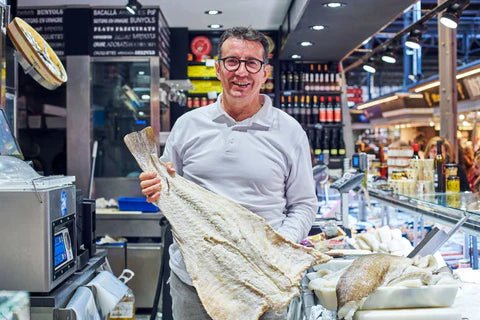
This is one of the most frequent questions from our customers, and the answer is reassuring: traditional dried salted cod does not pose a risk of live anisakis.
The curing process of dried salted cod involves several stages that make the parasite's survival impossible:
- Immediate evisceration: The cod is cleaned of viscera immediately after capture, eliminating the highest concentration of larvae (which are mainly lodged in the abdominal cavity).
- Intense salting: Salt is applied in concentrations much higher than 9% NaCl (usually between 18% and 25%). This saline concentration causes the dehydration and death of anisakis larvae due to osmotic pressure.
- Prolonged drying: The cod is dried for weeks or months under controlled conditions. The drastic reduction of the water activity (aw) of the product prevents the survival of any parasitic form.
- Desalting and cooking: Before consumption, the dried cod is desalted in water for 24-48 hours and then cooked at temperatures well above 60 C.
Scientific studies published in journals such as Food Control and International Journal of Food Microbiology confirm that the combination of intense salting (>6% NaCl) and prolonged dehydration is lethal to L3 larvae of Anisakis simplex. The dried salted cod we sell at Bacalalo comes from Iceland, where it is processed to the highest industry standards, guaranteeing a completely safe product.
You can enjoy our cod and all its nutritional properties with complete peace of mind, from a pil pil cod loin to a traditional cod with chickpeas.
100% safe cod products


Does smoked salmon have anisakis?
It depends on the type of smoking and prior processing. We must distinguish between two very different processes:
Hot-smoked
The salmon is smoked at temperatures exceeding 60-80 C for several hours. This heat treatment is sufficient to destroy any anisakis larvae. The resulting product is completely safe.
Cold-smoked
The salmon is smoked at temperatures below 30 C, which is not enough to eliminate the parasite. However, the industry applies mandatory prior freezing (at -20 C for at least 24 hours) before the smoking process. Additionally, the vast majority of commercial smoked salmon in Europe comes from aquaculture (Norway, Scotland), where the risk of anisakis is practically zero due to controlled feed.
The smoked salmon you will find at Bacalalo complies with all European food safety requirements. Our suppliers, such as Ahumados Domínguez, use Norwegian farmed salmon and apply the pre-freezing protocols required by law. You can enjoy it with complete confidence in preparations such as our gravlax-style marinated salmon or on toasts.
Smoked salmon: safe and delicious


Prevention at home: 7 basic rules
Following these recommendations based on AESAN guidelines and European regulations will allow you to consume fish without risk:
- Always freeze fish that you are going to eat raw or undercooked. Anchovies in vinegar, sashimi, ceviche, tataki, carpaccio or any preparation where the center of the fish does not exceed 60 C. Freeze for at least 5 days in a three-star or higher domestic freezer.
- Buy gutted fish. Always ask for the fish to be cleaned at the fishmonger, removing the entrails as soon as possible. Larvae migrate from the entrails to the muscle after the fish dies.
- Cook thoroughly. Baked, grilled, fried or boiled, make sure the thickest part of the fish reaches at least 60 C. A good indicator is that the flesh separates easily and is opaque to the center.
- Visually inspect the fish. When cleaning large pieces, inspect the abdominal cavity and musculature. Anisakis larvae are visible to the naked eye (2-3 cm, whitish, coiled in a spiral).
- Check your freezer. Make sure your freezer has at least three stars (***) and reaches -20 C. If it only has one or two stars, buy industrially frozen fish.
- Don't rely solely on vinegar, lemon, or light salt. Marinating with acids (vinegar, citrus) does not kill anisakis larvae. Neither does low-concentration salt nor cold smoking alone.
- When in doubt, cook. If you are not sure you have frozen it correctly or for long enough, cook the fish thoroughly. It is the simplest and most effective measure.
If you like to prepare tuna tataki or other recipes where the fish is raw in the center, prior freezing is absolutely essential.
Table: risk level by preparation type
| Preparation | Anisakis risk | Requires prior freezing? |
|---|---|---|
| Sushi / sashimi | HIGH | Yes, mandatory |
| Ceviche / marinated in lemon | HIGH | Yes, mandatory |
| Anchovies in vinegar | HIGH | Yes, mandatory |
| Tataki (seared outside, raw inside) | HIGH | Yes, mandatory |
| Escabeche without prior cooking | MEDIUM-HIGH | Yes, mandatory |
| Cold smoking | MEDIUM | Yes (industry does it) |
| Grill / oven / frying (well-done) | LOW | No, if cooked thoroughly |
| Dried salted cod (cured) | VERY LOW | No |
| Canned goods (sterilized) | NONE | No |
| Bivalve molluscs (mussels, clams) | NONE | No |
Anisakis in canned goods
Canned goods in tins or glass jars are one of the safest options against anisakis. The reason is simple: the industrial sterilization process in an autoclave subjects the product to temperatures above 115 C for a prolonged period, which completely destroys any parasitic life form, including anisakis larvae and their allergenic proteins.
This applies to all types of canned goods:
- Anchovies in olive oil
- Canned sardines
- Canned tuna and bonito
- Marinated mussels
- Natural clams
- Cockles
- Bonito belly
The gourmet canned goods we offer at Bacalalo undergo this rigorous industrial process. Brands such as Dardo, Olasagasti, Baymar, and Bacalalo apply the most demanding standards of the Spanish and Galician canning industry. If you are looking for the safest and most convenient option to enjoy fish, canned goods are a sure bet. Discover more in our guide to Spanish gourmet canned goods.
Safe and delicious canned goods


Myths and truths about anisakis
There is a lot of misinformation about anisakis. Let's debunk the most common myths with scientific data:
MYTH: "Vinegar kills anisakis"
FALSE. The acetic acid in vinegar does not destroy anisakis larvae. Anchovies in vinegar are precisely one of the main causes of anisakiasis in Spain. It is essential to pre-freeze the fish before preparing this traditional tapa.
MYTH: "Lemon and salt eliminate the parasite"
FALSE. Neither lemon juice nor low-concentration salt (like that used in ceviches) destroy the larvae. Salt is only effective in very high concentrations (>9% NaCl) maintained for weeks, as in traditional cod salting.
MYTH: "If the fish is fresh, it doesn't have anisakis"
FALSE. The freshness of the fish has no relation to the presence of anisakis. The parasite infects live fish in the sea. In fact, the fresher the fish, the more active the larvae will be.
MYTH: "Anisakis is only found in cheap fish"
FALSE. Anisakis does not discriminate by price. Expensive species such as Cantabrian hake or wild salmon have very high rates of parasitization.
TRUTH: "Aquaculture fish is safe"
TRUE. The EFSA confirms that fish raised with controlled feed in fish farms have a negligible risk of containing anisakis, provided they have not been fed with raw wild fish.
TRUTH: "Spain is one of the countries with the most cases"
TRUE. Our gastronomic tradition of consuming raw or marinated fish (anchovies in vinegar, marinated salmon, escabeches) places Spain as the second country in the world in incidence, after Japan.
Frequently asked questions about anisakis
Can anisakis be seen with the naked eye?
Yes. Anisakis L3 larvae are between 2 and 3 centimeters long, whitish in color, and are usually found coiled in a spiral. They are perfectly visible if you inspect the abdominal cavity and fish fillets with good lighting.
How long should fish be frozen to kill anisakis?
In a three-star or higher domestic freezer (-20 C), at least 5 days according to AESAN (7 days as an additional safety margin). In industrial freezing guaranteed at -20 C, 24 hours are sufficient. At -35 C, 15 hours are enough.
At what cooking temperature does anisakis die?
Larvae die when the center of the piece reaches 60 C for at least 1 minute. For safety, it is recommended to cook at 70 C or more for 2 minutes. In practice, when fish is well-done (opaque flesh that flakes easily), the anisakis has been destroyed.
Can anisakis cause allergies even if the fish is cooked?
Yes. People allergic to anisakis (sensitized to its proteins) can react even to well-cooked or frozen fish, because certain allergenic proteins of the parasite resist heat and cold. In these cases, an allergist can determine the level of sensitization and recommend whether it is necessary to avoid certain species.
Do shrimp, prawns, and other shellfish have anisakis?
No. Crustaceans (shrimp, prawns, Norway lobster, lobster, crab, velvet crab) are not hosts for the L3 anisakis larva that affects humans. Bivalve molluscs (mussels, clams, oysters, cockles, razor clams) also do not pose a risk, as they are filter feeders.
Is there anisakis in farmed salmon?
The risk is practically non-existent. Farmed salmon (Norway, Scotland, Chile) are fed with controlled feed that does not contain anisakis larvae. EFSA has confirmed this in multiple reports. This is one of the reasons why commercial smoked salmon is considered safe.
Can salted cod have live anisakis?
No. The intensive salting process (>18% salt) combined with prolonged drying for weeks completely eliminates any viable larvae. In addition, dried salted cod is always cooked before consumption, adding an additional layer of safety.
What should I do if I think I've eaten fish with anisakis?
If you experience severe abdominal pain, nausea, vomiting, or an allergic reaction (hives, swelling, difficulty breathing) between 1 and 12 hours after eating raw or undercooked fish, go to the emergency room. Inform the doctor that you have consumed fish. Diagnosis is usually made by endoscopy (where larvae can be removed) or serological tests.
Is it mandatory for restaurants to freeze fish?
Yes, in Spain it is established by Royal Decree 1420/2006. All restaurants and collective catering establishments are obliged to freeze all fish that will be served raw, marinated, pickled, cold smoked, or with any treatment that does not guarantee the death of the parasite, to -20 C for at least 24 hours.
Do canned anchovies have anisakis?
No. Canned anchovies (in cans or glass jars) have undergone a sterilization process at over 115 C that eliminates any parasitic forms. Semi-preserved anchovies in oil (those that are refrigerated) are also safe, as they go through a long salting maturation process that eliminates larvae before filleting.
Can I eat sushi during pregnancy due to anisakis?
Spanish health authorities recommend that pregnant women avoid consuming raw or undercooked fish not only due to the risk of anisakis, but also other pathogens (Listeria, Toxoplasma). If you wish to eat sushi during pregnancy, opt for varieties with well-cooked fish or vegetables, and confirm that the restaurant complies with the prior freezing obligation.
Can a microwave kill anisakis?
Technically yes, if the center of the piece reaches 60 C for at least 1 minute. However, microwaves heat unevenly and can leave cold spots inside the fish where larvae may survive. Therefore, it is not the most recommended method. If you use it, make sure the cooking is homogeneous, stirring and letting the fish rest to equalize the temperature.