


![Salmón Marinado Casero: Receta Nórdica Gravlax Paso a Paso [Fácil] - Bacalalo](http://bacalalo.com/cdn/shop/articles/salmon-marinado-casero-receta-nordica-gravlax-paso-a-paso-facil-8788777.jpg?v=1772706831&width=480)
Summary: Marinated salmon (gravlax) is one of the most elegant and easiest Nordic recipes there is: you only need fresh salmon, salt, sugar, and dill. No cooking, no smoking, no fuss. In this comprehensive guide, you'll find the classic recipe step-by-step, exact curing proportions, curing times based on fillet thickness, 5 creative variations (citrus, whiskey, beetroot, soy-ginger, juniper), how to slice it perfectly, and everything you need to know about preservation and pairing.
Table of Contents
- What is marinated salmon (and how does it differ from smoked and raw)
- Classic Gravlax Recipe Step-by-Step
- Ingredients and Exact Proportions
- Curing Times Based on Fillet Thickness
- Marinated vs. Smoked Salmon: Key Differences
- 5 Creative Variations of Classic Gravlax
- Comparative Table of Variations
- How to Slice Marinated Salmon Perfectly
- Storage and Shelf Life
- Presentation and Pairing
- Marinated Salmon in Nordic Cuisine: History and Tradition
- Common Mistakes When Making Gravlax (and How to Avoid Them)
- Frequently Asked Questions
What is marinated salmon (and how does it differ from smoked and raw)
Marinated salmon, internationally known as gravlax (from Swedish gravad lax, literally "buried salmon"), is a Nordic preparation that involves curing raw salmon with a mixture of salt, sugar, and dill for 24 to 72 hours in the refrigerator. It is neither heat-cooked nor smoked: the salt and sugar transform the fish's texture through osmosis, extracting moisture and creating a firm, silky flesh with a deep, clean flavor.
It's important to distinguish marinated salmon from other preparations that are sometimes confused:
- Marinated salmon (gravlax): cured in salt + sugar + dill. No smoke, no cooking. Firm-silky texture, sweet-salty flavor with herbaceous notes. Eaten raw, in thin slices.
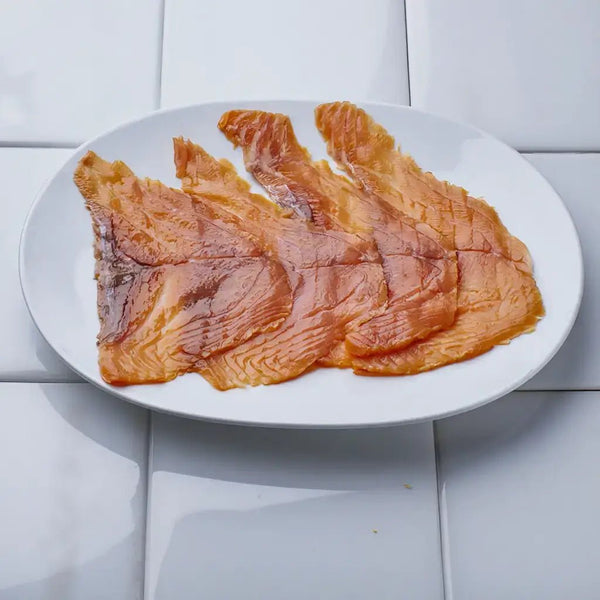
- Smoked salmon: cured in salt and then exposed to wood smoke at low temperature (cold smoked) or high temperature (hot smoked). Has a pronounced smoky flavor. This is what you'll find in our premium smoked salmon collection.
- Raw salmon (sashimi/tartare): uncured or untreated. Served immediately. Soft texture, mild flavor. Requires sashimi-grade fish and pre-freezing.
- Citrus-marinated salmon (ceviche): "cooked" in acid (lemon, lime). Protein is denatured by the acid. Different process and result than gravlax.
Gravlax is probably the simplest and most rewarding way to prepare salmon at home: you don't need special equipment, the result is spectacular, and it tastes just as good (or better) than in a Nordic restaurant.
Classic gravlax recipe step-by-step
This is the classic Scandinavian marinated salmon recipe, as prepared in Norwegian and Swedish homes for centuries. 8 steps, no complications.
- Choose your salmon: buy a fresh, good quality salmon fillet (600g - 1kg), with skin, boneless. The center part of the fillet is ideal because it has a uniform thickness. If you can, choose farmed Norwegian salmon or wild Pacific salmon.
- Pre-freeze (safety): to eliminate parasites (anisakis), freeze the salmon at -20°C for at least 48 hours before marinating. Thaw in the refrigerator the night before.
- Prepare the curing mixture: combine coarse salt + sugar + crushed black pepper + chopped fresh dill (see exact proportions in the next section). Mix well.
- Apply the mixture: place a generous layer at the bottom of a tray. Place the salmon skin-side down. Cover the entire flesh with the remaining mixture, pressing gently to ensure it adheres. The dill should be in direct contact with the flesh.
- Wrap and weigh down: cover with tightly fitted plastic wrap. Place a board or plate on top and a weight of 1-2 kg (cans, bottles). The weight is essential: it helps the cure penetrate uniformly and compacts the texture.
- Refrigerate: minimum 24 hours, optimal 48 hours, maximum 72 hours. Flip every 12 hours and drain any liquid released (this is normal: it's the water the salt extracts from the salmon).
- Clean and dry: remove the salmon, scrape off the curing mixture with your hand or a butter knife. Do not rinse under the tap (it loses flavor). Pat dry with paper towels.
- Rest (optional but recommended): leave the salmon uncovered in the refrigerator on a wire rack for 2-4 hours. A slightly dry surface forms, which makes slicing easier.
Result: a homemade cured salmon with a firm-silky texture, intense color, and deep flavor of dill, salt, and subtle sweetness. Ready to slice thinly and serve.
Ingredients and exact proportions
The proportions of salt and sugar are key to perfect gravlax. Too much salt and it becomes dry and salty. Too little sugar and it loses the sweet-salty balance that defines gravlax versus simple salted salmon.
Basic recipe for 600 g - 1 kg of salmon
| Ingredient | Quantity | Function |
|---|---|---|
| Coarse sea salt | 100 g | Extracts moisture, preserves, intensifies flavor |
| White sugar | 80 g | Balances salt, provides subtle sweetness, softens texture |
| Fresh dill | 1 large bunch (30-40 g) | Classic Nordic aroma, herbaceous freshness |
| Black peppercorns | 1 tablespoon, crushed | Mild heat, aromatic complexity |
| Lemon zest | 1 lemon (optional) | Citrus notes that enhance the fish |
Key proportion: salt vs. sugar
The classic Scandinavian ratio is 3:2 (salt:sugar). This provides a perfect balance. Common variations:
- 3:2 (classic): perfect balance, standard gravlax result. The one we recommend.
- 1:1 (mild): sweeter, silkier texture. Ideal if you're not used to gravlax or want a milder result for delicate toasts.
- 2:1 (intense): saltier, faster cure, firmer texture. For those seeking a more potent flavor.
Professional tip: always use coarse sea salt (never fine table salt, which penetrates too quickly and results in uneven curing). The sugar can be white or brown; brown sugar adds an interesting caramel note.
Curing times based on fillet thickness
The optimal curing time depends on the thickness of the salmon piece. A thin fillet will be over-cured in the same amount of time that a thick one becomes perfect. This table gives you the exact times:
| Fillet thickness | Light cure (mild) | Medium cure (standard) | Intense cure (firm) | Resulting texture |
|---|---|---|---|---|
| 2-3 cm (tail, thin piece) | 12-18 h | 18-24 h | 24-36 h | Light: buttery / Intense: firm |
| 3-4 cm (center of fillet) | 24 h | 36-48 h | 48-60 h | Light: silky / Intense: dense |
| 4-5 cm (thick fillet, head end) | 36 h | 48-60 h | 60-72 h | Light: creamy / Intense: bresaola-like |
General rule: if it's your first time, aim for a medium cure (36-48 hours for a standard 3-4 cm fillet). The result will be firm but still juicy marinated salmon, with a good balance of flavors. You can always cut a thin slice after 24 hours to check the progress.
An important detail: flip the salmon every 12 hours for uniform curing. Gravity causes liquid to accumulate at the bottom, and turning the piece compensates for this effect.
Marinated salmon vs. smoked salmon: key differences
It's the most frequent question: what's the difference between marinated salmon (gravlax) and smoked salmon? Both are eaten in thin slices, both have a silky texture, both are delicious. But they are distinct preparations with different flavors and processes.
| Characteristic | Marinated Salmon (Gravlax) | Cold Smoked Salmon |
|---|---|---|
| Process | Cured in salt + sugar + dill | Cured in salt + wood smoked |
| Dominant flavor | Sweet-salty, herbaceous (dill) | Smoky, salty, woody |
| Texture | Firm-silky, compact | Silky-buttery, softer |
| Color | Intense orange, translucent | Orange-pink, opaque |
| Difficulty at home | Very easy (refrigerator only) | Requires smoker or alternatives |
| Total time | 24-72 hours | 3-4 days (curing + smoking + resting) |
| Equipment | None special | Smoker (or wok/liquid smoke method) |
| Origin | Scandinavia (Sweden, Norway) | Scotland, Norway, Northern Europe |
| Storage (refrigerator) | 5-7 days | 2-3 weeks (vacuum-sealed) |
In summary: if you want a smoky flavor, choose smoked salmon. If you want freshness, dill, and ease of preparation, gravlax is your recipe. And if you want to try it directly without preparing it yourself, our artisanal smoked salmon is the perfect complement to always have ready in the fridge.
Premium Smoked Salmon — Bacalalo
5 creative variations of classic gravlax
The classic gravlax recipe with dill is perfect, but the curing technique allows for endless variations. Here are 5 tested variations that transform marinated salmon into something completely different. All start with the same base (salt + sugar) and only change the aromatics.
1. Citrus gravlax (orange and lemon)
Replace the dill with the zest of 2 oranges + 1 lemon + 1 teaspoon of crushed coriander seeds. The result is a fresh, bright marinated salmon, perfect for summer. It goes spectacularly with avocado on salmon toasts.
2. Whisky gravlax
Add 3-4 tablespoons of single malt whisky (or aquavit, if you want to be faithful to the Nordic original) to the curing mixture. The alcohol enhances the flavors and adds smoky depth without the need for a smoker. Keep the dill. This is the most "sophisticated" version and the one served in many Scandinavian restaurants.
3. Beetroot gravlax
Grate 200g of raw beetroot and mix it with the salt, sugar, and dill. The salmon absorbs the magenta color of the beetroot, resulting in a spectacular intense pink. The flavor is slightly earthy and sweet. Visually, it's the most striking gravlax of all: the slices look like rose petals.
4. Soy-ginger gravlax (Asian fusion)
Replace part of the sugar with brown sugar. Add 2 tablespoons of soy sauce, grated fresh ginger (20g), sesame seeds, and a touch of wasabi. Omit the dill and use fresh cilantro. This is a fusion version that works very well with Asian fish recipes.
5. Juniper and gin gravlax
Crush 1 tablespoon of juniper berries and mix with salt and sugar. Add 2 tablespoons of gin (which shares the juniper notes) and lemon zest. Keep the dill. This is the most "botanical" version of gravlax: complex, aromatic, with nuances reminiscent of the Scandinavian forest.
Comparative table of variations
| Variant | Key ingredient | Flavor | Difficulty | Best pairing |
|---|---|---|---|---|
| Classic (dill) | Fresh dill | Sweet-salty, herbaceous | Easy | Mustard-dill sauce, rye bread |
| Citrus | Orange + lemon + cilantro | Fresh, bright, fruity | Easy | Avocado, salads, toasts with arugula |
| Whisky | Single malt whisky + dill | Deep, subtly smoky, complex | Easy | Dark bread, sour cream, blinis |
| Beetroot | Grated raw beetroot | Earthy, sweet, visually spectacular | Medium | Goat cheese, horseradish |
| Soy-ginger | Soy + ginger + sesame | Umami, spicy, fusion | Medium | Rice, wakame, edamame |
| Juniper and gin | Juniper berries + gin | Botanical, aromatic, forest-like | Easy | Cucumber, dill, crispbread |
Our recommendation: start with the classic dill. Once you master it (it's a matter of doing it once), experiment with beetroot or whiskey, which are the most impactful variants in terms of flavor and presentation.
How to slice gravlax into perfect sheets
The cut is where gravlax becomes a restaurant-quality dish or remains just a "piece of salmon on a plate." The good news is that cutting it well is pure technique, not innate talent. Here are the steps:
- The knife: use a long, narrow, and very sharp knife. A ham knife or a salmon knife (flexible, thin blade) are ideal. Never a wide chef's knife.
- The temperature: the salmon should be cold but not frozen. If it's too soft, put it in the freezer for 20-30 minutes before slicing to firm it up.
- The angle: cut diagonally (about 20-30 degrees from the surface), using long, continuous strokes. Do not saw; slide the knife in a single motion.
- The thickness: slices of 2-3 mm. Thin and translucent. Light should be visible through each slice. This is what differentiates quality homemade gravlax from what is served at a mediocre buffet.
- The skin: cut towards the skin but do not cut through it. The skin acts as a natural cutting "board." When you reach the end, separate the slice from the skin with a gentle twist of the knife.
- Direction: start from the tail (thinner part) and move towards the head. This way each slice will be slightly larger than the previous one.
Professional tip: lightly moisten the knife blade with water between cuts. The salmon will not stick, and the slices will separate cleanly.
Storage and shelf life
One of the advantages of homemade gravlax over raw salmon is that curing in salt and sugar significantly extends its shelf life. But it is still a fresh product that requires constant refrigeration.
- In the refrigerator (whole piece, unsliced): 5-7 days from the end of curing. Wrap it tightly in plastic wrap or wax paper. Store it in the coldest part of the refrigerator (0-4 °C).
- In the refrigerator (already sliced): 3-4 days. Once sliced, cover the slices with a little extra virgin olive oil or wrap them in plastic wrap without air.
- Frozen: up to 2 months. Freeze in individual portions wrapped in plastic wrap + zip bag. Thaw in the refrigerator (never at room temperature). The texture remains quite good, although it loses some firmness.
- Signs that it is not good: strong ammonia smell (not to be confused with the natural smell of the sea), viscous or slimy texture on the surface, greenish discoloration. When in doubt, discard.
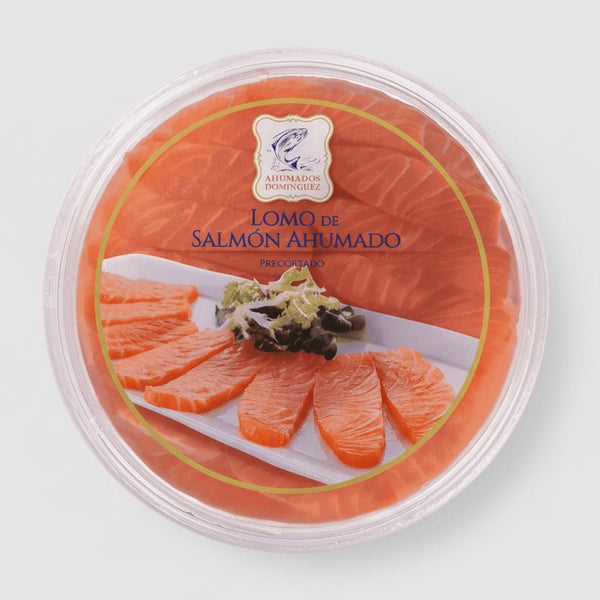
If you always want to have salmon ready without worrying about homemade preservation, our premium smoked salmon is shipped vacuum-packed with a cold chain and can be stored for several weeks in the refrigerator.
Presentation and pairing
Gravlax is one of the most photogenic dishes you can prepare at home. Here are the classic and modern ways to serve it:
Classic Scandinavian presentation
Slices of gravlax arranged on a wooden board or dark plate, with mustard and dill sauce (hovmästarsås) in a separate bowl, toasted rye bread, lemon wedges, and fresh dill sprigs. Simple, elegant, infallible.
Mustard and dill sauce (gravlax sauce)
Mix 3 tablespoons of mild Dijon mustard + 1 tablespoon of sugar + 2 tablespoons of white wine vinegar + 5 tablespoons of sunflower oil + chopped fresh dill. Emulsify with a hand blender. This sweet-and-sour sauce is the obligatory accompaniment to gravlax in Scandinavia.
Modern presentation ideas
- Nordic toast: rye bread or pumpernickel + cream cheese + gravlax slices + capers + thin red onion rings + dill. More ideas in our guide to smoked salmon toasts.
- Scandinavian bowl: rice or quinoa + gravlax + avocado + cucumber + radish + soy sauce + sesame seeds.
- Smoked and cured platter: combine gravlax with smoked salmon, gourmet preserves and cheeses. A contrast of flavors and textures on a single plate.
- Elegant canapés: warm blinis + crème fraîche + rolled gravlax slice + salmon roe on top.
Beverage pairing
- Dry white wine: Albariño, Chablis, or Alsatian Riesling. The acidity cleanses the palate between bites.
- Cava or brut champagne: the bubbles + acidity make a perfect pairing with the fat of the salmon.
- Craft beer: a well-chilled lager or pilsner. This is the classic Scandinavian pairing.
- Aquavit: the quintessential Scandinavian liquor. Served chilled, with its notes of caraway and dill, it is the natural complement to gravlax.
Gravlax in Nordic cuisine: history and tradition
The history of gravlax dates back to the Scandinavian Middle Ages, when fishermen in northern Sweden and Norway needed to preserve salmon without abundant salt (a luxury at the time). The solution was to literally bury the salmon: they wrapped it in birch bark with a little salt and buried it in the beach sand, above the high tide line. The pressure of the sand and slight fermentation did the rest.
The original result was a fermented fish, intense and with a considerable smell, very different from the refined gravlax we know today. Over time, as salt became more accessible, the technique evolved into the salt and sugar curing we use now, and fermentation disappeared from the process.
Today, gravlax is a pillar of Nordic gastronomy. In Sweden, it is essential in the julbord (Christmas table), along with pickled herring and meatballs. In Norway, it is served at celebrations and as an everyday appetizer. And the New Nordic Cuisine movement, led by restaurants like Noma in Copenhagen, has reinterpreted gravlax with modern techniques that have put it on the global gastronomic map.
What has not changed in centuries is the essence: salmon + salt + time. A recipe that has worked since the 14th century and that you can replicate in your kitchen with no more equipment than a refrigerator.
Salmon and seafood products — Bacalalo
Common gravlax mistakes (and how to avoid them)
Gravlax is a simple recipe, but there are common mistakes that can ruin the result. Here are the most frequent ones:
- Using fine salt instead of coarse: fine salt penetrates too quickly and unevenly. The outside becomes over-cured (dry, hard) while the inside remains raw. Always use coarse sea salt.
- Not applying weight: weight compacts the salmon and ensures even curing. Without weight, the mixture does not penetrate well, and the texture is uneven.
- Washing the salmon after curing: classic mistake. Washing under the tap dilutes flavors and adds unnecessary moisture. Just scrape off the mixture with your hands or a knife and pat dry with paper.
- Not draining the liquid: salmon releases a lot of water during curing (this is normal). If you don't drain it every 12 hours when turning it over, the salmon "swims" in the liquid, and the curing slows down.
- Curing too long: more than 72 hours and the salmon will be dry, overly salty, and have a jerky-like texture. 48 hours is the sweet spot for most fillets.
- Slicing the salmon before it rests: after removing the curing mixture, let the surface dry a bit in the refrigerator (2-4 hours). This greatly facilitates slicing.
- Not pre-freezing (safety): although salt curing inhibits most pathogens, it does not guarantee the elimination of anisakis. Always freeze at -20 °C for 48h before marinating.
🛒 Products mentioned in this article
⭐ 4.9/5 · Cold shipping 24-48h · Since 1990 at Mercat del Ninot
Frequently Asked Questions
Is homemade gravlax safe to eat?
Yes, provided you pre-freeze the salmon at -20 °C for at least 48 hours (to eliminate anisakis) and use the correct proportions of salt and sugar. Curing reduces water activity to levels that inhibit bacterial growth. It's a preservation technique used for centuries.
How long does it take to make gravlax?
Active work takes 10-15 minutes (mixing ingredients, applying the cure, wrapping). Passive curing in the refrigerator is 24-72 hours depending on thickness and preference. The total time is 1-3 days, but without active intervention.
Can I use frozen salmon to make gravlax?
Yes, and it's actually recommended for food safety. Thaw completely in the refrigerator (never at room temperature) before applying the cure. The texture of gravlax made with previously frozen salmon is practically identical to fresh.
What part of the salmon is best for gravlax?
The central part of the fillet, where the thickness is more uniform (3-4 cm). Avoid the tail (too thin, cures excessively) and the head part if it is very thick and uneven. Always choose pieces with skin.
Can gravlax be made without dill?
Yes. Dill is the classic aromatic, but it's not essential. You can substitute it with cilantro, tarragon, wild fennel, or simply omit it and leave only the salt and sugar mixture with pepper. Variants with beetroot, soy-ginger, or citrus do not use dill.
What is the difference between gravlax and lox?
Lox is an American term (from Yiddish laks) that originally referred to salmon cured only in salt (without sugar or dill, saltier). Today in the US, "lox" is also colloquially used to refer to cold-smoked salmon. Gravlax always uses salt + sugar + herbs and is never smoked.
Is gravlax suitable for pregnant women?
The official recommendation in Spain (AESAN) is that pregnant women should avoid raw or semi-raw fish, including gravlax, due to the risk of listeria. If the salmon has been previously frozen and properly cured, the risk is low, but consult your doctor before consuming it during pregnancy.
Can gravlax be made with other fish?
Yes. The technique works with trout, tuna, sea bass, fresh cod, or swordfish. Salmon is the classic due to its fat content (which gives it a silky texture), but trout gravlax is excellent, and tuna gravlax is spectacular for sashimi-style.
Can I speed up the gravlax curing process?
You can speed it up by cutting the salmon into thinner pieces (2 cm) and using a slightly higher salt proportion. A thin piece can be ready in 12-18 hours. But do not use more heat or leave it out of the refrigerator: curing must always be done in the cold.
How much gravlax do you get from 1 kg of salmon?
Approximately 700-800 g of finished product. Salmon loses 20-30% of its weight during curing (the water expelled by the salt). One kilo of fresh salmon yields about 25-30 thin slices, enough for 8-10 people as an appetizer.
Can already-made gravlax be frozen?
Yes, for up to 2 months. Wrap in plastic film and then in a zip bag, expelling all air. Thaw in the refrigerator. The texture remains good, although it loses some firmness compared to freshly made. It is best to freeze in individual portions.
Does gravlax contain alcohol? Can children eat it?
The classic recipe does not contain alcohol (only salt, sugar, and dill), so it is suitable for children over 3 years old. Variants with whiskey or gin do contain alcohol, although much of it evaporates during curing. If you are serving it to children, use the basic alcohol-free recipe.
Premium Seafood Products — Bacalalo
Since 1990 selecting the best from the sea at Mercat del Ninot, Barcelona. Refrigerated shipping 24-48h.
View smoked salmon →Related guides
- Homemade smoked salmon: how to make it step by step
- 8 Irresistible Smoked Salmon Toasts
- Buy Smoked Salmon Online: A Quality Guide
- Smoked Salmon: Properties and Benefits
- Gourmet Canned Food Recipes
- Freezing Smoked Salmon: How to Preserve It
If you prefer to enjoy the best salmon directly without marinating it yourself, discover our selection of artisanal smoked salmon: Norwegian, cold-smoked over oak wood, with a buttery texture and balanced flavor. Refrigerated shipping in 24-48h throughout the Peninsula.




![Tataki de Atún: Receta Fácil con Salsa al Sésamo [Paso a Paso] - Bacalalo](http://bacalalo.com/cdn/shop/articles/tataki-de-atun-receta-facil-con-salsa-al-sesamo-paso-a-paso-1492742.jpg?v=1772706833&width=480)
