Summary
On a supermarket shelf or a gourmet food store website, the options for canned anchovies can be overwhelming. In this guide: Can vs. glass jar: how it affects flavor and preservation, Olive oil vs. sunflower oil: real impact on anchovies, Cantabrian vs. Mediterranean vs. Imported: regional differences.
On a supermarket shelf or a gourmet food store website, the options for canned anchovies can be overwhelming. Aluminum cans, glass jars, olive oil, sunflower oil, Cantabrian, Mediterranean, Peruvian, size 0, size 00, with or without bone. Prices ranging from 2 to 30 euros for the same apparent format.
Not all are the same. And the differences between them directly affect the flavor, preservation, and how you will use them. This guide breaks down each variable so you can choose wisely, not randomly.
Can vs. glass jar: how it affects flavor and preservation
The packaging is not an aesthetic detail. It has real consequences for the consumption experience and the product's shelf life.
The aluminum can is the traditional format and remains the most common in large-scale production. Its advantages are physical resistance (it doesn't break), lower production cost, and total opacity to light, which is a real protective factor against fat oxidation in fish. Its disadvantages are that you cannot see the product before opening it, and once opened, it cannot be hermetically sealed: you have to transfer the contents to a glass container.
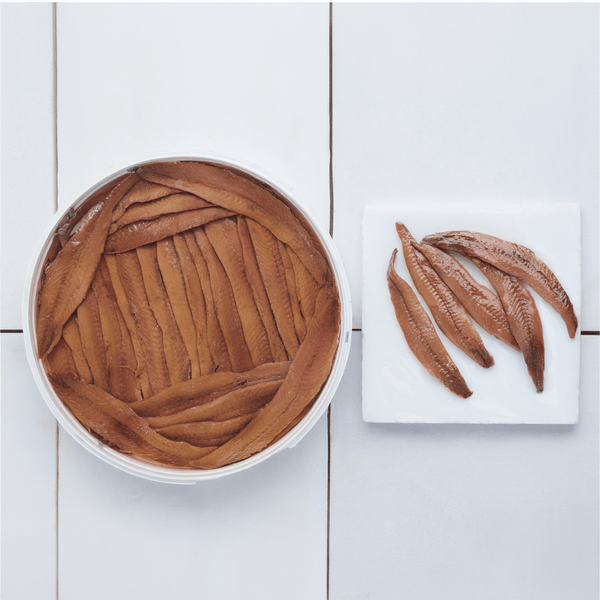
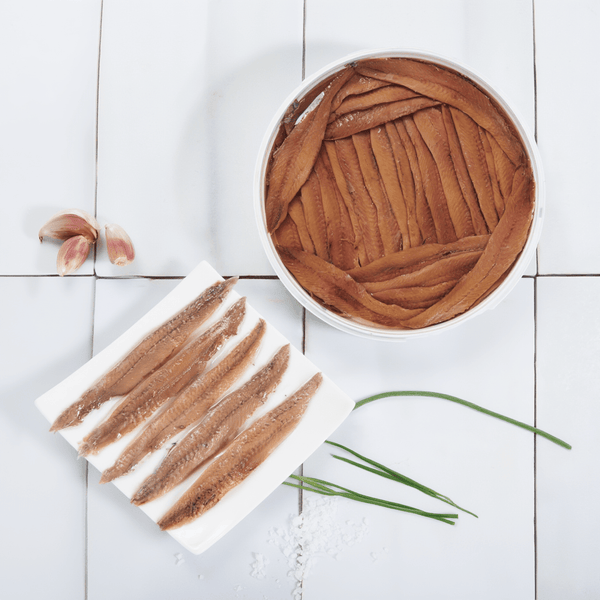
The glass jar allows you to see exactly what you are buying before opening: the color of the fillets, the amount of oil relative to the fish, the uniformity of the fillets, and the presence or absence of visible defects. This visual inspection point is its biggest advantage for the demanding consumer. It can also be closed and stored directly in the refrigerator once opened, with the oil covering the fillets.
Its main disadvantage is transparency: light accelerates the oxidation of the anchovy's polyunsaturated fats. A glass jar exposed to direct light (natural or artificial) for weeks or months on a shelf reduces product quality faster than an opaque can. Serious producers who use glass add cardboard boxes or opaque wraps precisely for this reason. If you buy anchovies in a glass jar without any additional light protection, that is a warning sign.
Does the packaging material affect the product's flavor? Under normal storage conditions (no direct light, stable temperature), the flavor difference between anchovies in a can and the same anchovies from the same producer in a glass jar is minimal or non-existent. What does affect it is post-opening management: in a glass jar with a screw cap, preservation is more practical, and the product holds up better once opened.
Olive oil vs. sunflower oil: real impact on anchovies
This is the variable that has the most impact on the final product's flavor, yet it is the one most consumers overlook when checking the label.
The oil in a can of anchovies is not just a preservation medium: it is part of the product's flavor profile. The anchovy absorbs some of the oil during the canning storage period, and that oil modifies the perception of flavor in the mouth.
Extra virgin olive oil contributes its own aromatic compounds (fruity, herbaceous, slightly bitter) that integrate with the anchovy's flavor and amplify its complexity. Olive oil fat has a higher melting point than sunflower fat, which gives the fillet a firmer texture and a more defined mouthfeel. In addition, olive oil has its own antioxidant properties (polyphenols, vitamin E) that contribute to the product's stability during storage.
Sunflower oil is neutral in flavor, which in theory should "let the anchovy speak for itself." In practice, the result is an anchovy that tastes flatter, less complex, and with a less defined mouthfeel. Sunflower oil does not contribute nuances but also does not help develop those that the anchovy already has. It is the cheapest oil and the most used in low-cost industrial productions.
There is a third type that appears on some labels: "olive oil" without the "extra virgin" specification. This is refined oil mixed with a small amount of virgin oil to regain some flavor. It is better than sunflower but clearly inferior to extra virgin. Brands that use it do so to reduce costs while keeping the word "olive" on the label.
Practical rule: if the oil is not extra virgin, you are saving on the element that most affects the product's flavor. In low-to-medium priced preserves, this is to be expected. In preserves that are presented as premium or artisanal at a high price, it is a warning sign.
Cantabrian vs. Mediterranean vs. Imported: regional differences
The geographical origin of the anchovy determines its biological profile before salting, and that biological profile translates into specific sensory differences in the final product.
Cantabrian anchovy (Engraulis encrasicolus from the Cantabrian Sea and Bay of Biscay) caught in the May-June season is the reference standard for Spanish preserves. The fish come to the coast from deep Atlantic waters, with maximum fat reserves accumulated during winter. Colder water favors slower growth and denser flesh. The campaign concentrated in a few weeks and the artisanal elaboration in the Santoña area are the factors that make Cantabrian anchovy the world reference for this type of preserve.
Mediterranean anchovy (the same Engraulis encrasicolus but from the Mediterranean) has different characteristics: generally smaller fish, lower fat content per season, milder and less intense flavor. It is consumed mainly fresh or as pickled anchovies (boquerones en vinagre). For salted preserve production, it yields a decent product but with less intensity and complexity than the Cantabrian. Mediterranean anchovies in preserves exist on the market, especially in Italian productions (Menaica anchovies, Cetara anchovies) which have their own tradition and identity, but the point of comparison for the Spanish market is clearly the Cantabrian.
Imported anchovies (Morocco, Peru, Argentina) are the category that causes the most confusion. The Engraulis ringens from Peru and Argentina is a different species from the European Engraulis encrasicolus, with a stronger and less delicate flavor profile. Anchovies processed in Morocco can be of a similar species to the Cantabrian (the Cantabrian Sea and the North Atlantic of Africa share species) but the processing is often industrial, faster, and with less quality control. A very low price (under 3 euros per can) for a product that says "anchovy" without specifying origin is usually a sign of industrial, accelerated processing of imported fish.
Spanish legislation allows products that do not meet origin or process requirements to be labeled as "Cantabrian anchovy" or "Cantabrian style." There is no European PDO (Protected Designation of Origin) that protects the term. The Cantabrian Anchovy Consortium certifies basic origin and process, but its seal is not mandatory or ubiquitous. Consumers who want certainty need to read the full label, not just the headline.
Related Bacalalo Products


Recommended Products

Cantabrian Anchovies in Olive Oil - 50g...
3,95 €

"Cantabrian Deluxe" Assortment
67,00 €

Artisanal Cantabrian Anchovy Gilda Hand-Prepared...
9,90 €

Northern White Tuna Belly in Olive Oil...
16,95 €
24-48h refrigerated shipping throughout the Peninsula
What to look for on the label before buying
With all the above as context, here is the labeling checklist we use at Mercat del Ninot when evaluating a new product for our store:
- Specific origin: "Santoña", "Cantabria", "Cantabrian Coast" are acceptable. "Cantabrian style" or "Cantabrian anchovy flavor" are warning signs.
- Type of oil: it should say "extra virgin olive oil." "Olive oil" alone is refined oil. "Sunflower oil" is the low end of the market, regardless of price.
- Drained weight: it must appear on the label. Always compare prices by drained gram, not by total package weight. A 100g can with 40g drained weight is more expensive per gram of anchovy than a 120g can with 80g drained weight at a similar price.
- Size or number of fillets: if the size (0, 00, 000) does not appear explicitly, the number of fillets per can allows you to calculate it. Less than 8 fillets in 50g drained: size 00 or higher. Between 8 and 14: size 0-00. More than 14: size smaller than 0 or substandard sizes.
- Date of production or campaign: producers who can specify this do so. It is a sign of transparency and quality control. Those who cannot or do not want to do not include it.
- Additives: a quality anchovy only contains anchovy, salt, and oil. The presence of antioxidants (E-300, E-301, E-302), acidifiers, or colorings in the ingredient list indicates that the product needs chemical help to maintain appearance and stability.
How to store an open can (the professional trick)
The most common mistake with canned anchovies is storing the open metal can in the refrigerator. The metal exposed to the air in the refrigerator oxidizes and transfers metallic flavors to the oil and fish. Within a few hours, the anchovies acquire a metallic aftertaste that spoils the product.
The correct procedure once the can is opened:
- Immediately transfer all contents (anchovies and oil) to a glass jar with an airtight lid.
- Make sure the fillets are completely covered with oil. If the oil from the can is not enough to cover them, add extra virgin olive oil until covered.
- Close the jar and store it in the coldest part of the refrigerator (not in the door).
- Consume within a maximum of 3-5 days.
Before serving, always remember to take the jar out of the refrigerator 15-20 minutes in advance. Olive oil partially solidifies at low temperatures, and cold anchovy fillets lose texture and flavor.
An additional trick used by many professionals: when there is little oil left in the jar but still fillets, add a little more good extra virgin olive oil. The oil absorbs the anchovy flavor and becomes an excellent condiment for toast, pasta, or salads once all the fillets have been consumed.
Canned anchovies in the kitchen: 8 specific uses
Canned anchovies have two registers of use in cooking: as a protagonist (where they are directly seen and tasted) and as a background enhancer (where they are not identified but their absence would be noticed).
- Gilda: pickled guindilla pepper + manzanilla olive + anchovy rolled on a toothpick. The most iconic use. Requires size 00 anchovy for the correct balance of proportions.
- Toast with butter: sourdough bread, unsalted butter at room temperature, anchovy fillets on top. Full description in our specific article on this recipe.
- Pasta sauce: 3-4 anchovy fillets dissolved in hot olive oil with sliced garlic and chili. Add al dente pasta, cooking water, and stir. A complete dish in 15 minutes.
- Sauté enhancer: 1-2 fillets dissolved in the sauté oil before adding onion and garlic. Enhances the flavor of any stew, tomato sauce, or braised dish without anyone identifying anchovy as an ingredient.
- Vinaigrette: 2 finely chopped fillets + sherry vinegar + olive oil + mustard. Ideal for tomato salads, Nicoise salad, or white asparagus.
- Pizza: on the already baked pizza, during the last 30 seconds in the oven or off the heat. Do not bake anchovies directly: heat dries them out and makes them too salty.
- Bagna càuda: Piedmontese sauce of anchovies, garlic, and olive oil for dipping raw vegetables. Requires quality anchovies because the sauce has nowhere to hide a bad ingredient.
- Anchovy butter: mix softened butter with very finely chopped anchovies in a 4:1 ratio. Refrigerate and use on steak, toast, or to finish a pasta dish. Keeps for a week in the refrigerator wrapped in film.
Frequently asked questions
How long does an unopened can of anchovies last?
A properly sealed can of anchovies in oil stored at a stable temperature (no direct light, no excessive heat) has a shelf life of 3 to 5 years from the production date. Moreover: many anchovies improve during the first 2-3 years in the can, as happens with some cheeses or wines. The expiry date is a minimum safety indicator; the optimal consumption date may be before or after depending on the producer and the elaboration style.
Are anchovies in glass jars better than those in cans?
Not necessarily. The glass container has advantages in pre-purchase visual inspection and post-opening preservation, but the quality of the product inside depends on the producer, size, oil, and process. An excellent anchovy in a can is superior to a mediocre one in a glass jar. Glass is an indicator that the producer invests in presentation, but it is not a guarantee of the product's quality itself.
What do the numbers on canned anchovies mean?
They are the sizing system by fillet size. Size 0: the smallest (12-14 fillets per 50g drained can). Size 00: medium-large fillets (8-11 fillets). Size 000: the largest (5-7 fillets). More zeros mean larger size, higher price, and greater flavor complexity per unit. For a detailed explanation, consult our specific article on anchovy size 00.
Do canned anchovies have a lot of sodium?
Yes. Canned anchovies have a very high sodium content, between 3,000 and 5,500 mg per 100g of drained product. The amount per individual fillet (3-7g) is 90-385 mg of sodium per fillet, depending on the size. In culinary uses where 2-3 fillets are used as a flavor enhancer, the impact on total sodium intake is limited. In direct consumption of several toasts or gildas, the sodium contribution is significant and relevant for people with dietary restrictions.
Can you distinguish a Cantabrian anchovy from a Mediterranean one in the can?
Without opening the can, only by the labeling. With the can open, there are visual and organoleptic differences: a good Cantabrian anchovy from a good season has a more intense color (dark reddish-gold), wider fillets for the same size, and a deeper, more complex aroma. Mediterranean anchovy tends to be paler, more delicate in aroma, and milder in flavor. But without direct simultaneous comparison, the distinction is difficult even for regular consumers.
Are supermarket private-label anchovies from Cantabria?
In most cases, not in the strict sense. Many private labels use anchovies of Mediterranean, North African, or imported origin, processed with accelerated industrial techniques. The denomination "Cantabrian anchovy" or "Cantabrian style" on a private-label can costing 2-3 euros is a stylistic reference, not an indication of verified origin. Always read the ingredient list, and if the origin is not specifically stated, assume it is not Cantabrian from a good season.
Do you want canned anchovies that are worth it? Visit our Cantabrian anchovy collection at Bacalalo.com. Selected at Mercat del Ninot since 1990, with extra virgin olive oil and verified size.
Products you might be interested in
Discover more