Our products
anchoas del cantabrico guia completa marcas calibres

Cantabrian Anchovies: A Complete Guide to Choosing the Best

February 3, 2026Lalo González Rodríguez⏱ 31 min de lectura

Summary: Cantabrian anchovies are Spain's most prized salted product, but not all are what they seem. In this comprehensive guide, we explain what makes Cantabrian anchovies unique, how the artisanal production process works, what the 000, 00, 0, and 1 calibers mean, how much the best brands actually cost, the differences between Santoña, Laredo, and Bermeo, and how to recognize a quality anchovy before buying it. With 35 years of experience selecting anchovies at Mercat del Ninot in Barcelona.

Contents

What makes Cantabrian anchovies unique

If you've tried canned anchovies from the supermarket and thought you didn't understand the hype, you might never have tasted a real Cantabrian anchovy. The difference isn't a matter of degree — it's a matter of category. It's the same distance as between acorn-fed Iberian ham and packaged turkey breast cold cuts.

But what makes a Cantabrian anchovy what it is? There are four factors that work together and cannot be replicated anywhere else in the world.

The species: Engraulis encrasicolus

Cantabrian anchovy comes exclusively from the European anchovy, Engraulis encrasicolus, caught in the Cantabrian Sea and the Bay of Biscay. This species, in these specific waters, develops a very particular intramuscular fat profile: enough to provide a melting texture and complex flavor, but without being cloying. Anchovies from Morocco, Argentina, or Chile are of the same species, but raised in different waters with different temperatures, salinity, and plankton diets. The end result is a fish with a distinct lipid profile that, when cured, produces an anchovy with less flavor complexity.

The fishing season: only three months a year

Anchovy fishing for salting in the Cantabrian Sea occurs between April and June. It's called "la costera" (the fishing season) and lasts approximately 10-12 weeks. During that period, anchovy shoals migrate through the Bay of Biscay and offer the fish at its optimal fat level — just before spawning, when all the fish's energy is stored in its muscle. Outside that window, Cantabrian anchovy changes its composition. Canneries that work with genuine product only have this raw material once a year. Those that use anchovy from other latitudes can produce year-round, but it is not the same product.

Artisanal tradition: over 130 years of craftsmanship

The Cantabrian anchovy industry was born in the second half of the 19th century, when Sicilian and Neapolitan fishermen and canners arrived in Santoña and taught the salting techniques of southern Italy. Since then, knowledge has been passed down from generation to generation. The "sobadoras" (female anchovy filleting experts) of Santoña, women with decades of experience, can recognize by touch if a fillet is well cured. The artisanal process is not about tradition for tradition's sake — it is the most effective method to transform an anchovy into the gastronomic product that is the Cantabrian anchovy.

Time: no shortcuts

A quality artisanal anchovy needs between 8 and 18 months of curing in salt. There is no industrial process that replicates what the fish's natural enzymes do during that waiting period. The endogenous protease and lipase of the anchovy slowly break down proteins and fats, generating the compounds responsible for the deep umami, melting texture, and buttery nuances that make Cantabrian anchovies irresistible. Accelerating this process produces an inferior result: saltier, less complex, with a rubbery texture.

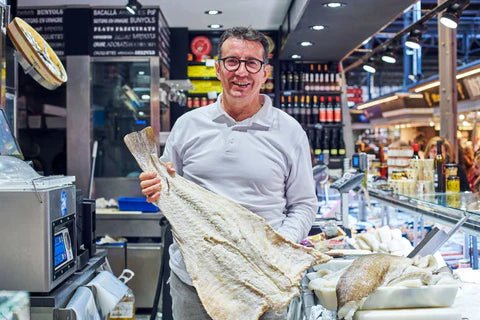
At Bacalalo, we have been selecting anchovies at Mercat del Ninot in Barcelona for 35 years. We have tasted hundreds of brands, batches, and calibers. What we sell online are those that pass our selection filter: those that meet the four factors we have just described.

Premium "00" Anchovies — The largest caliber in the Cantabrian Sea

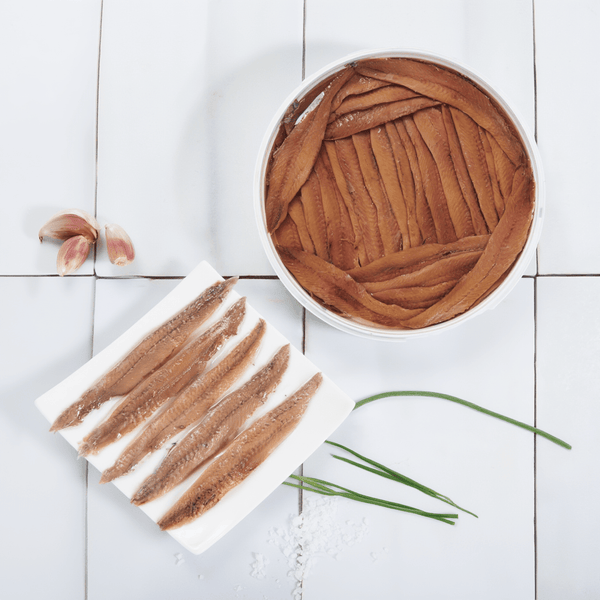
8-10 cm fillets, minimum 10-12 months curing, 100% hand-filleted, extra virgin olive oil. The selection we have been offering for years at Mercat del Ninot, now online.

View "00" Premium Anchovies — from €24.90

The production process: from catch to can

To appreciate a quality Cantabrian anchovy, it is worth understanding what goes into each can. The artisanal process has four main stages that cannot be compressed without sacrificing the final result.

1. The catch: purse seining and selection in port

Anchovy fishing boats use purse seines: a circular net that is deployed around the fish shoal and closed at the bottom to capture the entire school. Night fishing is the most common — anchovies gather at the surface at night, attracted by the boats' lights. Once in port, the anchovies are unloaded into ice boxes and quickly transported to the canneries. The cold chain from catch is critical: anchovies deteriorate quickly, and any delay affects the final quality.

In the factory, workers inspect the fresh anchovies and discard damaged or undersized specimens. This initial filter determines the proportion of large-caliber anchovies that will come from each fishing season.

2. The rubbing and salting: the basis of the process

The fresh anchovy is eviscerated (head and viscera are removed) and placed in barrels, alternating layers of fish and coarse sea salt. The term "sobado" (rubbing) refers to the process of arranging and pressing the anchovies in the barrel to ensure the salt penetrates evenly. The barrels are covered with a wooden lid and a weight on top to exert constant pressure.

The salt dehydrates the anchovy's muscle tissue and creates the environment where the fish's natural enzymes will act over the following months. The salt proportion is critical: too much blocks enzymatic activity and produces an excessively salty anchovy; too little allows bacterial growth. Artisanal canneries adjust this proportion based on experience and the conditions of each fishing season.

3. Maturation: 8 to 18 months of active waiting

This is the longest stage and the one that most differentiates the quality of artisanal canneries from industrial ones. The barrels are stored in cool places and rotated periodically to ensure uniform maturation. During this time, the anchovy's natural proteases and lipases work tirelessly: they break down muscle proteins into peptides and amino acids (including glutamate, responsible for umami), and transform fats into free fatty acids that contribute to aromatic complexity.

The visible result of this process is the color change: the grayish anchovy from the catch turns into a coppery-pink anchovy. The result on the palate is the melting texture and layered flavor that characterize the best Cantabrian anchovies.

High-end canneries cure for 10 to 18 months. Mid-range ones, between 6 and 10 months. Industrial ones, sometimes less than 6 months, with process accelerators. The difference in time directly translates into a difference in flavor.

4. Filleting and packaging: the work of the sobadoras

Once matured, the anchovy is removed from the barrel, washed to remove excess salt, and filleted by hand. The sobadoras remove the central bone, skin, and any residual bones with their fingers and a small tool. Each fillet is individually inspected and classified by size (caliber). The larger fillets go into 00 cans; the medium ones, into 0 cans; the small and broken ones, into smaller categories or the catering market.

Hand filleting is the most time-consuming part of the entire process — and the one that most influences the presentation of the final fillet. An experienced sobadora can fillet between 4 and 6 kg of anchovy per day. The result: whole fillets, boneless, skinless, with the uniform color of those that have spent exactly the right amount of time in salt.

The fillets are placed in the can or jar, covered with oil (extra virgin olive oil in premium ranges, standard olive or sunflower oil in basic ranges), and the container is sealed. The pasteurization process that follows stabilizes the product for storage at room temperature.

What the calibers mean: 000, 00, 0, and 1

The Cantabrian anchovy caliber classification system is one of the most confusing elements for new buyers. The zeros are not a designation of origin or an official certification — they are a de facto standard that canneries in northern Spain have adopted to communicate fillet size. Each cannery may apply it with slight variations, but there is a general consensus that has been in place for decades.

The basic rule: more zeros, larger fillet.

000 Anchovies (triple zero)

This is the most exclusive caliber and the least common in the market. 000 fillets are the largest of the entire fishing season: they exceed 10-12 cm in length and have considerable thickness. Only the largest specimens of Engraulis encrasicolus, those that have fed intensely during the season, produce fillets of this size. The proportion of 000 anchovies in a normal fishing season is small — hence they are scarce and expensive. The flavor is the maximum expression of the caliber: meaty, with a texture that slowly melts in the mouth, and a deep umami that lingers for several seconds after swallowing. If you want to understand more about this extreme caliber, we have an article dedicated to triple zero anchovies and how to identify them.

00 Anchovies (double zero)

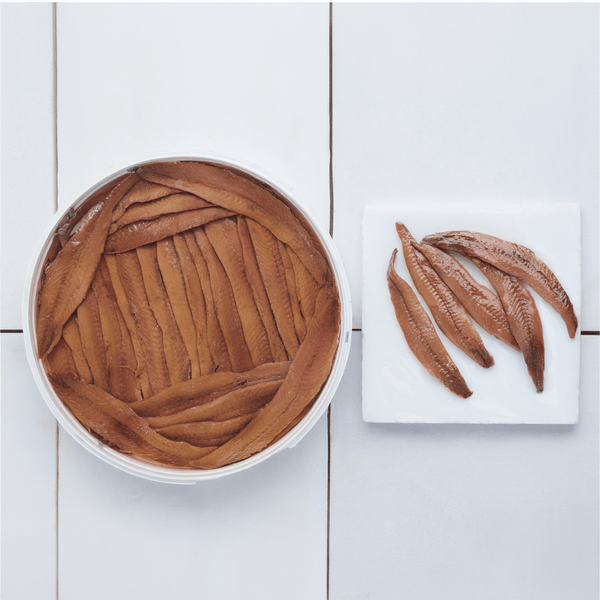
The benchmark caliber in the premium market. 00 fillets measure between 8 and 10 cm and come from the largest anchovies of the standard fishing season. These are served in high-end restaurants, included in top-tier cheese and charcuterie boards, and sought after by consumers who already know the product. At Bacalalo, our Premium "00" Anchovies are the selection we have been offering for decades to Mercat del Ninot customers who ask for "the best you have."

The difference between 00 and 0 on the palate: the 00 has more flesh, more thickness, and a more intense and lasting flavor profile. With the same curing time, the larger fillet develops more complexity. For someone just starting, the difference may seem subtle. For those who have been consuming artisanal anchovies for years, it is clear.

0 Anchovies (single zero)

The caliber for unbeatable value for money. 0 fillets measure between 6 and 8 cm — large, meaty, and with all the curing quality of the cannery, but without the premium price of the maximum caliber's exclusivity. For regular consumption as a tapa, appetizer, or montadito, the 0 is the rational choice. Our Gourmet Selection "0" Anchovies (35 fillets) are the best-selling product in our anchovy section for a reason: they are exceptional relative to their price.

1 Anchovies (single one) and "menu" size

Caliber 1 fillets are medium-small in size, between 4 and 6 cm. They come from the smallest anchovies of the fishing season. When the cannery is good, they have the same curing and flavor as the superior calibers — they are just smaller. They are perfect for cooking, for incorporating into sauces, for making anchovy pâtés, or for putting on pizza without the size being relevant.

The "menu" format mixes fillets of different sizes without classification. It does not imply worse quality of the anchovy or curing — they simply have not gone through the individual size selection process. From the same cannery, the menu format can have exactly the same curing quality as the 00, just with smaller or heterogeneous fillets. It is the most economical format per gram and the one we recommend for intensive use.

Caliber Fillet Length Profile Ideal Use Approximate Price/Fillet
000 (triple zero) >10-12 cm Most exclusive. Maximum size and flavor Tasting, gourmet gift, haute cuisine €1.50-€2.00
00 (double zero) 8-10 cm Premium. Intense, melting, layered Toast, quality appetizer, special dinner €1.07-€1.25
0 (single zero) 6-8 cm High-end. Excellent value for money Daily tapa, montadito, appetizer €0.80-€1.11
1 (single one) 4-6 cm Mid-range. Same flavor, smaller size Cooking, sauces, pâté, pizza €0.50-€0.80
Menu / unclassified Varied Mixed sizes, economy of scale Intensive use, catering, cooking €0.40-€0.65

For a more detailed guide on the zero-based classification system, including how to read labels and which canneries are most reliable for each caliber, consult our specific article on what the zeros in anchovies mean and how to choose the best ones.

Ranking of the best anchovy brands in 2026

The Cantabrian anchovy market has over 40 active canneries in the Santoña, Laredo, Colindres, Castro Urdiales, and Basque Country areas. Not all work to the same standards. This is our honest classification, based on 35 years of tasting products at Mercat del Ninot — not on advertising or commercial agreements.

Category A: benchmark artisanal canneries

These set the standard. They work exclusively with Cantabrian anchovy caught during the fishing season, cure for a minimum of 10 months, hand-fillet, and do not skimp on oil. Their 00 cans are found in the best restaurants. They are also the most expensive and have the least national distribution — many sell directly or through specialized stores.

Some of the canneries we would include in this category: Conservas Ortiz (their "El Velero" range), Ángel León de Laredo, La Española in its artisanal range, and several small canneries in Santoña and Colindres that do not have a presence in large supermarkets. The consistency of quality from batch to batch is their hallmark.

Category B: high-end canneries with wider distribution

They have managed to scale their production without sacrificing (too much) quality. Their anchovies are clearly superior to standard supermarket ones and offer solid value for money. They may have premium lines (with Cantabrian anchovy and long curing) and more economical lines (with anchovy from other origins). It is advisable to read the label and choose the correct line for each brand.

Category C: supermarket brands and mixed origin

Anchovies labeled as "from the Cantabrian Sea" or "from Santoña" but using anchovy from Argentina, Morocco, or Chile with 4-6 months of curing. It is not illegal — it is legal to process in Santoña with imported anchovy. But it is not the gastronomic experience described in this guide. They are suitable for cooking, for sauces, for pâté. Not for eating as a main feature.

Bacalalo's selection: our criteria

At Bacalalo, we don't list all brands on the market. We select those that pass our internal tasting process: 100% verified Cantabrian origin, minimum 10 months curing, hand-filleted, extra virgin olive oil in premium ranges, and consistent quality between batches. If a new batch arrives that does not meet these criteria, we do not put it on sale, even if it is from a well-known cannery.

The Cantabrian anchovy collection in our online store is the result of that 35-year selection process.

Gourmet Selection "0" Anchovies — Bacalalo's best seller

35 fillets of caliber 0 (6-8 cm), artisanal curing, extra virgin olive oil. The choice for those who want real quality daily without paying the price of the maximum caliber.

View Gourmet Selection "0" Anchovies — €38.90

Real prices: how much a good anchovy costs

The price confusion in the anchovy market is huge. You can find cans from €2 to jars of €80, all under the label "Cantabrian anchovies." To guide you, here are the real price ranges by category, with data updated to 2026.

Price per fillet: the metric that matters

Comparing prices by can makes no sense because formats vary enormously (from 10 to 100 fillets). The correct metric is the price per fillet. It is the only way to compare brands and calibers objectively.

Category Price per Can/Jar Approximate Fillets Price per Fillet Example at Bacalalo
Artisanal premium 00 €24.90 - €74.90 20-70 fillets €1.07-€1.25 Premium "00" Anchovies
Artisanal high-end 0 €28.90 - €38.90 30-45 fillets €0.86-€1.11 Gourmet Selection "0" Anchovies
Artisanal exclusive format €22.90 - €32.90 variable €0.90-€1.40 Exclusive Anchovy 160g
Artisanal menu format €26.95 45 fillets €0.60 Menu Anchovy 45 fillets
Cannery B (distribution) €8.00 - €18.00 20-50 fillets €0.40-€0.90 Medium-sized brands in the sector
Standard supermarket €1.50 - €5.00 15-40 fillets €0.10-€0.33 Hacendado, private labels

The low price deception: why a €0.15/fillet anchovy is not the same

A supermarket anchovy at €0.15/fillet is likely to meet these conditions: anchovy from Argentina or Morocco, 3-5 months curing (sometimes with external enzymes to accelerate the process), sunflower oil, small caliber, and industrial filleting. It is not a defective product — it is a different product. It works for cooking. It does not work for the gastronomic experience.

An artisanal Cantabrian anchovy at €1.07/fillet has behind it: 100% Cantabrian anchovy caught in season, 10-12 months curing in salt with natural enzymes, extra virgin olive oil, manually selected 00 caliber, and hand-filleted by a sobadora. The cost of that process cannot produce a fillet at €0.15. The math does not close in any other way.

How much to spend? Our honest recommendation

It depends on the use:

  • For cooking (sauces, pâtés, bases): a menu format or caliber 1 between €0.40-€0.60/fillet is completely sufficient. Don't waste a 00 in a sauce.
  • For regular appetizer and toast: caliber 0 between €0.80-€1.11/fillet is the optimal point. Real quality without exclusivity price.
  • For special occasions, gifts, and a complete gastronomic experience: caliber 00 between €1.07-€1.25/fillet. It is the product that changes the perception of anyone who tries it for the first time.

Anchovies from Santoña vs Laredo vs Bermeo: differences by region

The northern coast of Spain concentrates almost all artisanal anchovy production. But within that coastal strip, there are real differences between the producing areas that are worth knowing. For a complete guide to the origin and anchovy tradition, consult our article on Santoña anchovies: a complete guide.

Santoña (Cantabria): the anchovy capital of the world

Santoña is the undisputed epicenter. The Ría de Santoña, protected and with unique natural conditions, was where 19th-century Sicilian emigrants established the first canneries. Today it concentrates more than twenty active canneries, from small family workshops to companies with national and international distribution.

Characteristics of Santoña anchovies:

  • Curing between 10 and 18 months in premium ranges.
  • Large caliber fillets — the area has a tradition of working with the largest specimens of the fishing season.
  • Flavor profile: intense, with pronounced umami and a melting texture. Santoña anchovies are powerful, with personality.
  • The price of the name: Santoña sells so well that some canneries use the toponym with imported anchovy. You have to read the label.

Laredo and Colindres (Cantabria): the best kept secret

A few kilometers from Santoña, Laredo and Colindres have canneries that work with the same Cantabrian anchovy and the same artisanal tradition, but with much more limited distribution. Some of the best anchovies we have tasted in 35 years come from small workshops in these towns that you will never see in a supermarket.

The advantage of anchovies from Laredo and Colindres:

  • Limited production that forces them to maintain high standards (they cannot afford volume with low quality).
  • More direct access to anchovy from Santander Bay and the eastern Cantabrian coast.
  • Flavor profile often more delicate and balanced than the more powerful anchovies from Santoña.
  • Price slightly lower than Santoña due to the lesser notoriety of the brand-territory.

Bermeo, Getaria, and Ondarroa (Basque Country): the Basque tradition

Basque ports have their own anchovy tradition, influenced both by Italian heritage and by the unique character of Basque cuisine. Basque anchovies have some distinctive features:

  • Longer curing than the market average: some Basque canneries cure for 14-18 months.
  • More pronounced saltiness — the Basque palate appreciates a more saline anchovy.
  • Fillets often of homogeneous caliber and careful presentation.
  • Flavor profile: robust, with more intense umami notes and a more persistent aftertaste.

For those looking for a full-bodied anchovy with long curing, Basque anchovies from Bermeo or Getaria are an excellent choice. If you prefer a more balanced and less intense anchovy, those from Santoña or Laredo will be more your style.

Summary comparison

Area Average Curing Flavor Profile Saltiness Level Distribution
Santoña 10-18 months Intense, complex, melting Medium-high National and international
Laredo / Colindres 8-14 months Balanced, delicate, elegant Medium Local and specialized stores
Bermeo / Getaria / Ondarroa 12-18 months Robust, powerful, persistent High Regional and specialized stores

How to recognize a quality anchovy (5 visual cues)

Buying anchovies online has an advantage: you can read labels and compare objective data before buying. But when you have the open can or jar in front of you, there are five visual cues that immediately tell you if what you have in your hands is a quality anchovy or not. These are the same cues we use at Bacalalo when we evaluate a new batch before including it in our catalog.

For more detailed information on how to identify quality before and after opening the package, consult our guide on the best Cantabrian anchovies: complete comparison.

Cue 1: uniform coppery-pink color

A well-cured anchovy has a color between salmon pink and coppery gold, uniform throughout the fillet. If the color is grayish (insufficient curing), dark brown (excessive oxidation or too long curing in incorrect conditions), or very pale (poor quality anchovy), there is a problem. Color is the first indicator that the enzymes have done their job correctly during the months of maturation.

Cue 2: whole fillets without breaks

An anchovy hand-filleted by an experienced sobadora comes out whole: without breaks, without fragments, with clean edges. If you open a can and find more pieces than whole fillets, it is a sign of industrial filleting or poorly cured fillets (under-cured fillets are more fragile and break when handled). A whole fillet is not just an aesthetic matter — it indicates that the curing was correct and that the filleting process was done carefully.

Cue 3: clean and transparent oil

The oil in a well-made can of anchovies is clean and transparent, golden yellow if it is extra virgin olive oil. If the oil is cloudy, with suspended particles or an strange color, there is a problem with production or storage. Cloudy oil can indicate that the anchovy was insufficiently washed (excess dissolved salt) or that the can has been in incorrect conditions.

Cue 4: aroma of cured sea, not strong fish

The aroma of a quality anchovy is saline and of cured umami, with a subtle buttery background. It does not smell like fresh fish — that smell would indicate insufficient curing. It does not smell rancid — that would indicate fat oxidation. It does not smell metallic — that would indicate a problem with the packaging or oil. If the aroma is clean, marine, and appetizing, the anchovy has passed the first filter.

Cue 5: firm-melting texture to the touch

Carefully pick up a fillet. It should be firm to pick up (not fall apart) but yield gently when pressed. When you put it on your tongue, the first few seconds are firm; then, the fillet slowly melts, almost without chewing. That is the melting texture that characterizes a well-cured anchovy. If the fillet is rubbery and needs to be chewed like gum, the curing was too short. If it falls apart when picked up without being pressed, the curing was excessive or the raw material was inferior.

How to store anchovies once opened

The storage of anchovies once the can is opened is a topic that raises more questions than it should. The basic answer is simple, but there are nuances that make the difference between enjoying the fillets for several days or wasting part of a product you paid good money for.

For a complete guide with all possible scenarios, consult our specific article on how to store anchovies: guide to refrigerating in oil.

The basic rule: cold and covered in oil

Opened anchovies always go in the refrigerator, always covered in oil. The oil is the barrier that protects them from oxygen and bacterial contamination. Without oil, the fillets oxidize quickly (the color darkens, the flavor deteriorates) and lose texture. With oil and refrigeration: 5-7 days in the original can (if it closes well) or 8-10 days in a glass jar with an airtight seal.

The problem with cans that don't close

Most anchovy cans do not have an airtight seal once opened. The solution: transfer the fillets you are not going to consume immediately to a small glass jar with a rubber seal. Place the fillets vertically, cover them completely with the oil from the can, seal tightly, and refrigerate. If the oil in the can is not enough to cover them, add a little more extra virgin olive oil.

Don't throw away the oil

The leftover oil from a can of quality anchovies is an exceptional condiment. It has absorbed all the aromatic compounds of the fillet during months of contact: it has umami, it has just the right saltiness, and it has a flavor profile that enhances any dish you add it to. Use it to dress tomatoes, to make vinaigrette, to emulsify with toasted bread, or to finish a pasta dish. Throwing it away is wasting something that is worth more than many flavored oils on the market.

Salted anchovies vs. anchovies in oil: different storage

If you have salted anchovies (in barrel or large unprocessed container), storage is different: cool and constant temperature (between 8 and 15 °C), always covered with salt and with a weight on top. Unopened salted anchovies can be stored for months or even years under correct conditions. Once you start taking fillets out of the barrel, the exposed surface must be kept clean and covered with salt.

5 ways to enjoy anchovies beyond toast

Anchovy toast with tomato and olive oil is a classic that never fails. But quality Cantabrian anchovies offer much more. Here are five ways to enjoy them that go beyond the usual montadito, all tried at Mercat del Ninot and in our home kitchen.

For more ideas and recipes with seafood ingredients, consult our article on anchovy recipes: easy and gourmet ideas.

1. Anchovies with butter and quality bread

The anchovy-butter combination is old and perfect. The fat in the butter softens the anchovy's saline intensity and creates an emulsion of flavors in the mouth that is hard to beat. Toasted sourdough bread, a generous spoonful of quality butter at room temperature, and two 00 anchovy fillets on top. That's it. It's the appetizer served in Parisian bistro restaurants and that anyone can replicate at home with good product.

2. Anchovies in pasta: umami enhancer

Two or three anchovy fillets dissolved in hot olive oil at the beginning of any sofrito multiply the depth of flavor of the final result. The anchovy is not noticeable as a distinct ingredient — it integrates and enhances all the other flavors of the dish. It is the secret behind the flavor of many classic Italian sauces: puttanesca, bagnacauda, genovese. For this use, the menu format or caliber 1 is perfectly valid.

3. Gilda: the anchovy in its maximum pintxo expression

The Gilda is the most famous Basque pintxo and one of the best examples of how anchovy can be the center of an unadorned preparation. A pickled guindilla pepper, a Manzanilla olive, and a 00 anchovy fillet skewered on a toothpick. The acidity of the pepper, the fat of the olive, and the saline umami of the anchovy are perfectly balanced. For gildas, caliber matters: a 00 fillet has the necessary substance to remain a protagonist alongside the guindilla.

4. Anchovies with roasted piquillo peppers

The soft sweetness of roasted piquillo peppers is the perfect counterpoint to the anchovy's saline intensity. This combination works both cold (piquillo salad with anchovies and extra virgin olive oil) and warm (piquillos stuffed with anchovy and cheese). It's a restaurant tapa that can be made in ten minutes with quality product.

5. Anchovies in tomato salad: the summer version

A quality tomato (on the vine or beefsteak in season, Raf out of season) cut into thick slices, salt, extra virgin olive oil, and anchovy fillets on top. The acidity of the tomato, the oil, and the umami of the anchovy form a trilogy of flavors that needs nothing else. This is the preparation where the difference between an artisanal 00 anchovy and a supermarket anchovy is most evident: without heat, without masking flavors, the fillet speaks for itself.

Where to buy quality Cantabrian anchovies online

The online market for Cantabrian anchovies has grown enormously in recent years. The good news: you can access artisanal products without leaving home. The bad news: the proliferation of sellers makes it more difficult to distinguish genuine product from empty marketing.

For a complete guide on how to buy anchovies online without making a mistake — what formats to choose, how to read labels, what questions to ask — consult our specific article on how to buy Cantabrian anchovies online.

What to look for in an online anchovy seller

Before buying, check these points in the product description or on the seller's website:

  • Origin of the anchovy: it should specify "Cantabrian anchovy" or "Engraulis encrasicolus caught in the Cantabrian Sea." If it only says "Santoña anchovy" without specifying the origin of the anchovy, it is not guaranteeing anything about the raw material.
  • Curing time: premium ranges should specify a minimum of 10 months. If this data does not appear, assume short curing.
  • Type of oil: extra virgin olive oil for premium ranges. Olive oil or sunflower oil for basic ranges.
  • Caliber: must be specified. If no caliber appears, it is probably unclassified or "menu" size.
  • Traceability: the best sellers specify the cannery or workshop of origin. Anonymizing the origin is a red flag.

Bacalalo: 35 years of selection, now online

At Bacalalo, we started in 1990 at Mercat del Ninot in Barcelona. For decades, the only way to access our selection of anchovies was to visit us in person at the market. Now, the online store for Cantabrian anchovies allows you to receive the same product at home that we select for Ninot customers, with delivery in 24-48 hours throughout mainland Spain.

Our selection of anchovies to buy online includes three entry points depending on budget and use:

  • Menu Anchovy 45 fillets (€26.95 — €0.60/fillet): the entry to the artisanal world. View product.
  • Gourmet Selection "0" Anchovies 35 fillets (€38.90 — €1.11/fillet): our best seller. Large caliber, long curing, extra virgin olive oil. View product.
  • Premium "00" Anchovies (€24.90 / €74.90 — €1.07-€1.25/fillet): the maximum caliber from the Cantabrian Sea. For special occasions or for those who already know what they are looking for. View product.

We also have the Exclusive 160g jar in oil for those who prefer the glass jar format over the can.

If you have questions about which format best suits your consumption or would like advice, write to us through the website or visit us at Mercat del Ninot. We have been explaining anchovies for 35 years — we enjoy doing it.

Menu Anchovy 45 fillets — The entry into the artisanal world

45 artisanal Cantabrian anchovy fillets at €0.60/fillet. The most economical format to discover the real difference between an artisanal and a supermarket anchovy. Same origin, same curing — without the caliber selection.

View Menu Anchovy 45 fillets — €26.95

Frequently asked questions

What makes Cantabrian anchovies unique compared to other anchovies?

Cantabrian anchovies are unique due to the combination of four factors: the species Engraulis encrasicolus caught in the cold waters of the Cantabrian Sea during the spring fishing season (April-June), which produces an anchovy with an optimal fat profile; the artisanal tradition of over 130 years initiated by Italian canners in Santoña; the long curing in salt (8-18 months), which develops the melting texture and deep umami; and the manual filleting by sobadoras with decades of craftsmanship. No other origin can replicate these four factors together.

What does caliber 00 mean for anchovies?

00 anchovies (double zero) are the largest caliber within the standard market classification: fillets of 8 to 10 cm in length, from the largest anchovies of the fishing season. The classification system (000, 00, 0, 1) indicates size: more zeros equates to a larger fillet. 00 anchovies are those served in high-end restaurants and sought after by the most demanding consumers. They have more flesh, more thickness, and, with the same curing, more flavor and intensity than smaller calibers. You can find more information in our guide on what the zeros in anchovies mean.

How much do the best Cantabrian anchovies cost?

The best artisanal Cantabrian anchovies cost between €0.80 and €1.50 per fillet, depending on the caliber and the cannery. At Bacalalo, prices range from €0.60/fillet for the Menu format (€26.95 for 45 fillets) to €1.25/fillet for Premium "00" anchovies in a 20-fillet format (€24.90). The large 70-fillet 00 format comes out to €1.07/fillet. Supermarket anchovies cost between €0.10 and €0.33/fillet, but they are not the same product in any relevant sense.

Are anchovies from Santoña better than those from the Basque Country?

It depends on the flavor profile you are looking for. Santoña anchovies have been cured for 10-18 months, offering an intense and complex flavor with pronounced umami and a medium-high saltiness. They are the most internationally recognized. Basque anchovies (Bermeo, Getaria, Ondarroa) usually have longer curing times (12-18 months) and a more pronounced saltiness, with a more robust and persistent flavor profile. Anchovies from Laredo and Colindres, between these two areas, tend to be more balanced and delicate. There isn't an objectively "better" one — there is a better one for each palate.

How do I know if an anchovy is truly from the Cantabrian Sea?

The label should specify "Cantabrian anchovy" or "Engraulis encrasicolus caught in the Cantabrian Sea." Processing in Santoña or Cantabria with anchovy from Morocco, Argentina, or Chile is completely legal, but it is not Cantabrian anchovy. In addition: the curing time should be specified (minimum 8-10 months for artisanal range), the oil must be olive oil (extra virgin in premium ranges), and the caliber should be indicated. The traceability of the cannery (name of the workshop, production locality) is another guarantee signal. Sellers who do not specify these details generally have something to hide.

How long do opened anchovies last?

Opened anchovies in oil will keep for 5-7 days in the refrigerator in their original can if it seals well, or 8-10 days in an airtight glass jar. They must always be completely covered in oil. If the oil in the can is not enough, add extra virgin olive oil. Never leave opened anchovies at room temperature for more than a few hours. The leftover oil retains all the flavor of the anchovy and is perfect for dressing toasts, pasta, or salads — don't throw it away. For more details, consult our guide on how to store opened anchovies.

What is the difference between "00" anchovies and "0" anchovies?

The caliber: 00 anchovies have fillets of 8-10 cm and 0 anchovies have fillets of 6-8 cm. From the same cannery and with the same curing, 00 anchovies are meatier, thicker, and have a slightly more intense flavor profile due to the larger volume of muscle tissue per fillet. For eating alone, on toast, or as a special appetizer, 00 anchovies offer the most complete experience. For regular use as a tapa or montadito, 0 anchovies are the rational choice with excellent value for money. At Bacalalo, our Gourmet Selection "0" anchovies are our best-selling product precisely because of this balance.

Is it worth buying artisanal anchovies online compared to the supermarket?

If the use is for cooking (sauces, bases, pâtés), supermarket anchovies are sufficient and the price difference is not justified. If the use is to eat them as protagonists — on toast, as an appetizer, on a gourmet board or in a salad — the difference between an artisanal Cantabrian anchovy and a supermarket anchovy is abysmal in texture, flavor, and experience. An artisanal 00 anchovy costs between €1 and €1.25 per fillet. Consumed alone, on good bread, that fillet is one of the most complete gastronomic experiences for that price in Spanish cuisine. Customers who buy from us for the first time rarely return to the supermarket for this use.

Conclusions

Quality Cantabrian anchovies are the result of four inseparable factors: the correct raw material (Cantabrian anchovy in season), the correct process (artisanal salting and curing for a minimum of 8-10 months), the correct time (not rushed), and the correct craftsmanship (manual filleting, caliber selection, quality oil). When these four factors coincide, the result is one of the most extraordinary gastronomic products in Spanish cuisine.

What we have covered in this guide:

  • Why Cantabrian anchovy produces an anchovy that no other origin can replicate.
  • The artisanal production process, from catch to fillet in the can.
  • What the calibers mean (000, 00, 0, 1, menu) and when to choose each one.
  • The real differences between Santoña, Laredo, and Bermeo.
  • How to recognize quality with all five senses before taking the first bite.
  • Real prices and the correct metric for comparison: the price per fillet.

At Bacalalo, we have been doing exactly this for 35 years at Mercat del Ninot in Barcelona: selecting the anchovies that pass our tasting filter and offering them to customers with the guarantee that every can will live up to expectations. Our online selection is the same as at the Ninot counter:

And if you want to keep reading about anchovies, you have the entire collection of anchovies and boquerones in the store and these complementary guides:

Lalo González Rodríguez

Lalo González Rodríguez

Master Cod Craftsman · Founder of Bacalalo

Expert in salted fish and founder of Bacalalo with over 35 years of experience selecting the finest pieces of Icelandic cod and gourmet seafood at the Mercat del Ninot in Barcelona.

Know our story →
Product listYou can see the products we have in our store.
Surtido "Pulpo & Bacalao" - envase y embalaje premium
Filetes de anchoa del Cantábrico "00" Premium - detalle del producto
Regular priceFrom 38,90 € Unit price77,80 € / kg
Rating: 4.6 out of 5
Cantabrian Anchovies "0" Gourmet Selection
Surtido "Todo el Mar en Casa" - presentación y formato
Morro Extra de Bacalao Desalado Limpio (2ud) - 500g - detalle del producto
Regular price 24,97 € Sale price25,95 € Unit price49,94 € / kg
Rating: 5.0 out of 5
Extra Clean Desalted Cod Snouts (2 units) - 500g
-4%
30gr
Caviar Beluga Iraní 000 Calidad Premium - detalle del producto
Regular priceOn Sale from 90,00 €
No reviews
Imperial Iranian Beluga Caviar 00
Up to -42%
Default Title
Lomitos de Bacalao Desalado Limpio (2ud) - 500g - detalle del producto
Regular price 21,45 € Sale price22,95 € Unit price42,90 € / kg
Rating: 5.0 out of 5
Cleaned Desalted Cod Loins (2 units) - 500g
-7%

Related articles