Summary: Cantabrian anchovies are fillets of European anchovy (Engraulis encrasicolus) fished in the Cantabrian Sea, cured in salt, and packed in olive oil. It is a denomination of origin that indicates both the origin of the fish and a manufacturing tradition that has more than a century of history on the northern coast of Spain.

Table of Contents
- What are Cantabrian anchovies?
- The species: Engraulis encrasicolus
- The fishing season: "la costera"
- Production areas in Spain
- From sea to can: the production process
- Signs of quality (and poor quality)
- Packaging formats
- Cantabrian anchovies vs. other anchovies
- Why is there such a price difference?
- Uses in cooking
- Frequently asked questions
- Conclusions
What are Cantabrian anchovies?
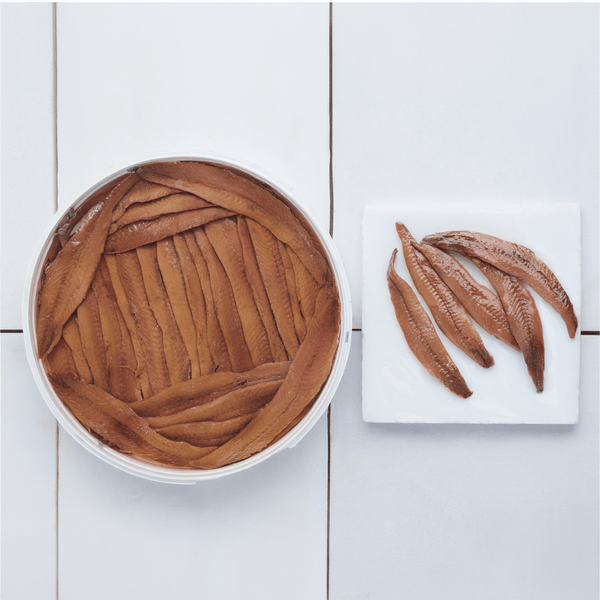
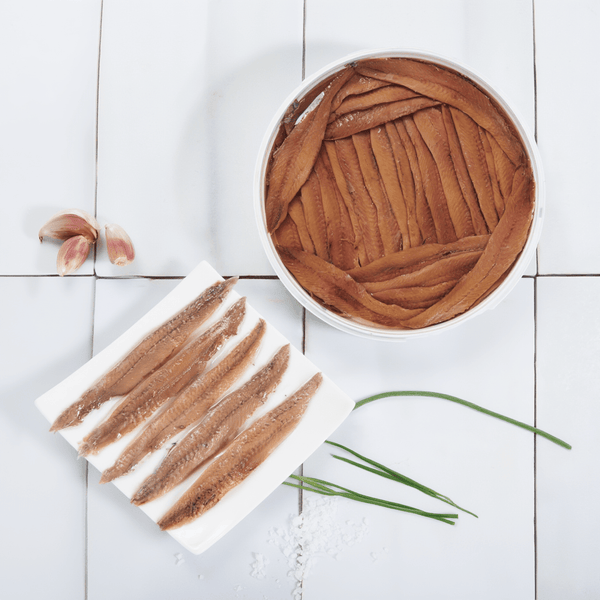
Cantabrian anchovies are fillets of European anchovy (Engraulis encrasicolus) fished in the Cantabrian Sea, cured in salt, and packed in olive oil. It is a denomination of origin that indicates both the origin of the fish and a manufacturing tradition that has more than a century of history on the northern coast of Spain.

The Cantabrian Sea is a cold sea, with strong currents and an ecosystem rich in plankton. These conditions produce anchovies with an optimal fat profile: enough to provide a melt-in-your-mouth texture and intense flavor, but not so much as to be cloying. It is this combination of cold waters, natural feeding, and the genetics of the European anchovy that makes Cantabrian anchovies considered the best in the world for salting.
At Bacalalo, we work exclusively with Cantabrian anchovies of artisanal production, selected for their size, texture, and flavor. We believe that a good anchovy is one of the great gastronomic pleasures: simple, direct, and unforgettable.
The species: Engraulis encrasicolus
The European anchovy (Engraulis encrasicolus) is a small pelagic fish (8-20 cm) that lives in large schools in the eastern Atlantic and the Mediterranean. In Spain, it is known as bocarte or boquerón when fresh, and as anchoa when cured in salt and packed in oil.
What makes this species special for salting is its fat and muscle proportion. The European anchovy has firm, compact flesh that withstands the curing process well without falling apart, and its fat (which varies by season) develops complex umami flavors during maturation. Anchovies caught in spring ("costera" fishing season) have the optimal fat content for salting.
The fishing season: "la costera"
The anchovy fishing season ("costera") in the Cantabrian Sea occurs between April and June, when schools of anchovies migrate to the coast to feed and reproduce. It is during these months that the fish has the ideal fat proportion and is caught at its best.

The fishing season is strictly regulated by the European Union to ensure the sustainability of the resource. There are catch quotas, temporary bans, and minimum sizes. In recent years, after a population collapse in 2005-2010 that forced the closure of the fishery, populations have recovered, and the fishing season has again been productive, although never to the level of previous decades.
Canneries buy fresh anchovies in the fish markets of Santoña, Laredo, Castro Urdiales, Bermeo, Getaria, and other Cantabrian ports. The quality of the raw material depends on the time of capture, the size of the pieces, and how quickly they are brought to the factory. The best anchovies are salted on the same day they are caught, guaranteeing maximum freshness.
Related Products from Bacalalo


Production areas in Spain
Santoña and Cantabria
The most famous and traditional area. Santoña is the undisputed capital of Spanish anchovies, with more than 40 canneries. Also Laredo, Colindres, and Castro Urdiales.
Basque Country
Getaria, Bermeo, Ondarroa, and Mundaka have their own canning tradition. Basque anchovies tend to be saltier and cured for longer. The quality is comparable to those from Santoña.
L'Escala (Catalonia)
L'Escala, on the Costa Brava, has an anchovy tradition of over 100 years, with Italian influence similar to Santoña. L'Escala anchovies are excellent and have their own designation. Although the anchovy usually comes from the Cantabrian Sea, the production is Catalan.
Asturias and Galicia
Less anchovy canning tradition, but there are quality artisanal producers gaining recognition.
From sea to can: the production process
- Receiving and classification: Fresh anchovies arrive at the factory and are classified by size. Large pieces (8-10 cm+) go to premium ranges.
- Heading and evisceration: The head and viscera are removed, leaving the body clean.
- Salting in barrels: Alternate layers of anchovy and sea salt in plastic or wooden barrels. Pressed with weights. The salt initiates the curing.
- Maturation (6-18 months): During this time, the fish enzymes and salt transform the texture and flavor. The fish darkens, firms up, and develops complex umami notes. Controlled temperature (12-18 °C).
- Washing: Salt is removed, and the fish are washed in a mild brine.
- Manual filleting: "Sobadoras" (skilled workers) separate the fillets from the central bone, remove the skin, and clean each piece. It is manual labor requiring skill and speed.
- Packaging: The fillets are neatly placed in cans or jars and covered with olive oil. They are vacuum-sealed.
Signs of quality (and poor quality)
Good signs
- Uniform coppery pink color
- Whole fillets, without breaks or fraying
- Firm texture that melts in the mouth
- Clean flavor: salty with umami, without bitterness or rancidity
- Clean and transparent oil
Bad signs
- Very dark color (brown or gray): excessive curing or poor raw material
- Broken, frayed fillets or with visible bones: poor filleting
- Rubbery or pasty texture: poor curing
- Bitter, metallic, or rancid taste: oxidation or old product
- Cloudy oil or with residue: deficient packaging
Packaging formats
- Round can (8-14 fillets): the most classic format. Protects from light. Formats from 50 g to 100 g.
- Glass jar: allows you to see the product. More elegant. Better for gifts. Same quality.
- Large can (20-40 fillets): for catering or family consumption. Better value for money per gram.
- Salted fillets (not packed in oil): product in salt, for cleaning and home use. More artisanal, saltier. Requires prior preparation.
Cantabrian anchovies vs. other anchovies
In the supermarket, you will find anchovies at very different prices. The main differences are in the origin of the fish and the process:


- Cantabrian (Spain): Engraulis encrasicolus. Long artisanal curing. High price (60-150 €/kg). Premium quality.
- Mediterranean (Spain, Italy, Croatia): same species. Variable quality. Generally less curing. Medium price (30-60 €/kg).
- Argentina: Engraulis anchoita. Different species, decent quality, low price. Widely used for private labels.
- Peru/Chile: Engraulis ringens (anchoveta). Lower quality for salting. Very low price. The cheapest anchovies on the market.
- Morocco: same species as European. Quality on the rise. Competitive price. Some Spanish canneries produce there.
Why is there such a price difference?
A 50g can can cost from €1.50 to €15. The difference is explained by:
- Origin of the fish: Cantabrian anchovy vs. Pacific anchoveta. The cost of raw material can differ 5-10x.
- Curing time: 6 months vs. 12-18 months. More time = more storage, more shrinkage, more cost.
- Filleting: manual (Santoña) vs. mechanical (industry). Manual filleting is slow and expensive.
- Selection: premium ranges discard 30-50% of pieces that do not meet standards. Economic ranges use everything.
- Oil: extra virgin olive oil vs. refined vs. sunflower. The cost difference is significant.
In short: you pay for craftsmanship, time, and selection. An anchovy in a €10 can has undergone a 12+ month process and has passed through the hands of specialized people at each step. An anchovy in a €1.50 can has been industrially produced in weeks.
Storage and shelf life
Cantabrian anchovies are a salt-cured product, which gives them a long shelf life if stored correctly:
- Closed can or jar: store in a cool, dry place (pantry, 15-20 °C). Refrigeration is not necessary. The best-before date is usually 2-3 years from packaging, but well-preserved anchovies can be perfect long after this date.
- Once opened: transfer to a glass container with olive oil covering the fillets. In the refrigerator, consume within 5-10 days. The main enemy is oxidation: fillets not covered in oil will darken and change flavor.
- Do not freeze: freezing alters the texture of cured anchovies. It is not recommended.
- Serving temperature: remove from the refrigerator 10-15 minutes before consuming so that the oil becomes fluid and the aromas unfold.
An interesting fact: canned anchovies, like good wines, can improve with age. Some canneries sell specific vintages (anchovies cured for 18-24 months) that achieve extraordinary flavor complexity, with notes of dried fruits and a deep umami reminiscent of cured Iberian ham.
The oil in the can also has value: it is impregnated with the flavor of the anchovies and is delicious for dressing salads, pasta, or toast. Don't waste it.
Uses in cooking
- Appetizer: alone on toast, the noblest and most direct use.
- Pintxos: gildas, matrimonios, skewers with olives and chili.
- Salads: Caesar, Mediterranean, Catalan (with escalivada).
- Pasta: puttanesca, aglio e olio with anchovies, bagna cauda.
- Pizzas: anchovy is a classic pizza topping (Napoletana).
- Sauces: green sauce, tapenade, anchovy butter, salad dressings.
- Meats: vitello tonnato (with tuna and anchovies), lamb with anchovies (Provençal cuisine).
Conclusions
- What are Cantabrian anchovies?: Cantabrian anchovies are fillets of European anchovy (Engraulis encrasicolus) fished in the Cantabrian Sea, cured in salt, and packed in olive oil.
- The species: Engraulis encrasicolus: The European anchovy (Engraulis encrasicolus) is a small pelagic fish (8-20 cm) that lives in large schools in the eastern Atlantic and the Mediterranean.
- The fishing season: "la costera": The anchovy fishing season in the Cantabrian Sea occurs between April and June, when schools of anchovies migrate to the coast to feed and reproduce.
- Production areas in Spain: The most famous and traditional area.
- From sea to can: the production process: In the supermarket, you will find anchovies at very different prices.
Frequently asked questions
Are all Cantabrian anchovies the same?
No. The fish is the same, but the quality varies enormously depending on the cannery: curing time, selection, manual or mechanical filleting, type of oil. There are excellent and mediocre Cantabrian anchovies.
Can the origin of the anchovy be known?
Regulations require indicating the catch area on the label. "FAO Zone 27 Subarea VIII" indicates Cantabrian Sea/Bay of Biscay. If another zone is indicated (e.g., FAO 34, 37, 41), the fish is not from the Cantabrian Sea. The difference is explained by: Origin of the fish: Cantabrian anchovy vs. Pacific anchoveta.
Do anchovies expire?
Canned anchovies have a best-before date (not an expiration date). Unopened, they can be good for years after the date. Once opened, consume within 5-10 days, covered in oil, in the refrigerator.
Are Cantabrian anchovies sustainable?
The Cantabrian anchovy fishery is regulated with quotas, closed seasons, and minimum sizes. Following the collapse of 2005-2010, management has improved and populations have recovered. Look for MSC certified brands if sustainability is a priority for you.
How many anchovies are in a can?
It depends on the format. A 50g net can usually contains 6-10 fillets. A 100g can, 14-20 fillets. It varies depending on the size of the anchovies and the brand. The species: Engraulis encrasicolus The season: fishing season Processing areas in Spain From sea to can: processing method Quality (and poor quality) signals Packaging formats Cantabrian Anchovies vs other anchovies Why is there such a price difference?
Try our artisanal Cantabrian anchovies at Bacalalo.