Quick answer: Anchovies and "boquerones" (fresh anchovies) are the same fish (Engraulis encrasicolus). The difference is in the preparation: "boquerones" are consumed fresh or marinated in vinegar; anchovies are the same fish cured in salt for months and then packed in olive oil. They are the same species, but two totally different products in terms of taste, texture, and price.
The same fish, two different products
The confusion between anchovies and "boquerones" is one of the most common in Spanish gastronomy, and it has a simple explanation: they are the same fish. The Engraulis encrasicolus, a small oily fish of the Engraulidae family that lives in the Atlantic and the Mediterranean.
So, why do they have different names? Because the Spanish language distinguishes between the fresh fish and the processed fish:
- Boquerón: the fresh fish, as it comes from the sea, or marinated in vinegar
- Anchoa: that same fish after being cured in salt for months and packed in oil
It's like talking about grapes and wine: the same raw material, a completely different product after processing. A fresh "boquerón" from the market becomes an anchovy after an artisanal salting process that can last between 6 and 12 months.
This distinction is exclusive to Spanish. In English, both are anchovy. In French, anchois. In Italian, acciuga. Only we have two names for the same animal, which says a lot about the importance of both preparations in our gastronomic culture.
What is a "boquerón" (fresh anchovy)
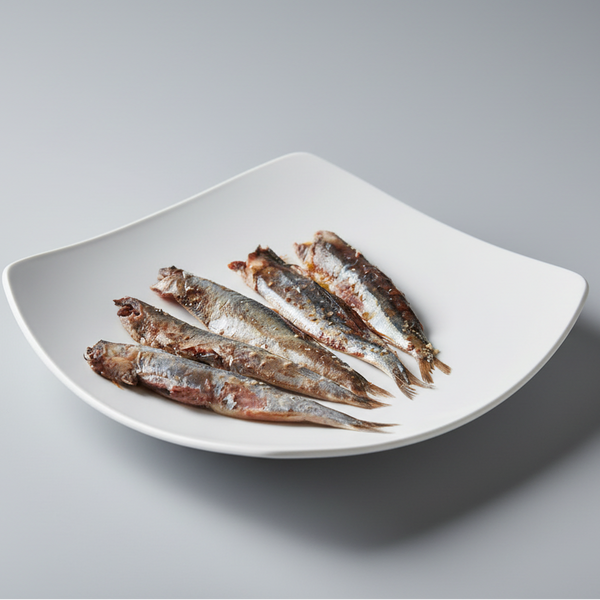
A "boquerón" is the name given to Engraulis encrasicolus when it is consumed fresh, fried, or marinated in vinegar. It is a small oily fish (10-15 cm), elongated, with a bluish-green back and a silvery belly. It lives in huge schools in temperate waters and is caught with purse seines, especially in spring and summer.
Main preparations of "boquerón"
- Boquerones en vinagre: The most famous preparation. The fillets are marinated in vinegar for 6-12 hours until the flesh turns white and firm, and are seasoned with garlic, parsley, and extra virgin olive oil. It is one of Spain's most iconic tapas.
- Fried boquerones: Floured and fried in abundant hot olive oil. Crispy on the outside, juicy on the inside. A classic of Andalusian fry shops.
- Grilled boquerones: Whole, with a squeeze of lemon. Simple and delicious.
- Boquerones en escabeche: Cooked and preserved in a sauce of vinegar, oil, bay leaf, and spices.
Fresh "boquerón" has a delicate sea flavor, a soft texture, and a fat content that varies with the season (fattier in summer, leaner in winter). It is an economical, nutritious, and versatile fish.
What is an anchovy
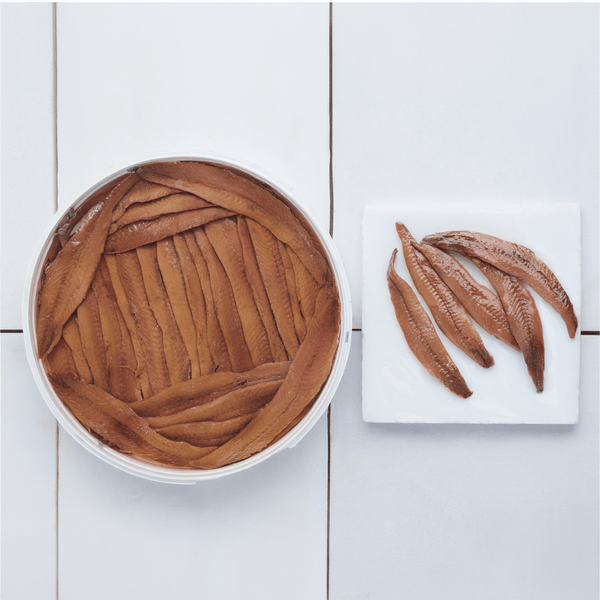
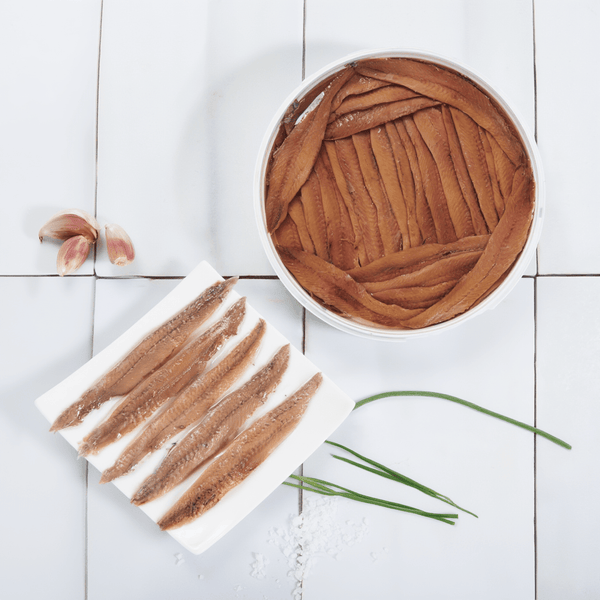
An anchovy is the result of curing that same "boquerón" in salt for 6 to 12 months. During that time, the fish's natural enzymes and the action of the salt completely transform the flesh: its color changes (from silvery to reddish-brown), its texture (from soft to firm and buttery), and its flavor (from mild to intense, complex, and with deep umami).
After curing, the anchovies are cleaned, filleted by hand, skin and bones are removed, and they are packed in olive oil. The result is a gourmet product with an incomparable flavor: salty, intense, with nutty notes and an umami that makes them one of the most powerful flavor enhancers in Mediterranean cuisine.
Anchovy formats on the market
| Format | Description | Best for |
|---|---|---|
| In olive oil (can/jar) | Clean fillets ready to eat | Direct consumption, toasts, salads |
| Salted (large can) | Whole anchovies in salt, need to be cleaned | Professional cooking, saving in large quantities |
| In vinegar | Fillets in vinegar and oil | Softer alternative to classic ones |
From "boquerón" to anchovy: the production process
Understanding how a "boquerón" becomes an anchovy helps to understand why they are such different products and why anchovies cost what they do.
1. Selection and heading
The "boquerones" arrive fresh from the fish market, ideally caught in spring (April-June), when they have the ideal fat content for maturation. Damaged ones are discarded, and they are headed one by one by hand, removing the guts with the head.
2. Packing in salt
The headed "boquerones" are arranged in alternating layers with coarse sea salt in barrels or large cans. The proportion is approximately 30% salt to the weight of the fish. They are pressed so that the salt acts uniformly.
3. Maturation (6-12 months)
This is the key step. For months, the fish's own proteolytic enzymes slowly break down proteins, creating free amino acids (responsible for umami flavor), peptides, and complex aromatic compounds. Salt controls the speed of this process and acts as a preservative. The color changes from silvery to reddish-brown, and the texture becomes firm and buttery.
4. Cleaning and filleting
After maturation, each anchovy is cleaned by hand: the skin, central spine, and any remaining salt are removed. Each "boquerón" is separated into two fillets. This work is done by hand by specialized female workers (sobadoras) and is the most laborious phase of the process.
5. Packing in oil
The clean fillets are carefully placed in cans or glass jars and covered with olive oil (extra virgin in premium brands, refined in more economical ones). They are hermetically sealed.
From one kilo of fresh "boquerones", approximately 200-250 g of anchovies in oil are obtained. This low yield — coupled with months of maturation and manual labor — explains the price of quality anchovies.
Flavor and texture comparison
| Characteristic | Boquerón (fresh/vinegar) | Anchovy (salt-cured) |
|---|---|---|
| Flavor | Mild, marine, clean. Acidic if in vinegar | Intense, salty, deep umami, nutty notes |
| Texture | Soft and tender (fresh) or firm (in vinegar) | Firm, buttery, melts in the mouth |
| Color | Silvery (fresh) or white (in vinegar) | Dark reddish-brown |
| Aroma | Fresh sea, vinegar, garlic | Complex, cured, olive oil |
| Intensity | Low-medium | High |
The flavor of anchovies is incomparably more complex than that of "boquerón". The curing process creates hundreds of aromatic compounds that do not exist in the fresh fish: glutamic acid (responsible for umami), histidine, and volatile compounds reminiscent of nuts, butter, and cured cheese. It is this complexity that makes anchovies such a valued ingredient in high cuisine.
Nutritional comparison: anchovies vs "boquerones"
| Nutrient (per 100g) | Fresh boquerón | Anchovy in oil |
|---|---|---|
| Calories | 131 kcal | 210 kcal |
| Protein | 20 g | 29 g |
| Total fat | 5 g | 10 g |
| Omega-3 (EPA+DHA) | 1.4 g | 1.6 g |
| Sodium | 100 mg | 3,600 mg |
| Iron | 1.0 mg | 4.6 mg |
| Calcium | 77 mg | 232 mg |
| Vitamin B12 | 6.2 mcg | 3.7 mcg |
Both are excellent sources of omega-3, high-quality proteins, and minerals. The main differences:
- Sodium: Anchovies have 36 times more sodium than fresh "boquerón" due to salt curing. People with hypertension should moderate their consumption.
- Protein: Anchovies have 45% more protein due to concentration during curing (the fish loses water).
- Iron and calcium: Anchovies are significantly richer in these minerals, also due to the concentration from curing.
- Calories: Anchovies in oil have more calories due to the olive oil fat. If well drained, the difference is reduced.
Price comparison: why anchovies cost more
The price difference between anchovies and "boquerones" is enormous and has real justification:
| Product | Approximate price | Price factors |
|---|---|---|
| Fresh boquerón (kg) | 5-10 €/kg | Season, origin, freshness |
| Boquerones en vinagre (tray) | 8-15 €/kg | Labor for cleaning and filleting |
| Anchovies (mid-range) | 40-70 €/kg | 6-12 months curing + manual filleting |
| Premium Cantabrian anchovies | 80-150 €/kg | Premium raw material + artisanal process + brand |
Why can an anchovy cost 15 times more than a "boquerón"?
- Yield: From 1 kg of fresh "boquerones", only 200-250 g of anchovies are obtained. 75% is lost in heads, guts, bones, skin, and water.
- Time: A minimum of 6 months of maturation in salt, occupying space in temperature-controlled warehouses.
- Manual labor: Each anchovy is cleaned, filleted, and packed by hand. An experienced worker processes about 10 kg of salted anchovies per day.
- Selection: Only "boquerones" of the right size and fat content are suitable for quality anchovies. Not just any "boquerón" will do.
- Spoilage: Some barrels do not mature correctly and are discarded entirely.
When to use each: a practical guide
Use "boquerones" when...
- You want a fresh and light tapa: Boquerones en vinagre are perfect for summer appetizers.
- You are looking for an economical fish: Fried "boquerones" are one of the cheapest and most delicious options on the market.
- You are cooking for many people: Fried or baked "boquerones" go a long way and are inexpensive.
- You prefer a mild flavor: For palates that do not enjoy intense and salty flavors.
Use anchovies when...
- You are looking for a powerful flavor in a small amount: 2-3 anchovy fillets transform an entire dish.
- You want a gourmet appetizer: Anchovies alone on toast with butter are an unparalleled pleasure.
- You are cooking sauces: Anchovies dissolved in hot oil add deep umami to sauces, dressings, and sofritos.
- You are preparing special dishes: Caesar salad, gildas, pizza, Piedmontese bagna cauda.
Cantabrian Anchovies selected by Bacalalo


Cantabrian Anchovies: Why they are special
When talking about quality anchovies, Cantabrian anchovies are the gold standard. But what truly differentiates them from anchovies from other origins?
The raw material
The anchovy from the Cantabrian Sea (Engraulis encrasicolus) reaches a larger size than that from the Mediterranean thanks to the cold, nutrient-rich waters of the North Atlantic. A larger size means bigger, meatier fillets with a better meat-to-bone ratio.
The canning tradition
The Cantabrian canning industry, concentrated in towns like Santoña, Laredo, Castro Urdiales, and Getaria, has over 100 years of tradition. Families who have spent generations perfecting the salting process pass down knowledge that cannot be learned from books.
The artisanal process
The best Cantabrian anchovies are still made by hand: manual heading, artisanal packing in salt, controlled maturation, and "sobado" (filleting) by expert workers. This manual process allows for the selection of each piece and the discarding of those that do not meet the standard.
Grades and qualities
Cantabrian anchovies are classified by grade (fillet size):
| Grade | Size | Characteristics | Relative Price |
|---|---|---|---|
| 00 | Very large (+9 cm) | Premium, meaty, more intense flavor | €€€€ |
| 0 | Large (7-9 cm) | Excellent quality, good size | €€€ |
| I | Medium (5-7 cm) | Good value for money | €€ |
| II | Small (<5 cm) | Ideal for cooking, affordable price | € |
In our collection of Cantabrian anchovies, we work directly with artisanal producers from Santoña to offer 00 and 0 grades with maximum freshness and traceability.
How to choose good anchovies: 5 signs of quality
Not all anchovies are created equal. These are the indicators that distinguish a premium anchovy from a mediocre one:
- Color: A good anchovy has a homogeneous reddish-brown color, without dark or whitish spots. If they are too dark, they may be over-cured.
- Texture: Firm but dissolves smoothly when bitten. If it's gummy, it's low quality. If it breaks when lifted, it may be over-cured.
- Aroma: Of clean cured fish, with nutty notes. If it smells strongly of rancid fish or ammonia, discard it.
- Fillet size: Look for whole fillets, without breaks. Broken fillets often indicate a careless filleting process.
- Oil: The oil should be clear and clean. If it's cloudy or has sediment, the preserve may be in bad condition or have been open for too long.
Discover our Cantabrian anchovies
Directly selected from artisanal producers in Santoña. 00 and 0 grades with a minimum curing time of 10 months. Refrigerated shipping within 24-48h.
Frequently asked questions about anchovies and marinated anchovies
Conclusion
Anchovies and marinated anchovies are the same fish but two different gastronomic worlds. Marinated anchovies are freshness, lightness, and versatility. Anchovies are intensity, complexity, and a flavor that only months of artisanal curing can create.
It's not about choosing one over the other, but knowing when to use each. Marinated anchovies are the perfect tapa for a Sunday vermouth. Anchovies on toast with butter are an appetizer that can rival any high-cuisine dish. And in cooking, two anchovy fillets dissolved in a soffritto add a depth of flavor that no other ingredient can match.
At Bacalalo, we have been selecting top-quality seafood products since 1990. Our Cantabrian anchovies come directly from artisanal producers in Santoña, with a minimum curing time of 10 months and 00 and 0 grades. Because the difference between correct anchovies and exceptional ones is the same as between a fresh anchovy and one from the day before yesterday: you notice it in the first bite.