

![Anchoas de Santoña: Guía de Marcas y Precios [2026]](http://bacalalo.com/cdn/shop/articles/d17d440596b0cf8fda981241534720c0.jpg?v=1780954297&width=480)
Summary
If you're looking for quality gourmet Bacalalo cod, we ship it refrigerated all over Spain in 24-48 hours.
Santoña is a fishing village in Cantabria with 11,000 inhabitants that produces some of the best anchovies in the world. In this guide: Why Santoña and not somewhere else, The denomination: what it protects and what it doesn't, The 10 most important brands: analysis and prices.
Santoña Anchovies: Brand and Price Guide [2026]
Santoña is a fishing village in Cantabria with 11,000 inhabitants that produces some of the best anchovies in the world. It is no exaggeration: Santoña anchovies have an international reputation, appear on the tables of the best restaurants in Europe, and are exported to Japan, where umami is understood like few other things. At Bacalalo, we have been working with Cantabrian producers for years and know how to distinguish what is worthwhile from what is not. This guide gives you the real information to make a good purchase.
The problem with the anchovy market is that the label "de Santoña" has become a marketing term that doesn't always reflect reality. You have to be able to read beyond the name.
Why Santoña and not somewhere else
Geography matters. Santoña is at the mouth of the Asón river, in Santoña Bay, surrounded by mountains that create a microclimate with high humidity and stable temperatures. But what truly makes Santoña anchovies unique is the combination of three factors:
The Cantabrian anchovy (Engraulis encrasicolus): The same species as in the Mediterranean, but with different characteristics. The Cantabrian Sea is colder (between 12 and 18 degrees in summer), which forces the anchovy to accumulate more subcutaneous fat to survive. More fat means more flavor, more texture, and a slower, more complex curing process.
The fishing season: Santoña anchovies are caught between April and June, when the anchovy migrates to the Cantabrian Sea from the South Atlantic. At that time, the fish has between 18 and 24 grams of fat per 100 grams. Out of season, the fat content drops to 4-8 g/100g, and the quality is not comparable.
The artisan salting process: The anchovy is cleaned by hand (removing head and guts), pressed into barrels alternating layers of salt and fish, and left to cure for 8 to 18 months. During this time, the fish's own enzymes transform proteins into amino acids and peptides that generate the characteristic umami flavor. It is a process that cannot be rushed.
The denomination: what it protects and what it doesn't
Santoña anchovies do not have a Protected Designation of Origin (DOP) or a Protected Geographical Indication (IGP). This means that any manufacturer can put "Santoña style" or even "from Santoña" on their label, even if the anchovy is from the Mediterranean or the Pacific and has been cured in another province.
What does exist since 2004 is the collective brand "Anchoa del Cantábrico" (Cantabrian Anchovy), which certifies that the anchovy comes from the Cantabrian Sea and is processed in the area. This distinction does not appear on all labels because not all producers have applied for it, but it is a real guarantee of origin when it does appear.
How to identify an authentic Cantabrian anchovy:
- The label indicates "Engraulis encrasicolus" and "Mar Cantábrico" or "Golfo de Vizcaya"
- The number of fillets per can is low: between 6 and 12 fillets per 50g can
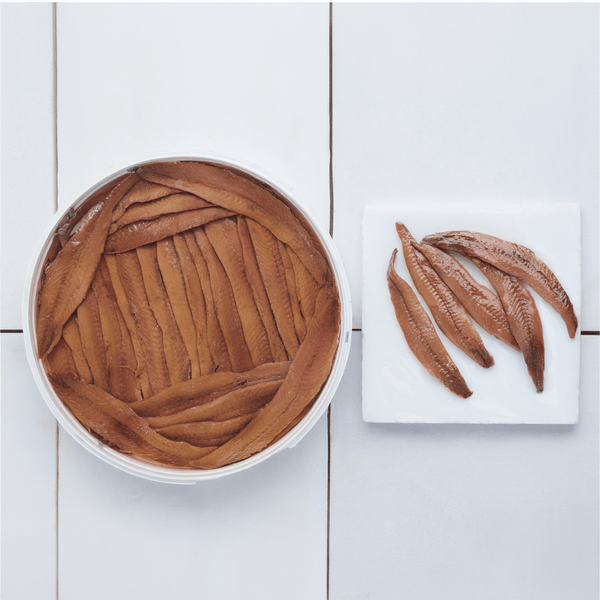
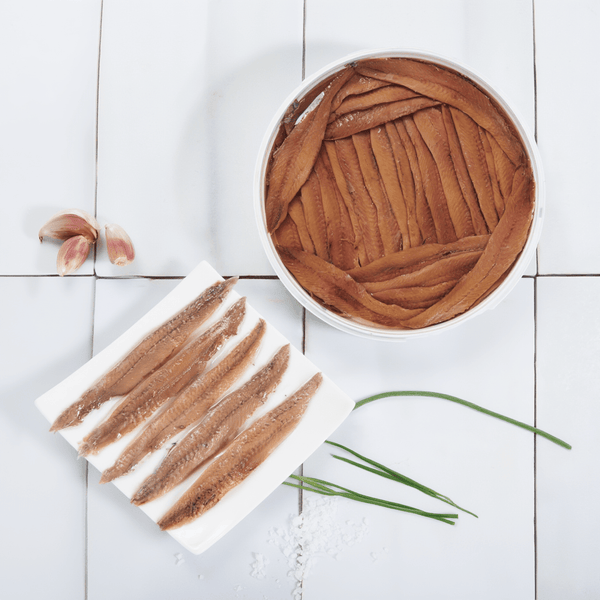
- The color is chestnut brown, not grey or pink. The color comes from the long curing process
- The oil is olive oil (not sunflower oil in quality ones)
- The price is not less than 3 euros per 50g can for entry-level category
The 10 most important brands: analysis and prices
The Santoña anchovy market has about 30 active brands. These are the most relevant in terms of quality, distribution, or value for money:
1. Ortiz (El Velero): The most internationally known brand. It has been in the Cantabrian Sea since 1891. Its L-12 anchovy (12 fillets per 47g can) is the benchmark for serious entry-level, at about 4-5 euros. The "El Velero" range is its premium line, with 8 large fillets per can, at 8-10 euros.
2. Olasagasti: A San Sebastián brand with great prestige in the sector. It works with both anchovies and bonito. Its 00 anchovy (extra large caliber, less than 7 fillets per 45g can) is one of the best on the market, cured for 14-16 months. Price: 10-14 euros.
3. Conservera premium de Santoña: Local producer with high-end products highly valued in restaurants. Its anchovies are distinguished by their extra caliber and long curing (up to 18 months). Price: 12-18 euros per premium can.
4. Cooperativa artesanal de Santoña: One of the benchmarks for authentic local production. Less marketing, more product. Price: 6-10 euros, excellent value for money.
5. Serrats: Family brand from the Basque Country. Highly valued for its consistent quality year after year. Price: 7-12 euros depending on caliber.
6. Conservera artesanal premium: Very high-end anchovies, with selective curing and raw material control. Its 100g cans with 8-10 fillets are 18-25 euros. For collectors and gourmets.
7. Bacalalo Gourmet: Brand that works with selected Cantabrian producers. Good value for money for entering the artisan market. Price: 3.95-7 euros.
8. Otra conservera premium: Traditional producer. Average price: 8-12 euros.
9. Conservera histórica: Catalan producer that also works with Cantabrian anchovies. Price: 5-9 euros.
10. Supermarket private labels (El Corte Inglés Seleqtia, Carrefour Selección): They usually work with Santoña or Cantabrian producers under contract. Price: 4-7 euros. Quality has improved significantly in recent years.
Bacalalo Products

Cantabrian Anchovies in Olive Oil - 50g...
3,95 €

"Deluxe Cantabrian" Assortment
67,00 €

Artisan Cantabrian Anchovy Gilda
9,90 ��

Bonito del Norte Belly - 190g | Olasagasti
16,95 €
Refrigerated shipping 24-48h to the entire Peninsula
How to read the label: calibers and categories
The calibers of Santoña anchovies are expressed as the number of fillets per kilogram or per can. The smaller the number, the larger the caliber and, generally, the higher the quality:
- Caliber 00 or extra: Less than 20 fillets per kg. These are large anchovies, with a long curing period and a high price. These are the ones served in the best restaurants.
- Caliber 0: Between 20 and 25 fillets per kg. Excellent quality, the optimal point for gourmet home use.
- Caliber 1: Between 25 and 35 fillets per kg. Good quality anchovy, perfect for cooking and as an appetizer.
- Calibers 2, 3, 4: Smaller anchovies, lower price, suitable for pizzas, pâtés, and preparations where size doesn't matter.
In a 50g can, the equivalent is: caliber 00 = 6-8 fillets, caliber 0 = 8-12 fillets, caliber 1 = 12-16 fillets, caliber 2 = 16-20 fillets.
How to store and serve Santoña anchovies
Proper storage makes the difference between an anchovy that tastes good and one that disappoints. For canned Santoña anchovies:
- Before opening: at room temperature, in a cool, dark place. They last several years in a sealed can.
- After opening: covered with the original oil, in an airtight container in the refrigerator. They last up to 2 weeks.
- To serve: take them out of the refrigerator 15 minutes beforehand. Cold oil thickens the texture and masks the aroma.
The oil in which the anchovies come is as valuable as the anchovies themselves. Don't throw it away: use it to dress salads, to dip bread, or to finish a pasta dish. It has all the umami of the anchovy in liquid form.
For presentation:
- On a slice of bread with grated tomato (the classic Catalan combination)
- On butter with a touch of black pepper
- With roasted piquillo peppers
- As a topping for a warm potato salad
Santoña anchovies vs other anchovies in the world
Competition mainly comes from four origins:
Anchovies from the Spanish Mediterranean: Mainly from Roses (Girona) and L'Escala. Very good quality, similar curing but with smaller and less fatty anchovies than those from the Cantabrian Sea. Similar price. For culinary use, they are interchangeable; for pure tasting, the Cantabrian wins in complexity.
Italian anchovies (acciughe di Cetara): Cetara, on the Amalfi Coast, produces exceptional quality brined anchovies, especially its "colatura di alici" (the fermented liquid extracted from the process, equivalent to Roman garum). High price, limited distribution in Spain.
Anchovies from Peru and Argentina: Much cheaper, industrial production. These are used in chain pizza, basic supermarket anchovy fillets, and burger sauces. The quality difference with Santoña anchovies is enormous.
Anchovies from Norway: Irregular quality. Some Norwegian producers make good quality anchovies with North Atlantic anchovies, but they do not have the level of artisan curing of the Cantabrian Sea.
Bacalalo Products
Cantabrian Anchovies AOVE - 50g
3,95 €
"Deluxe Cantabrian" Assortment
67,00 €
Artisan Cantabrian Anchovy Gilda
9,90 €
Bonito del Norte Belly - Olasagasti
16,95 €
Refrigerated shipping 24-48h to the entire Peninsula
🛒 Products mentioned in this article
⭐ 4.9/5 · Cold shipping 24-48h · Since 1990 at Mercat del Ninot
Frequently asked questions about Santoña anchovies
Are all anchovies that say "from Santoña" actually from Santoña?
No. As there is no PDO or PGI, the term "from Santoña" or "Santoña style" can be used by any producer. To verify that they are authentic from the Cantabrian Sea, look on the label for the species indication (Engraulis encrasicolus), catch area (Cantabrian Sea or Bay of Biscay) and, if available, the collective brand "Anchoa del Cantábrico".
How long do Santoña anchovies last in an unopened tin?
Anchovies in tin cans with olive oil last perfectly well between 3 and 5 years from the packing date. The best before date on the tin is conservative: a well-cured anchovy in quality oil can be in perfect condition beyond that date. The real indicator is the appearance (uniform brown color, no gray areas) and the smell (marine and salty, never rancid).
What is the difference between anchovies in oil and salted anchovies?
Salted anchovies are those that arrive at the producer directly from the boat, pressed in salt without further processing. They must be washed, desalted, and put in oil before eating. It is the purest form and the one professionals use. Tinned anchovies are ready to eat: they have been cleaned, desalted, and packed in oil at the factory. The difference in taste is minimal in good brands; the convenience, enormous.
Why are some anchovies darker than others?
The color of anchovies ranges from salmon pink (short curing, less than 6 months) to dark brown, almost black (long curing, more than 14 months). Quality Santoña anchovies have a uniform chestnut brown color. Those that are too light indicate insufficient curing; those with gray or greenish areas may indicate storage problems.
How many Santoña anchovies do I eat per serving?
For an appetizer, 3-4 fillets per person are sufficient if accompanied by bread. For a main course featuring preserves, between 8 and 12 fillets per person is typical. A 50g tin with 8-10 size 00 fillets is perfect for 2-3 people as an appetizer.
Are Santoña anchovies good for your health?
Cantabrian anchovies are rich in omega-3 (especially EPA and DHA), vitamin D, vitamin B12, and minerals like selenium and phosphorus. The caloric content is moderate: about 210 kcal per 100g. The point to watch is sodium: a 30g serving of anchovies provides approximately 1,200-1,500 mg of sodium, which represents 60-75% of the recommended daily intake. People with high blood pressure should consume them in moderation.
Which wine pairs best with Santoña anchovies?
The classic pairing is Basque txakoli: its acidity, slight effervescence, and low alcohol cleanse the palate between bites and complement the umami of the anchovy without competing with it. Other options that work: Manzanilla from Sanlúcar de Barrameda (the sea salt of the Manzanilla connects with the salt of the anchovy), young Albariño, or a Brut Nature Cava. Avoid tannic red wines, which clash with the saltiness and fish.