Summary
Cod kokotxas are one of those products that cause confusion at the time of purchase precisely because quality varies greatly between suppliers and because there are few public and clear criteria to evaluate it. In this guide: The 5 criteria for evaluating kokotxa quality, Kokotxas in traditional markets vs. online, What kokotxa formats will you find?.
Cod kokotxas are one of those products that cause confusion at the time of purchase precisely because quality varies greatly between suppliers and because there are few public and clear criteria to evaluate it. You can find kokotxas in a supermarket, in a local fishmonger, in a municipal market or in a specialized online store, and the quality difference between these four options can be enormous even if the price is similar.
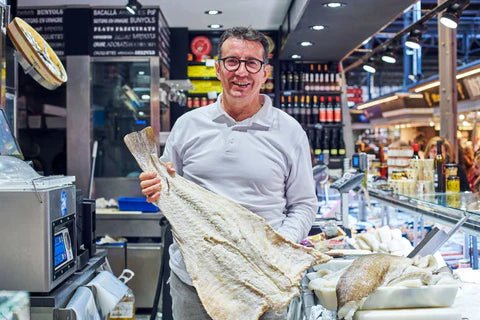
This guide stems from 35 years of working with cod at the Mercat del Ninot in Barcelona. It is not a marketing text: it is an honest attempt to convey the criteria we use to evaluate and select the kokotxas that arrive at our stall, so that you can apply them anywhere you buy.
The 5 criteria for evaluating kokotxa quality
Before talking about where to buy, it's important to be clear about what we're looking for. These five criteria are what make the difference between kokotxas that will work in the pan and those that will disappoint, regardless of the recipe:
1. Species: Gadus morhua as a reference
The reference cod kokotxa comes from North Atlantic cod, whose scientific name is Gadus morhua. This species has a collagen and fat profile that makes it especially suitable for sauce preparations, and it is the one behind classic Basque and Catalan kokotxa dishes.
Other species are sold under the commercial name "cod" and used for cheaper kokotxas: blue whiting (Micromesistius poutassou), pollock (Pollachius virens), or even Pacific cod (Theragra chalcogramma). These species are legitimate and have their uses, but they have a different collagen profile that results in less ability to thicken sauces, a softer texture, and less pronounced flavor. If the recipe is pil pil or green sauce, the difference is noticeable.
2. Size and uniformity
The size of the kokotxas is directly proportional to the size of the cod they come from. Large cod, 4-8 kg cleaned, produce good-sized kokotxas (6-10 cm long) with more flesh and more collagen per piece. Juvenile or small cod produce tiny kokotxas which, although they have the same flavor, yield much less per kilo and are more difficult to handle during cooking.
Uniformity of size in the batch also matters: if the pieces vary greatly, it means that the supplier has not made a careful selection or that they are mixing different sizes or even different catch batches.
3. Color and visual appearance
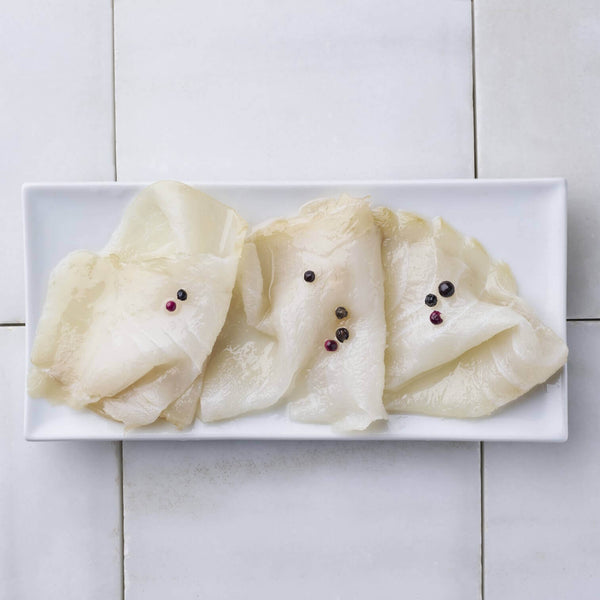
The correct color of fresh kokotxas is whitish-pink, clean and uniform. For desalted kokotxas, the color should be pearly white, without gray spots. A yellowish color in any format is a sign of fat oxidation, especially in cured cod, and results in a rancid taste that no amount of cooking can correct.
4. Proper desalting of cured kokotxas
For kokotxas from cured dried cod, the desalting process is crucial for the final result. Insufficient desalting leaves the product too salty; excessive desalting removes some of the characteristic flavor imparted by curing. The correct point is achieved by changing the water every 8-12 hours, in the refrigerator, and for a period that varies depending on the thickness of the piece.
When you buy commercially desalted kokotxas, this process has been carried out under controlled conditions. But not all suppliers do it the same way. The quality criterion here is the salt point of the final product: it should be what chefs call "ready to cook," meaning with enough salinity to season the dish but without the need to add additional salt.
5. The cold chain
The cold chain is not a visible criterion, but its breakdown manifests in clear signs: a strong or ammoniacal odor in fresh ones, accumulated liquid in the packaging of frozen ones, or pieces that fall apart when touched. A serious supplier can explain how the product has been maintained from origin to point of sale. If they cannot or will not answer that question, it is a red flag.
Kokotxas in traditional markets vs. online
Each channel has real advantages and real limitations. Knowing both helps you choose better according to your circumstances:
Traditional markets and specialized fishmongers: The main advantage is that you can see, smell, and ask directly. A good market fishmonger will tell you when the produce arrived, where it comes from, and how to store it at home. Direct contact allows for immediate sensory evaluation that no photo can replace. The limitation is availability: kokotxas are not a product that is always present in all stalls, especially outside large cities or during seasons of scarce catch.
When buying in the market, the three questions you should ask are: what species are they from? when did they arrive? and are they desalted or from dried cod? A fishmonger who answers these questions confidently and in detail is a supplier you can trust. One who cannot answer or gives vague responses deserves caution.
Online stores specializing in cod and seafood products: The advantages are different but equally valuable: guaranteed access to the product regardless of where you live, detailed information on species, origin, and format on the label, and the possibility of choosing between several formats (fresh, desalted, frozen, dried) depending on what you need for each recipe. A good online supplier ships with a guaranteed cold chain and has a clear return policy if the product does not arrive in good condition.
The limitation of the online channel is that you cannot evaluate the product before buying it. That's why the supplier's reputation and the information they provide about the product are more important than the price when buying kokotxas online.
What kokotxa formats will you find?
The market offers kokotxas in four main formats, each with its own characteristics of use, price, and preservation:
- Whole fresh kokotxas: The most direct way to work with the product. Seasonal availability, higher price, and a use window of 24-48 hours. Ideal for classic pil pil when the best possible result is desired. Estimated price: €18-30/kg depending on season and quality.
- Perfectly desalted kokotxas: Already hydrated and with the correct salt point. Cook directly without prior preparation. More stable availability than fresh ones. Estimated price: €20-28/kg. They are the most practical option for the home cook who doesn't want to manage the desalting process.
- IQF frozen kokotxas: The option with the highest availability and lowest price. Quality can be excellent if the freezing method was appropriate. Allows for menu planning weeks in advance. Estimated price: €12-20/kg. Requires correct thawing in the refrigerator (12-24 hours) before use.
- Canned kokotxas: The least common but useful for specific uses. Already cooked, they require no preparation. They are commonly used in salads, pintxos, or as a finishing element in cold dishes. The flavor and texture are different from kokotxas cooked at home. Estimated price: €8-15/can depending on size and quality.
The choice of format depends not only on the price but also on the preparation you are going to make. For demanding pil pil, fresh or desalted. For green sauce and stews, the first three options work well. For cold preparations or as a topping, canned has its place.
Related Products from Bacalalo


How to read the label: what to look for before buying
The labeling of kokotxas, especially in online channels or on packaged products, contains information that allows you to assess quality before opening the package. These are the fields worth reviewing:
- Species: The scientific name or at least a clear commercial designation should appear. "Atlantic Cod" or "Gadus morhua" are the correct answers. "Cod" without further specification may hide lower quality species.
- Net weight vs. drained weight: For packaged desalted kokotxas, the net weight includes the preserving liquid. The drained weight is the weight of the actual product you will cook. The difference can be 20-30%, which directly affects the real cost per kilo of product.
- Salt point: For desalted kokotxas, look for indications like "ready to cook" or "perfectly salted." If there is no indication about the salt point, you will likely need to taste the product before adding salt during cooking.
- Expiration or best-before date: Indicates how long the product has a useful life from purchase. Packaged desalted kokotxas usually have between 10 and 20 days. Frozen ones can last up to 12 months if properly maintained.
- Geographic origin: North Atlantic cod from the best fishing grounds (Iceland, Norway, Faroe Islands, Newfoundland) is the quality reference. It's not the only criterion, but origin matters because it determines the animal's living conditions, its diet, and the quality of its tissues.
Labeling that omits information or uses vague terms is rarely a good sign. Suppliers who work with quality products are interested in explaining exactly what they sell.
Why the supplier matters more than the price
At the Mercat del Ninot in Barcelona, the Bacalalo stall has been open since 1990. In that time, we've seen many trends, many suppliers, and many changes in the cod market. And the clearest conclusion we've drawn is that the difference between extraordinary kokotxas and disappointing ones lies not primarily in the price, but in who selected them and with what criteria.
Manual selection is a process that doesn't scale well. It cannot be done efficiently when volumes are large and margins are tight. That's why in large distributions, the selection criterion is almost always weight and price, not the quality of each individual piece. In a smaller, specialized operation, it is possible to review batch by batch, discard pieces that do not meet the correct size or color, and ensure that the salt point in desalted ones is truly what is needed for cooking, not what is most economical to produce.
This difference in criteria translates into concrete results in the pan. It is not romantic or anecdotal: it directly affects the amount of collagen available to bind the pil pil, the firmness of the final texture, and the balance of salt in the dish. A supplier who knows the product and selects with their own criteria is adding real value that justifies choosing them over cheaper but less rigorous options.
Bacalalo: selected kokotxas from Mercat del Ninot
At Bacalalo, we have been specializing in cod and its finest parts for over three decades. Kokotxas are one of the products we pay the most attention to, precisely because they are technically demanding in both selection and cooking.
We work with two kokotxa formats that are available for shipping throughout Spain:
- Desalted cod kokotxas: hand-selected, hydrated under controlled conditions, and ready to cook directly. The salt point is adjusted so no correction is needed for most classic preparations.
- Dried cod kokotxas: for those who prefer to control the desalting process at home or who seek a longer shelf life before cooking.
All shipments are made with guaranteed cold chain, in isothermal packaging designed to ensure the product arrives in the same condition as if you picked it up at the market. If you have any questions about the most suitable format for your recipe or about the salt level of the desalted ones, you can consult us before placing your order. We have been answering these questions for a long time and can easily guide you according to what you are going to cook.
Our philosophy is simple: we sell what we ourselves would use at home for a recipe we want to turn out well. This means selecting with discernment, being transparent about the product we offer, and not compromising quality to reduce costs.
🛒 Products mentioned in this article
⭐ 4.9/5 · Chilled delivery 24-48h · Since 1990 at Mercat del Ninot
Frequently asked questions about where and how to buy cod kokotxas
Can cod kokotxas be bought online with a quality guarantee?
Yes, as long as the supplier works with a guaranteed cold chain and provides clear information about the species, origin, and product format. Specialized cod and seafood suppliers are more reliable than generalist platforms because the product is their specialty, and they have better criteria for selection and shipping.
How much do quality cod kokotxas cost?
The price varies depending on the format: fresh ones can range between €18 and €30/kg in high season, desalted ones between €20 and €28/kg, and IQF frozen ones between €12 and €20/kg. Prices significantly below these ranges usually indicate a lower quality species or a less rigorous selection process.
Are the kokotxas sold in supermarkets of poorer quality?
Not necessarily, although the probability of finding premium quality products is lower. Supermarkets work with large volumes and tight margins, which makes manual piece-by-piece selection difficult. Furthermore, information on species and origin is usually more limited in this channel.
How do I know if the kokotxas I buy are Gadus morhua or another species?
The labeling should indicate it. If not, ask directly. In a fish market, the vendor should know what species their product is. If the answer is vague or they don't know the species name, it's a red flag. In the online channel, the scientific name should appear on the product page.
Can I buy kokotxas out of season?
Yes. IQF frozen kokotxas allow access to the product year-round with a quality very close to that of fresh product. If your preparation is not a demanding pil-pil, the difference between high season and the rest of the year is minimal with good frozen ones.
How many kilos of kokotxas should I order for an online order?
To amortize shipping costs and cold packaging, it is most efficient to order at least one kilo. If you have freezer space, an order of 1.5-2 kg of frozen kokotxas goes a long way and gives you flexibility for several occasions. Desalted ones should be ordered in the quantity you will use in the next 2-3 days.
Are hake kokotxas a valid substitute for cod kokotxas?
It depends on the preparation. Hake kokotxas are more delicate, less fatty, and have less collagen. For pil-pil, cod has no direct substitute because the emulsion depends on those specific proteins. For mild stews and very light green sauce, hake works. They are different products, not interchangeable in all recipes.
What is the difference between cocochas and kokotxas?
None. They are the same product with two names: "cocochas" is the Spanishized form, "kokotxas" is the Basque term. In Basque cuisine, "kokotxas" is always used; in Catalonia and the rest of Spain, "cocochas" is more common. In our store, we use both interchangeably because customers search for us with both terms.
Can fresh kokotxas be ordered online?
Fresh kokotxas are difficult to manage in the online channel due to their short shelf life. Most specialized online suppliers primarily work with desalted (shelf life of 10-20 days vacuum-packed) or frozen (up to 12 months) products. If you are looking for fresh ones for a specific recipe, the local market is the most suitable channel.
How are kokotxas shipped to ensure they arrive in good condition?
A reputable supplier ships desalted or fresh kokotxas in isothermal packaging with cooling gel, via express transport (24-48 hours maximum). Frozen ones travel in polystyrene packaging with dry ice or phase-change gel. Upon receiving the order, check that the product is cold to the touch and that the cooling gel is not completely melted. If there is any anomaly, report it to the supplier immediately.
Discover our premium selection
Selected seafood with discernment since 1990 at Mercat del Ninot, Barcelona. Chilled delivery 24-48h.
Discover our premium selection
Selected seafood with discernment since 1990 at Mercat del Ninot, Barcelona. Chilled delivery in 24-48h.