

Summary
Pil pil is probably the most technically demanding preparation in Basque cuisine. Not because the ingredients are complicated — there are only four — but because the result depends on a delicate balance... In this guide: What do you need to make perfect pil pil cocochas?, The secret to pil pil emulsion, Step-by-step recipe.
Pil pil is, probably, the most technically demanding preparation in Basque cuisine. Not because the ingredients are complicated —there are only four— but because the result depends on a delicate balance between temperature, time, and movement that cannot be improvised. At Mercat del Ninot, we have been seeing customers for 35 years arriving with doubts about how to make perfect pil pil cocochas, and over time we have learned to identify exactly where most people go wrong.
This is the real recipe, with no shortcuts or tricks, with the times and temperatures that work. Pil pil cocochas (kokotxas) are a dish that rewards patience with a sauce that seems like magic: thick, shiny, silky, created solely by the collagen from the fish emulsified with the oil itself. No other dish in Spanish cuisine achieves anything like it.
What do you need to make perfect pil pil cocochas?
The ingredient list is deceptively short. Precisely this brevity means that each element must be of the highest possible quality, because there is nothing else to compensate for inferior raw materials.
Ingredients for 4 people:
- 600-700 g of desalted cod cocochas (or dry cocochas desalted at home for 36-48 hours)
- 200 ml of mild-flavored extra virgin olive oil (Arbequina variety or similar, not the most intense oil)
- 4-6 large garlic cloves, sliced or whole depending on preference
- 1-2 cayenne peppers (optional, for those who enjoy a spicy kick)
- Salt to taste (with great caution if using cocochas desalted at home, as they may have residual salt)
Regarding the oil: this is the ingredient that generates the most discussion among Basque chefs. The traditional position favors a mild EVOO, not too bitter or fruity, so it doesn't compete with the cod's flavor. A recently harvested Arbequina oil is an excellent choice. Very intense oils (Hojiblanca, Picual) can be excessive and mask the nuances of the cocochas.
Regarding the cocochas: size matters a lot. The desalted cocochas we select at Bacalalo are medium-to-large in size, coming from adult cod with high collagen content. A small cococha, from young cod, has so little collagen that the pil pil barely forms. If yours are small, you'll need more patience and more constant movement.
The secret to pil pil emulsion
Before getting to the steps of the recipe, it is essential to understand what happens in the pan from a physical-chemical point of view. Without that understanding, the cook works blindly and does not know how to correct when something goes wrong.
Cod cocochas have a very high concentration of collagen, the structural protein that forms the connective tissue of the muscle. When gentle and constant heat is applied —between 65 and 80 degrees Celsius, never more— the collagen gradually denatures and dissolves into the cooking liquid. This dissolved collagen acts as a natural emulsifier: it has simultaneous affinity for water molecules and fat molecules, and that is why it is able to keep them together in a stable suspension that we know as an emulsion.
The circular motion of the pan is the mechanical mechanism that incorporates the released collagen into the oil before it settles at the bottom. Each circle mixes the aqueous collagen with the hot oil, creating small fat droplets enveloped by collagen molecules. These droplets are what give the sauce its opacity, body, and shine.
Temperature is the most critical factor. Below 65°C, collagen does not dissolve efficiently. Above 85°C, the oil begins to fry instead of confit, and the collagen coagulates too quickly, forming lumps instead of a smooth emulsion. The optimal range is 70-78°C, which in practical terms means the oil should be hot but not aggressively bubbling. A very slow, lazy, almost imperceptible bubbling is what you're looking for.
A kitchen thermometer, while not essential for an experienced cook, is highly recommended the first time. Most failures in pil pil are due to excessive temperature, and the thermometer completely eliminates that variable.
Step-by-step recipe
Pre-preparation (the day before or 12 hours prior):
- If using salted cocochas, start desalting well in advance. Cover them with cold water in a bowl and change the water every 8 hours for 36-48 hours. During the last hour of soaking, taste for salt. They should be slightly salty, not bland.
- If using desalted Bacalalo cocochas, simply drain them and pat them dry with paper towels just before cooking.
- Slice the garlic into 2-3 mm rounds. Not too thin, or they will burn.
Cooking:
- Pat the cocochas very dry with absorbent paper. Surface moisture is the greatest enemy of pil pil at the start of cooking.
- Pour the oil into an earthenware casserole dish or a shallow pan and set the heat to minimum. Add the sliced garlic and the chili pepper (if using). The goal is to infuse the oil with the garlic very slowly, without browning it. The garlic should be tender and slightly translucent, never brown. This takes about 8-10 minutes over very low heat.
- Remove the garlic and chili pepper with a slotted spoon and set aside. The oil should be perfectly clean, with no residue that could burn.
- With the infused oil at about 70°C, place the cocochas skin-side up (the smooth side down, against the bottom of the pan). At this point, you'll see small pearls of milky liquid starting to release: that's the collagen at work.
- Keep the heat on absolute minimum for 10-12 minutes without moving anything. Just make sure the oil doesn't bubble more than it should. If it starts to bubble vigorously, remove the pan from the heat for a few seconds and then return it.
- After the first 10 minutes, start moving the pan with a gentle circular motion, holding the handle with both hands. Slow, constant circles, as if you were stirring a giant hourglass. You'll notice the liquid in the pan starting to thicken and whiten. That's the emulsion forming.
- Continue the circular motion for 15-20 minutes. It doesn't have to be continuous: you can do 2 minutes of motion, 1 minute of rest, 2 minutes of motion. What matters is consistency over time. If at any point you see the emulsion break (the oil and liquid separate), lower the heat even further and move more vigorously. It usually recovers.
- When the sauce has a consistency similar to a light cream —it should coat the spoon and fall slowly— the pil pil is ready. Return the garlic and chili pepper to the pan to garnish and add final flavor.
- Serve immediately, if possible in the same earthenware dish, with quality bread for dipping. Pil pil doesn't wait.
Total active time: 35-45 minutes. Pre-preparation time: 36-48 hours if desalted at home.
Related Products from Bacalalo


Recommended Products

Natural Cod Liver Foie Gras - 120g | Smoked C...
3,90 €

CHATKA Wild King Crab 60% Legs 40% Shredded | ...
95,00 €

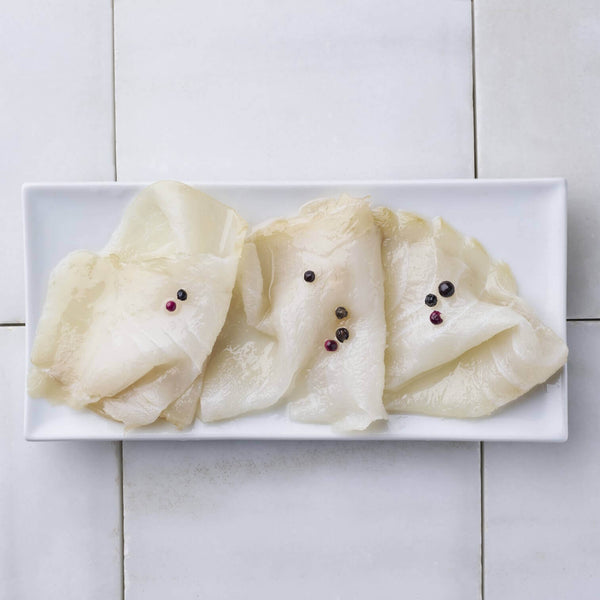
Artisan Cut Smoked Cod Carpaccio | 1 Tray Pack
15,90 €

Dried Cod Cocochas (1 tray) - 500g
19,95 €
Refrigerated shipping 24-48h throughout the Peninsula
Common mistakes when making pil pil with cocochas
After years of explaining this recipe, we have identified the most common mistakes. If your pil pil doesn't turn out well, the answer is almost certainly in this list.
Error 1: Temperature too high. This is the most frequent error and the one that ruins the most dishes. Frying oil does not emulsify: it coagulates the collagen before it can do its job. If you see the oil bubbling vigorously or the cocochas browning, the heat is too high. Lower it immediately or remove the pan from the heat.
Error 2: Moving the pan too quickly or too forcefully. The circular motion should be slow and gentle. Moving too roughly can disintegrate the cocochas before they are cooked, and moving too quickly can create air bubbles that destabilize the emulsion. Think of a cradle rocking, not a cocktail shaking.
Error 3: Not properly defrosting frozen cocochas. Frozen cocochas that go directly into the pan release too much water at once, which abruptly lowers the oil's temperature and can break the emulsion before it forms. Always defrost in the refrigerator for at least 12 hours and pat dry with paper towels before cooking.
Error 4: Using oil that is too old or of inferior quality. Oil that has been heated before or is at the end of its shelf life has poorer emulsifying capacity and can impart rancid flavors that ruin the result. Always use fresh, high-quality oil.
Error 5: Cocochas that are too small. Cocochas from small cod have very little collagen. Pil pil requires good-sized cocochas. If you only have small cocochas, consider adding a little neutral gelatin dissolved in water (a modern trick) or cooking at an even lower temperature for a longer time.
Error 6: Too much salt at the beginning. Salt extracts water from the fish more quickly and can alter the rate of collagen release. If you desalt cocochas at home, always check the salt level before cooking and adjust only at the end of the dish.
Recipe variations
The classic pil pil allows for some variations that expand the repertoire without betraying the essence of the technique.
Cocochas in green sauce: Follow the same initial steps —garlic infused in oil, gentle cooking of the cocochas— but instead of aiming for the pil pil emulsion, add hot fish broth, finely chopped fresh parsley, and move the pan in a similar way. The resulting sauce is lighter and a bright green color. You can incorporate clams or cockles in the last 5 minutes. This version is somewhat easier to execute correctly and is just as spectacular.
Pil pil cocochas with chili and tomato: A more modern version where a teaspoon of concentrated tomato is added at the end of the process and the amount of chili is slightly increased. The result is an intensely orange-colored pil pil, with more body and a touch of acidity and spiciness that some prefer. Very popular in the bars of San Sebastián's Old Town.
Cocochas in an oven-baked earthenware dish: Place all ingredients in individual earthenware dishes and bake at 150°C for 20 minutes, taking the dish out every 5 minutes to stir. The emulsion forms more slowly, but temperature control is simpler because the oven maintains uniform heat. Ideal for serving directly in the dish in a restaurant or formal dinner setting.
Pil pil cocochas with seaweed: A contemporary adaptation that incorporates rehydrated wakame or blanched sea spaghetti into the finished dish. The seaweed provides marine minerality and color, and although it is a non-traditional variation, it fits perfectly with the cod's flavor profile. This version is increasingly seen in creative restaurants in the Basque Country and Catalonia.
What to serve with pil pil cocochas
Pil pil is a dish with a very distinct personality. Accompaniments should be respectful of it, without competing or masking the star of the dish.
Bread: Mandatory. There is no better companion for a pil pil than good open-crumb bread, lightly toasted, for dipping in the sauce. In the Basque Country, this custom of dipping bread in pil pil is almost a ritual. Use good quality bread: a sourdough loaf, a country bread, or even a good baguette. Sandwich bread doesn't work well; it's too soft and doesn't absorb the sauce properly.
Patatas panaderas (baker's potatoes): The most classic accompaniment and probably the best. Potatoes cut into thin slices, confit in olive oil with onion and garlic until tender and lightly golden. The neutral potato balances the intensity of the cod and absorbs the juices of the dish. They are served under the cocochas or on the same plate.
White Rice: A lighter option that makes the hake cheeks a complete dish without adding too much extra fat. Steamed rice absorbs the pil pil excellently. In some restaurants in La Barceloneta and El Ninot neighborhoods, hake cheeks are served on a bed of soupy rice, creating a dish halfway between bacalao al pil pil and cod rice.
Roasted Piquillo Peppers: A counterpoint of sweetness and mild acidity that works very well with the richness of the pil pil. The peppers can be served cold alongside the hot hake cheeks, creating a pleasant temperature contrast.
Regarding wine: Txakoli is the traditional Basque choice, with its sparkling acidity and saline notes that cleanse the palate between bites. A Galician Albariño works similarly and may be easier to find. If you prefer a fuller-bodied white, a light oak-aged Rioja Viura or a Valdeorras Godello are excellent options. Avoid red wines: the tannins clash directly with the richness of the pil pil.
Frequently Asked Questions
How long does it take to make cod kokotxas al pil pil?
Active cooking takes between 35 and 45 minutes. If you use desalted cod kokotxas ready to cook, that's all the time you need. If you use salted cod kokotxas, add 36-48 hours of prior desalting. This is not a dish that can be improvised at the last minute with dry kokotxas.
Can I make the pil pil the day before?
Technically yes, although freshly made pil pil is always superior. If you prepare it in advance, store it covered in the refrigerator. When reheating, do it very slowly in a pot over low heat, stirring gently. If the emulsion has separated in the refrigerator, reheating with stirring usually restores it.
Why does my pil pil separate?
The most common reasons are that the heat is too high or the kokotxas have too much surface moisture. To restore a separated emulsion: turn off the heat, let the pot cool slightly for 2-3 minutes, and then stir patiently again. In many cases, the emulsion will reconstitute. If not, you can add a teaspoon of cold water while stirring to help re-emulsify.
Which pot is best for pil pil?
A clay pot is the traditional and most recommended option because it distributes heat very evenly and retains it well, which helps maintain a constant temperature. A low-sided cast iron skillet is a good alternative. Avoid thin-bottomed stainless steel pots: they transmit heat too quickly and unevenly.
How many kokotxas per person?
As a main course, estimate between 150 and 180 grams per person. As a starter or tapa, 80-100 grams is sufficient. Keep in mind that kokotxas shrink slightly during cooking.
Can pil pil be made with hake kokotxas?
It can, but the result is different. Hake kokotxas have less collagen, so the emulsion is less dense and lighter. You will need an even lower temperature and more patience. Some chefs add a little of the collagen from the hake cooking broth itself to compensate. The result is delicious, but it's not the classic, unctuous pil pil obtained with cod kokotxas.
Which oil is best for pil pil?
A mild-flavored extra virgin olive oil, preferably arbequina variety. The starting point of the oil affects the final flavor of the entire sauce. Avoid very bitter oils or those with an intense spicy aftertaste, which can dominate the flavor profile of the kokotxas.
Can frozen kokotxas be used for pil pil?
Yes, with good results, provided they are thawed correctly: in the refrigerator for 12-24 hours, never with hot water or in the microwave. Dry them very well before cooking. Quality frozen kokotxas, frozen fresh right after extraction, retain almost all of the collagen's emulsifying capacity.
Why is my pil pil liquid and not thickening?
The most frequent reasons are: kokotxas that are too small (little collagen), excessive temperature that coagulated the collagen before it emulsified, or insufficient time of circular stirring. Try to continue stirring the pot over very low heat for longer. The collagen is still functional if the temperature was not excessive.
Can I use sunflower oil instead of olive oil?
Physically it works (sunflower oil also emulsifies with collagen), but the result is much less flavorful and loses all the Mediterranean personality of the dish. Olive oil is non-negotiable in authentic pil pil: its phenolic compounds and fatty acid profile directly contribute to the flavor of the finished dish.
Products you might be interested in
Discover more