Summary: Making homemade anchovies in salt is a fascinating project for any food lover. It's an ancient artisan process that has been practiced for centuries in the Cantabrian Sea and the Mediterranean, and you can replicate it in your kitchen with surprisingly good results. However, you need patience: the complete process takes a minimum of 6 months.

Content
- Is it worth making anchovies at home?
- Raw material: fresh boquerón
- Required materials
- The process step by step
- Curing: patience as an ingredient
- Filleting and packaging
- Storing homemade anchovies
- Food safety: histamine and risks
- Common mistakes and how to avoid them
- Frequently asked questions
- Conclusions
Is it worth making anchovies at home?
Making homemade anchovies in salt is a fascinating project for any food lover. It's an ancient artisan process that has been practiced for centuries in the Cantabrian Sea and the Mediterranean, and you can replicate it in your kitchen with surprisingly good results. However, you need patience: the complete process takes a minimum of 6 months.

Is it worth it? It depends on what you're looking for. If you're looking to save money, probably not: fresh boquerones are not cheap at the fishmonger, and the time invested is considerable. But if you're looking for the satisfaction of creating your own artisanal product, understanding how anchovies are made from scratch, and enjoying a unique result (because your anchovies will be different from any you buy), then absolutely yes.
At Bacalalo, we sell artisanal Cantabrian anchovies made by professional canneries with decades of experience, and we recognize that it's difficult to match that level at home. But this guide will allow you to get very close and, above all, will give you a deep understanding of why artisanal Santoña anchovies cost what they do.
Raw material: fresh boquerón
The quality of your homemade anchovies depends fundamentally on the quality of the fresh boquerón you get. Here are the keys to choosing well:
Season
The best time to buy boquerón is during the spring fishing season (April-June), when the fish has more fat and better flavor. Autumn or winter boquerón is leaner and will produce a drier, less flavorful anchovy. If you live on the coast, look for fresh boquerón from the fish market. If you are inland, many fishmongers receive fresh Cantabrian boquerón in season.
Size
Choose medium to large boquerones (8-12 cm). Those that are too small are difficult to fillet after curing. Very large ones (over 14 cm) have a more fibrous texture. The medium size is ideal for homemade anchovies.
Freshness
The boquerón must be extremely fresh: bright eyes, firm flesh, clean sea smell (not "fishy"). If the boquerón has been on ice for days, the quality of the final anchovy will suffer. Ideally, it should be salted on the same day of purchase, as professional canneries do.
Quantity
Buy at least 1-2 kg of boquerón to make the process worthwhile. Keep in mind that you will lose 50-60% of the weight between cleaning, curing, and filleting: from 1 kg of fresh boquerón, you will get about 300-400 g of cured anchovy fillets.
Required materials
- Fresh boquerón: 1-2 kg (or more if you wish).
- Coarse sea salt: the same amount as fish (1:1 ratio by weight). Do not use iodized salt or fine salt: coarse salt drains moisture better.
- Glass, ceramic, or food-grade plastic container: with a lid. Do not use metal (it reacts with salt and fish). Large glass canning jars work perfectly.
- Weight for pressing: a plate that fits inside the container with something heavy on top (clean stones, canned goods, a bag of water). The weight is essential to expel liquid from the fish.
- Sharp knife and cutting board for cleaning and subsequent filleting.
- Extra virgin olive oil to package the anchovies once cured.
- Small glass jars with lids for final packaging.
Related Bacalalo Products


The process step by step
Step 1: Clean the boquerón
- Remove the head of each boquerón by pulling downwards: the guts usually come out with the head.
- Open the belly with your thumb and remove any remaining guts.
- Do not remove the backbone or tail: they are left during curing and removed during subsequent filleting.
- Do not wash with water: water is the enemy of salting. If you need to clean residue, do so briefly with salted water and dry immediately with kitchen paper.
Step 2: First layer of salt
- Cover the bottom of the container with a layer of coarse salt about 2 cm thick.
- Place a layer of boquerones on the salt, all in the same direction, close to each other but without piling them up.
- Cover with another generous layer of salt (1 cm).
- Repeat: layer of boquerones + layer of salt, until all boquerones are used.
- The last layer should be a thick layer of salt (2-3 cm) that completely seals the fish.
Step 3: Pressing
- Place a plate or disc that fits inside the container on top of the last layer of salt.
- Place weight on top: 2-3 kg for 1 kg of boquerón. You can use canned goods, clean stones, or a zip-lock bag filled with water.
- The weight expels liquid from the fish (brine), which will rise during the first few days.
- Cover the container (without sealing hermetically: it needs some air) and place it in a cool, dark place (basement, pantry). Ideal temperature: 12-18 °C.
Curing: patience as an ingredient
This is where the magic happens, and where you need patience. Curing in salt is a slow transformation process:


- First 48 hours: the salt begins to extract water from the fish. You will see liquid (brine) rise. Do not remove this liquid: it is part of the curing process.
- Weeks 1-2: the boquerón changes color (from silvery to dark pink) and texture (from soft to firm). The smell will be strong but clean: like salted fish, not rotten.
- Months 1-3: curing progresses slowly. The flesh darkens and compacts. The flavor begins to develop umami notes.
- Months 3-6: the anchovy is "edible" after 3 months, but we recommend waiting at least 6 for a full flavor. Between 6 and 12 months is when it reaches its optimal point.
During curing, check the container every 2-3 weeks. The brine should cover the fish. If the level drops, add more brine (water saturated with salt: dissolve salt in water until no more is absorbed). If you see mold on the surface, remove it with a clean spoon: it does not affect the fish underneath if it is covered with brine, but it is a sign that you need more weight or more salt.
Filleting and packaging
When the curing is complete (minimum 6 months), it's time to fillet and package your anchovies. This is the step that requires the most skill:
- Remove the boquerones from the salt: carefully remove them. They will be firm and dark.
- Remove the salt and skin: briefly run each boquerón under cold water to remove the coarse salt. With your fingers, peel off the skin (it comes off easily in well-cured anchovies).
- Fillet: with a thin knife or your thumbs, separate each fillet from the central backbone. Gently pull the backbone and the two fillets will separate. Remove the tail and any remaining bones.
- Dry the fillets: place them on kitchen paper to remove excess moisture.
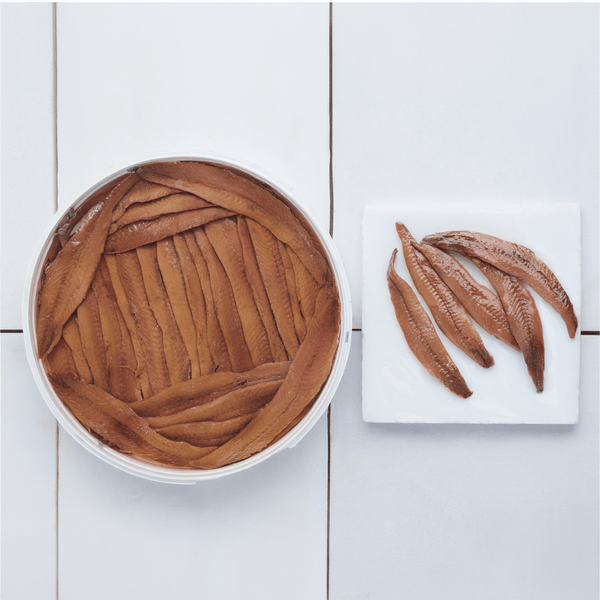
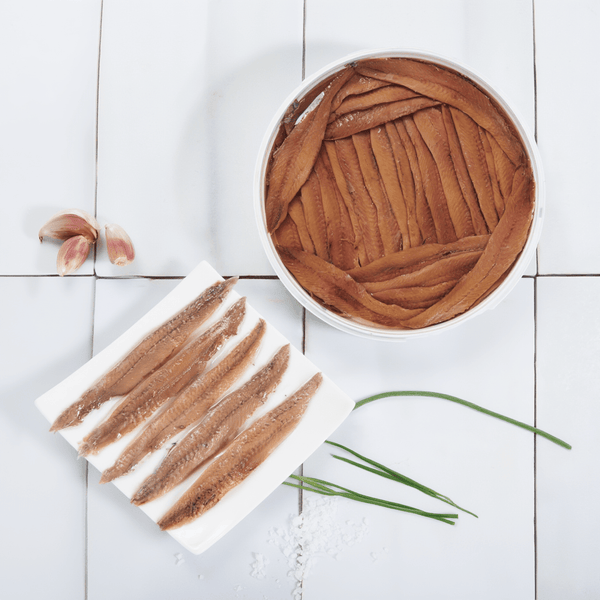
- Package in oil: place the fillets in small glass jars, layer by layer, and cover them completely with extra virgin olive oil. Seal tightly.
Newly filleted anchovies packaged in oil still need 1-2 weeks of resting before eating them: the oil needs to penetrate the fillet and "soften" the texture of the curing.
Storing homemade anchovies
- In salt (unfilleted): cured boquerones in salt can be stored for up to 2-3 years in their original container, provided they are covered in brine and in a cool place (12-18 °C). It's like a "storage" from which you take what you need.
- Filleted in oil: in a sealed jar, in the refrigerator, they last 3-6 months. Once the jar is opened, consume them within 7-10 days, always keeping the fillets covered in oil.
- Do not freeze: freezing deteriorates the texture of cured anchovies. It is not necessary if they are well preserved in salt or oil.
Food safety: histamine and risks
The main safety concern when making homemade anchovies is histamine. This compound forms when fish is not kept at adequate temperatures and certain bacteria transform histidine (a natural amino acid in fish) into histamine. An excess of histamine can cause intoxication (headaches, nausea, skin rashes).

To minimize the risk:
- Absolute freshness: salt the boquerón on the same day of purchase. Keep it on ice or in the refrigerator until salting.
- Curing temperature: keep the container between 12-18 °C. Never cure in a hot place (over 22 °C).
- Sufficient salt: do not skimp on salt. The 1:1 ratio (salt weight equal to fish weight) is standard for safety.
- Hygiene: clean hands, clean utensils, clean containers. Cross-contamination is a real risk.
If at any point in the process you detect an unpleasant odor (ammonia, rotten), an intensely bitter taste, or a pasty and decomposed texture, discard the entire batch. Correct salting produces a strong but clean smell, never putrid.
Common mistakes and how to avoid them
- Insufficient pressing weight: if you don't press enough, the liquid doesn't drain and the curing is uneven. Use at least 2-3 kg of weight for every kg of boquerón.
- Curing too short: impatience is the biggest enemy. "3-month" anchovies are edible but bland. 6 months is the minimum for a decent flavor; 10-12 months is optimal.
- Inadequate salt: use coarse sea salt. Fine salt forms an impenetrable crust; iodized salt leaves a metallic aftertaste.
- Metal container: never use metal. The salt-metal-fish reaction contaminates the product and produces unpleasant flavors. Only use glass, ceramic, or food-grade plastic.
- Not monitoring the brine: if the brine level drops and the boquerones are exposed to air, they will oxidize and spoil. Check every 2-3 weeks.
- Filleting without experience: the first anchovies you fillet will be imperfect. Don't be discouraged: it's a matter of practice. The women who fillet anchovies in Santoña take months to master the technique.
Do you prefer to leave the artisanal work to the professionals? At Bacalalo you will find Cantabrian anchovies made by master canners with decades of experience.

🛒 Products mentioned in this article
⭐ 4.9/5 · Cold shipping 24-48h · Since 1990 at Mercat del Ninot
Conclusions
- Is it worth making anchovies at home?: Making homemade salted anchovies is a fascinating project for any food lover.
- Raw material: fresh anchovies: The quality of your homemade anchovies depends fundamentally on the quality of the fresh anchovies you obtain.
- Necessary material: This is where the magic happens, and where you need patience.
- Filleting and packaging: When the curing is complete (minimum 6 months), it's time to fillet and package your anchovies.
- Preservation of homemade anchovies: The main safety concern when making homemade anchovies is histamine.
Frequently Asked Questions
How long does the whole process take?
Preparing the anchovies takes 1-2 hours. Curing in salt, a minimum of 6 months (10-12 months ideal). Filleting, 1-2 hours depending on the quantity. Total: about 6-12 months of waiting with 3-4 hours of active work spread over two sessions.
Can any fish be used or only anchovies?
Anchovy (European anchovy, Engraulis encrasicolus) is the traditional species and gives the best result. Sardines can also be salted, but the result is different (fattier, more intense). Other small fish do not work as well for salting.
Do I need a refrigerator for curing?
Not necessarily. Traditional curing is done at room temperature in cool places (basement, pantry, garage, 12-18 °C). If you live in a warm climate without a cool space, you can cure in the refrigerator, but the process will be slower.
How much salt do I need exactly?
The rule is 1:1 by weight: 1 kg of anchovies = 1 kg of coarse sea salt. It's a lot of salt, but it's necessary for safety and quality. Leftover salt can be reused as "anchovy salt" for cooking (it has an incredible umami flavor).
What if mold appears?
White mold on the surface of the brine is relatively normal: remove it with a clean spoon and make sure the anchovies remain covered with brine. If the mold is green, black, or smells bad, discard the batch.
Can I speed up the process?
Not safely. Some try to cure at a higher temperature to speed it up, but this increases the risk of histamine and produces lower quality anchovies. Slow curing at low temperature is what produces the best anchovies. There are no shortcuts.
Are homemade anchovies safe for pregnant women?
Anchovies properly cured in salt for 6+ months are safe because the salting process eliminates parasites and pathogens. The main risk is histamine, which is avoided with freshness and appropriate temperature. If you have any doubts, consult your doctor. More about anchovies and pregnancy.
Is it cheaper to make them at home?
Usually not. A kilo of fresh anchovies costs €8-15/kg and yields 300-400g of filleted anchovy. Plus the salt and oil, plus 6 months of waiting. A commercial can of good quality can be more economical. The main motivation for making homemade anchovies is artisanal satisfaction, not saving money.
How long do anchovies need to be in salt?
How long do anchovies need to be in brine? They remain there for a minimum of three months, although this period can extend between six and eight months. During this time, the anchovies lose water and fat, and absorb the salt while acquiring the color, smell, and flavor characteristic of anchovies.
How long do anchovies last in brine?
Generally, anchovies can have a shelf life of between six months and a year if stored correctly. Check the date indicated on the package and make sure to consume your anchovies before then. Once opened, anchovies should be consumed within a week.
How can I desalt homemade anchovies?
Products you might be interested in
Discover more