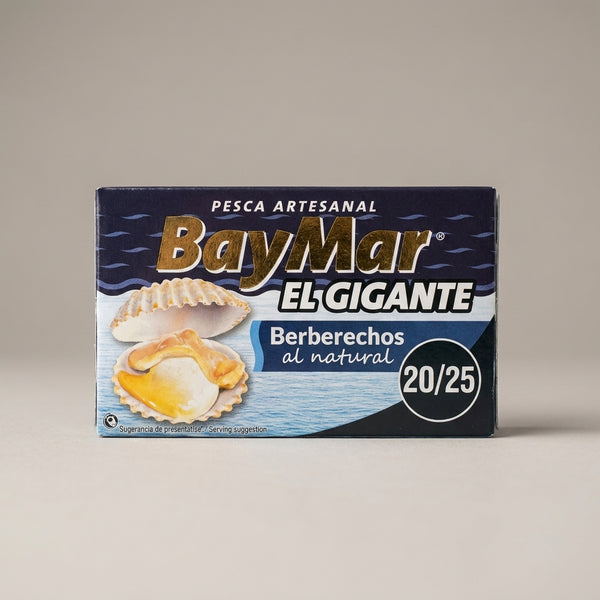
Summary: Canned cockles are one of the great jewels of Spanish canned seafood. Easy to serve, extraordinarily versatile in the kitchen, and with a huge variability in quality between brands: from industrial cockles used as a filling to artisanal Galician preserves where each can is almost a luxury product.
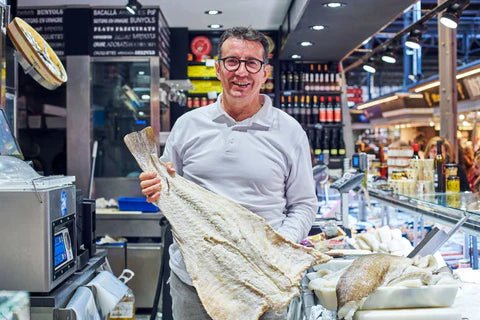
At Bacalalo, we have been selecting canned goods at the Mercat del Ninot in Barcelona since 1990. This guide is born from years of tasting, comparing, and listening to customers who want to understand what they are buying when they see "cockles 45/55" on a label.
Contents
- What are Cockles and Where Do They Come From?
- Cockle Sizes: The Key to Understanding the Price
- How Canned Cockles Are Made
- Reference Brands
- Differences between Natural Cockles, Pickled Cockles, and Cockles in Oil
- How to Serve Canned Cockles
- Recipes with Canned Cockles
- How to Store Cockles Once the Can is Opened
What are Cockles and Where Do They Come From?
The cockle (Cerastoderma edule) is a bivalve mollusc with a ridged shell that lives in the intertidal and subtidal zones of European Atlantic coasts. The Galician Rías Baixas —especially the estuaries of Arousa, Pontevedra, and Vigo— are the world's production center for quality cockles, thanks to the planktonic richness of their cold waters and a shellfishing tradition that dates back centuries.
Canned cockles are a Galician industry with an informal designation of origin: when you see "cockles from the Galician Rías," you know you're looking at the benchmark product.
Cockle Sizes: The Key to Understanding the Price
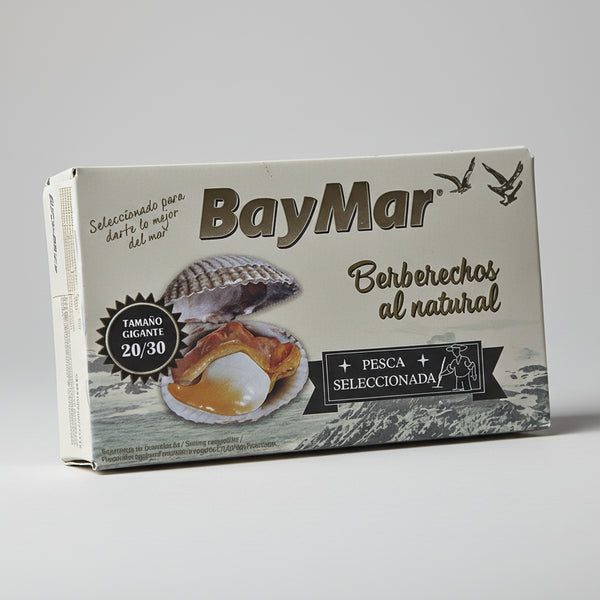
Cockle size is expressed as the number of pieces per kilogram. This number is what appears on the label as "35/45," "45/55," "55/70," etc.
- 35/45: Between 35 and 45 cockles per kilo. These are the largest. Fewer quantity, more meat per unit. The most valued and expensive.
- 45/55: Between 45 and 55 per kilo. Large-medium size. The balance sought by many quality canneries.
- 55/70: Between 55 and 70 per kilo. Medium size. The most common in the general market.
- 70/90 or more: Small cockles. More economical, greater quantity, but less meat per piece.
Simple rule: the lower the number, the larger the cockle. A 35/45 size is notably larger than a 70/90.
Which size to choose?
For appetizers or when the product is the star: 35/45 or 45/55. The amount of meat per piece is satisfying and the organoleptic experience is much better.
For recipes where the cockle is integrated into a dish (rice dishes, creams, sauces): 55/70 is sufficient. The flavor is the same; size matters less when the cockle is not the main component.
How Canned Cockles Are Made
The process in artisanal Galician canneries:
- Harvesting: By shellfish gatherers in regulated areas of the Rías. Collected by hand or with a rake, respecting minimum sizes and closed seasons.
- Purification: Live cockles spend 24-48 hours in tanks of clean seawater to remove sand and potential bacteria.
- Steam Cooking: Brief exposure to steam (2-4 minutes) to open the shells. Critical point: precise cooking to avoid overcooking.
- Manual Selection: Broken or poorly opened pieces are removed. In the most artisanal canneries, this selection is very rigorous.
- Canning: In a steel can or glass jar, covered with their own cooking liquid (with salt) or light brine.
- Sterilization: Final thermal treatment for room temperature preservation.
The difference between artisanal and industrial canneries lies mainly in: the origin of the cockle (certified Galician Rías vs. imported from Morocco, Portugal, or France), the selected size, and the time and care taken at each step.
Related products from Bacalalo


Recommended Products

Fresh Coastal Sardines - Pack of 4 Pieces | ...
2,95 €

Whole Tuna Mojama Gourmet Extra Central Loin...
95,00 €

Cockles in Natural Brine 30/40 Pieces - 111g | Ba...
7,95 €

Northern White Tuna Loins in Olive Oil Jar...
13,95 €
Refrigerated shipping 24-48h to all of the Peninsula
Reference Brands
Pay Pay
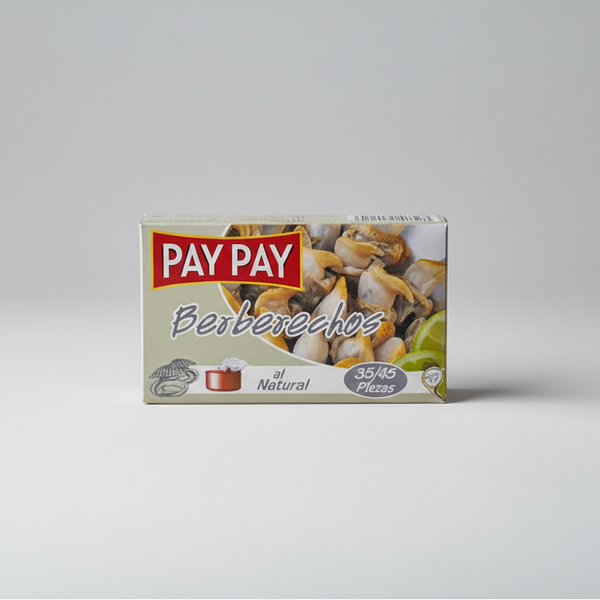
Pay Pay (from the Cuca cannery) is one of the best-known brands in Spain for canned seafood. Their cockles are widely consumed, with good distribution in supermarkets. The quality is solid for its price range: standard size, Galician or Atlantic origin, good flavor.
For consumers who want quality without paying a premium price, Pay Pay is a safe choice. For those seeking the excellence of 35/45 size, there are more specialized options.
Conservas Nardín
Nardín is a Basque cannery (Getaria, Basque Country) primarily known for its anchovies, but which also produces very high-quality canned seafood. Their cockles, when produced, are large-sized and processed with great care.
Artisanal Galician canneries
The highest level of the pyramid is occupied by small Galician canneries such as:- Ramón Peña: a benchmark in the premium range, cockles in select sizes
- Cuca: mid-to-high range
- Dardo: cannery focused on artisanal quality
- Frinsa / Mariscadora: larger scale but good quality in their premium ranges
At Bacalalo, we select brands from the Galician Rías that meet our quality and origin criteria. If you have any doubts about which one to choose, ask us at the Mercat del Ninot or in our online store.
Differences between Natural Cockles, Pickled Cockles, and Cockles in Oil
Natural (in their own juice or brine): The most common. Only cockles, water, and salt. The marine flavor is pure and without interference. Best for direct appetizer.
Pickled: The cockles are covered in a pickle of vinegar, oil, paprika, and spices. More complex and acidic flavor. Less common, but they have their advocates for use in salads or pintxos.
In olive oil: Covered in olive oil instead of brine. Milder and rounder flavor. The oil absorbs the marine flavor of the cockle and becomes a dressing in itself.
If you want to explore our selection of canned cockles, visit Bacalalo — canned seafood. We select leading Galician brands with premium sizes for those who don't want to settle for standard cockles.
How to Serve Canned Cockles
Classic appetizer
Open the can, drain slightly (but not too much, the liquid has flavor), serve on a plate or in a bowl with a few drops of lemon. Toothpicks. Baguette for the liquids. Simple as that, good as that.
With spring onion vinaigrette
A classic from northern bars: drained cockles with a vinaigrette of finely chopped spring onion, parsley, extra virgin olive oil, and a splash of Jerez vinegar. Let it marinate for 10 minutes before serving.
On toast with butter and lemon caviar
More gastronomic preparation: rye bread toast, a thin layer of salted butter, three or four large cockles, lemon caviar pearls (or a few drops of natural lemon), and chives.
In salad
Cockles work very well in green salads with plenty of acidity: arugula, endive or lamb's lettuce, mustard vinaigrette, cucumber, and cockles. The liquid from the can can be used as part of the vinaigrette.
Recipes with Canned Cockles
Creamy rice with cockles
For 4 people
- 320g bomba rice
- 400g canned cockles (45/55 size or larger)
- 1 leek
- 2 cloves of garlic
- 100ml white wine
- 1L fish broth
- Saffron, parsley, olive oil, salt
- Sauté the leek and garlic in oil until tender.
- Add the rice and stir for 2 minutes until translucent.
- Pour in the white wine and let it evaporate.
- Add the hot broth with infused saffron, little by little, stirring. Cook for 18 minutes.
- In the last minute, add the drained cockles (and part of their liquid to enhance marine flavor).
- Rest for 2 minutes. Garnish with chopped parsley and serve.
Cockle cream soup
For 4 people as a first course
- 400g cockles (2 cans of medium size)
- 1 onion
- 2 cloves of garlic
- 200ml cooking cream
- 500ml fish broth or the liquid from the cans + water
- Olive oil, salt, white pepper
- Sauté onion and garlic until very tender (25 min over low heat).
- Add the drained cockles and the broth. Cook for 5 minutes.
- Blend with an immersion blender. Pass through a fine sieve.
- Add the cream, heat without boiling. Adjust salt and pepper.
- Serve with a few whole cockles reserved on top and a drizzle of olive oil.
Cockles with clams and steamed shrimp
This is not strictly a recipe, but an appetizer combination: open cans of cockles, clams, and cooked shrimp, served together with lemon and bread. The sum of the liquids from the preserves, mixed, is a concentrated marine broth that can be drunk separately.
How to Store Cockles Once the Can is Opened
- Transfer to a glass or food-grade plastic container with a lid.
- Cover with the liquid from the can.
- Refrigerate at 2-4°C.
- Consume within a maximum of 2-3 days.
- Do not return to the original can: oxygen contact with the uncoated steel can impart metallic flavors.
Frequently Asked Questions about Canned Cockles
1. How long do unopened canned cockles last? Generally between 3 and 5 years from the production date, if stored in a cool, dry place away from direct light. Cans should not be dented, creased at the seams, or rusted on the exterior.
2. Are Pay Pay cockles good quality? Yes, for their price range, they are a solid and consistent option. If you are looking for a premium experience (35/45 size from certified Galician Rías), there are more specialized brands, but Pay Pay is a reliable reference for regular consumption.
3. Is there a difference between fresh and canned cockles? In taste, fresh steamed cockles have a slightly different texture (firmer) and a more immediate flavor. Canning provides a higher concentration of flavor due to the process and is more practical. For everyday use, quality canned cockles are excellent; for a special occasion with fresh cockles in season (spring-summer), fresh wins in experience.
4. What size cockles do restaurants buy? Restaurants that offer cockles as a quality appetizer usually opt for 35/45 or 45/55. The size of the piece is part of the customer experience. For use in cooking (stuffings, rice dishes), they use smaller sizes to optimize cost.
5. Do canned cockles make you fat? Cockles are very low in calories (approximately 80-100 kcal per 100g drained product), rich in protein (13-16g/100g) and very low in fat. They are one of the most nutritionally "light" seafoods. The liquid in the can has high sodium, but the product itself is very suitable for balanced diets.
6. Can I use the liquid from a can of cockles? Absolutely. The liquid is a concentrated seafood broth. Added to rice, soup, or a sauce, it provides depth of marine flavor at no additional cost. It's the "plus" of quality preserves: the liquid also tastes good.
7. How do I know if a can of cockles is bad? Warning signs: bulging can (never open), odor upon opening different from the usual marine smell (rancid, ammoniacal, or very metallic), unusually dark color, or disintegrated texture. If there is any doubt, discard it.
8. Do cockles have a lot of sodium? Yes, brine preserves have a considerable sodium content (approximately 400-600mg/100g). Those who need to control sodium due to hypertension or other reasons can briefly rinse cockles under cold water before consuming them, losing some flavor but reducing sodium.
9. Are cockles bivalve mollusks or crustaceans? Bivalve mollusks, like clams, mussels, scallops, and oysters. Crustaceans are the group of prawns, crabs, and lobsters. This distinction is relevant for allergies: an allergy to crustaceans does not necessarily imply an allergy to mollusks, although they can coexist.
10. What time of year are fresh cockles best? The main harvesting season in Galicia is from March to September, with peaks in spring and summer. In preserves, the product is available all year round, but canneries usually process the spring catch, which is of the highest quality.
11. Are "berberecho" and "berberecho de tapa" the same thing? In Spain, when "berberechos" are ordered in a bar, canned cockles are usually served. There is no special distinction between "berberecho" and "berberecho de tapa": it is the same mollusk; the difference lies in the brand and caliber used by the establishment.
12. Where can I buy quality canned cockles in Barcelona? At Mercat del Ninot, you will find a selection of cockles from the Rías Gallegas in various sizes at Bacalalo. Also available in our online store with shipping throughout Spain.
At Bacalalo, we have been selecting the best seafood preserves at Mercat del Ninot in Barcelona since 1990. Quality cockles — large sizes, certified Galician origin, artisanal canneries — are part of that selection. If you are looking for the best of the sea in a can, visit our online store or stop by Mercat del Ninot.
Discover more