Content of this guide
- What are Cantabrian anchovies?
- Difference between anchovy and boquerón
- The production process: from fresh boquerón to cured anchovy
- Santoña: anchovy capital of the world
- Sizes: 00, 0, and 1 — what they mean and when to choose each
- How to recognize quality anchovies
- Storage once the can is opened
- How to serve premium anchovies
- Pairing: wines and beverages
- Conclusion
- Frequently asked questions
What are Cantabrian anchovies?
When we talk about "Cantabrian anchovies," we are referring to a very specific product: fillets of European anchovy (Engraulis encrasicolus) caught in the Cantabrian Sea and the Bay of Biscay, cured in salt for months, and packed in olive oil. It is not fresh fish. It is not just any preserve. It is the result of an artisanal transformation process that converts a small, perishable oily fish into one of Spain's most highly valued gastronomic products.
The species is the same as that found in the Mediterranean, Morocco, or Argentina — Engraulis encrasicolus in all cases. But the waters of the Cantabrian Sea make a measurable difference: the colder temperature, the particular salinity of the Bay of Biscay, and the Atlantic plankton diet produce an anchovy with a distinct intramuscular fat profile. More complex, more balanced, with just the right amount of fat to give a melt-in-your-mouth texture without being cloying.
The other factor that makes these anchovies unique is time. A quality artisanal anchovy requires between 8 and 18 months of salt curing. During this period, the fish's natural enzymes — endogenous proteases and lipases — slowly break down proteins and lipids, generating amino acids (including glutamate, responsible for umami) and free fatty acids that produce that deep, complex, and addictive flavor unlike anything else.
There is no way to speed up this process without sacrificing the result. Canneries that cure for 3-4 months with the help of external enzymes produce an anchovy that looks like an anchovy but doesn't taste the same. The difference between a long cure and a short one is not subtle — it is evident to anyone who tastes both side by side.
Difference between anchovy and boquerón
The confusion between anchovy and boquerón is one of the most common in Spanish gastronomy, and it has a simple explanation: they are the same fish in two different states.
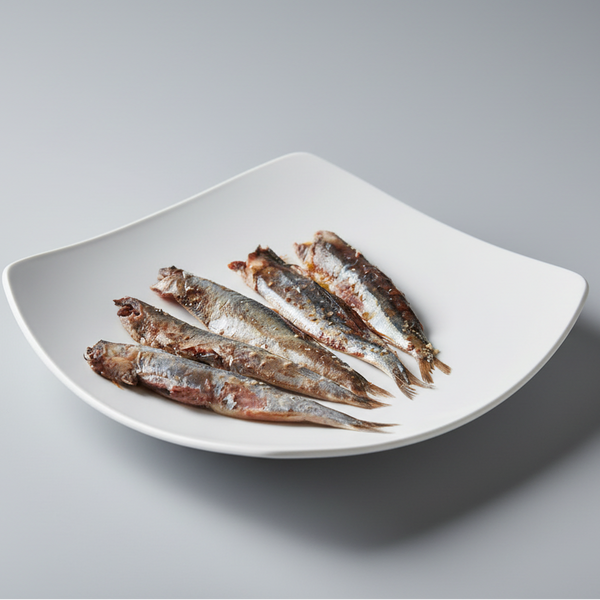
Boquerón is the fresh fish or fish marinated in vinegar. It's what you eat at the bar, pickled, with its white flesh and acidic flavor. It's caught fresh, cleaned, and marinated in vinegar (or fried, or cooked in another way). It's a quick process — hours, not months.
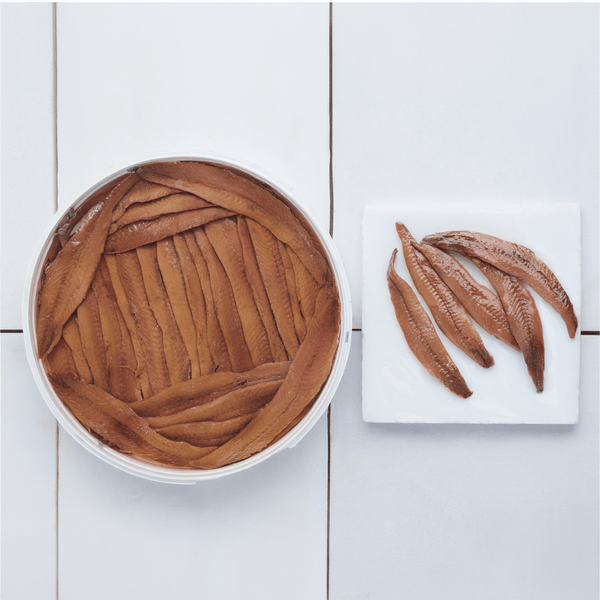
Anchoa is that same boquerón, but transformed through salting and prolonged curing. Salt, time, and natural enzymes convert the white, firm flesh of the boquerón into a pinkish-copper fillet, melt-in-your-mouth, with a deeply umami flavor that has nothing to do with the taste of the fresh product.
In summary:
| Characteristic | Boquerón | Anchoa |
|---|---|---|
| Species | Engraulis encrasicolus | Engraulis encrasicolus |
| State | Fresh or in vinegar | Cured in salt (8-18 months) |
| Color | White / silvery | Pinkish-copper |
| Flavor | Acidic, fresh, light | Umami, salty, melt-in-your-mouth |
| Preservation | Refrigerated, days | In can/jar, years |
It's the same relationship that exists between fresh grapes and wine, or between milk and aged cheese. Same origin, completely different processes, products that do not compete with each other.
The production process: from fresh boquerón to cured anchovy
Understanding the production process helps to understand why artisanal anchovies cost what they do — and why there is no cheap version that produces the same result. There are four critical stages, each one.
1. Catch and selection in port (April-June)
The fishing of boquerón for salting is concentrated in "la costera": between April and June, when schools of Engraulis encrasicolus migrate through the Bay of Biscay with the optimal body fat level, just before spawning. Boats use purse seine nets — a circular net that catches the entire school — and unload at the ports of Santoña, Laredo, Colindres, Bermeo, and Getaria within hours.
In the workshop, workers immediately separate damaged or undersized specimens. The cold chain from catch to processing is critical: boquerón deteriorates quickly, and any delay affects the final product.
2. Evisceration and salting
The boquerón is manually eviscerated — head and guts are removed — and placed in wooden or food-grade plastic barrels, alternating layers of fish and coarse sea salt. "Sobado" is the process of arranging and pressing each layer so that the salt penetrates evenly. A weighted lid is placed on top to maintain constant pressure throughout the curing process.
The salt ratio is a delicate balance: too much salt blocks enzymatic activity and produces an excessively salty anchovy; too little allows bacterial growth. Artisanal canneries adjust this point based on generations of accumulated experience.
3. Maturation: 8 to 18 months of natural transformation
This is the stage that separates an artisanal anchovy from an industrial one. The barrels are stored in cool premises and rotated periodically. For months, the boquerón's own natural enzymes work non-stop:
- Proteases break down muscle proteins into free amino acids — including glutamate, directly responsible for umami.
- Lipases transform fats into free fatty acids that provide aromatic complexity and buttery notes.
- The color changes progressively: from the silvery-gray of fresh boquerón to the pinkish-copper of mature anchovy.
High-end canneries cure for 10-18 months. Industrial ones sometimes cure for less than 6, with process accelerators. More time is not always better (over-maturation exists), but less than 8 months rarely produces an anchovy with real flavor depth.
4. Manual filleting and packaging
The cured anchovy is removed from the barrel, washed to remove excess salt, and hand-filleted. The sobadoras — specialized workers with years of experience — remove the central bone, skin, and any remaining bones with their fingers and a small tool. Each fillet is individually inspected.
An experienced sobadora fillets between 4 and 6 kg per day. The fillets are classified by size (calibre), placed in the can or jar, covered with extra virgin olive oil (in premium ranges), and the container is sealed. This manual process is what makes the product most expensive — and what most influences the visual and gastronomic quality of the final fillet.
Santoña: anchovy capital of the world
Santoña, a coastal town of about 11,000 inhabitants in Cantabria, is home to more than twenty anchovy canneries and is considered the world capital of this product. But Santoña's anchovy industry was not born Spanish — it was born Italian.
In the second half of the 19th century, Sicilian and Neapolitan fishermen and canners emigrated to northern Spain seeking new coasts rich in boquerón. They found ideal conditions in the Ría de Santoña: a protected bay with direct access to the Cantabrian fishing grounds, an active port, and a receptive fishing community. They brought with them salting techniques from the Italian Mediterranean and adapted them to the local raw material.
The combination proved extraordinary. The Cantabrian boquerón, with its particular fat profile, responded to Italian salting by producing an anchovy of superior quality to that obtained in the Mediterranean. Within a few decades, Santoña became the world reference — a status it has maintained for more than 130 years.
Today, the name "Santoña" on a can of anchovies has enormous brand power. But it should be known that it is legal to process imported bocarte from Argentina, Morocco, or Chile in Santoña. "Made in Santoña" and "Cantabrian bocarte" are not synonymous. An anchovy can meet the first without meeting the second. The label is what matters: look for it to specify the origin of the bocarte, not just the place of production.
To delve deeper into the history and differences between production areas (Santoña vs Laredo vs Bermeo), we have a dedicated article on Santoña anchovies: history and tradition.
Sizes: 00, 0, and 1 — what they mean and when to choose each
The sizing system for Cantabrian anchovies measures the fillet size. It is not an official certification or a regulated denomination — it is a de facto standard that canneries have adopted and that the market understands. The rule is simple: more zeros, larger fillet.
| Size | Fillet length | Ideal use | Price per fillet (indicative) |
|---|---|---|---|
| 00 (double zero) | 8-10 cm | Toast, special dinner, gift | €1.07-€1.25 |
| 0 (single zero) | 6-8 cm | Appetizer, tapa, daily use | €0.80-€1.11 |
| 1 (single one) | 4-6 cm | Cooking, sauces, pizza, pâté | €0.50-€0.80 |
Size 00: the premium experience
Double zero fillets are what high-end restaurants serve and what consumers who already know the product choose. They come from the largest boquerones of the season — a limited proportion of the total catch. With the same curing time, a larger fillet develops more complex flavor because the enzymes have more muscle tissue to work on. If you want an anchovy to eat on its own on a piece of toast with good oil, this is the size.
To fully understand the value of size 00, we have a specific article on why 00 anchovies cost more.
Size 0: the best value for money
This is our usual recommendation for regular consumption. Size 0 has all the curing quality of the cannery without the premium price of the largest fillet's exclusivity. For montaditos, aperitifs with vermouth, gildas, or sharing platters, size 0 is the rational choice. If you eat anchovies frequently, don't spend money on 00 for daily use.
Size 1 and menu format: for cooking
Size 1 fillets are smaller, but if the cannery is good, they have the same cure and flavor. They are perfect for anchovy sauces, pâtés, pizza with anchovies, or pasta with anchovies — recipes where the fillet size is irrelevant because it integrates into the dish. The "menu" format mixes unclassified sizes and is the most economical per gram.
Our recommendation: don't waste a 00 in a sauce and don't expect a 1 to be the star of a toast. Each size has its moment.
How to recognize quality anchovies
There are five signs that immediately tell you whether an anchovy is of quality or not. These are the same ones we use at Bacalalo when we evaluate a new batch before including it in our catalog.
1. Uniform pinkish-copper color
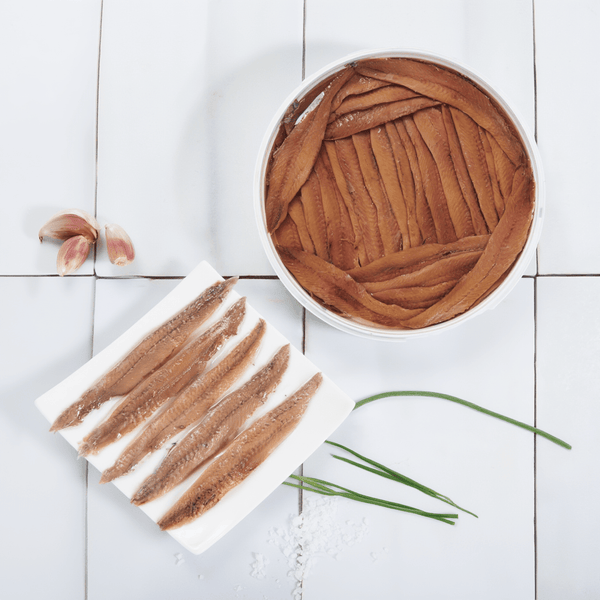
A well-cured anchovy has a color between salmon pink and golden copper, uniform throughout the fillet. Avoid: grayish (insufficient curing), very dark brown (over-oxidation), or very pale (low-quality raw material). Color is the first indicator that the enzymes have worked correctly for months.
2. Whole fillets, without breakages
An anchovy filleted by hand by an experienced sorter comes out whole: clean edges, no fragments. If you open a can and find more pieces than fillets, it's a sign of industrial filleting or poor curing — under-cured fillets are more fragile and break when handled.
3. Clean and clear oil
The oil should be clean, transparent, and golden yellow if it's extra virgin olive oil. Cloudy oil or oil with particles indicates insufficient washing (excess dissolved salt) or incorrect storage.
4. Cured sea aroma, never strong fishy smell
The correct aroma is saline and umami, with a subtle buttery background. It should not smell like fresh fish (insufficient curing), rancid (fat oxidation), or metal (packaging problem). If the aroma is clean, marine, and appetizing, the anchovy has passed the first filter.
5. Firm-melting texture
The fillet should be firm to the touch but yield gently when pressed. On the tongue, the first few seconds are firm; then, it slowly melts almost without chewing. If it's gummy and needs to be chewed like gum, the curing was too short. If it falls apart when picked up without pressure, the curing was excessive.
For a detailed comparison between brands and how to identify quality in each one, consult our article on the best anchovies from the Bay of Biscay: brand comparison.
Storage once the can is opened
Unopened canned anchovies can be stored for years at room temperature. The problem comes when you open them. Here are the rules we apply at Mercat del Ninot, verified with thousands of opened cans over decades.
If you plan to consume them within 2-3 days
Leave the fillets in the same can or jar, ensuring they are covered in oil. Cover with plastic wrap or the original lid if it's a glass jar. Store in the refrigerator between 4-7 °C. Fillets maintain their quality perfectly for 3-4 days if submerged in oil and refrigerated.
If you plan to take longer than 3 days
Transfer the fillets to a glass or ceramic container (never plastic, which absorbs odors and can alter the flavor). Cover completely with new extra virgin olive oil if the original is not enough. Seal tightly and store in the refrigerator. This way, they can last 7-10 days without noticeable loss of quality.
What you should never do
- Do not freeze cured anchovies. Freezing breaks down the protein structure that gives them their melting texture. They lose texture and flavor irreversibly.
- Do not leave fillets exposed to air. Fat oxidation causes rapid rancidity. Always keep them covered in oil.
- Do not store in the opened metal can for more than 24 hours. Metal exposed to air can impart a metallic taste to the product. Use glass or ceramic.
We have a dedicated article with more details on how to store anchovies once opened.
How to serve premium anchovies
Quality anchovies from the Bay of Biscay deserve a respectful service. It's not pretension — it's logic: you've paid for an artisanal product with months of curing, so the last step (how it reaches your mouth) makes the difference between a correct experience and a memorable one.
Temperature: take them out of the fridge 15 minutes before
Cold anchovies from the fridge have a "blocked" flavor. The fat is solidified, and the aromatic compounds are not released well. 15 minutes at room temperature is enough for the fillet to reach 14-16 °C — the point where the flavor fully unfolds. You can check this: try one fillet freshly out of the fridge and another after 15 minutes. The difference is noticeable.
Presentation: less is more
The classic way is the most effective: fillets arranged on a toast of crystal bread (or country bread with good toasted crumb), a drizzle of extra virgin olive oil on top, and nothing else. No lemon, no butter, no sauces — the anchovy is the star.
If you want to add sophistication without complication:
- On bread with grated tomato: the acidity of the tomato contrasts perfectly with the saltiness of the anchovy.
- With piquillo peppers: the sweetness of the pepper amplifies the umami of the fillet.
- In a gilda: anchovy + chili pepper + olive: the quintessential Basque appetizer. We have a complete guide to making perfect gildas.
- With quality butter: in French tradition, anchovy on buttered bread (unsalted) is a classic that works extraordinarily well.
Quantity per person
As an appetizer: 4-6 fillets per person are sufficient. For a shared platter among 4 people, a can of 20-25 fillets is the right size. If anchovies are the main course (an anchovy tasting, for example), calculate 8-10 fillets per person.
Accompaniments that work
- Bread: crystal bread, coca bread, toasted ciabatta. Avoid breads with strong flavors of their own (dark rye, seeds) that compete with the anchovy.
- Olives: Gordal or Manzanilla. The vegetable fat of the olive complements the animal fat of the anchovy.
- Tomato: ripe, thinly sliced, with salt and oil. Simple and perfect.
- Peppers: roasted piquillo peppers, mild green chili peppers.
Pairing: wines and drinks
Anchovies from the Bay of Biscay have a flavor profile dominated by saltiness, umami, and fat. This conditions the pairing. You need a drink that contrasts with the salt, supports the umami without being overwhelmed, and cleanses the palate of fat.
Those that always work
- Manzanilla or Fino: the canonical option. The saltiness of Jerez wine dialogues with the saltiness of anchovies. The acidity cleanses the palate. It is the perfect pairing, without discussion.
- Txakolí: the quintessential Basque wine to accompany pintxos and preserves from the Bay of Biscay. High acidity, natural gas, Atlantic freshness. If you eat anchovies in the north, this is what you drink.
- Albariño: Rías Baixas produces white wines with the necessary acidity and minerality to support the anchovy without competing with it.
- Champagne or brut nature cava: the bubbles and acidity cleanse the fat and refresh the palate between bites. A quality brut nature cava is a splendid companion.
- Vermouth: the classic Mediterranean aperitif. The bitter notes of vermouth complement the umami of anchovies. The vermouth + anchovy + olive combination is a standard of the Spanish aperitif for a reason.
Those that work with nuances
- Beer: it works, but not just any beer. A cold pilsner or lager with moderate bitterness is correct. Very hoppy IPAs compete too much with the anchovy. Wheat beers are too sweet.
- Rosé: a dry and fresh Provençal rosé can work well, especially in summer.
Those that don't work
- Full-bodied reds: tannins clash with salt and the result is metallic, bitter, and unpleasant.
- Sweet wines: the combination of sweetness with the intense saltiness of anchovies produces a contrast that for most palates is excessive.
- Sugary sodas: they completely nullify the flavor of anchovies. If you've paid for a premium product, don't drown it in Coca-Cola.
For more combinations, consult our article on anchovy and wine pairing.
Discover our premium selection
Seafood products selected with criteria since 1990 at Mercat del Ninot, Barcelona. Refrigerated shipping in 24-48h.
Conclusion
Cantabrian anchovies are one of the great products of Spanish gastronomy — but only when they are genuine. The difference between an artisanal anchovy with Cantabrian whitebait and 12 months of curing and an industrial anchovy with imported whitebait and 4 months of processing is not subtle. It is evident, measurable, and verifiable.
Key points of this guide:
- The species is Engraulis encrasicolus, but the waters of the Bay of Biscay and long curing make all the difference.
- The artisanal process lasts 8-18 months and does not allow for shortcuts without loss of quality.
- Caliber 00 is for premium experience, 0 for daily quality use, 1 for cooking.
- Coppery pink color, whole fillets, clean oil, marine aroma, and melting texture are the five signs of quality.
- Take them out of the fridge 15 minutes before serving and pair with Manzanilla, Txakolí, or Cava.
At Bacalalo, we have been selecting Cantabrian anchovies since 1990 at Mercat del Ninot in Barcelona. We only sell what passes our internal tasting process: verified 100% Cantabrian origin, minimum 10 months of curing, and manual filleting.
Frequently asked questions about Cantabrian anchovies
Are anchovies and boquerones the same fish?
Yes. Anchovy and boquerón are the same fish: Engraulis encrasicolus. The difference is in the processing. Boquerón is consumed fresh or in vinegar; anchovy is that boquerón cured in salt for months. Same origin, completely different products.
How long do unopened canned anchovies last?
Unopened canned anchovies have a shelf life of 2-3 years when stored at room temperature, away from heat sources and direct light. Some canneries indicate that the product improves during the first year of canning, similar to how wine evolves. Once opened, consume within 3-4 days (in the fridge, covered in oil) or transfer to a glass container to extend up to 7-10 days.
Why are Cantabrian anchovies so expensive?
The price reflects three real factors: 1) The raw material is scarce — Cantabrian whitebait is only fished 10-12 weeks a year, between April and June. 2) The curing lasts 8-18 months, which immobilizes the product and capital for over a year. 3) Filleting is manual — a sorter processes 4-6 kg per day. There is no way to reduce these costs without changing the raw material or shortening the process, which results in an inferior product.
What size anchovy should I buy?
It depends on the use. For eating as a main ingredient (toast, premium appetizer, tasting), choose caliber 00 (8-10 cm). For regular quality consumption (tapas, montaditos, gildas), caliber 0 (6-8 cm) offers the best value for money. For cooking (sauces, pizzas, pâtés), caliber 1 (4-6 cm) or menu format is sufficient — the flavor is the same, only the size changes.
Can Cantabrian anchovies be frozen?
It is not recommended. Freezing breaks down the protein structure that gives cured anchovies their characteristic melting texture. When thawed, the fillet becomes soft, pasty, and loses some of its flavor. If you need to store opened anchovies for more than a week, transfer them to a glass container covered in olive oil and keep them in the coldest part of the refrigerator (4 °C).
How do I know if an anchovy labeled "from Cantabria" is really from Cantabria?
Read the label carefully. Look for it to specify the origin of the whitebait ("Cantabrian whitebait," "caught in FAO area 27," or "Bay of Biscay"), not just the place of processing. "Processed in Santoña" does not guarantee that the whitebait is Cantabrian — it is legal to process imported raw material in Santoña. Quality artisanal canneries usually clearly specify the origin of the raw material because it is their main selling point.
Which wine pairs best with anchovies?
Manzanilla or Fino de Jerez is the canonical pairing — the wine's salinity dialogues perfectly with that of the anchovy. Txakolí and Albariño also work due to their acidity and freshness. Champagne or brut nature cava are splendid. Vermouth is the classic aperitif companion. Avoid full-bodied reds (tannins clash with salt) and sugary drinks that cancel out the flavor.
Lalo González Rodríguez
Specialist in seafood products and premium preserves. Contributor to Bacalalo from Mercat del Ninot in Barcelona, where the González family has been selecting cod, anchovies, caviar, and gourmet seafood products since 1990. Each article reflects decades of experience buying, tasting, and selling the best products to customers who demand real quality.