Summary: Anchovies on pizza generate more debate than any other Neapolitan pizza ingredient, yet their use has been perfectly documented since the origins of modern pizza in the 19th century. In this article, we explain why Italians put anchovies on pizza, what type of anchovy to use and when to add it, what are the classic combinations of Neapolitan and Roman tradition, and how to replicate them at home with results that surpass most pizzerias. The quality of the anchovy is the factor that most differentiates the final result.
Table of Contents
- The History of Anchovies in Italian Pizza
- Why Italians Put Anchovies on Pizza: The Chemistry of Umami
- What Type of Anchovy to Use on Pizza
- When to Add Anchovies: Before or After Baking
- The Classic Neapolitan Pizza: Marinara with Anchovies
- Roman Pizza: The Most Direct Version
- Modern Combinations That Work with Anchovies
- The Right Dough for Anchovy Pizza
- Common Mistakes When Putting Anchovies on Pizza
- Frequently Asked Questions
The History of Anchovies in Italian Pizza
Updated March 2026. Since 1990, we have hand-selected every product. This guide reflects that experience.
Anchovies have been on Italian pizza since before pizza had tomatoes. The precursor to modern pizza — the 18th-century Neapolitan "pizza bianca" — was a flat bread dough with olive oil, garlic, and salted anchovies. Tomatoes arrived in Naples later, but anchovies were already there.
The relationship between southern Italy and salted anchovies is ancient. Roman "garum," a fermented fish sauce that was the universal condiment of the Empire for centuries, is the direct antecedent of the salted anchovies still produced in Cetara, on the Amalfi Coast, using techniques almost identical to those of two thousand years ago. Cetara's colatura di alici is the contemporary version of garum, and its use in pasta and pizza is a cultural continuity that spans millennia.
When Neapolitan and Sicilian emigrants arrived in Santoña and Laredo in the 19th century to establish the anchovy industry in the Cantabrian Sea, they brought this culinary tradition with them. Salted anchovy as a cooking ingredient is neither Italian nor Spanish — it is Mediterranean, and has circulated along the coasts of this inland sea since antiquity.
Why Italians Put Anchovies on Pizza: The Chemistry of Umami
The simplified answer is: because anchovies are a glutamate bomb. Monosodium glutamate is the compound responsible for "umami," the fifth basic taste alongside sweet, salty, sour, and bitter. Salted anchovies, after their curing process of 10 to 18 months, have an extraordinarily high concentration of free glutamate — more than aged Parmesan, more than sun-dried tomatoes, more than any other common ingredient in Mediterranean cuisine.
When you add anchovies to a pizza, you're not just adding salt and fish flavor. You're adding a natural flavor enhancer that makes tomatoes taste more like tomatoes, cheese taste more like cheese, and dough taste more like bread. It's the same principle that leads Italian chefs to add a small amount of mashed anchovies to meat sauces or ragù — not to make it taste like anchovies, but to make everything else taste more intense.
The debate about whether anchovies "belong" on pizza is, from this point of view, irrelevant. The right question is: do you want your pizza to have more flavor? If the answer is yes, anchovies are the most direct answer.
What Type of Anchovy to Use on Pizza
Not all anchovies behave the same way on pizza. Choosing the right type makes a substantial difference in the result.
Anchovies in olive oil: the most accessible and versatile option
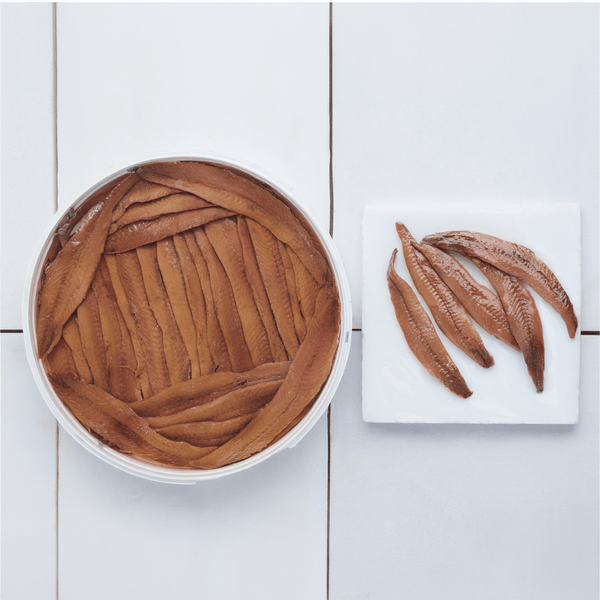
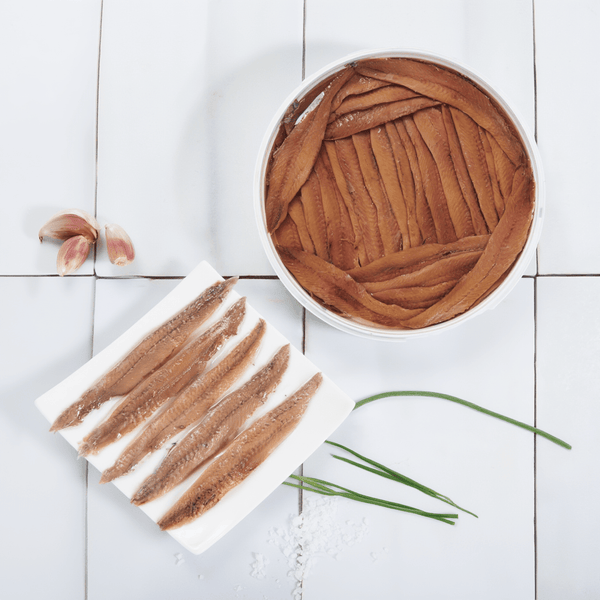
Anchovy fillets in olive oil are the most convenient form for home pizza use. They are placed directly on the pizza, either before or after baking depending on the desired texture. The oil from the can is also a valid ingredient: a drizzle over the pizza before baking adds flavor without needing to add separate olive oil.
The correct size for pizza is 0 or 1 — fillets from 4 to 8 cm. Size 00 fillets are too large, and their visual presence on the pizza might be excessive for those who are not fans. Small fillets of menu or 1 size integrate better visually and their size is proportionate to the other pizza ingredients.
Salt-cured anchovies: the artisan option
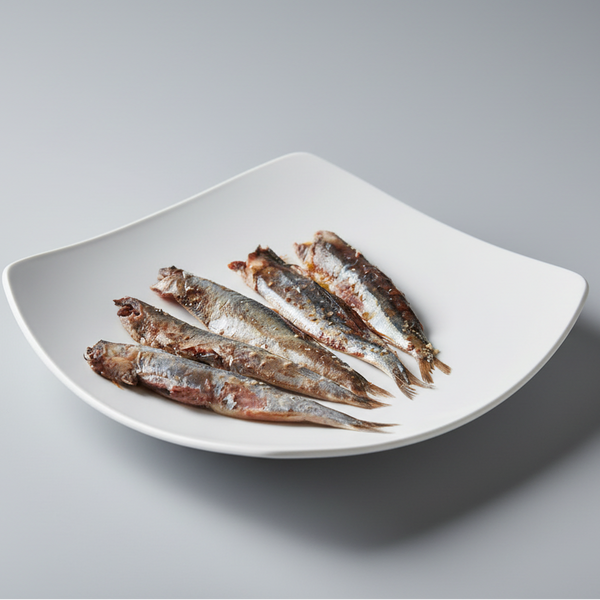
Whole, cleaned, and soaked salt-cured anchovies have a more intense flavor than canned ones. Neapolitan haute cuisine pizzaiolos prefer them because they produce a deeper result. They require prior preparation (cleaning, filleting, desalting), but the result justifies the effort for those who want to approach Neapolitan authenticity.
Our Cantabrian anchovies for cleaning (€5.95) are the ideal starting point for this artisanal approach. They are salt-cured anchovies that are processed at home, with desalting and preparation control that determines the final flavor profile.
Anchovy paste (colatura): the invisible option
If you want the flavor of anchovies without the visual presence of the fillet, colatura di alici (Italian anchovy sauce) or an anchovy paste integrated into the base tomato sauce is the solution. A couple of fillets dissolved in the tomato sauce while cooking provides the full umami dimension without anyone identifying anchovies as an ingredient.
Cantabrian Anchovies in olive oil — For pizza and Italian cuisine
Fillets in extra virgin olive oil, minimum 10 months of artisan curing. The ingredient that turns a homemade pizza into something that surpasses most neighborhood pizzerias. Selected at Mercat del Ninot in Barcelona.
When to Add Anchovies: Before or After Baking
This is the most important technical question about anchovies on pizza, and the correct answer depends on what you are looking for.
Before baking: Anchovies partially melt during cooking. Their flavor integrates with the other ingredients, and the fillet's texture partially disappears. The result is a pizza where anchovy is a powerful background flavor, without a defined visual presence. This is the option for those who want umami without the visual identity of the fillet. If you use a very hot oven (250-300 °C), the fillets can become dry and salty — use a reduced amount.
After baking: The fillets are placed on the pizza freshly out of the oven, when the cheese is still melted and hot. The residual heat warms the fillets but does not cook them. The result is a pizza where the anchovy maintains its soft texture, coppery color, and visual presence. The flavor is cleaner and more distinct from the other ingredients. This is the option for those who want the anchovy to be an identifiable protagonist.
Recommendation: For a pizza with anchovies as the main ingredient (Neapolitan pizza with anchovies, Roman alla puttanesca pizza), add after baking. For a pizza where anchovy enhances other ingredients (pizza carbonara, vegetable pizza with anchovies), add before baking so the flavor integrates.
The Classic Neapolitan Pizza: Marinara with Anchovies
The original Neapolitan Marinara pizza (not the seafood version found in other countries) is one of the simplest in the repertoire: tomato, garlic, olive oil, and oregano. No cheese. The variant with anchovies, simply called "Marinara con alici" in Naples, adds four or five fillets on top of the tomato, with garlic and oregano.
Ingredients for a 30 cm pizza:
- Pizza dough (250 g, minimum 24 h fermentation)
- 3 tablespoons of quality crushed peeled tomatoes
- 1 clove of garlic, thinly sliced
- 1 teaspoon of dried oregano
- 3-4 tablespoons of extra virgin olive oil
- 4-5 Cantabrian anchovy fillets
- Salt to taste (little, as anchovies are already salty)
Preparation: Stretch the dough. Spread the tomato, leaving a 2 cm border. Place the garlic slices. Add the oregano and olive oil. Bake at the maximum temperature of a home oven (250 °C if possible) for 8-10 minutes until the crust is golden. Remove from the oven and place the anchovy fillets on the hot tomato. Serve immediately.
No cheese. This is the pizza that scares those who don't know it and converts those who try it the most. The absence of cheese puts anchovies in the spotlight and allows the complexity of tomato and garlic to be appreciated with a clarity that pizza with cheese does not have.
Roman Pizza: The Most Direct Version
Roman pizza has a thinner, crispier crust than Neapolitan. Its structure allows for a higher proportion of ingredients without the dough collapsing. Roman pizza alla puttanesca uses a tomato base with black olives, capers, and anchovies — all the ingredients that define puttanesca sauce applied directly to the pizza.
Ingredients for a pizza alla puttanesca:
- Thin Roman pizza dough
- 4 tablespoons of concentrated tomato sauce
- 8-10 pitted Kalamata black olives
- 1 tablespoon of drained capers
- 5-6 anchovy fillets
- 1 minced garlic clove
- Oregano, olive oil
With this combination, anchovies are added before baking because all ingredients have intense flavors, and integration during cooking produces a more homogeneous result than if each ingredient maintains its individual profile.
Modern Combinations That Work with Anchovies
Beyond classic Italian recipes, there are contemporary combinations with anchovies that deserve attention for their gastronomic coherence.
Anchovies, burrata, and cherry tomatoes: White dough (no tomato base), whole burrata in the center, roasted cherry tomatoes around, anchovy fillets on the burrata after baking. The contrast between the creamy dairy of the burrata and the marine saltiness of the anchovy is one of the best in modern pizza.
Anchovies, roasted red pepper, and goat cheese: A combination that connects with the Spanish tradition of roasted peppers with anchovies. Tomato base, roasted red peppers, crumbled goat cheese, anchovy fillets before baking. Sprinkled with fresh thyme upon serving.
Anchovies and potato: Pizza with sliced potato is a Roman specialty that perfectly admits anchovies. Thinly sliced potato, rosemary, olive oil, and anchovy fillets placed between the potato slices. No cheese, with plenty of oil. Simple and extraordinary.
For more recipe ideas with anchovies beyond pizza, see our guide to anchovy recipes: easy and gourmet ideas.
The Right Dough for Anchovy Pizza
The dough is more important than it seems in relation to how the anchovy is perceived. Dough without sufficient fermentation has a yeasty flavor that competes with the anchovy and muddies the result. Long-fermented dough (24-72 hours in the refrigerator) has a complex flavor with acidic notes that complement the anchovy's saltiness in a way similar to how sourdough bread complements anchovy butter.
The minimum recipe that works well: 500 g of strong 00 flour, 325 ml of cold water, 1 g of dry baker's yeast, 12 g of salt. Mix, knead for 10 minutes, let ferment for 24 hours in the refrigerator. The result with this slow fermentation is a dough that handles well when cold, bubbles in the oven, and has a flavor that holds its own against the anchovy without being overwhelmed.
Common Mistakes When Putting Anchovies on Pizza
The most common mistake is using low-quality anchovies. Standard supermarket canned anchovies have a disproportionate saltiness and a flat flavor that produces an excessively salty pizza without the complexity that makes a pizza with real anchovies memorable. A good Cantabrian anchovy, with artisanal curing, has a balanced saltiness and a complex flavor that elegantly integrates with the other ingredients.
The second mistake is using too many anchovies. With size 0 fillets on a 30 cm pizza, four or five fillets are enough. With more, the pizza becomes disproportionately salty. Less is more when an ingredient has such powerful flavor.
The third mistake is combining anchovies with very sweet ingredients on the same pizza. Sweet-salty combinations work well in appetizers, but on pizza, the dough already provides its own sweetness from fermentation. Adding pineapple, honey, or fruits to an anchovy pizza produces a result that lacks gastronomic coherence.
Cantabrian Anchovies — For pizza, pasta, and Mediterranean cuisine
The difference between a mediocre anchovy pizza and a memorable anchovy pizza is artisanal curing and verified origin. Our complete collection of Cantabrian anchovies, selected at Mercat del Ninot in Barcelona, available with refrigerated shipping throughout Spain.
Premium Seafood — Bacalao
Since 1990, selecting the best from the sea at Mercat del Ninot, Barcelona. Refrigerated shipping 24-48h.
View Cantabrian Anchovies →🛒 Products mentioned in this article
⭐ 4.9/5 · 24-48h cold shipping · Since 1990 at Mercat del Ninot
Frequently Asked Questions about Anchovies on Pizza
Are anchovies on pizza too salty?
With quality and the right amount of anchovies, no. The problem arises when industrial anchovies with high salinity are used, or when too many are added. Four or five artisanal Cantabrian anchovy fillets on a 30 cm pizza is the correct proportion – they add flavor and umami without overpowering the overall saltiness.
On which pizzas do anchovies not work?
On pizzas with very sweet bases (barbecue sauce, honey) or with very strong-flavored ingredients that compete directly (strong gorgonzola, very spicy 'nduja). Anchovies need ingredients that complement them, not ones that cancel them out or are canceled out by them.
Can sunflower oil anchovies be used instead of olive oil?
Yes, but the result is inferior. The extra virgin olive oil from the tin is part of the fillet's flavor. Anchovies in sunflower oil have a flatter flavor profile. For quality pizza, always use anchovies in olive oil.
Are anchovies from tins and jars the same for pizza?
From the same cannery, yes – the difference is in the packaging, not the product. The jar allows you to see the fillet before buying and makes it easier to remove them without breaking them. For pizza, where the presentation of the whole fillet matters (especially if added after baking), the jar has a practical advantage.
Can I make pizza with anchovies if I don't like anchovies?
If you incorporate them before baking and dissolve them in the tomato sauce, the result doesn't taste specifically of anchovy – it tastes like pizza with more depth of flavor. Many people who say they don't like anchovies don't identify the ingredient when used this way. See also how they work in anchovy sauce and bagna cauda, where the same principle of "enhanced but anonymous flavor" applies in a different format.