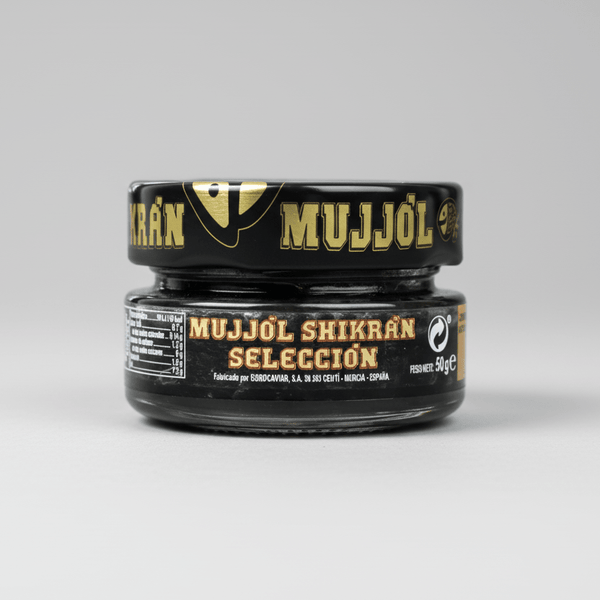
Sturgeon is the most valuable fish on the planet. Its family has been on Earth for 200 million years—it survived the dinosaurs—and today it produces the world's most expensive food: caviar. But not all sturgeon are alike: there are over 25 species, each with distinct caviar in flavor, texture, and price. In this article, we explain exactly what sturgeon is, what the main species are, why it costs what it does, and how its aquaculture has evolved. If you're interested in caviar, understanding the fish that produces it is the first step.
What is sturgeon? The living fossil that produces caviar
Updated March 2026. In our over 30 years of experience at Mercat del Ninot, this is what we recommend.
Sturgeon is a fish of the family Acipenseridae, a lineage that has been on the planet for over 200 million years. To put it in perspective: sturgeon were already swimming when dinosaurs roamed the Earth. They are, literally, living fossils.
There are 27 recognized species of sturgeon, distributed across the northern hemisphere: from the Caspian and Black Seas to the rivers of North America and Asia. All share unmistakable traits:
- Elongated body with five rows of bony plates (scutes) instead of scales.
- Pointed snout with four sensory barbels for detecting food on the bottom.
- Cartilaginous skeleton, like sharks, instead of true bone.
- Protrusible ventral mouth (toothless in adults) adapted for sucking invertebrates from the riverbed.
- Slow growth and extreme longevity: some species live for more than 100 years.
But what has made sturgeon the world's most coveted fish is not its meat—which is also prized—but its roe. Sturgeon roe, once processed and salted, becomes caviar: the most exclusive and expensive gourmet food that exists.
Not just any fish roe is caviar. By strict definition (and European regulation), only sturgeon roe can be called caviar. Everything else—salmon roe, lumpfish roe, trout roe—are substitutes or "caviar of [species]," but not simply caviar.
Main sturgeon species: each, a different caviar
Of the 27 sturgeon species, only a handful produce commercially relevant caviar. Each species yields roe with unique characteristics in size, color, flavor, and price. These are the ones you need to know:
Beluga (Huso huso) — The king of caviar
The beluga is the largest sturgeon in the world. It can exceed 5 meters in length and 1,000 kg in weight, although current specimens rarely reach those dimensions due to historical overfishing. It mainly inhabits the Caspian Sea and the Black Sea.
Its caviar is the most sought after: large eggs (3-4 mm in diameter), pearl gray to dark gray in color, with a buttery, complex, and persistent flavor. A kilo of beluga caviar can exceed €10,000 on the international market.
The problem: the female beluga does not reach sexual maturity until 18-25 years of age. That means a fish farm needs to keep a fish for two decades before obtaining a single gram of caviar. This is the main reason for its stratospheric price.
Osetra (Acipenser gueldenstaedtii) — The chefs' favorite
For many experts, osetra (also spelled oscietra or ossetra) is the sturgeon with the most gastronomically interesting caviar. It reaches 2 meters and about 80-200 kg. It is found in the Caspian Sea, the Black Sea, and the Sea of Azov.
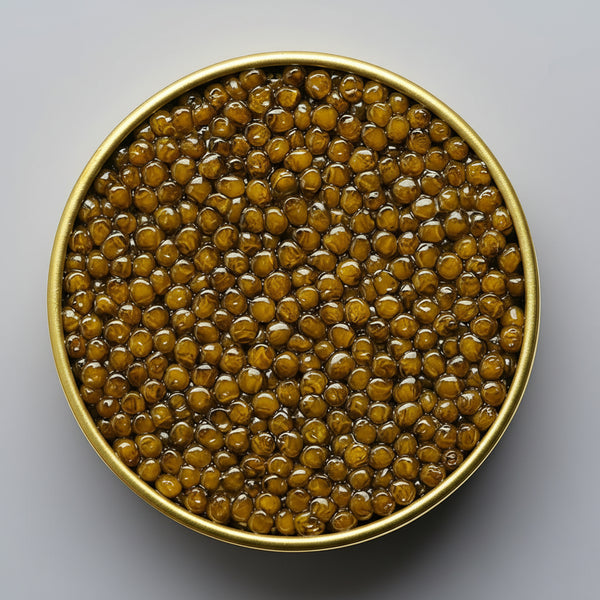
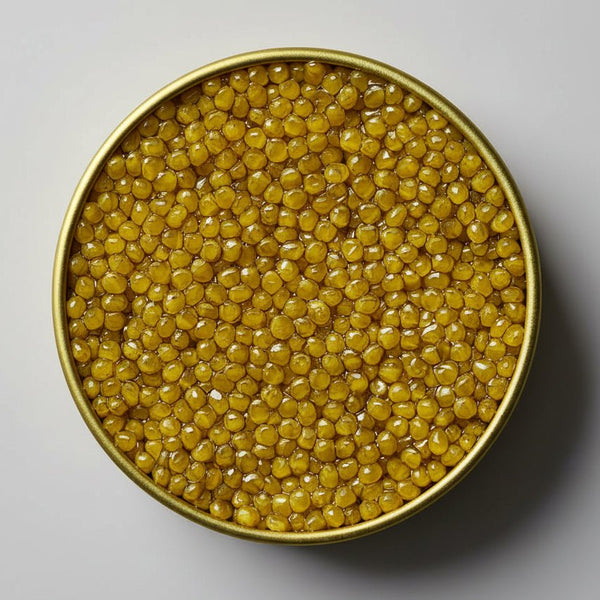
Its caviar features medium-large eggs (2.5-3 mm), with an exceptional range of colors: from amber gold to dark brown, including green and gray tones. The flavor is nutty, with hints of walnut and a clean marine aftertaste. Osetra caviar is the most appreciated by professional chefs for its versatility.
It matures between 12-15 years, which makes it somewhat more economically viable than beluga, but it is still a long-term investment for producers.
Sevruga (Acipenser stellatus) — The most intense
The sevruga is the smallest of the three great Caspian sturgeons: it rarely exceeds 1.5 meters and 25-30 kg. It is easily recognized by its elongated and narrow snout, almost like a sword.
Its caviar has the smallest eggs (under 2 mm) but the most intense and iodized flavor of all. Dark gray to black color, with a firm texture that bursts in the mouth. It matures in 7-10 years, which historically made it the most accessible caviar of the three classics. Even so, its price ranges from €3,000-€5,000/kg.
Baerii (Acipenser baerii) — The workhorse of aquaculture
The Siberian sturgeon or baerii is, by far, the most cultivated species in aquaculture worldwide. Originally from the rivers of Siberia, it adapts well to controlled breeding conditions and matures relatively quickly: between 5 and 8 years.
Its caviar is medium-sized (2-2.5 mm), dark gray to black, with a smooth, slightly nutty, more accessible flavor than beluga or osetra. It is the caviar you will most often find in restaurants and gourmet stores as an entry point into the world of caviar.
France, Italy, Germany, and China are the main producers of baerii caviar. Its price ranges from €1,500-€3,000/kg, making it the option with the best value for money.
Adriatic sturgeon (Acipenser naccarii) — The Spanish sturgeon
Acipenser naccarii is a species endemic to the Adriatic and Southern Europe. In Spain, it is the basis of caviar production for Nacarii, the pioneering Spanish caviar company, and Riofrío, the world's first organic caviar fish farm.
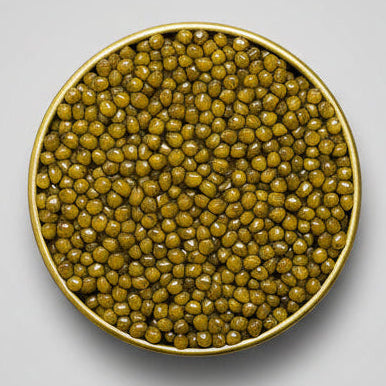
It reaches 1.5-2 meters and about 20-25 kg. Its caviar is medium-sized, greenish-gray to brown, with a delicate, clean, herbaceous flavor. It matures in 8-12 years. It is a critically endangered species in the wild, which gives its aquaculture production added conservation value.
White sturgeon (Acipenser transmontanus) — The American giant
The Pacific white sturgeon is North America's largest freshwater fish: it can exceed 6 meters and 800 kg. It is found on the West Coast, from Alaska to California.
Its caviar features large eggs, light to dark gray in color, with a clean, buttery, and slightly sweet flavor. Aquaculture of this species has grown significantly in the United States, with producers in California and Oregon. It matures between 10-15 years.
Comparison table: 6 sturgeon species and their caviar
| Species | Scientific name | Max. weight | Max. length | Caviar produced | Approx. price (€/kg) | Sexual maturity | IUCN status |
|---|---|---|---|---|---|---|---|
| Beluga | Huso huso | 1,000+ kg | 5-6 m | Beluga — pearl gray, large, buttery | €7,000-€15,000 | 18-25 years | Critically Endangered |
| Osetra | A. gueldenstaedtii | 80-200 kg | 1.5-2 m | Osetra — golden to brown, nutty | €3,000-€7,000 | 12-15 years | Critically Endangered |
| Sevruga | A. stellatus | 25-30 kg | 1.2-1.5 m | Sevruga — dark gray, intense, iodized | €3,000-€5,000 | 7-10 years | Critically Endangered |
| Baerii | A. baerii | 50-100 kg | 1-1.5 m | Baerii — dark gray, smooth, nutty | €1,500-€3,000 | 5-8 years | Endangered |
| Naccarii | A. naccarii | 20-25 kg | 1.5-2 m | Naccarii — greenish-gray, delicate, herbaceous | €2,500-€5,000 | 8-12 years | Critically Endangered |
| White | A. transmontanus | 800 kg | 4-6 m | White Sturgeon — light gray, buttery, sweet | €2,000-€4,000 | 10-15 years | Least Concern |
Why is sturgeon so expensive? The 5 real reasons
The price of caviar—and by extension, sturgeon—is not a market whim. There are very specific biological, regulatory, and economic reasons that explain it:
1. Extremely long reproductive cycle
A female sturgeon needs between 5 and 25 years to reach sexual maturity, depending on the species. In aquaculture, this means feeding, maintaining, and caring for a fish for years—sometimes decades—before obtaining a single gram of caviar. No other food product requires a comparable time investment.
For a fish farm working with beluga, the return on investment begins to arrive 20 years after the first stocking. With baerii, the timeframe is reduced to 5-8 years, which explains why it dominates global production.
2. CITES regulation and international protection
All sturgeon species are listed in Appendices I or II of CITES (Convention on International Trade in Endangered Species). This implies:
- All legally traded caviar requires a CITES traceability code on the can.
- Exports require government permits from both the country of origin and the destination.
- Wild sturgeon fishing is prohibited or severely restricted in virtually all countries.
These regulations are necessary for the survival of the species, but they add significant bureaucratic and logistical costs to the final product.
3. High aquaculture costs
Raising sturgeon is not like raising trout or salmon. Requirements include:
- High-quality water: sturgeon need clean, oxygenated water, ideally from a spring or river.
- Space: they are large fish that need spacious ponds.
- Feeding: specific high-protein diets for years.
- Sexing: until they reach a certain age, males cannot be distinguished from females. Males do not produce caviar and represent approximately 50% of the stock.
- Health control: strict and constant throughout the fish's life.
4. Low yield per fish
Roe accounts for between 10% and 15% of the female's body weight. A 10 kg baerii sturgeon can produce 1-1.5 kg of caviar. After processing (cleaning, salting, moisture loss), the net yield is even lower. If a fish farm has invested 7 years in raising that fish, the cost per kilo of resulting caviar is considerable.
5. Artisan processing
Caviar is processed by hand. A master caviartist evaluates the roe, separates it from the ovarian membrane, washes it, salts it with precision (between 3% and 5% salt), and packages it. All of this must be done within minutes of extraction to preserve freshness. It is a specialized craft that requires years of experience.
The sturgeon crisis in the Caspian Sea
For centuries, the Caspian Sea was the global epicenter of caviar. Russia and Iran produced more than 90% of the world's caviar. But the recent history of sturgeon in the Caspian is an environmental tragedy:
Overfishing and collapse
After the fall of the Soviet Union in 1991, fishing control in the Caspian collapsed. The newly independent republics (Kazakhstan, Turkmenistan, Azerbaijan) lacked effective regulation. The result:
- Illegal sturgeon fishing multiplied by 10-12 times compared to legal quotas.
- Beluga populations fell by 90% in two decades.
- Osetra and sevruga suffered similar declines.
- It is estimated that in the 1990s, for every kilo of legal caviar, 8-10 kilos of illegal caviar were traded.
Closures and regulation
The international response was forceful:
- 2006: CITES temporarily suspended all caviar exports from the Caspian Sea.
- 2010: Russia imposed a total moratorium on commercial sturgeon fishing in the Caspian.
- 2020: The five Caspian countries signed reinforced protection agreements.
Iran has been the relative exception: it maintained restocking programs and more controlled fishing management on the southern Caspian coast. That is why Iranian caviar maintains its reputation for superior quality, and its supply—although limited—was never completely interrupted.
Are populations recovering?
Slowly. Restocking programs (releasing captive-bred fry into rivers and the Caspian itself) are yielding results, but sturgeon reproduce so slowly that full recovery will take decades. Meanwhile, aquaculture has taken over as the primary source of caviar in the world.
Aquaculture: how sturgeon are farmed today
Sturgeon aquaculture has gone from a curiosity to becoming the source of 95%+ of the world's caviar. China is now the largest producer (yes, China), followed by Italy, France, Germany, Spain, the United States, and Iran.
The farming process
- Broodstock Selection: the best specimens are chosen for genetics and roe quality.
- Incubation: fertilized eggs are incubated under controlled temperature and oxygenation conditions.
- Hatchery Phase: the first few months are critical. High natural mortality (30-50%).
- Growth: juveniles are transferred to larger ponds. Fed with high-protein feeds.
- Sexing (year 2-4): sex is determined by ultrasound or biopsy. Males are destined for meat; females continue until maturity.
- Maturation (year 5-25, depending on species): females are periodically monitored to assess roe development.
- Extraction: when the roe reaches its optimal point, extraction proceeds (more details below).
Sustainable vs. Conventional Aquaculture
Not all fish farms are equal. The difference between a sustainable and a conventional operation lies in:
- Water Source: natural spring/river vs. treated water.
- Stocking Density: fewer fish per cubic meter = less stress = better caviar.
- Feeding: organic vs. conventional feeds.
- Certification: organic (like Riofrío) or conventional.
Sustainable aquaculture caviar is not only better for the environment, but many tasters agree that it produces a cleaner-tasting caviar.