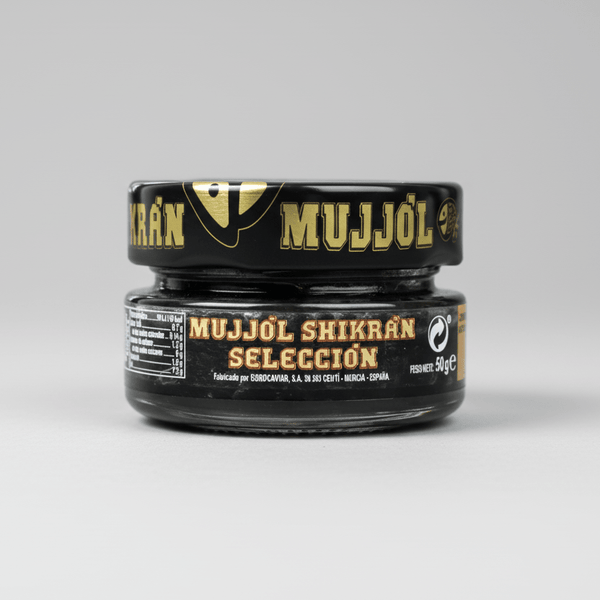
Riofrio Caviar: The Spanish Organic Caviar You Must Know
In a sector historically dominated by the Caspian Sea and in recent years by China, Spain has its own caviar. It is produced in Granada, in the cold waters of the mountains, and has the double honor of being the world's first certified organic caviar and one of the few European caviars that has earned the respect of international experts. Riofrio caviar is not a patriotic marketing product: it is a serious gastronomic proposal, with unique characteristics that differentiate it from any other caviar on the market.
In this article, we explain exactly what Riofrio caviar is, its history, its varieties, its prices, and how it compares to Iranian Caspian caviar, which has been our specialty at Bacalalo since 1990. As always, we try to be useful and objective: if Riofrio is the best option for certain buyers, we state it clearly.
What is Riofrio caviar
Riofrio is a caviar production company located in the municipality of Riofrio, in the province of Granada, in the foothills of the Sierra Nevada. The company operates a fish farm where they raise Acipenser naccarii sturgeons, known as the Adriatic sturgeon or Italian sturgeon, in pure spring water from the mountains.
What distinguishes Riofrio in the global caviar landscape is its organic certification. Since 2009, Riofrio caviar has been the world's first certified organic caviar by an independent entity (Sohiscert, Andalusia's organic certification body). This means that sturgeons are raised without antibiotics, without growth hormones, with population densities below ecological limits, with feed based on verified organic ingredients, and with a documented animal welfare protocol.
Organic certification is not just a marketing argument: it has real implications for the product's organoleptic profile. Sturgeons raised in lower density conditions, with better quality feed and without pharmacological intervention, develop cleaner fat and a more nuanced flavor than those raised in intensive industrial conditions.
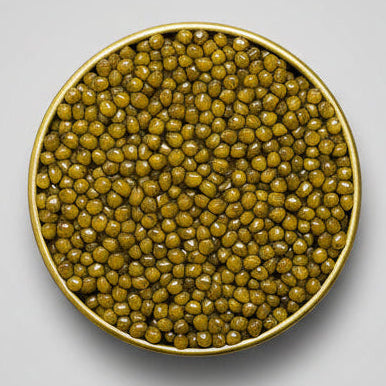
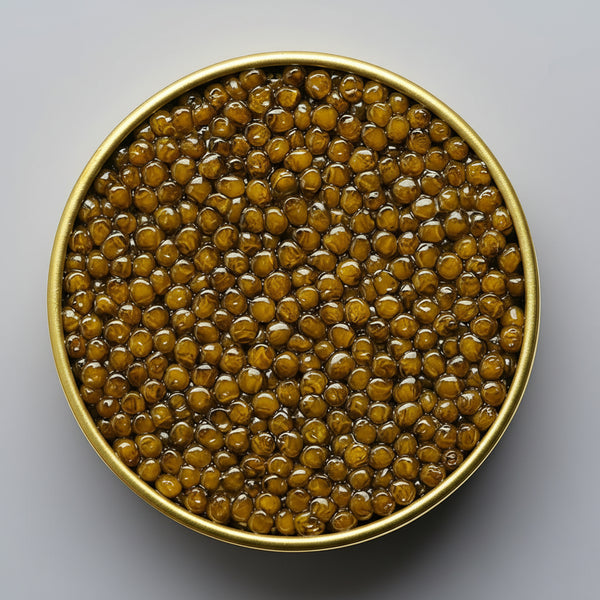
The result is a caviar with its own characteristics: medium-sized roe, brownish or dark green color, less iodized flavor than classic Caspian but with surprising complexity, especially in the malossol (minimum salt) variety.
History: Granada and the world's first organic caviar
The history of sturgeon in Spain is older than most imagine. Acipenser sturio, the Atlantic sturgeon, was a relatively common fish in large Iberian rivers for centuries: the Guadalquivir, the Ebro, the Tagus. Historical references to sturgeon fishing in the Guadalquivir date back to Roman times, and during the Middle Ages, sturgeon was a prized product in Spanish aristocratic cuisine. Overfishing and the transformation of Spanish rivers during the 20th century led the Atlantic sturgeon to the brink of extinction in Iberian waters.
The Riofrio fish farm was founded in 1963, originally to raise trout. From the 1980s, they began experiments with sturgeon, and in the 1990s, they started small-scale caviar production. The organic commitment began to take shape in the early 2000s when the company's founder, Mario Solari, decided to differentiate himself from the intensive aquaculture model that was beginning to dominate global caviar production, especially in China.
Official certification as the world's first organic caviar in 2009 was formal recognition of a process that had been under development for more than a decade. Since then, Riofrio has won international awards and has appeared in leading global gastronomic publications as one of the most interesting European caviars.
The location is part of the proposal: the Sierra Nevada waters that feed the Riofrio ponds have a purity, constant temperature, and mineral composition that is difficult to replicate. The water reaches the fish farm at a constant 14°C throughout the year, which produces slow and uniform growth of the sturgeons, which take between 8 and 10 years to reach the reproductive maturity necessary for caviar extraction.
Varieties and prices of Riofrio caviar
Riofrio's catalog is deliberately limited, reflecting the artisanal scale of production. They do not produce the volume of a company like China Sturgeon or even Iranian producers. Each year they produce a limited quantity that is sold, in significant part, through their own direct sales channel and to high-end restaurants.
Riofrio Original. The flagship product. Caviar from Acipenser naccarii, malossol (with little salt, the standard for haute cuisine), in a 30g tin. This product concentrates the most representative characteristics of Riofrio caviar: medium roe, characteristic greenish-brown color, clean flavor with hazelnut notes and a mineral aftertaste that reflects the purity of the mountain water. Approximate price: 75-90€ for 30g in direct sales.
Riofrio Seleccion. A superior selection, with larger roe and a more intense organoleptic profile. Available in 30g and 125g formats. Approximate price: 90-110€ for 30g, 350-420€ for 125g.
Riofrio Reserve. The highest expression of production. Roe at maximum ripeness, with more complex notes and a creamier texture. Very limited production, availability not guaranteed. Price: from 120€ for 30g.
Riofrio also offers derived products: sturgeon fat for cosmetic use, smoked sturgeon carpaccio, and preserves of sturgeon meat produced as a byproduct of caviar production. The company's circular economy is an additional argument for its coherence with the organic model.
Riofrio Caviar vs. Iranian Caviar: comparative table
This is the comparison that serious caviar buyers in Spain ask about the most. These are two distinct proposals, not incompatible. The question is not which is "better" in abstract, but which best suits each consumer profile and each use.
| Factor | Riofrio Caviar | Iranian Caspian Caviar (Bacalalo) |
|---|---|---|
| Species | Acipenser naccarii (Adriatic sturgeon) | Huso huso (Beluga), A. gueldenstaedtii (Osetra), A. stellatus (Sevruga) |
| Geographical origin | Riofrio, Granada, Spain | Caspian Sea, Iran |
| Organic certification | Yes (Sohiscert since 2009) | Not organically certified, but controlled fish farm |
| Flavor profile | Mineral, clean, hazelnut, less iodized | Marine, deep umami, buttery, hazelnut, long aftertaste |
| Roe size | Medium (2.5-3mm) | Variable depending on species: Sevruga small (2mm), Osetra medium-large (3-3.5mm), Beluga large (3.5-4mm) |
| Estimated price 30g | 75-120€ | Variable depending on variety: Sevruga 45-65€, Osetra 55-90€, Beluga 120-200€ |
| Availability | Limited, reduced seasons and stocks | Regular, with constant availability |
| International prestige | Recognized in European haute cuisine | Historical world reference, maximum status |
| Differentiating argument | Organic, Spanish, local history | Historically most valued Caspian variety, superior organoleptic profile in Beluga and Osetra |
When to choose each one
There is no universal answer. The choice depends on the use, the buyer, and the message you want to convey.
Choose Riofrio caviar if:
- Organic certification is an important value for you or for the recipient as a gift
- You want a Spanish caviar with local history and a clear differentiating argument
- You are looking for a more mineral and less iodized flavor profile, suitable for palates new to caviar or those who prefer cleaner flavors
- You will serve the caviar in a context where the "world's first organic caviar" argument adds to the experience
- You want to support artisanal Spanish production
Choose Iranian Caspian caviar if:
- You are looking for maximum organoleptic complexity, especially in Osetra and Beluga
- The caviar is for an occasion of utmost importance where the prestige of the origin matters
- You want greater availability of varieties (Beluga, Osetra, Sevruga) with regular stock
- You are looking for the best available Beluga: it is a category where Iranian has no real competition
- Price is a factor and you want the best quality-price ratio in premium caviar
In our experience at Bacalalo, customers who buy caviar as a gift usually opt for Iranian, especially Osetra, because the brand "Caspian Sea, Iran" immediately communicates exclusivity. Customers who buy for personal use and have strong sustainability values often highly appreciate Riofrio's organic argument.
How to taste Riofrio caviar correctly
The rules for tasting caviar are universal regardless of its origin. Riofrio is no exception. The correct way to taste caviar maximizes the perception of its organoleptic characteristics and avoids interferences that spoil the experience.
Serving temperature. Between 2°C and 6°C. Take out of the refrigerator 5 minutes before serving, no more. Caviar should never be at room temperature.
Container. Tradition dictates using mother-of-pearl, glass, or ceramic containers. Metal (except high-quality stainless steel) can oxidize and transfer metallic flavors to the caviar. Conventional metal spoons are contraindicated for the same reason.
Amount per person. For an appetizer tasting: 10-15 grams per person. For caviar to be the star of a first course: 20-30 grams. Below 10 grams, the experience is unsatisfactory; above 50 grams in a single session, the experience usually proves excessive for most palates.
Accompaniments for Riofrio. Riofrio's mineral and less iodized profile makes it especially suitable with neutral-flavored accompaniments that do not compete: classic warm blini with a little unsalted butter, unleavened white bread toast, fresh unacidified cream. Chopped onion and hard-boiled egg are traditional Russian accompaniments that work well with more potent caviars (Sevruga) but can mask Riofrio's subtlety.
Beverage. Iced vodka is the traditional combination and works perfectly: vodka cleanses the palate between spoonfuls and enhances the perception of marine notes. Blanc de Blancs Champagne (pure Chardonnay) or a Chablis Premier Cru are the wine alternatives with the best affinity. Avoid wines with too much wood or tannins: they kill the delicacy of the caviar.
To discover how the tasting experience differs between Spanish organic caviar and Imperial Iranian Osetra Caviar from the Caspian, you have to try both. It's not a competition: they are distinct expressions of the same tradition, with profiles that complement each other more than they exclude each other.
Discover Caspian caviar from Barcelona. At Bacalalo, we directly select our Caspian caviar to offer you Beluga, Osetra, and Sevruga varieties with the highest quality and freshness. Express shipping throughout Spain. From Mercat del Ninot, Barcelona, since 1990.
Where to buy Riofrio caviar
Riofrio caviar can be purchased directly on the company's website (caviarderiofrio.com), with shipping throughout Spain. Its presence in physical stores is more limited: some high-end delicatessens in Madrid and Barcelona have it in stock, although not always. It is also present in some high-end restaurants that include its product on the menu, generally as an argument for sustainability and local origin.
Riofrio does not distribute through third parties in most cases: they prefer to control the sales chain directly to maintain the integrity of the product and the brand message. This means that if you want Riofrio, you must go to its direct source.
If you are looking for Iranian Caspian caviar, at Bacalalo we have it available online with express shipping from Barcelona. Our Caspian caviar collection includes the three great varieties with regular stock and direct advice from specialists who have been working with seafood for 35 years.
To delve deeper into the world of caviar beyond Riofrio, our complete caviar guide: types, prices, and how to taste it is the most detailed resource we have published on the subject.
🛒 Products mentioned in this article
⭐ 4.9/5 · 24-48h cold shipping · Since 1990 in Mercat del Ninot
Frequently asked questions about Riofrio caviar
Is Riofrio caviar the only Spanish caviar?
No, although it is the best known and the first to establish itself as a serious producer. In recent years, other Spanish caviar producers have appeared, mainly in Extremadura and the Ebro Valley, although with much smaller productions and less recognition. Riofrio remains the undisputed reference for Spanish organic caviar.
Which sturgeon species is used in Riofrio?
Acipenser naccarii, known as the Adriatic sturgeon or Italian sturgeon. It is a different species from the Beluga sturgeon (Huso huso), Osetra (Acipenser gueldenstaedtii), or Sevruga (Acipenser stellatus) from the Caspian Sea. It has unique characteristics that influence the caviar's profile.
Why is Riofrio caviar a different color from Caspian caviar?
The color of the roe depends on the sturgeon's species, diet, and age. Acipenser naccarii typically produces roe that is brown or olive green, darker than the typical grey of Osetra or the bluish-black of Beluga. It is not an indicator of quality; it is simply a characteristic of the species.
Can the Riofrio fish farm be visited?
Yes. Riofrio offers guided tours of the fish farm, which has become a tourist attraction in the region. It allows visitors to see the sturgeon farming process firsthand and, during some periods, the caviar production. A recommended experience for product enthusiasts.
Is Riofrio caviar more sustainable than Iranian caviar?
It has formal organic certification, which Iranian caviar does not. In terms of documented environmental impact, Riofrio has a verifiable advantage. However, it is important not to confuse "not organically certified" with "not sustainable": Iranian controlled aquaculture farms operate under strict CITES regulations and have production standards that in many cases are equivalent, though without the formal organic label.
Can I buy Riofrio caviar and Iranian caviar for a comparative tasting?
This is one of the most interesting experiences a caviar enthusiast can have. Tasting both in the same session, with the same bread and cream, allows for a much more precise appreciation of the different profiles than any written description. The 30g formats of both are sufficient for a tasting for two people.
What distinguishes Iranian caviar from others in terms of flavor?
The depth of umami and the length of the aftertaste are the two most difficult characteristics to replicate in other origins. Iranian Osetra has an aftertaste that can last between 5 and 15 minutes, with a flavor evolution that goes through marine notes, then hazelnut, then butter, and ends in a subtle mineral. It is an experience of organoleptic complexity that the best sommeliers and industry experts still consider to have no true equivalent from other sources.
Discover our premium selection
Seafood selected with expertise since 1990 at Mercat del Ninot, Barcelona. Refrigerated delivery in 24-48h.