Summary: Sturgeon was on the brink of extinction in the Caspian Sea before 2000. Controlled aquaculture was not a compromise on quality — it was the solution that saved the species and today produces the best caviar available on the legal market. This guide explains the real history, the current status of sturgeon in the world, how sustainable production works, and how consumers can verify that the caviar they buy does not contribute to the problem.
The Caspian collapse: what almost destroyed caviar
Updated March 2026. Since 1990, we have hand-selected every product. This guide reflects that experience.
The Caspian Sea is the world's largest saltwater lake — with an area of 371,000 km2 — and for centuries it was the absolute epicenter of the global caviar trade. The three classic Caspian sturgeon species — Huso huso (Beluga), Acipenser gueldenstaedtii (Ossetra), and Acipenser stellatus (Sevruga) — produced enough quantities to supply the global luxury market without threatening populations, provided fishing was managed judiciously.
The problem arose with the dissolution of the Soviet Union in 1991. During the Soviet era, sturgeon fishing in the Caspian was centralized and state-controlled: strict quotas, production inspection, export regulation. With the disintegration of the USSR, five independent states shared the Caspian — Russia, Iran, Azerbaijan, Kazakhstan, and Turkmenistan — and regulatory coordination practically disappeared for years. Illegal fishing and a lack of control over quotas significantly increased pressure on sturgeon populations at a time when the international caviar market — with post-Soviet economic opening — experienced unprecedented demand.
The data is dramatic: in the 1970s, the Caspian produced approximately 25,000 tons of sturgeon annually. By 2005, legal catches had fallen to less than 1,000 tons. The Beluga population in the Caspian had decreased by more than 90% compared to mid-20th century levels. The IUCN declared Huso huso critically endangered.
The international response came with CITES: the Convention on International Trade in Endangered Species listed all Caspian sturgeon species in its Appendix II since 1997, requiring documentation and export quotas. In 2006, due to continued overexploitation, CITES suspended international trade in wild Caspian sturgeon caviar. Legal global caviar production ceased — and with it began the most significant transformation in the history of this product.
Current status of sturgeon: 27 species, almost all endangered
Sturgeon is the vertebrate group with the highest proportion of threatened species on the planet. Of the 27 sturgeon species that exist in the world, the IUCN classifies 85% in some threat category — from "vulnerable" to "critically endangered." Four species are considered potentially extinct in the wild, including the Chinese Yangtze sturgeon (Acipenser dabryanus).
In the Caspian, the three classic caviar species have different conservation statuses:
- Huso huso (Beluga): critically endangered (CR) according to IUCN. Wild populations are fragments of what they once were. Natural reproduction in the Caspian is seriously compromised by dams that block their historical reproductive migration routes.
- Acipenser gueldenstaedtii (Ossetra): endangered (EN). Better situation than Beluga but equally vulnerable. Repopulation programs in Iran and Russia have had some success.
- Acipenser stellatus (Sevruga): vulnerable (VU), the best situation of the three although still requiring active management.
In the Caspian, repopulation programs coordinated by Iran and Russia release millions of sturgeon fry annually as a recovery measure. Results are slow — sturgeon have the longest life cycle of any freshwater fish — but verifiable.
Aquaculture as a solution: the 180-degree turn
The suspension of wild caviar trade in 2006 forced the market to find an alternative. The alternative already existed in incipient forms — some European fish farms had been raising sturgeon under controlled conditions for years — but the combination of a legal ban on wild sturgeon and persistent market demand spurred unprecedented expansion of sturgeon aquaculture worldwide.
Between 2006 and 2015, global aquaculture caviar production increased from approximately 100 tons per year to over 300 tons. In 2024, global aquaculture caviar production is estimated at over 500 tons annually, with fish farms in Iran, China, Italy, France, Germany, the United States, Uruguay, and dozens of other countries.
This shift has implications that the market has not yet communicated well to consumers: aquaculture caviar is not a substitute for wild caviar nor an inferior version of the historical product. It is the product that today allows the legal caviar market to exist without destroying remaining sturgeon populations. And in many cases — especially in the case of Iranian Caspian aquaculture caviar — the aquaculture product is of comparable or superior organoleptic quality to wild caviar of the 1980s, thanks to controlled production conditions that guarantee uniformity and consistent quality.
How a quality sturgeon farm works
Sturgeon caviar production in aquaculture is one of the longest and most technically demanding food production processes in the world. Understanding how it works helps to understand both the logic of pricing and the criteria for distinguishing a quality fish farm from a low-cost mass production one.
The breeding cycle: everything starts with fry, usually from breeding females maintained on the fish farm. The fry grow in tanks or ponds with controlled water quality — temperature, oxygenation, pH, mineral composition — and are fed specific diets formulated to replicate their natural diet. The cycle until the first roe is obtained is 7-25 years depending on the species.
Water quality control: the taste of caviar directly reflects the composition of the water where the sturgeon lives. Premium fish farms in Iranian Caspian use water from the Caspian itself — with its specific mineral composition — or treated water to replicate that composition. This explains why Iranian aquaculture caviar has a different flavor profile from continental European fish farms that use river water or treated water with completely different mineral profiles.
Caviar extraction: there are two main methods. The lethal method, historically dominant, involves sacrificing the female and extracting all the roe. The non-lethal method ("milking" or "stripping") extracts roe from mature females without sacrificing them — similar to the process of milking a cow — allowing the female to produce caviar in subsequent cycles. Higher quality fish farms committed to long-term sustainability are migrating to the non-lethal method. The non-lethal method is more expensive and requires greater precision, but it maximizes the productive life of each female — an animal that can produce caviar for 20-30 years under aquaculture conditions.
The curing process: malossol caviar — the highest quality — is cured with salt in minimal proportions (3-5% of weight). The process requires artisanal expertise: the exact amount of salt, resting time, chamber temperature — any deviation affects the final profile. Premium fish farms employ master caviarmakers who supervise each batch.
Iran as a model for sustainable Caspian production
Among all the Caspian littoral countries, Iran has developed the most robust framework for sustainable caviar production. The Iranian Fisheries Research Institute (IIFRO) is the regulatory body that controls all Iranian caviar production, certification, and export. Its functions include:
- Certification of all fish farms authorized to produce caviar for export
- Quality control of each batch before export
- Sturgeon repopulation programs in the Iranian Caspian, with millions of fry released annually
- Scientific research on sturgeon reproduction and improvement of aquaculture techniques
- Application of CITES regulations for all Iranian caviar exports
The result is that Iran has built a system where caviar production is structurally linked to the conservation of sturgeon populations — these are not conflicting objectives but parts of the same system. A fish farm that depletes the natural resources it needs for its future production is not economically sustainable, which aligns producer incentives with conservation goals.
Iranian caviar certified by IIFRO carries on its label the batch identification codes, the producing fish farm's number, and the IIFRO export reference. This traceability — which starts with the animal on the farm and extends to the tin in the consumer's hand — is the most robust guarantee available on the caviar market.
Certifications that matter: CITES, ASC, IFO
Consumers who want to verify the sustainability of the caviar they buy have concrete tools:
CITES label: mandatory for all sturgeon caviar legally traded in the EU. It includes the species code, country of origin, production type (aquaculture indicated as "A"), batch number, and date. The absence of a CITES label is a legal irregularity, not just a matter of sustainability.
ASC (Aquaculture Stewardship Council) Certification: the most internationally recognized responsible aquaculture certification. It evaluates environmental impact, labor conditions, use of chemicals and antibiotics, and relationship with local communities. Some European sturgeon farms have ASC certification; it is still unusual in the Iranian Caspian but is growing.
IIFRO Certification: for Iranian caviar, the certification from the Iranian Fisheries Research Institute is the equivalent guarantee — and in many aspects more rigorous in terms of specific product quality control — than ASC certification.
Organic or biological certification: some European sturgeon farms produce caviar under national organic certifications (European Organic Agriculture, national equivalents) that include restrictions on the use of antibiotics, population density in ponds, and water quality. This is the most demanding level of certification and also represents the smallest volume in the total market.
The myth of second-rate aquaculture caviar
There is a persistent myth in the caviar market that aquaculture caviar is inevitably inferior to historical wild Caspian caviar. This myth has a partially valid historical basis — the first aquaculture caviars of the 1990s and 2000s were, in many cases, inferior to the best wild caviar available — but it does not correspond to the reality of today's market.
The reasons why premium aquaculture caviar equals or surpasses historical benchmark wild caviar:
Total control of variables: in quality aquaculture, the producer controls diet, water temperature, animal stress, and the exact moment of roe extraction. This consistency produces batches of uniform quality that wild caviar — subject to the variations of the natural environment — cannot guarantee.
Female traceability: in a well-managed fish farm, the caviarmaker knows the history of each producing female — age, health, diet, previous production cycles — which allows optimizing the extraction moment to maximize roe quality. This level of knowledge of the producing animal is impossible with wild caviar.
The Iranian Caspian as a natural advantage: Iranian Caspian fish farms — unlike continental European ones — use water from the Caspian itself, maintaining the conditions that historically produced the world's best caviar. The final product has the chemical and organoleptic characteristics of historical Caspian caviar because the production environment is literally the same.
Professional tasters, in repeated blind tastings with caviars of diverse origin, find no systematic differences in quality between the best Iranian Caspian aquaculture caviar and historical benchmark wild caviar. The difference exists in price — the symbolism of wild caviar has market value — but not necessarily in taste.
The future of caviar: where global production is headed
Global aquaculture caviar production continues to grow, with China rapidly becoming the largest producer by volume — estimates place current Chinese production between 150 and 200 tons annually, approximately 30-40% of total global production. However, the higher-value premium caviar market is not dominated by Chinese volume but by Iranian Caspian producers and specialized European fish farms that can guarantee verifiable origin, process, and quality.
The most impactful trend for the coming years is the expansion of the non-lethal extraction method, which allows repeated production from the same female for decades. This practice radically changes the economics of production — it reduces the cost per gram of caviar in the long term and allows the investment in the producing animal to be amortized over multiple cycles. Fish farms that systematically adopt this method will have a competitive and sustainability advantage that will benefit the premium market in the long term.
Genetic research on sturgeon is providing knowledge that could allow identifying, at early stages of breeding, which females will produce higher quality caviar. This early selection capability will reduce effective breeding times and improve production consistency — with implications for both the sector's economy and the sustainability of resource use.
How to buy sustainable caviar: a practical guide
Consumers who want to make informed decisions about sustainability when buying caviar have concrete and verifiable criteria:
- Demand a complete CITES label. It is mandatory. If it's not there, the product cannot be of verifiable legal origin.
- Verify the production type code on the CITES label. The letter "A" indicates aquaculture. The letter "W" would indicate wild capture — which practically no longer exists in the legal market.
- Prefer Iranian origin certified by IIFRO for the maximum combination of quality and verified sustainability in the Caspian.
- Buy from channels with direct responsibility for the product — specialized distributors with traceability from producer to consumer, not from channels with multiple intermediaries without identification of the real origin.
- Be wary of prices significantly below market for the declared type and origin. Quality sustainable caviar has a production cost that cannot be overlooked.
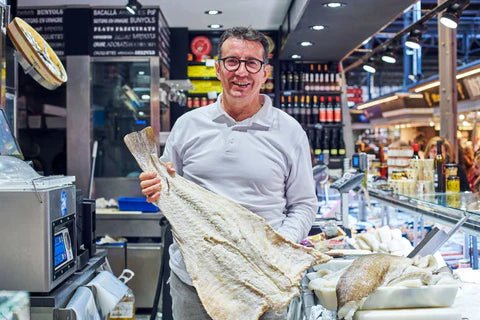
At Bacalalo, from Barcelona's Mercat del Ninot, we approach caviar with the same criteria we apply to cod and anchovies: verified origin, complete traceability, direct relationship with the producer. All our selection of Caspian caviar has IIFRO certification of Iranian origin and full CITES labeling.
Premium Seafood Products — Bacalalo
Since 1990, selecting the best from the sea at Mercat del Ninot, Barcelona. Refrigerated shipping 24-48h.
View Caspian caviar →🛒 Related products from Bacalalo
⭐ 4.9/5 · Chilled delivery 24-48h · Since 1990 at Mercat del Ninot
Frequently asked questions about sustainable caviar
Does farmed caviar taste the same as wild caviar?
Caspian farmed caviar from Iran — produced in the same ecosystem as historical wild caviar — has a very similar flavor profile to the best benchmark wild caviar. Professional tasters in blind tastings do not find systematic quality differences between the best Caspian farmed caviars and historical benchmark wild caviar. European continental farmed caviar has a different profile due to changes in water conditions, not because it is of lower quality in absolute terms.
Is legal wild caviar available on the market today?
In very limited quantities and with very strict documentation, yes. Iran maintains a very small quota for wild sturgeon capture for the domestic market and for specially controlled export. In the European market, the volume of legal wild caviar available is minimal — the vast majority of caviar sold on the legal world market today is farmed.
Does buying caviar contribute to sturgeon extinction?
Buying caviar with a CITES label of verified farmed origin does not contribute to sturgeon extinction — on the contrary, it funds sustainable production programs that include active restocking of natural populations. Buying caviar without documentation or from suspicious sources can contribute to the black market, which has historically been the biggest factor in the destruction of wild populations.
Which countries produce the best sustainable caviar besides Iran?
Italy (especially caviar from Caviar Giaveri and other northern fish farms) and France (Sturia, Prunier) have high-quality sturgeon farms with rigorous environmental certifications. Germany, Spain, Israel, and the United States also have quality productions. China produces the largest global volume but with greater variability in quality and a lower average level of certification available to the European consumer.
Can Caspian sturgeon recover?
Available evidence is moderately optimistic. Iranian restocking programs have contributed to some stabilization of certain populations. The reduction of illegal fishing — one of the most destructive factors — has improved with greater coordination among the five riparian states. However, the extremely long life cycles of sturgeon mean that any recovery is a process of decades, not years. Aquaculture does not recover wild populations by itself, but it reduces pressure on them by eliminating the need for capture.
Discover our premium selection
Seafood selected with care since 1990 at Mercat del Ninot, Barcelona. Refrigerated shipping in 24-48h.