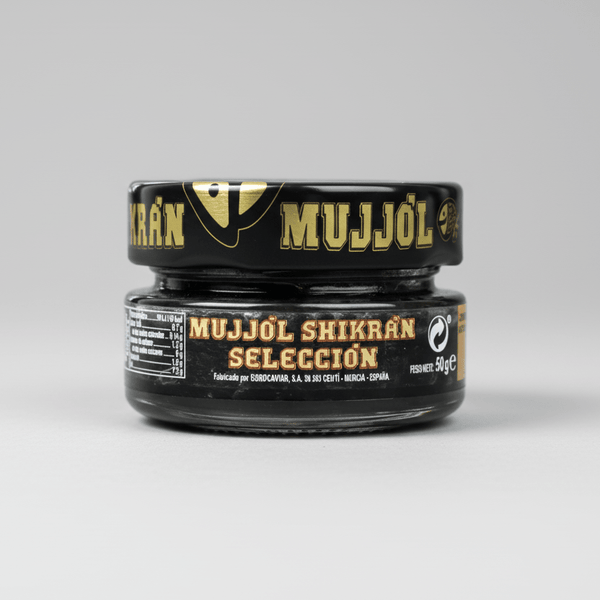
Summary: Beluga caviar is the world's most recognized luxury food product, and its price has a real biological explanation, not just marketing. In this guide, you will find what exactly Beluga is, why it costs what it costs, how to distinguish the authentic from the inauthentic, how much to pay in Spain in 2026, and how to taste it to extract its full complexity. Verifiable information, without vendor mythology.
Contents
- What is Beluga caviar: the largest sturgeon in the world
- Why Beluga is the most expensive caviar: the arithmetic of scarcity
- Iranian Beluga vs. other origins: why the Caspian makes a difference
- Price of Beluga caviar in Spain in 2026: table by weight
- How to recognize authentic Beluga: quality indicators
- How to taste Beluga caviar correctly
- Beluga pairing: what to drink and what to accompany it with
- Beluga vs. Osetra: which to choose depending on the occasion
- Where to buy authentic Beluga caviar in Spain
- Frequently asked questions about Beluga caviar
What is Beluga caviar: the largest sturgeon in the world
Updated March 2026. Every day at Mercat del Ninot we see what works and what doesn't. This is our real experience.
Beluga caviar comes from Huso huso, the largest sturgeon on the planet and one of the largest freshwater and estuarine vertebrates in known history. An adult specimen can exceed 6 meters in length and 1,000 kilograms in weight. It is not a modern fish: Huso huso has been in the oceans for over 200 million years with a morphology that has barely changed since the Triassic, before dinosaurs appeared on Earth.
This antiquity is not merely decorative. The Beluga sturgeon is an animal with extraordinarily slow biological cycles: females do not reach sexual maturity until 18-25 years of age. Only then do they begin to produce the roe which, once mature and cured with salt, becomes the Beluga caviar we know. There is no way to compress that cycle. There is no technology that can accelerate it. Every gram of Beluga caviar literally represents two decades of animal rearing.
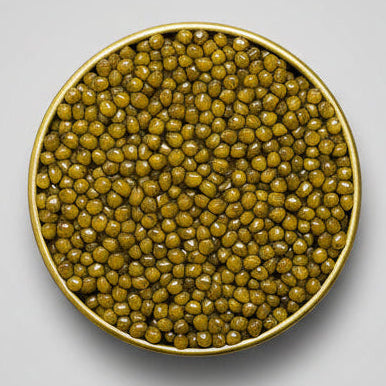
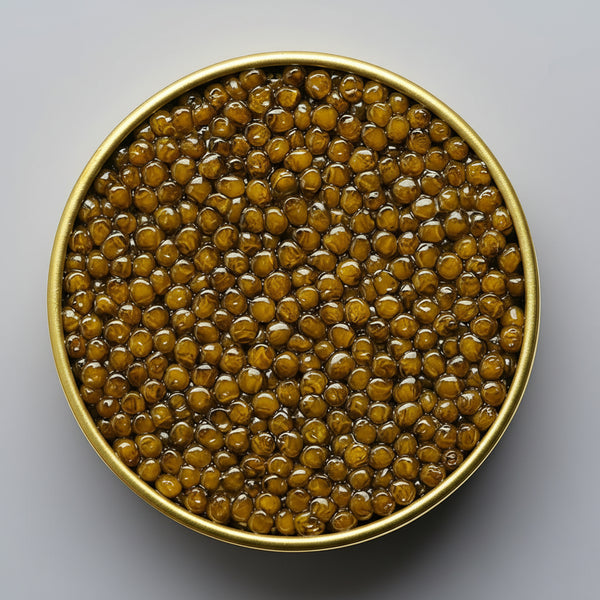
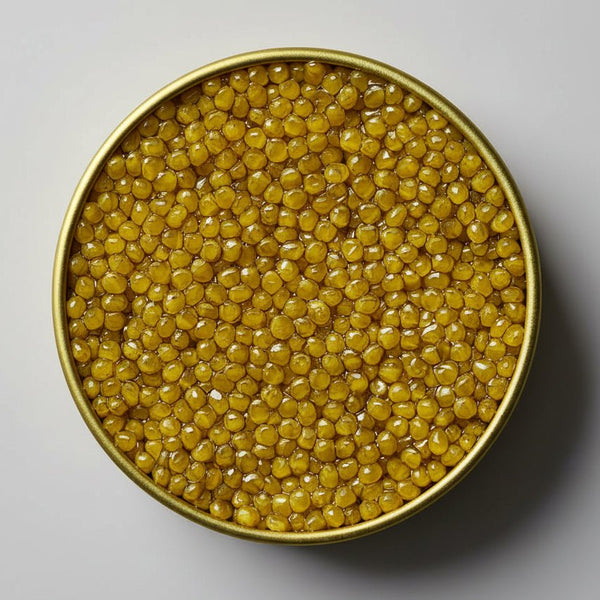
Beluga roe is the largest of the three classic types of sturgeon caviar: between 3 and 4 millimeters in diameter, with a fine but firm membrane that gives the product its characteristic texture. The color varies from luminous pearl gray to dark gray, almost black, depending on the age of the animal and the origin of the waters. Older specimens produce lighter, almost silver-toned roe, which historically was valued as the highest expression of the product — the so-called golden or almas caviar, extracted from specimens over 100 years old, today practically unobtainable on the market.
The species is classified as critically endangered in the wild by the IUCN. Industrial overfishing in the 20th century, the construction of dams that blocked reproductive migration routes, and the pollution of the Caspian Sea decimated wild populations to the point that CITES (Convention on International Trade in Endangered Species) applied severe restrictions starting in 1998 and suspended international trade in wild Caspian caviar in 2006. The Beluga caviar legally traded today comes almost exclusively from controlled aquaculture under government supervision.
Why Beluga is the most expensive caviar: the arithmetic of scarcity
The price of Beluga caviar has four verifiable components that have no equivalent in any other food product on the market:
Maturation time: 18-25 years of rearing until the first caviar is obtained. During this period, the fish farm invests in feed, facilities, veterinary care, water quality control, and specialized personnel. The accumulated cost per animal before producing a single gram of caviar is structurally high.
Yield per female: an adult female Huso huso produces between 10% and 18% of her body weight in roe. But extracting that caviar involves a delicate process — increasingly with non-lethal techniques that prolong the animal's productive life — that requires highly specialized personnel. Production per animal per year is limited by biological definition.
Regulatory restrictions: the trade of sturgeon caviar is subject to CITES regulations and European legislation that require documentation of origin, health certificates, and quality controls at every level of the chain. The regulatory cost is real and is passed on to the price.
Globally inelastic demand: the market for premium Beluga caviar has a relatively inelastic demand — buyers who seek it do not have an equivalent substitute — which keeps prices high regardless of general economic fluctuations.
All this explains why the price of authentic Beluga caviar of verifiable quality starts in a certain range and why prices well below that range should raise suspicion about the product's origin or quality.
Iranian Beluga vs. other origins: why the Caspian makes a difference
The Caspian Sea is an inland sea with no connection to any ocean, making it a unique ecosystem with chemical and biological characteristics that exist nowhere else on the planet. Its waters have a much lower salinity than oceans — between 1.2% and 1.3% compared to 3.5% for oceans — and a specific mineral composition that directly influences the aromatic profile of the sturgeon roe that lives and feeds in them.
The Iranian sector of the Caspian — the southern part of the sea, bordering the coast of Iran — has the most favorable conditions: colder temperatures, greater depth in the seabeds where sturgeon inhabit, and a higher concentration of the organisms that make up their natural diet. These factors result in roe with a higher density of omega-3 fat, a firmer membrane, and a more complex aromatic profile than sturgeon raised in continental European aquaculture or other regions of the Caspian.
Iran also has the strictest regulatory framework for Caspian caviar. The Iranian Fisheries Research Institute (IIFRO) controls all production, certification, and export. There is no legal export of Iranian caviar without this certification seal. This combination — optimal natural conditions plus demanding regulatory control — is why Iranian caviar remains the global quality benchmark, even though quality fish farms now exist in Italy, France, China, and other countries.
Price of Beluga caviar in Spain in 2026: table by weight
The price range of Beluga caviar in the Spanish market in 2026 varies significantly depending on origin, quality, and sales channel. As a guiding reference:
| Weight | Price range for verifiable quality Beluga | Note |
|---|---|---|
| 10g | 25-45 EUR | Minimum individual tasting |
| 30g | 75-130 EUR | Complete individual tasting |
| 50g | 120-220 EUR | For two people or special occasion |
| 100g | 230-450 EUR | Luxury gift, celebration table |
Prices well below these ranges — Beluga at 15 EUR for 30g, for example — should be interpreted as a warning sign about the product's origin or quality classification. The price of authentic, controlled aquaculture Beluga from the Caspian has a floor determined by real production costs.
Our Iranian Beluga Caviar at 125 EUR and Iranian Imperial Beluga Caviar at 90 EUR — both with certified Iranian Caspian origin — represent the verifiable quality reference available in our catalog.
How to recognize authentic Beluga: quality indicators
The demand for Beluga caviar far exceeds the available supply of authentic product, which creates a market with a lot of mislabeled products or those with deficient traceability. These are the indicators that an informed consumer should verify:
CITES Certification: all sturgeon caviar legally traded in the EU must be accompanied by its CITES label with the species code, country of origin, production type (aquaculture or wild-caught), batch number, and processing date. The absence of this label is a legal irregularity, not just a sign of dubious quality.
Scientific name on the label: authentic Beluga is Huso huso. If the label only says "sturgeon" or uses the term "Beluga" without the scientific species, the origin is not verifiable.
Visual texture: the roe of authentic Beluga is spherical, separated, shiny, without crushing or excessive liquid in the tin. Caviar that presents broken roe, opaque color, or excess dark liquid at the bottom has lost some of its quality.
Aroma: quality Beluga caviar has a soft, slightly salty marine aroma, without notes of stale fish or ammonia. A pungent or unpleasant odor is an indicator of a preservation problem or inferior quality.
How to taste Beluga caviar correctly
Beluga has the mildest and creamiest flavor profile of the three classic types, which makes it especially susceptible to any element that distracts from the tasting. That's why the serving protocol is even more important than with other caviars.
Temperature: between 2 and 4 degrees Celsius. Serve on crushed ice and keep it cold throughout the tasting. Beluga at room temperature quickly loses its aromatic definition.
Utensil: mother-of-pearl, bone, wood, or ceramic spoon. Never standard metal. Beluga is particularly sensitive to metallic contamination due to the delicacy of its aromatic profile.
First spoonful always plain: place the caviar on your tongue without chewing. Let the roe rest for two to three seconds, then gently press against the palate. Beluga's creaminess unfolds at that moment like a gentle wave that gains complexity as the seconds pass.
Aftertaste: in premium Beluga, the aftertaste is prolonged — between 30 and 45 seconds — with notes of open sea, butter, and a subtle mineral background. This is the parameter that best differentiates premium Beluga from an inferior one: the duration and intensity of the aftertaste.
Beluga pairing: what to drink and what to accompany it with
Beluga caviar has such a particular flavor that accompaniments must be chosen with specific criteria. The general rule is: neutrality and cleanliness, nothing that competes with the product's creaminess.
Champagne Blanc de Blancs (pure Chardonnay): the classic combination par excellence. The high acidity and fine bubbles of Blanc de Blancs Champagne cleanse the palate between bites, and the neutrality of Chardonnay does not compete with Beluga's creaminess. A quality Cremant d'Alsace plays the same role at a lower price.
Very cold Russian or Polish vodka: the Slavic tradition has its logic: vodka at -18 degrees radically cleanses the palate, and its organic neutrality allows the next bite of caviar to start from scratch. This is the historical combination of the Caspian and high-gastronomy Russian and Iranian tables.
Very cold sparkling mineral water: the option for those who do not drink alcohol. The bubbles in the water serve some of the function of champagne — cleansing the palate — although with less effectiveness than sparkling wine.
Solid accompaniments: warm blini (mini buckwheat crepes), sour cream or crème fraîche, finely chopped hard-boiled egg, chives. Never lemon on caviar — it masks the aromatic profile.
Beluga vs. Osetra: which to choose depending on the occasion
The question that every caviar enthusiast eventually asks is not which is better in absolute terms — but which is more suitable for each situation.
Beluga is the right choice when the occasion calls for the ultimate symbol of culinary luxury: a celebration that allows no compromise, a gift that must communicate that no expense has been spared, an experience remembered as the most exquisite. Its soft and creamy profile makes it accessible even for those who have never tried caviar before — it seduces without confronting.
Osetra is the connoisseur's choice: for those who already know caviar and seek a more complex and distinctive profile. The Iranian Imperial Osetra Caviar at 75 EUR has a more pronounced personality — notes of nuts, mineral, a more intense aftertaste — which is more interesting from a gastronomic point of view for those with a developed palate.
There is no objective answer as to which is "better": they are distinct expressions of the same tradition, and the most respected experts in the field divide their preferences between the two depending on the context.
Where to buy authentic Beluga caviar in Spain
The Spanish Beluga caviar market has suppliers of very heterogeneous quality. The selection criteria applied by an informed buyer are: verifiable origin traceability, CITES labeling present, scientific species declared, documented preservation process, and a distribution channel with direct responsibility for the product.
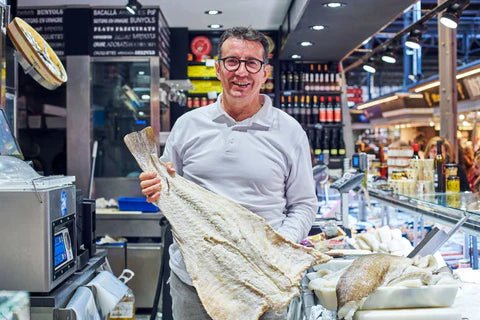
At Bacalalo, from Mercat del Ninot in Barcelona, we apply the same standards as to the rest of our seafood catalog: verified origin, complete traceability, without intermediaries diluting responsibility for quality. We work directly with Iranian Caspian producers with valid IIFRO and CITES certification.
Our selection of Beluga includes Iranian Imperial Beluga and Iranian Beluga, both from the Iranian Caspian with complete origin documentation. The difference between the two references lies in the classification of the producing female — Imperial comes from specimens selected for the quality of their roe, with greater uniformity in size and color.