Summary
At the Bacalalo counter in Mercat del Ninot, this comparison is constantly made. Smoked salmon is everywhere — wedding appetizers, hotel breakfasts, supermarket refrigerators — and... In this guide: Key differences at a glance, Taste and texture: the most important difference in cooking, Which dish to use each for.
At the Bacalalo counter in Mercat del Ninot, this comparison is constantly made. Smoked salmon is everywhere —wedding appetizers, hotel breakfasts, supermarket refrigerators— and smoked cod is starting to gain ground as a more interesting and, in many cases, tastier alternative. But are they interchangeable? The short answer is no. They are distinct products, with very different profiles, that work best in different dishes. Here's why.
Contents
Key differences at a glance
Before going into detail, this table summarizes the main differences between both products:
- Type of fish: Cod = white fish (Gadus morhua). Salmon = oily fish (Salmo salar or Oncorhynchus).
- Flavor: Cod is more intense, marine, and saline. Salmon is milder, fattier, and slightly sweet.
- Texture: Cod is firmer, with defined flakes. Salmon is silkier and more unctuous.
- Fat: Cod 1-3 g per 100 g. Salmon 10-14 g per 100 g.
- Protein: Cod 20-22 g per 100 g. Salmon 18-20 g per 100 g.
- Calories: Cod 130-160 kcal/100 g. Salmon 180-220 kcal/100 g.
- Sodium: Both are high due to the curing process, but cod tends to be saltier.
- Price: Smoked cod is usually more economical than smoked salmon of equivalent quality.
- Common origin: North Atlantic Cod (Norway, Iceland). North Atlantic Salmon (Scotland, Norway) or Pacific.
Taste and texture: the most important difference in cooking
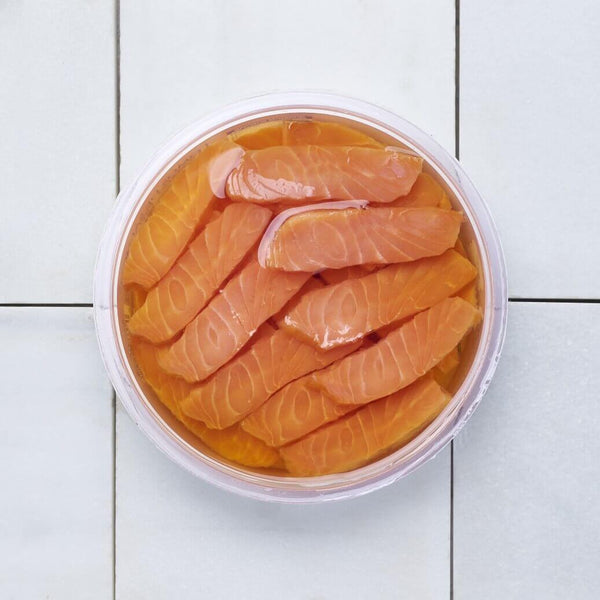
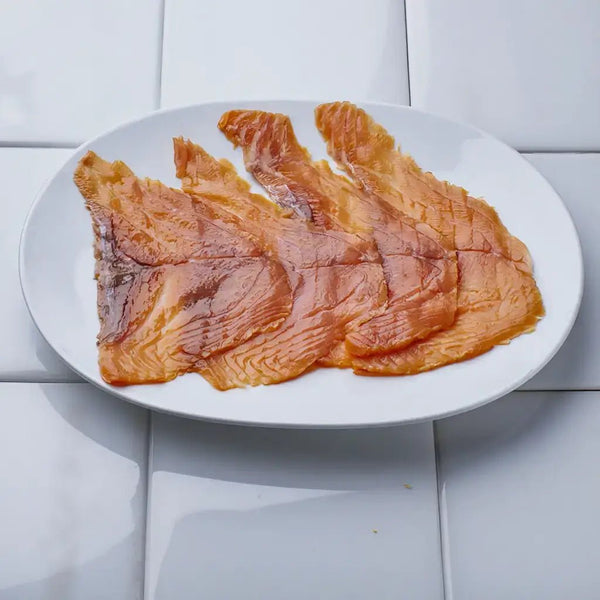
Salmon is an oily fish: its muscle is infiltrated with fat, just like tuna or sardines. This fat is what gives it its silky texture and its smooth, enveloping flavor. When smoked, the result is a product that melts in the mouth and whose smoky flavor is softened by the fat, resulting in a pleasant, easy-to-like profile that appeals to almost everyone.
Cod is a white fish: almost no intramuscular fat (less than 3%). This means that the smoke flavor is not dampened by fat. The result is a more direct, more intense, more marine, and more saline flavor. The texture is firm: smoked cod flakes easily with the fingers but does not fall apart. It has more character and requires more full-bodied accompaniments to balance it.
This doesn't mean one is better than the other: it means each requires a different culinary approach.
Which dish to use each for
Toasts and canapés
Both work, but with different accompaniments. Smoked salmon on toast with cream cheese and dill is a classic that never fails: its mildness pairs well with delicate ingredients. Smoked cod on toast needs stronger flavors to balance its intensity: capers, red onion, mustard. If you only serve it with cream cheese, the cod can be overpowering.
For an informal appetizer where you want something everyone will like: salmon. For something more interesting and with more character: cod.
Pasta
Smoked salmon goes very well with mild cream sauces, with a touch of dill or lemon. The fat from the salmon melts with the cream and creates a smooth and homogeneous sauce. Smoked cod in pasta requires more structured sauces: cream with shallots and garlic, or butter with capers. If you use it in a tomato sauce, the result doesn't work: the acidic tomato and the smoky cod amplify each other to excess.
Salads
Smoked salmon is more versatile in salads because its mild flavor can handle both sweet ingredients (orange, mango, beetroot) and acidic ones (citrus, vinaigrette). Smoked cod works better in warm salads —with potato, hard-boiled egg, mustard vinaigrette— where its intensity has something to dialogue with. In light green salads, cod can be too overpowering.
Mousses and patés
To make a mousse, smoked cod needs more added fat (cream cheese, crème fraîche, whipped cream) to soften it and give it creaminess. Smoked salmon already has its own fat, and the mousse is easier to achieve with fewer additions. That said, smoked cod mousse has more flavor and is more interesting for palates looking for something different from salmon.
Eggs
In scrambled eggs or poached eggs, smoked cod holds up better to temperature than salmon: its firmer texture does not fall apart with residual heat. Salmon tends to become stringy if even slightly heated. For egg dishes, smoked cod is the more technical option.
Related Products from Bacalalo


Recommended Products

Supreme Gourmet Smoked Salmon Domínguez Fine Slic...
8,90 €

Whole Smoked Salmon Domínguez Uncut - 2.2kg | Artis...
145,00 €

Smooth and buttery smoked salmon loins
24,90 €

Sliced Smoked Salmon Celebration Format | 1.5 kg
89,95 €
Refrigerated shipping 24-48h to the entire Peninsula
Nutrition compared
- Calories: Smoked cod 130-160 kcal/100 g — Smoked salmon 180-220 kcal/100 g.
- Protein: Cod 20-22 g/100 g — Salmon 18-20 g/100 g. Both are excellent sources of complete protein.
- Total fat: Cod 1-3 g/100 g — Salmon 10-14 g/100 g.
- Omega-3: Salmon wins hands down: 1.5-2.5 g of EPA+DHA per 100 g versus 0.1-0.3 g for cod. If you are looking for omega-3 fatty acids, salmon is clearly superior.
- Sodium: Both are high due to the salt in the process: 800-1,200 mg/100 g in cod, 900-1,400 mg/100 g in salmon depending on preparation.
- Vitamin D: Salmon provides significantly more vitamin D than cod, again due to its higher fat content.
- Iodine and selenium: Cod provides more iodine and selenium than salmon per 100 g.
Nutritional summary: if you are looking for more protein with fewer calories and less fat, smoked cod is the option. If you are looking for omega-3 and vitamin D, salmon wins. If you are concerned about sodium, both should be consumed in moderation.
Which is more sustainable
The sustainability of both products depends enormously on the origin and production method, not on the type of fish itself.
North Atlantic cod (Gadus morhua) from MSC-certified fisheries in Norway, Iceland, or the Faroe Islands is one of the most sustainable options available: populations are well-managed and recovering after the collapse in the 1990s. At Bacalalo, we work exclusively with cod from these certified origins.
Mass-market smoked salmon primarily comes from aquaculture —especially from Norway and Chile. Farmed salmon has a debated environmental impact: it consumes wild fish protein in its feed and generates waste on the seabed. Wild Pacific salmon (sockeye, king, coho) is generally more sustainable than farmed salmon, but also much more expensive.
In terms of overall ecological footprint, certified origin smoked cod has clearer traceability and a better-documented environmental impact than most smoked salmon available on the Spanish market.
When to choose each: practical summary
- Choose smoked cod if you want more flavor and character, if you are looking for a lower-fat, lower-calorie option, if you are going to use it in dishes with powerful accompaniments (capers, mustard, onion, egg), or if you want to try something different for an appetizer.
- Choose smoked salmon if you want something everyone will like without argument, if you need omega-3 in your diet, if you are going to use it in mild cream sauces or in salads with delicate or sweet ingredients, or if you are looking for the silkiest texture possible.
Frequently asked questions
Can they be substituted for each other in any recipe?
Not always. In toasts and appetizers, substitution works by adjusting the accompaniments. In creamy pasta, both work, although with different results. In warm salads with potato, smoked cod is more appropriate. In preparations with tomato or sweet ingredients, salmon is a better option.
Which one has more fish flavor?
Smoked cod has a more pronounced and direct marine flavor than salmon. This is a consequence of its lower fat content: the fat in salmon softens and masks the marine flavor, while in cod it is more exposed. If fish flavor makes you uncomfortable, start with salmon.
Which is cheaper?
In Spain, smoked cod of equivalent quality is usually cheaper than premium smoked salmon. Good quality Scottish or Norwegian salmon has a high price. That said, the price varies enormously depending on origin, format, and distributor.
Can children eat it?
Both are safe for children, although their sodium content should be taken into account. In small children, quantities should be moderate. Consult your pediatrician if you have doubts about sodium intake.
Where to buy quality smoked cod?
At Bacalalo, in Mercat del Ninot in Barcelona, or in our online store at bacalalo.com/collections/bacalao-ahumado with refrigerated shipping throughout the Peninsula. We work with certified Gadus morhua from the North Atlantic, cold-smoked with beech and applewood. We have been in the business since 1990 and can advise you on the most suitable format for each preparation.
Products you might be interested in
Discover more