Summary: Smoked salmon is one of the most consumed gourmet products in Spain, but the difference between industrial and artisan can be abysmal. In this complete guide, we explain the types of smoking, the origins of salmon, how to identify real quality, and what to avoid. With over 30 years of selecting products at the Mercat del Ninot, we share verifiable criteria so you can buy with knowledge, not marketing.
| Aspect | Key fact |
|---|---|
| Types of smoking | Cold (20-30 °C) and hot (60-80 °C) |
| Main woods | Beech, oak, cherry, apple |
| Most common origins | Norway, Scotland, Ireland, Pacific (wild) |
| Storage (opened) | 3-5 days in fridge, well wrapped |
| Protein per 100 g | ~20 g |
| Omega-3 per 100 g | ~1.8 g (EPA + DHA) |
What is smoked salmon and why is fish smoked?
Smoked salmon is a product made from salmon fillets that undergo a salting process and subsequent exposure to noble wood smoke. The result is a silky meat, with an intense flavor and a much longer shelf life than fresh fish.
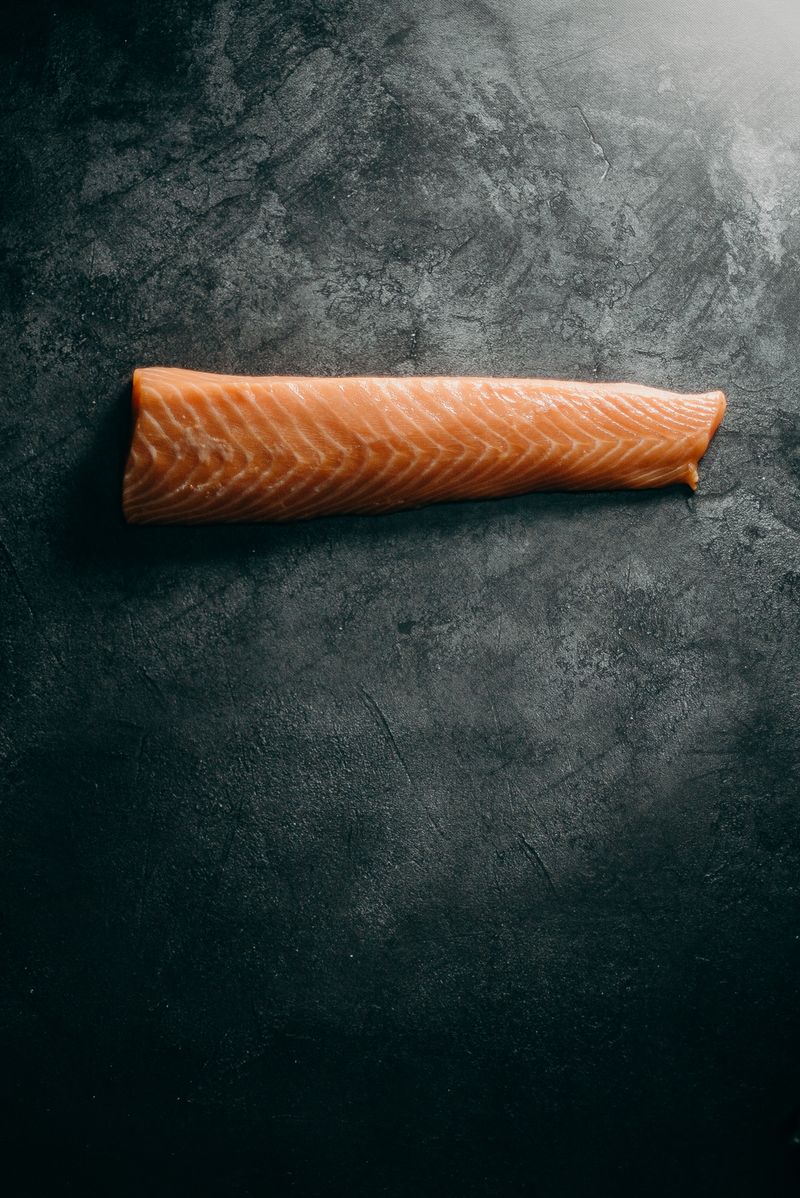
Fish smoking has ancient roots. Scandinavian and Celtic communities were already smoking salmon over 1,000 years ago as a preservation method to survive long winters. What was then pure survival is now high-level gastronomy.
The basic process consists of three phases: first, salting (dry or in brine) which partially dehydrates the fish and enhances the flavor. Second, resting, where the salmon stabilizes the absorbed salt. Third, the smoking itself, which adds aromas, color, and a natural antibacterial protective layer.
Not everything sold as "smoked" actually is. Some industrial manufacturers use liquid smoke (chemical smoke condensate) sprayed onto the fish, a shortcut that does not provide the aromatic complexity of real smoking. If the label says "smoke flavor" in the ingredients, it is not traditional smoked salmon.
Cold smoking vs. hot smoking: real differences that matter
This is probably the most relevant distinction when buying smoked salmon, and the one least people know about. It's not a subtle nuance: they are two completely different products.
Cold smoking (20-30 °C)
The salmon is exposed to smoke at temperatures that never exceed 30 °C, for 12 to 48 hours depending on the producer. Since it does not reach cooking temperature, the protein does not denature: the texture remains raw, silky and unctuous. This is what you find in thin slices, served at a good brunch or on a blini.
It is the most appreciated type in gastronomy and the one we sell in our selection of smoked salmon. Since 1990 at Mercat del Ninot, we have tested dozens of suppliers, and the difference between a well-executed cold smoke and a mediocre one is immediately noticeable on the palate.
Hot smoking (60-80 °C)
Here the salmon is cooked during the smoking process. The temperature exceeds 60 °C, which coagulates the proteins and gives a firm, flaky texture, similar to baked fish. The smoked flavor is more pronounced, and the meat easily flakes.
It is excellent for salads, pasta, fillings, and dishes where you need the salmon to integrate as a cooked ingredient. It is neither better nor worse than cold-smoked: it is a different product.
| Characteristic | Cold smoked | Hot smoked |
|---|---|---|
| Temperature | 20-30 °C | 60-80 °C |
| Duration | 12-48 hours | 3-8 hours |
| Texture | Silky, raw, unctuous | Firm, flaky, cooked |
| Smoked flavor | Subtle, complex | Intense, direct |
| Main use | Sliced, canapés, sushi | Salads, pasta, fillings |
| Average price | Higher (longer process) | Lower |
Types of wood for smoking: the invisible ingredient
Wood is not a minor detail. It is literally the ingredient that defines the aromatic profile of salmon. Each species provides distinct nuances, and good producers choose the wood with the same discernment that a winemaker chooses the barrel.
- Beech: the most used in Europe. Produces a clean, smooth, and balanced smoke. It is the standard wood in quality Scandinavian smokehouses. It provides sweet and lightly toasted notes without overpowering the salmon's flavor.
- Oak: more intense than beech, with earthy nuances and a hint of tannin. Common in Scottish and Irish smokehouses. Ideal for those looking for a more pronounced smoked flavor.
- Cherry: sweet and fruity, with a slightly acidic touch. Less common in Europe, highly appreciated in North America. Produces an attractive reddish color on the surface.
- Apple: the most delicate of all. Smooth, slightly sweet, almost floral smoke. Perfect for subtly flavored salmon where you don't want the wood to overshadow the fish.
A good producer always indicates what wood they use. If the label doesn't specify, they probably use industrial mixes or liquid smoke. Transparency in the process is the first indicator of quality.
Origin of salmon: Norwegian, Scottish, Irish or wild Pacific
Origin matters, but not in the simplistic way many believe. Not all Norwegian salmon is good, and not all wild salmon is superior. Let's look at the real differences.
Norwegian salmon (Salmo salar, farmed)
Represents more than 50% of the smoked salmon consumed in Spain. It is Atlantic salmon farmed in Norwegian fjords, with cold water and natural currents. Quality varies enormously depending on the farm: the best control fish density, feeding, and growth time.
Good Norwegian salmon has well-infiltrated fat, a natural pink-orange color, and a mild flavor. A bad one tastes like feed and has a soft, watery texture.
Scottish salmon
Raised in the Highlands and islands of Scotland, generally under stricter conditions than standard Norwegian farms. Scottish Label Rouge guarantees a maximum density of 20 kg/m³ (compared to 25-35 kg/m³ for conventional farms). More intense flavor, firmer texture. Price 20-30% higher than standard Norwegian.
Irish salmon
Similar to Scottish in farming conditions. Smaller production, less known, but some of the best smoked salmon in Europe is Irish. The Connemara area and County Clare stand out.
Wild Pacific salmon (Oncorhynchus)
Species like sockeye, king (chinook), or coho are caught in Alaska, British Columbia, and Kamchatka. These are different species from Atlantic salmon. Leaner meat, more intense flavor, more pronounced red color. Excellent option, but scarce and expensive. Do not confuse with chum or pink salmon, which are lower quality species.
| Origin | Type | Fat | Flavor | Relative price |
|---|---|---|---|---|
| Norwegian | Aquaculture | High | Mild, buttery | Medium |
| Scottish | Premium aquaculture | Medium-high | Intense, complex | High |
| Irish | Premium aquaculture | Medium-high | Fine, mineral | High |
| Wild Pacific | Wild | Low-medium | Potent, earthy | Very high |
If you are interested in a specific comparison between supermarket and artisanal salmon, we have published a detailed analysis in Mercadona vs. artisanal Norwegian smoked salmon where we break down ingredients, prices per kilo, and real differences.
How to choose quality smoked salmon: 5 verifiable criteria
After more than three decades of selecting products, these are the indicators we use at Bacalao to reject or approve a smoked salmon. These are not opinions: they are verifiable criteria that you can apply yourself.
- Color: natural pink-orange, never intense red. Quality smoked salmon has a shade between pale pink and soft orange. If the color is bright red or excessively uniform, it is likely that synthetic astaxanthin was excessively added to the feed. Wild salmon has a natural red color, but farmed salmon should not be gaudy.
- Texture: silky and flexible, not pasty or dry. When folded, a slice should curve without breaking and partially return to its shape. If it sticks to itself like a paste or breaks like cardboard, there is a processing problem or poorly managed prior freezing.
- Fat: visible white streaks in the flesh. Infiltrated fat (the white lines running through the slice) is a sign of well-fed salmon with adequate growth time. Salmon without visible fat streaks probably grew too quickly.
- Aroma: soft and natural smoke, never chemical. Bring your nose close to the opened package. You should perceive a delicate smoke mixed with marine notes. If the smoky smell is aggressive, acrid, or reminiscent of an industrial chimney, you are dealing with liquid smoke or excessive smoking to mask mediocre product.
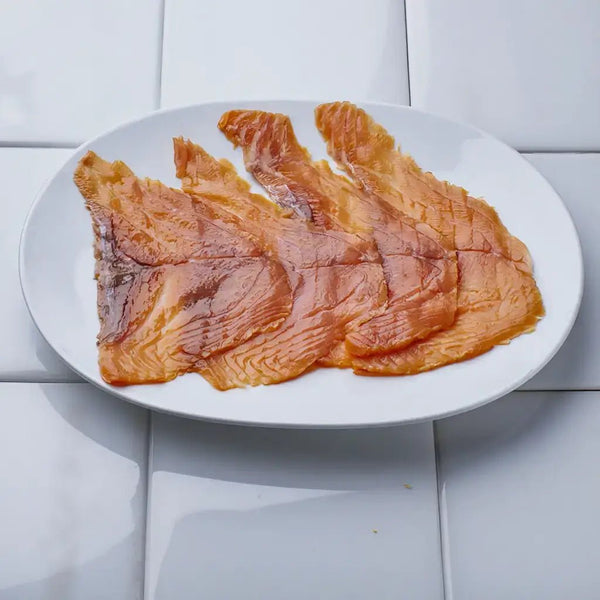
- Cut: hand vs. machine. Hand-sliced produces irregular, wider sheets that follow the muscle fiber. Machine cutting generates uniform and thin slices. Both can be quality, but hand-cutting allows controlling the thickness according to the area of the loin, extracting the best from each piece.
Artisan vs. industrial slicing: what you see and what you don't
Slicing is the final step before salmon reaches your table, and it makes a bigger difference than it seems.
Artisanal knife slicing is performed by a master cutter who adjusts the angle and thickness to each area of the loin. The fattier part (belly) is cut thinner; the leaner part (loin) can be left thicker. Each slice has its own character. The smoked salmon loins we offer are prepared following this criterion.
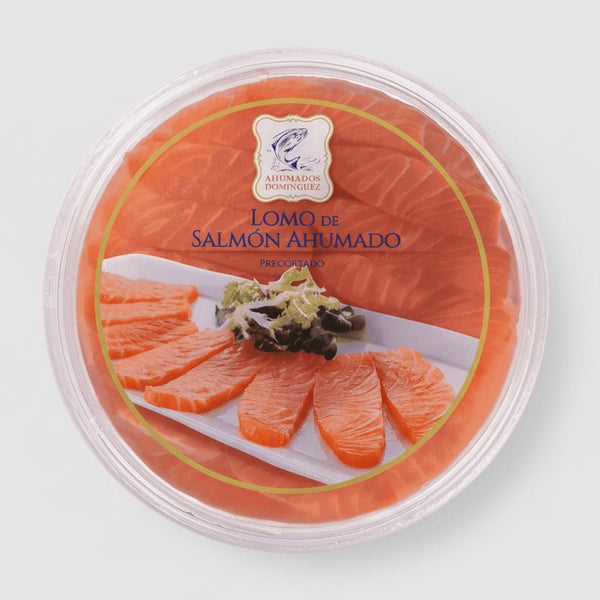
Industrial slicing uses calibrated mechanical blades. It produces perfectly uniform slices of 1-2 mm. It is efficient and consistent, and smoked salmon slices from good producers like Domínguez maintain a high standard with this method. It is not inferior by definition, but it loses the piece-by-piece adaptation.
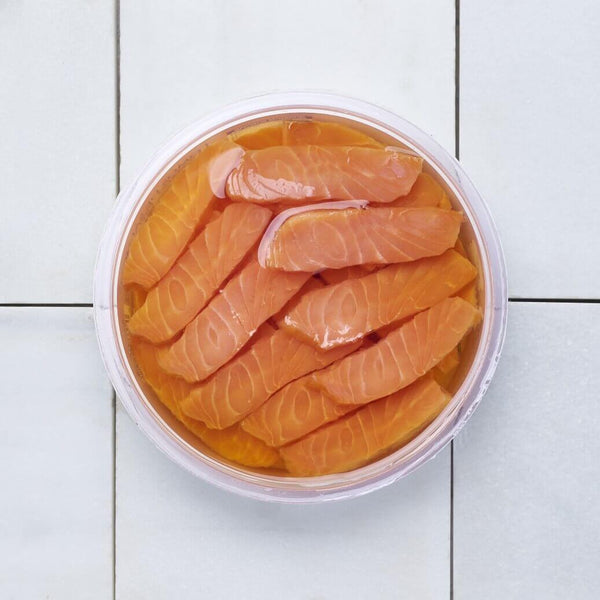
For special formats like smoked salmon sashimi, the cut follows Japanese tradition: thick blocks of 5-8 mm eaten with chopsticks and soy sauce. It is a different way to enjoy the product that is worth trying.
Smoked salmon preservation: times and methods
A storage error can ruin excellent salmon. These are the real times and methods, not the "just in case" you'll find on most websites.
Sealed packaging (unopened)
Respect the manufacturer's expiration date. Store in the refrigerator between 0 °C and 4 °C. Vacuum-packed smoked salmon, well refrigerated, can last between 3 and 6 weeks from its production, depending on the producer.
Once opened
Consume within 3 to 5 days maximum. Wrap tightly in cling film or store in an airtight container, removing as much air as possible. Always keep in the coldest part of the refrigerator (usually the lower back area). If you notice the surface darkens or becomes viscous, discard it.
Freezing
Yes, smoked salmon can be frozen, although the texture loses some silkiness. The trick is to freeze it as flat as possible, well wrapped in film and inside a zip-lock bag with no air. Freezer duration: up to 2-3 months. Always thaw in the refrigerator (never at room temperature) for 12-24 hours. We have written a complete guide on freezing smoked salmon with all the details.
Nutritional value: what smoked salmon really provides
Smoked salmon is nutritionally dense. For every 100g of product, these are the average values:
| Nutrient | Amount per 100 g | % Daily Value (approx.) |
|---|---|---|
| Calories | 117-150 kcal | 6-7% |
| Protein | 18-20 g | 36-40% |
| Total fats | 4-8 g | 6-12% |
| Omega-3 (EPA + DHA) | 1.5-2.0 g | >100% |
| Sodium | 600-1,200 mg | 25-50% |
| Vitamin D | 11-17 µg | 55-85% |
| Vitamin B12 | 3-4 µg | 120-160% |
The good: It is an exceptional source of complete protein, long-chain omega-3s (the ones that truly matter for heart and brain health), vitamin D, and B12. Few foods concentrate so many essential nutrients per serving.
The point to watch: sodium. The salting process raises the salt content to 600-1,200 mg per 100 g. For most people, a 50-80 g serving is perfectly compatible with a balanced diet. If you have a medical prescription for sodium restriction, consult your specialist for the appropriate amount.
Smoked salmon is suitable for protein, keto, paleo, and Mediterranean diets. It is not ultra-processed: its ingredients are salmon, salt, and smoke. Nothing else.
Pairing: what to serve with smoked salmon
Smoked salmon has a fatty, salty, and slightly smoky profile that pairs extraordinarily well with acidic, fresh, and crispy ingredients. These are the combinations that really work.
Wines and Cava
- Cava Brut Nature: Acidity and bubbles cut through the fat of the salmon. It is probably the best universal pairing. Look for a Cava aged for a minimum of 15 months.
- Albariño or Godello: Galician white wines with marked acidity and fruity notes that complement without competing.
- Champagne Blanc de Blancs: For special occasions, the minerality of Chardonnay works extraordinarily well.
- Dry Riesling (Alsace or Germany): Its electric acidity and citrus notes are a classic North European pairing.
Classic Accompaniments
- Capers: Their salty and acidic touch contrasts perfectly with the fat of the salmon. Use small capers (nonpareilles), not the large ones.
- Thinly sliced red onion: Raw, it provides a bite that cleanses the palate between mouthfuls.
- Lemon: A few drops just before eating. The citric acid lightly "cooks" the surface and enhances the flavor. Don't drench the entire slice: a few drops are enough.
- Fresh dill: The classic Scandinavian herb. Its fresh anise aroma is the natural complement to smoked salmon.
- Cream cheese or crème fraîche: The neutral fatty base that brings all the flavors together. Spread it on a blini or a rye bread toast.
- Rye bread: The traditional Nordic option. Its earthy flavor and dense texture support the weight of the salmon without falling apart.
For those who want to go further, smoked salmon also works with ripe avocado, fresh grated radish (Japanese wasabi or European horseradish), and poached egg. A complete brunch that impresses and requires no cooking.
🛒 Products mentioned in this article
⭐ 4.9/5 · 24-48h refrigerated shipping · Since 1990 at Mercat del Ninot
Frequently Asked Questions about Smoked Salmon
Is smoked salmon raw?
It depends on the type of smoking. Cold smoking (the most common for slices) is technically raw, as the temperature never exceeds 30 °C. However, salt and smoke cure it, eliminating most pathogenic bacteria. Hot smoking is cooked, as it exceeds 60 °C.
Can pregnant women eat smoked salmon?
Spanish (AESAN) and European health authorities recommend avoiding cold-smoked salmon during pregnancy due to the risk of Listeria monocytogenes. Hot-smoked, being cooked, is considered safe. If in doubt, consult your gynecologist.
How much does quality smoked salmon cost?
Artisanal smoked salmon of good origin ranges from €45 to €80 per kilo, depending on the type of salmon, the process, and the cut. Standard supermarket ones are around €25-€40/kg. In our smoked salmon collection, you can see the current prices for each reference. The price difference reflects real product differences, not just brand.
Can smoked salmon be frozen without losing quality?
Yes, although the texture loses some silkiness upon thawing. The key is to freeze quickly, well-wrapped, and without air. We have written a specific guide on how to freeze smoked salmon with the exact steps to minimize quality loss.
What is the difference between smoked salmon and cured salmon (gravlax)?
Gravlax is cured with salt, sugar, and dill, but is not smoked. The texture is similar to cold-smoked, but the flavor is different: more herbaceous and sweet, without smoky notes. They are two distinct preparations starting from the same fish.
Is the orange color of smoked salmon artificial?
In farmed salmon, the color comes from astaxanthin added to the feed (the same pigment that wild salmon get from eating krill). This is legal and common. What would be artificial is the use of colorings added directly to the final product, something that serious producers do not do. A soft, natural pink-orange color is a sign of good practice.
How to tell if smoked salmon is spoiled?
Three clear signs: sour or ammonia smell (different from natural smoke smell), viscous or sticky texture to the touch, and color change to brownish or greenish tones. If you have any doubts, discard it. Don't take risks with raw products.
Is hand-cut smoked salmon better?
Hand-cutting allows the thickness to be adapted to each area of the fillet, which maximizes the mouthfeel experience. But a good machine cut of excellent salmon will be better than a poor hand cut of mediocre salmon. What matters most is the quality of the raw material; the cut is the final step that can add or subtract. If you want to learn how to prepare your own smoked salmon, consult our guide to making smoked salmon at home.