

Summary: Salt-cured anchovies are the product as it comes out of the "coceta": fish cured in salt for months, unfilleted, unwashed, without oil. It is the anchovy in its purest and also its most economical form. Buying salt-cured anchovies and preparing them at home gives you total control over the result...
Salt-cured anchovies are the product as it comes out of the "coceta": fish cured in salt for months, unfilleted, unwashed, without oil. It is the anchovy in its purest and also its most economical form. Buying salt-cured anchovies and preparing them at home gives you total control over the final result: the salt level, the texture, the oil you use. And the flavor, when prepared correctly, surpasses that of many anchovies in oil at a much higher price.
At Mercat del Ninot, we have been selling salt-cured anchovies for over 35 years, and the most common question is always the same: "How do I clean them?" This guide answers that question and all the ones that follow: how to choose them, how to preserve them, and how to get the most out of them.
What exactly are salt-cured anchovies?
Salt-cured anchovies are anchovies from the Cantabrian Sea (or other origins) that have undergone a long curing process in salt. The process is simple but requires time: fresh anchovies, freshly caught during the season (May-June), are partially gutted, layered with coarse sea salt in cocetas (cylindrical barrels), and pressed with weights for a minimum of 6 months. During this time, the salt extracts moisture, protein transforms, fat redistributes, and the aromatic compounds that give the anchovy its characteristic flavor develop.
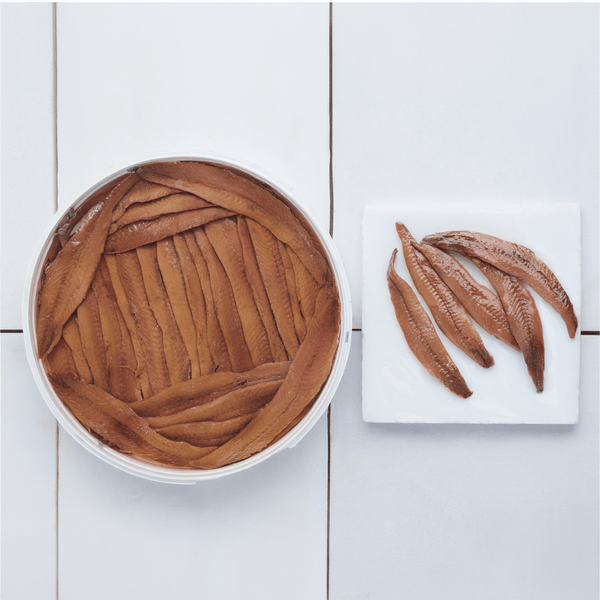
The result is a whole fish, with skin, central bone, and adhered salt residue, dark reddish-brown in color, with an intense and concentrated aroma. It is not a product ready to eat directly: it requires a process of desalting, cleaning, and filleting before consumption.
If you are interested in the production process from scratch, we have a complete guide on how to make homemade salt-cured anchovies. This article focuses on the next step: you have already bought them ready, and now you need to prepare them.
Differences between salt-cured anchovies and anchovies in oil
Understanding this difference is fundamental to knowing what you are buying and what you can expect from each format:
- Salt-cured anchovies: whole fish cured in salt, unfilleted and unwashed. Requires preparation before consumption. More intense and potent flavor. Lower price per kilo. More control over the final result. Typical format: 1-5 kg tins or smaller containers for domestic use.
- Anchovies in oil: fillets already cleaned, desalted, and packed in olive oil (ideally extra virgin). Ready to eat. Milder and more balanced flavor due to the oil. Higher price due to the preparation work. Typical format: 50-100g tins.
Salt-cured anchovy is the same raw material as anchovy in oil, but at an earlier stage of the process. When a restaurant serves extraordinary anchovies, in many cases they have bought them salt-cured and prepared them in-house, adjusting the salt level and oil to their taste. You can do exactly the same.
For a complete overview of the world of anchovies, our complete guide to Cantabrian anchovies covers calibers, brands, and quality criteria in detail.
How to choose quality salt-cured anchovies
Not all salt-cured anchovies are the same. These are the criteria we use at Ninot to select ours:
- Origin: Cantabrian anchovies (Engraulis encrasicolus, May-June season in the Cantabrian Sea) are the benchmark. Higher fat content, better texture after curing, more complex flavor. Mediterranean or imported anchovies are a more economical alternative but with a different profile.
- Curing time: minimum 6 months, ideally 10-12 months. Longer curing produces anchovies with more complex flavor and silkier texture. Anchovies cured for less than 6 months (accelerated product) are harder and less flavorful.
- Visual appearance: quality salt-cured anchovy has a uniform reddish-brown color, no black spots or whitish areas. The flesh should appear compact, not crumbled or pasty.
- Smell: intense, marine, with notes of controlled fermentation. Rancid, ammoniacal, or sour smell indicates spoilage.
- Size: larger pieces produce more generous fillets with a better meat-to-bone ratio.
Our salt-cured anchovies Pack 4 are selected directly from Santoña producers who work with seasonal anchovies and a minimum curing of 8 months. They are the ideal format for those who want to prepare their own anchovies at home with professional results.
Related Bacalalo Products


How to clean salt-cured anchovies: step by step
The cleaning process is simple but requires some practice. The first time it will take you about 20-30 minutes for a handful of anchovies; with experience, you will do it in half the time.
Materials needed
- Salt-cured anchovies
- A large bowl with cold water
- Kitchen paper or a clean cloth
- A small knife or a thin spatula (optional)
- Extra virgin olive oil
- A glass container with a lid to store them
Step 1: Remove external salt
Take the anchovies out of the container and remove the excess coarse salt adhering to the surface with your fingers. There is no need to be exhaustive in this step: the remaining salt will wash off during soaking.
Step 2: Soak in cold water
Place the anchovies in a bowl with cold tap water. Let them soak for 15 to 30 minutes, depending on your salt preference. For a milder result, change the water once or twice during soaking. For a saltier profile (ideal for cooking), 10-15 minutes may be enough.
Key tip: never use hot or lukewarm water. Heat cooks the protein and ruins the texture. Always use cold water.
Step 3: Open and fillet
Take the anchovies out of the water one by one. With your fingers, separate the head by gently pulling downwards: the guts will come out with it. Now, with your thumbs, open the anchovy in half along the central bone, as if opening a book. The flesh separates easily from the bone if the curing has been correct.
Remove the central bone with your fingers or with the help of a small knife, pulling from the tail towards the head. The two fillets will be clean. If there are any remains of fin or dark skin, remove them by gently scraping with your thumb under running water.
Step 4: Second rinse
Pass each fillet briefly under a stream of cold water to remove any remaining salt, small bones, or entrails. Do not leave the fillets under water for too long in this step: they are already desalted from the previous soak, and excessive washing would remove flavor.
Step 5: Dry
This step is crucial and many people ignore it. Place the fillets on kitchen paper and dry them carefully, patting gently on both sides. A damp fillet does not absorb oil well and deteriorates faster. The drier they are, the better the result.
Step 6: Cover with oil
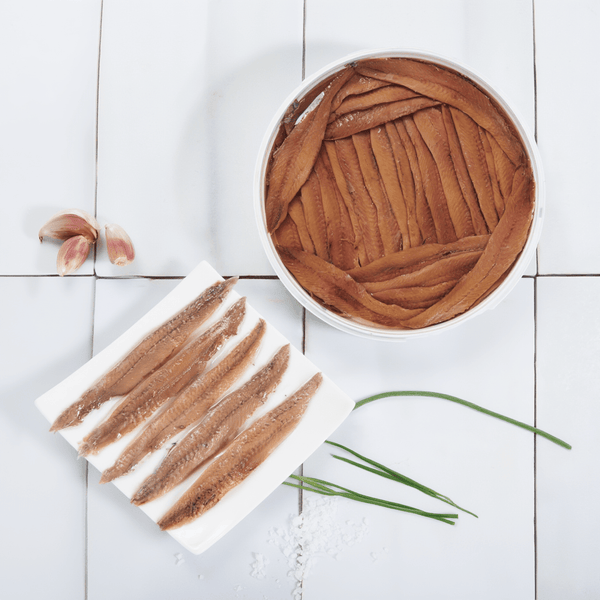
Place the fillets in a glass container in a single layer (or layers separated by oil) and cover them completely with good quality extra virgin olive oil. The oil is what will preserve them and give them their final finish. Mediocre oil produces a mediocre result. Close the container and store it in the refrigerator.
The fillets will be at their optimum after 24-48 hours in oil, when the oil has penetrated the flesh and the flavor has softened slightly. They can be consumed immediately, but this resting period makes a difference.
Preserving salt-cured anchovies
Unopened (salt-cured)
Unopened salt-cured anchovies can be stored for months in a cool, dark place, or in the refrigerator. Salt acts as a natural preservative. A well-sealed container of salt-cured anchovies can last 12-18 months without problems in the fridge. At room temperature (cool, no more than 18-20 °C), several months.
Once opened (salt-cured)
If you have opened the container but are not going to clean all the anchovies at once, make sure the remaining ones are well covered with salt and the container is tightly closed. Store them in the refrigerator. They will last for weeks without problems as long as the salt covers all the fish.
Cleaned and in oil
Prepared fillets covered in oil in the refrigerator last between 1 and 2 weeks without losing quality. After the second week, the flavor becomes more concentrated and the texture may become slightly softer. Ideally, prepare quantities that you will consume within 7-10 days.
Uses of salt-cured anchovies in cooking
Once cleaned and filleted, homemade anchovies are used exactly like commercial anchovies in oil, but with the advantage that you control the salt level and the quality of the oil.
As an appetizer or tapa
Anchovy toast with butter, "gilda", anchovy on piquillo peppers, gourmet preserved food platter. In all these uses, homemade anchovy has more presence and character than the average commercial anchovies in oil. For a complete preserved food platter, combine them with other products from our selection of salted and smoked foods.
As an ingredient in cooking
Salt-cured anchovies are exceptional as an umami enhancer in:
- Tomato sauces: 2-3 fillets dissolved in the initial sofrito transform an ordinary sauce into something extraordinary.
- Pasta: pasta alla puttanesca, with anchovies, capers, olives, and tomato, is a classic that directly depends on the quality of the anchovy.
- Salad dressings: Caesar vinaigrette includes anchovy as a fundamental ingredient.
- Meats: vitello tonnato, anchovies on Roman-style roast lamb, or simply an anchovy fillet on beef carpaccio.
- Vegetables: anchovies with roasted peppers, with ripe tomatoes, with eggplants, or with artichokes create simple and perfect combinations.
Preservation in flavored oils
Once you master the basic preparation, you can experiment with flavored oils: oil with sliced garlic and chili, oil with rosemary, oil with lemon zest. The fillets absorb the aromas during resting in the refrigerator, and the result is a personalized anchovy that you won't find in any commercial tin.
Premium vs. economical salt-cured anchovies
The price difference between quality salt-cured anchovies and economical ones can be 3x or more. Is it worth paying more?
The short answer is yes, especially if you are going to consume them as an appetizer where the anchovy is the star. Premium Cantabrian anchovies have:
- Higher fat content, which translates into more flavor and silkier texture after cleaning.
- Longer curing (10-12 months vs. 4-6), with the development of more complex aromas.
- Larger and more uniform pieces, which produce more generous and easier-to-handle fillets.
For cooking (sauces, sofritos, pasta), a medium-range salt-cured anchovy performs perfectly. For direct consumption, it is worth investing in quality.
If you prefer the convenience of already prepared anchovies, our "0" Gourmet Selection anchovies and premium anchovies in oil are ready to consume directly, with the quality of Cantabrian anchovy you are looking for.
Common mistakes when preparing salt-cured anchovies
After decades selling anchovies and seeing customers prepare them, these are the most common mistakes:
- Using hot water to desalt: cooks the protein and ruins the texture. Always use cold water.
- Desalting for too long: more than 30-40 minutes and the anchovy loses flavor and becomes bland. If you want less salt, change the water twice in 20 minutes instead of leaving it longer.
- Not drying the fillets well: residual moisture prevents the oil from penetrating and shortens shelf life. Always dry them with kitchen paper.
- Storing them without covering with oil: a fillet exposed to air oxidizes in hours and acquires an unpleasant metallic taste. The oil must cover them completely.
- Using low-quality oil: oil is the second most important ingredient after the anchovy itself. Always use extra virgin.
- Preparing too much quantity: prepare what you will consume in a week. It is better to make several small batches than one large one that spoils.
Frequently asked questions
How long do unopened salt-cured anchovies last?
In the refrigerator, unopened salt-cured anchovies can last between 12 and 18 months. Salt acts as a natural preservative. At cool room temperature (less than 20 °C), several months. Always in a dark, dry place.
Can salted anchovies be frozen?
It is not necessary or recommended. They have a very long shelf life thanks to the salt. Freezing them can alter their texture, making them softer and more difficult to fillet. Simply keep them well covered with salt in the refrigerator.
How much salt should be removed when cleaning them?
It depends on the use. For an appetizer, soaking them for 20-30 minutes in cold water, changing the water once, leaves a balanced saltiness. For cooking in sauces, 10-15 minutes is enough. If they are too salty, extend the soaking time by 5-10 minutes next time.
What is the difference between buying salted anchovies and anchovies in oil?
The price and control. Salted anchovies cost less per kilo because you save on the cost of filleting, washing, packaging, and oil. In return, you invest your time. The result can surpass that of many commercial anchovies in oil because you control the salt level and the quality of the oil.
Can I prepare anchovies with vinegar instead of oil?
Yes, you can make a version similar to "boquerón en vinagre" (marinated anchovies), but the result will differ from the traditional one. Desalt thoroughly (soak for 30-40 minutes), fillet, and immerse in white wine vinegar for 1-2 hours. The flavor will be more intense than conventional "boquerón en vinagre."
Are salted anchovies suitable for coeliacs?
Yes. They contain only fish and salt, so they are naturally gluten-free. Make sure the oil you use to preserve them is pure, without blends or additives.
How many salted anchovies do I need per person?
As an appetizer, estimate 4-6 whole pieces (8-12 fillets) per person. For cooking, 2-3 pieces per serving are usually sufficient. Keep in mind that one whole anchovy yields two fillets.
What should I do with the leftover oil from anchovies?
Don't throw it away. The oil absorbs flavor and aroma from the fish and is an extraordinary condiment for dressing salads, drizzling on tomato toasts, adding to stir-fries, or marinating roasted vegetables.
Related Products from Bacalalo
🛒 Products mentioned in this article
⭐ 4.9/5 · 24-48h refrigerated shipping · Since 1990 at Mercat del Ninot
Conclusion
From Mercat del Ninot in Barcelona, we have been selecting the best seafood products for over 35 years. If this guide has been helpful, explore our catalog at bacalalo.com and receive the same quality at home that we have been selling in the market since 1990.