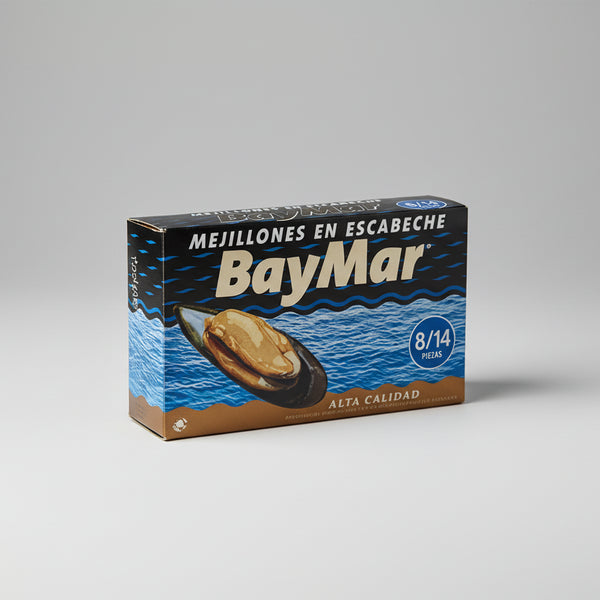
Summary: Canned clams are one of those products that can range from mediocre to extraordinary with almost the same external appearance. A can of natural clams from the Rías Gallegas, well-processed, with the correct size and certified origin, is a jewel of Spanish canning. The alternative—industrial imported clams of inconsistent size—is also labeled "natural clams," although the experience is radically different.
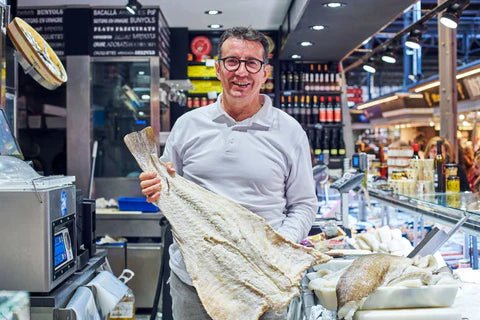
At Bacalalo, we have been working with premium quality canned goods at the Mercat del Ninot in Barcelona since 1990. This guide helps you understand what you are buying, why fine clams are worth more than carpet shell clams, and how to get the most out of them.
Contents
The Three Main Types of Canned Clams
Not all "natural clams" are the same. Labels in Spain can refer to very different species:
Grooved Carpet Shell Clam (Ruditapes decussatus)
The grooved carpet shell clam — also called European clam or Galician clam — is the most prized species. It grows slowly in the Rías Gallegas in sandy, clean seabeds. It is recognized by:
- Shell wider than long, with a fine and marked reticulation
- Firmer meat and larger size per piece
- Softer, sweeter, and more refined flavor
- Higher price (can cost double or triple that of the carpet shell clam)
The grooved carpet shell clam is what appears in the best seafood restaurants. In canned form, it is the premium category.
Warty Venus Clam (Venerupis corrugata)
The warty venus clam has a shell with more pronounced longitudinal ribs and a slightly different texture. It also lives in the Rías Gallegas. It is somewhat more affordable than the grooved carpet shell clam, with a very similar flavor but a slightly softer texture. Highly appreciated in Galicia, where it is considered a quality alternative to the grooved carpet shell.
Carpet Shell Clam (Chamelea gallina)
The carpet shell clam is the lowest-priced bivalve in the group. It has a rounder shell, smaller size, firmer texture, but a more intense and iodized flavor. Very common in more economical canned goods and in high-volume catering. It is not an intrinsically lower quality product: it has its own organoleptic characteristics that some consumers prefer. But it is different from the grooved carpet shell, and labeling them the same without specifying the species is a practice that confuses the buyer.
What to look for on the label: that it specifies the species. "Grooved carpet shell clam," "warty venus clam," or "carpet shell clam" are clearer designations than the generic "clams in natural brine."
What "Natural" Means
"Natural" in canned seafood means that the product is packed in its own juice (cooking water + sea salt), without additives: no oil, no vinegar, no spices. It is the way that best preserves the original flavor of the bivalve.
The most common alternative is clams in escabeche (with vinegar and spices) or in olive oil. To appreciate the pure flavor of the clam, "natural" is the option.
The Sizes of Canned Clams
Like cockles, clams are classified by the number of pieces per kilogram:
| Size | Pieces per kilo | Size |
|---|---|---|
| Extra large / 30-40 | 30-40 pieces/kg | Very large |
| Large / 40-55 | 40-55 pieces/kg | Large |
| Medium / 55-70 | 55-70 pieces/kg | Medium |
| Small / 70+ | 70+ pieces/kg | Small |
Related Products from Bacalalo


Recommended Products

Fresh Coastal Sardines - 4 Pieces Pack | ...
€2.95

Whole Extra Gourmet Tuna Mojama Central Lo...
€95.00

Natural Cockles 30/40 Pieces - 111g | Ba...
€7.95

North Atlantic Bonito Loins in Olive Oil Ja...
€13.95
Refrigerated shipping 24-48h to all of the Peninsula
Leading Galician Artisan Brands
Galicia is the world center of fine clam production. Galician artisanal canneries are the benchmark:
Ramón Peña: One of the most recognized canneries in the premium segment. Their fine clams are large in size, firm in texture, and have the characteristic mineral flavor of the Rías.
La Brújula: Basque cannery with excellent Galician clams in its catalog.
Conservas Dardo: Small Galician cannery with an artisanal focus.
Cuca (Pay Pay): Mid-to-high range with good distribution and consistent quality.
Conservas Mariscadora / Frinsa: Larger scale but with premium ranges of recognized quality.
A Muxiganeira: Small artisanal Galician cannery with very limited production and exceptional quality.
At Bacalalo, we select brands based on product quality, not just commercial recognition. For a query about which brand to choose for your specific use, visit the Mercat del Ninot or contact us.
If you are looking for premium quality natural clams, you will find our selection of premium canned goods in our online store. Also at our stall in the Mercat del Ninot, where we can advise you directly.
How to Choose When Buying
1. Species specification: Prefer labels that clearly indicate "fine clam" or species. The generic "clams" can be anything.
2. Origin: "Rías Gallegas" or "Galicia" as an indication of origin. Quality Galician canneries are explicit about their origin.
3. Size: For direct consumption as an appetizer, size 40-55 at a minimum. If the price is very low, the size probably is too.
4. Packaging format: A glass jar allows you to see the product before opening. In a can, you have to trust the brand. Glass is also better for appreciating the liquid, which in a good preserve is clear and slightly golden in color.
5. Can liquid: In a glass jar, if the liquid is cloudy, has excessive sediment, or is very dark in color, it may indicate low quality or poor processing. Good quality liquid is clear, clean, with minimal sediment.
6. Packaging condition: Never buy dented cans at the seams, bulging, or with visible rust. Always check the bottom of the can (if it's bulging, discard).
How to Serve Natural Clams
The pure appetizer
Open the can or jar, serve in a bowl with its liquid (that broth is the best part), a few drops of lemon, and crusty bread. The goal is for the clam's flavor to have no interference. The temptation to add sauce or dressing must be resisted: a large-sized fine clam from Galicia needs nothing more.
With herb vinaigrette
If you want a slightly more elaborate touch without overpowering the flavor: drain the clams (save the liquid for cooking), dress with a very mild vinaigrette of olive oil, apple cider vinegar (not sherry vinegar, which is very strong), chives, and parsley. Mix gently. Serve on endives or in a tartlet.
On toast
Toasted sourdough bread, rubbed with tomato, a few large clams on top, a drizzle of extra virgin olive oil, Maldon sea salt flakes. A premium version of pa amb tomàquet marinera.
Recipes with Canned Clams
Pasta alle vongole (with canned clams)
Classic pasta alle vongole uses fresh clams, but a good can of fine clams yields a very satisfying result:
For 4 people- 400g spaghetti or linguine
- 2 cans of natural fine clams (approx. 250g drained)
- 4 cloves of garlic
- 1 dried chili pepper
- 100ml dry white wine
- Plenty of parsley
- Extra virgin olive oil
- Salt, pepper
- Cook pasta al dente in salted water.
- In a large pan, heat oil with sliced garlic and chili over medium heat. Brown the garlic without burning it.
- Add white wine and reduce by half.
- Add the liquid from the clam cans (not the clams yet). Reduce for 2 minutes.
- Drain the pasta, add it to the pan with the broth. Mix over high heat for 1 minute for the pasta to absorb the broth.
- Turn off the heat. Add the clams, plenty of chopped parsley, a drizzle of raw olive oil. Mix gently.
- Serve immediately.
Clam cream with cream and saffron
For 4 people
- 3 cans of natural clams (reserve the liquid)
- 1 large leek
- 2 shallots
- 150ml cooking cream
- The liquid from the cans + fish stock to make 600ml
- Saffron (a few strands)
- Olive oil, salt, white pepper
- Sauté leek and shallot in oil over low heat, 20 minutes.
- Add broth + clam liquid with saffron infused. Cook for 10 minutes.
- Add half of the clams. Blend. Strain through a sieve.
- Add cream. Heat without boiling. Adjust salt.
- Serve with the remaining whole clams floating on top and chopped chives.
Clam and shrimp rice
For 4 people
- 320g bomba rice
- 2 cans of natural clams
- 200g peeled shrimp (frozen or fresh)
- 1 onion, 2 cloves of garlic, 1 ripe tomato
- 1L fish stock
- Olive oil, salt, saffron, parsley
- Sauté onion and garlic. Add grated tomato, reduce for 5 minutes.
- Add rice, toast for 2 minutes.
- Add hot stock with saffron, little by little. Cook for 18 minutes.
- In the last minute, add shrimp and drained clams (with some of their liquid).
- Rest for 2 minutes. Garnish with parsley and serve.
How to Store Clams Once the Can is Opened
- Transfer to a glass container with a lid.
- Cover with the liquid from the can.
- Refrigerate at 2-4°C.
- Consume within a maximum of 2 days.
- The liquid can be used for cooking for up to 3-4 days.
🛒 Products mentioned in this article
⭐ 4.9/5 · 24-48h refrigerated shipping · Since 1990 at Mercat del Ninot
Frequently Asked Questions about Natural Clams
1. What is the difference between "almeja fina" and "chirla" clams? They are different species. "Almeja fina" (Ruditapes decussatus) is larger, has firmer meat, a milder flavor, and a higher price. "Chirla" (Chamelea gallina) is smaller, has a more intense and iodine-rich flavor, and is more economical. Both are good, but they are different products.
2. Can the liquid from the can of clams be drunk? Yes, and it's delicious. It's a concentrated marine broth. Drink it directly or use it to enrich rice dishes, soups, or sauces. A good can of clams provides a dual product: the clams and their broth.
3. How many clams are in a standard can? It depends on the size and drained net weight. A can with 105g drained weight of 40-55 caliber clams typically contains 15-25 clams. A 220g drained weight can will have between 30 and 50 pieces.
4. Do canned clams have the same protein content as fresh ones? Practically, yes. The canning process does not destroy protein: clams are rich in protein (15-18g/100g drained), iron, zinc, and vitamin B12. Canned clams are nutritionally comparable to cooked fresh clams.
5. Are natural clams suitable for pregnant women? Sterilized canned goods are safer than fresh seafood from a microbiological standpoint. However, pregnant women should consult their doctor or midwife before including seafood in their diet, as sodium content and potential allergens may be relevant.
6. How do I know if a can of clams is spoiled? Warning signs: bulging can (do not open, may contain botulism), an odor upon opening that is different from the usual marine smell (ammonia-like, rancid, or very metallic), or very soft or disintegrated clam texture. When in doubt, discard.
7. Are natural clams gluten-free? The pure product (clams + water + salt) is naturally gluten-free. You should check the label of each brand for any additives. In case of celiac disease, look for a certified "gluten-free" label.
8. How much sodium do canned clams contain? In brine: approximately 400-700mg of sodium per 100g of drained product. Rinsing briefly under cold water significantly reduces sodium, although some flavor is also lost.
9. Can I use clam liquid instead of fish broth? Perfectly. It is more concentrated than a typical homemade broth: use sparingly and adjust the salt in the dish accordingly. Ideal for rice dishes, fideuás, soups, and seafood sauces.
10. Where can I buy quality natural clams in Barcelona? At Bacalalo, in the Mercat del Ninot, we have a selection of fine Galician clams of different calibers. Also available in our online store with shipping throughout Spain.
At Bacalalo, we have been selecting the best seafood preserves since 1990 for customers in Barcelona and all over Spain. Premium natural clams—fine Galician clams, large caliber, artisanal cannery—are part of that selection. Discover our range in the online store or visit us at the Mercat del Ninot.
Discover more