Summary: To serve anchovies like a chef: bring to 15-18 °C (25 min out of the fridge), handle with a spatula not a fork, pair with toasted rustic bread and EVOO, avoid added acids (they are not boquerones), and always keep the oil covering them after opening. The difference between good and excellent lies in these details, not in paying more.
Why technique matters with a premium product
A "00" Cantabrian anchovy costs 40-80 cents per fillet. It is a product with a high real cost: 6-12 months of salt curing, fish selected from artisanal coastal fishing, hand-filleted. And even so, most are served poorly — straight from the fridge, on industrial white bread, with cold oil. The result is good, not excellent.
At Mercat del Ninot we have seen customers come and go for 30 years. Those who return and repeat are those who understand that the same anchovy can taste different depending on how it is served. This guide compiles the tricks we learn from the good restaurants that buy from us week after week — and from the Cantabrian curers we work with.
The guiding principle is simple: respect the product, don't mask it. A good anchovy doesn't need sauces, extra marinades, or complex garnishes. It needs temperature, support, and serving order. These are the three pillars of any chef's anchovy technique.
Starting point: choosing the right anchovy
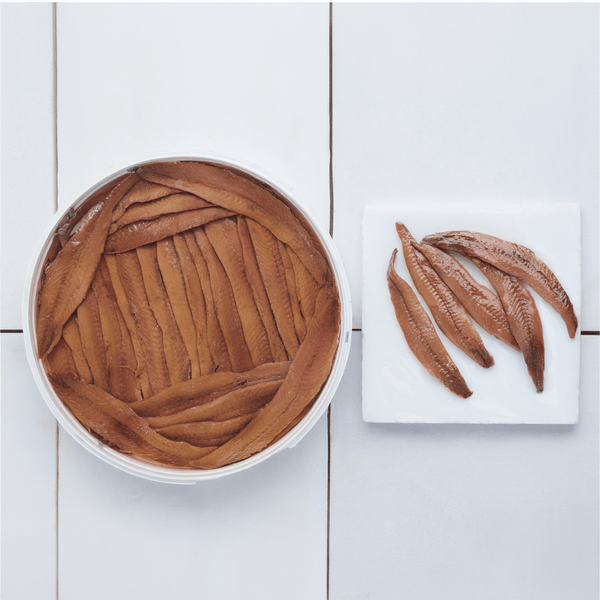
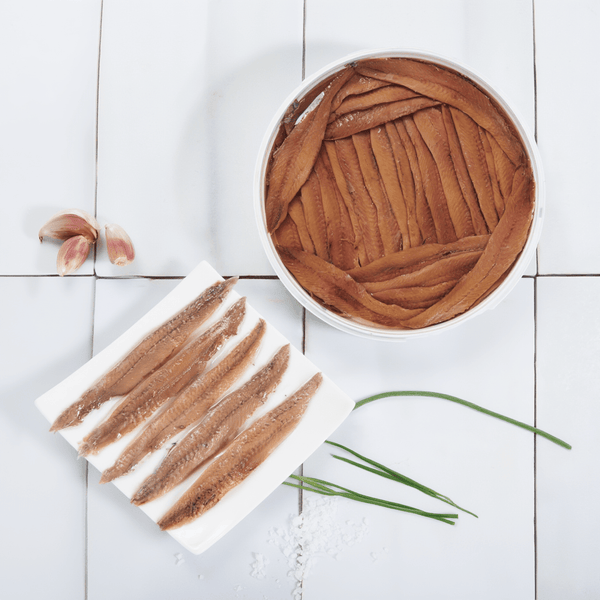
Before any technique, there is the product. Four signs identify a "00" or "000" anchovy (highest quality):
- Intense and uniform reddish-brown color (not pale pink).
- Thick fillet, minimum 2-3 g each.
- No residual scales or bones in the central spine.
- Clean oil, preferably Picual or Arbequina monovarietal EVOO.
We talk in depth about qualities in our 000 anchovy guide and about brands and formats in canned anchovies: complete guide.

The number one secret: serving temperature
If you only apply one technique from this guide, let it be this: never serve anchovies cold.
Olive oil partially solidifies below 8 °C and volatile aromas get trapped. At 4 °C from the fridge, the anchovy loses 30-40% of its sensory profile. The ideal serving temperature is 15-18 °C — cool, not cold.
Tempering protocol
- Take the closed tin out 25-30 minutes before in the kitchen (not exposed to direct sunlight).
- Open just before plating.
- If you have transferred to a Tupperware or jar, take it out for the same amount of time.
- Do not use a microwave, bain-marie or warm oven: you would cook the fillet.
- If you need to speed it up, turn it out onto a plate and leave it in the air for 10 min — it will lose a little oil but temper faster.
When a tapas chef in the Born serves an anchovy "at temperature," the customer perceives more flavor with the same raw material. It's pure sensory psychology, not shamanism.
The oil that accompanies them: when and how to change it
The oil in the tin is the primary flavor factor after the fillet itself. The rule:
- If it's quality EVOO (Picual, Arbequina single varietal, origin label) → do nothing.
- If it's generic olive oil without a PDO or sunflower oil → drain and transfer to good EVOO.
How to transfer correctly
- Remove fillets with a spatula onto absorbent paper for 1-2 seconds.
- Place in a clean glass jar.
- Pour good EVOO cold until completely covered.
- Cover and leave in the fridge for at least 2 hours, ideally 24 hours.
- The fillet "re-oils" and absorbs the nuances of the new oil.
Extra tip: add a fresh bay leaf to the jar during resting. It subtly flavors without overpowering.
Desalting salted anchovy: chef's technique (without ruining it)
Pure salted anchovies (without oil, sold loose) are a different product: they require prior preparation. The well-done home process competes with industrial preserves.
Materials
- Tray with cold mineral water (not tap water if it has strong chlorine).
- Absorbent paper.
- Thin tweezers or clean fingers.
- Good EVOO.
- Glass jar.
Steps
- Rinsing brine: run each piece under cold tap for 10 seconds. Remove external salt.
- Short hydration: immerse for 20-30 minutes in mineral water. No longer — it would lose flavor.
- Opening: with your fingers, open the fish along the back. Remove the central bone by gently pulling from the head.
- Fine deboning: with tweezers, remove side bones if any.
- Drying: absorbent paper, very gentle pressure.
- Oiling: place fillets in a jar, cover with EVOO. Rest for 24 hours in the fridge before eating.
More detail on preservation in our step-by-step preservation guide.
Professional cuts and presentation
Premium anchovies are always whole fillets — never cut if serving whole. Some pro formats:
On crispy bread (the universal base)
- Rustic bread, sourdough, 1 cm thick.
- Toasted in a pan with hot EVOO on one side only.
- Anchovy placed at the end, do not heat.
- Optional: a drop of the oil from the tin on the bread.
Skewer with piparra (Classic Gilda)
- Gordal olive, piparra (green Basque chili, not spicy), anchovy.
- Skewered in this order — the anchovy rolled on the stick.
- Served at room temperature, not cold.
On ripe tomato (Catalonia, Levante)
- Seasonal tomato, cut, no added salt.
- Crystal bread or rustic bread.
- Anchovy last.
- EVOO drizzled at the end, optional freshly ground pepper.
On butter
- Quality artisanal butter (not margarine).
- Hot toasted bread, butter that melts on contact.
- Anchovy on top — the fat cushions the saltiness and creates sublime umami.
- French trick: a turn of finely chopped fresh chives.
How to enhance the flavor without masking the anchovy
The question we get most at the Ninot: "Should I add anything else?". Answer: little and carefully chosen. These are the accompaniments that enhance without masking:
| Category | Accompaniment | Why |
|---|---|---|
| Yes — elevates | EVOO drizzled at the end | Adds fat with green nuances that embrace the anchovy. |
| Yes — elevates | Freshly ground black pepper | Provides subtle warmth, does not mask. |
| Yes — elevates | Artisanal butter | Dairy fat that softens salt and elevates umami. |
| Yes — elevates | Ripe seasonal tomato | Natural acidity balanced by tomato sweetness. |
| Yes — elevates | Cured egg yolk or poached egg | Fat-protein that harmonizes with curing. |
| Careful | Raw garlic | Only if infused in oil, not grated directly. |
| Careful | Vinegar or lemon | Only if the recipe is structural (not a drip). |
| No — masks | Industrial mayonnaise | Dominates the palate, cancels out nuances. |
| No — masks | Sweet sauces (honey, jam) | Sugar shock masks salt and umami. |
| No — masks | Intense cured cheeses | Compete in intensity, both lose. |
Pro pairings: wine, ferments and fats
Wines that work
- Manzanilla or Fino seco frío (Jerez): the oxidative wine cleans salty fat. An unbeatable classic.
- Young Albariño (Rías Baixas): saline, mineral acidity, dialogues with Cantabrian anchovy.
- Txakoli: vibrant acidity, perfect in a Gilda.
- Champagne brut nature or Cava reserva: bubbles + acidity = "palate cleanser" between bites.
- Well-made red Vermouth: bitter herbs soften salt, subtle sweetness.
What doesn't work
- Powerful reds (Ribera del Duero crianza, Priorat): tannin clashes with salt.
- Sweet white wines (Moscatel, late harvest Riesling): mask umami.
- Cold industrial beer: refreshes but adds nothing — prefer a smooth craft beer.
Ferment combinations
- Anchovy + mild cured cheese (young Idiazábal, semi-cured Manchego): dairy fat softens.
- Anchovy + fermented tomato or candied pepper: sweetness + acidity without vinegar.
- Anchovy + cured egg or salted yolk: double cured umami.

Mistakes that ruin a good anchovy
Mistake 1: serving straight from the fridge
Already covered in the temperature section. This is by far the #1 mistake.
Mistake 2: piercing it with a fork
A fork breaks the buttery fiber. Use a flat spatula or wooden spoon to remove from the tin. If you need to cut, do so on a plate with a sharp knife in a single clean cut.
Mistake 3: adding lemon or vinegar out of habit
This is the most common confusion: they are not boquerones. Anchovies are already a cured product, acid + salt curing = hardening.
Mistake 4: inappropriate bread
Sliced bread, soft bread, overly sweet bread, industrial brioche bread. Anchovies demand a crispy crust and dense crumb that can hold weight without getting soggy.
Mistake 5: leaving them exposed to air
Once out of the oil, anchovies oxidize in minutes. If you plate in advance, cover with EVOO until serving. If you're serving tapas at a party, bring the open tin or jar to the table, not prepared dishes at 6:00 PM if you're eating at 9:00 PM.
Mistake 6: frying them
Canned anchovies are not fried. For frying, use fresh anchovies. If you add anchovies to a hot sauce, do so off the heat or at a maximum of 60-80 °C, stirring until dissolved.
Error 7: Buying expensive and serving poorly
We've seen €80/kg anchovies served on sliced bread with ketchup at weddings. If you pay premium, serve premium. And if you're going to serve it in a hurry or poorly, save money and buy Hacendado – you won't notice the difference.
Summary table: tips by situation
| Situation | Combination | Extra tip |
|---|---|---|
| Formal appetizer | Individual board with 3-4 fillets, crispy bread, a drizzle of EVOO, sherry wine | Bring to room temperature 30 min beforehand |
| Quick tapa (at home) | Bread + ripe tomato + anchovy, red vermouth | Don't peel tomato, cut into bite-sized pieces |
| Classic Gilda | Gordal olive + piparra pepper + anchovy, individual toothpick | Serve with piparra brine at room temperature |
| Pasta | Aglio-olio + anchovies dissolved in warm oil + parsley | Never put anchovies in boiling oil |
| Sauce for roasts | Noisette butter + dissolved anchovies + rosemary | Classic Pyrenees steak sauce |
| Winter toast | Butter + anchovy + toasted dark bread | French trick, instantly elevates |

How to store them after opening (without losing quality)
An open, poorly stored can loses 50% of its quality in 48 hours. Correct protocol:
- Transfer to a glass jar proportional to the remaining volume (don't leave too much air at the top).
- Completely cover with EVOO — the fillets should not be exposed.
- Seal tightly and refrigerate at 0-4 °C.
- Consume within 10-14 days maximum.
- Only take out what you are going to use — do not return anything you have touched to the jar.
If you're going to take longer, consider freezing them submerged in their oil — it works, although the texture suffers a bit (granular after thawing). More details on how to store open anchovies and storage tips.

Discover our premium selection
Seafood products selected with expertise since 1990 at Mercat del Ninot, Barcelona. Refrigerated shipping in 24-48h.
Conclusion: detail makes the difference
A premium anchovy served poorly is like a Rioja Gran Reserva in a plastic cup. The raw material dictates, but technique determines the final result. If you take three things from this guide:
- Always bring to room temperature 25-30 min beforehand (half the problems are avoided).
- Respect the product: no acids, sweet sauces, or direct cooking.
- Cover with oil for any storage after opening.
If you want to practice with high-quality raw material, in our Cantabrian anchovy collection we select directly from the producer: cured for 8-10 months, hand-filleted, Picual EVOO from Jaén. Premium guarantee so that the only variable is you and your technique.
Related articles
- Cantabrian Anchovies: 15 expert tips and tricks
- 000 Anchovies: how to identify top quality
- Canned Anchovies: a complete guide
- How to preserve anchovies in oil step by step
- How to desalt cod quickly and well at home
- Homemade anchovy pâté