Summary: Cod tripe is one of those products that divides cod lovers: those who know it seek it out enthusiastically; those who don't, pass by without knowing what they're missing. At Bacalalo, we have been selecting cod in Barcelona's Mercat del Ninot since 1990, and tripe —also called cod stomach or cod maws— has always held a special place on our counter.
In this guide, we tell you everything you need to know about cod tripe: what exactly it is, how it differs from other parts of cod, how it's prepared and preserved, how to desalt it correctly, and, most importantly, how to cook it to get the most out of it.
Contents
What is cod tripe?
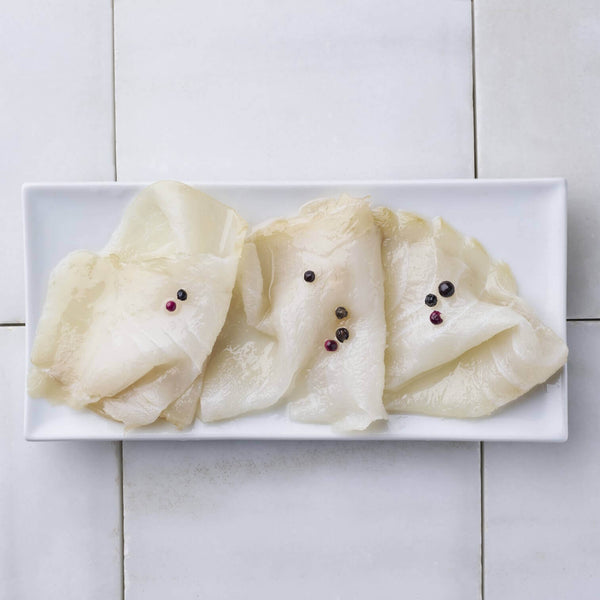
Cod tripe —or cod maws, a more common denomination in northern Spain— is the swim bladder of cod (Gadus morhua). It is not the animal's intestine, as the name might suggest, but rather that internal organ that the fish uses to regulate its buoyancy in the water.
It is a thick, gelatinous membrane with a very characteristic texture: firm on the outside and spongy on the inside, with an extraordinary capacity to absorb the flavors of the stew in which it is cooked. It is, in essence, the "pure collagen" of cod.
Tripe vs. cod maws: are they the same?
Yes. Depending on the region of Spain, it will receive one name or another:
- Cod tripe: predominant denomination in Catalonia and Levante
- Cod maws: more common term in the Basque Country, Navarre, and the rest of the Peninsula
- Cod buche: name used in some areas of Portugal and Galicia
Beyond the name, the product is the same: the swim bladder of Gadus morhua, salt-cured following the same traditional process as desalted cod.
How salted cod tripe is made
The curing process for cod tripe follows the same ancient logic as for the rest of salted cod: extracted from fresh fish, it is cleaned, flattened, and placed in layers of coarse sea salt. Curing time varies but usually ranges from 3 to 6 months.
During this process, the salt extracts moisture from the membrane and concentrates the flavors. The result is a compact tripe, yellowish-white in color, quite hard to the touch, and with an intense and pungent odor —characteristic of well-cured cod.
The most common origin of cod tripe found in Spain comes from:
- Iceland and Norway: where North Atlantic cod is processed using techniques with centuries of tradition
- Portugal: a great tradition in the production of "bucho" or cod tripe
- Spain (to a lesser extent): some artisanal producers in the north also work with tripe
Difference from other parts of cod
To understand the tripe, it is useful to place it within the universe of cod parts:
| Part | Description | Texture when cooked |
|---|---|---|
| Loin | The dorsal, meatiest part | Firm, flaky |
| Belly | Cod belly, fattier | Soft, very gelatinous |
| Kokotxa (maw) | Lower jaw area | Very gelatinous, natural pil-pil sauce |
| Tripe / Maws | Swim bladder | Gelatinous, spongy, absorbs flavors |
| Tongue | Inside of the mouth | Delicate, slightly gelatinous |
Related products from Bacalalo


Recommended Products

Natural Cod Liver Foie Gras - 120g | Smoked Cod Liver from Iceland...
3,90 €

CHATKA Wild King Crab 60% Legs 40% Shredded | Large...
95,00 €

Smoked Cod Carpaccio Artisanal Cut | Pack 1 Tray
15,90 €

Dried Cod Maws (1 tray) - 500g
19,95 €
Refrigerated shipping 24-48h throughout the Peninsula
How to desalt cod tripe step by step
Desalting tripe requires a bit more time than desalting a conventional cod loin, because the membrane is thicker and denser. Here are the steps to follow:
Traditional method (48 hours)
- Rinse the tripe under cold water to remove excess surface salt
- Cover it with cold water in a large container. The tripe should be well submerged
- Change the water every 8-10 hours (minimum 4-5 changes in total)
- After 36-48 hours, taste a small piece. It should be slightly salty (never bland — cod always retains a hint of salt)
- Refrigerate the container throughout the process — never desalt at room temperature
Signs that the tripe is properly desalted
- The membrane has softened and has some flexibility
- When tasted, the salty flavor is mild, not aggressive
- Its color has lightened slightly and it looks more translucent
Common mistakes when desalting tripe
Not changing the water frequently enough: the water absorbs salt and becomes ineffective. Without changes, the tripe remains oversalted.
Using hot water: speeds up the process but degrades the texture, leaving the tripe rubbery.
Excessive desalting: a completely bland tripe loses part of its character. The optimal point is a mild, almost imperceptible saltiness.
Recipes with cod tripe
Basque-style cod maws
The most iconic dish with cod tripe. The Basque recipe combines tripe with kokotxas (cod cheeks) in a sauce of choricero peppers and garlic.
Ingredients (4 servings):- 400 g desalted cod tripe
- 200 g desalted cod cheeks
- 3 dried choricero peppers
- 4 cloves of garlic
- 1 medium onion
- 1 ripe tomato
- Extra virgin olive oil
- Fresh parsley
- Hydrate the choricero peppers in hot water for 30 minutes. Scrape out the flesh with a spoon
- Sauté the garlic and onion in plenty of oil over low heat until transparent
- Add the grated tomato and cook for 10 minutes
- Incorporate the choricero pepper flesh and mix well
- Add the tripe and cod cheeks. Cover with water or light fish broth
- Cook over low heat for 35-45 minutes until the tripe is tender and the sauce has thickened thanks to the natural gelatin
- Finish with chopped parsley
Chickpea stew with cod tripe
A Spanish Lenten classic, especially popular in Catalonia and central Spain.
Ingredients (4-6 servings):- 300 g desalted cod tripe, cut into pieces
- 300 g cooked chickpeas
- 200 g fresh spinach
- 1 onion
- 3 cloves of garlic
- 1 tomato
- 1 teaspoon sweet paprika
- Olive oil, salt, bay leaf
- Sauté the onion, garlic, and tomato until a well-concentrated sofrito is obtained
- Add the paprika and stir quickly
- Incorporate the chickpeas and cover with water or broth. Cook for 15 minutes
- Add the cod tripe and spinach
- Cook for 20-25 more minutes over low heat. The tripe will provide the gelatin that will bind the broth
- Adjust salt to taste carefully — the tripe contributes residual salt
Cod tripe with samfaina (Catalan version)
Samfaina —Catalan ratatouille of eggplant, bell pepper, and zucchini— is the perfect accompaniment for tripe.
Ingredients (4 servings):- 400 g desalted cod tripe
- 1 eggplant
- 2 red bell peppers
- 2 green bell peppers
- 2 zucchinis
- 3 ripe tomatoes
- Garlic, olive oil, salt
- Prepare the samfaina: sauté all the vegetables in oil over low heat, starting with the peppers and finishing with the tomato. Cook for 40 minutes until everything is very tender
- Incorporate the tripe and cook for 20-30 more minutes
- The tripe absorbs the flavors of the vegetables and the gelatin it releases gives consistency to the sauce
Buy cod tripe at Bacalalo: selected directly in Mercat del Ninot, salt-cured and without additives. Ready to desalt and cook. View cod tripe in our store
Nutritional properties of cod tripe
Cod tripe is a food with an interesting nutritional profile:
- High in protein: like the rest of cod, it provides complete proteins of high biological quality
- Very high in collagen: its main characteristic. Marine collagen is especially bioavailable
- Low in fat: unlike the belly, tripe is a lean part
- Rich in minerals: potassium, phosphorus, and calcium, concentrated by the salting process
It is a food especially valued in nose-to-tail cooking and in diets seeking natural collagen sources.
Where to buy quality cod tripe
Not all cod tripe is created equal. In the market, you will find notable differences depending on the origin of the cod, the curing time, and the preparation process.
At Bacalalo, we select cod tripe directly through our trusted suppliers in Iceland and Norway, the same ones who supply us with loins and other parts. We have been in Mercat del Ninot since 1990 and know every piece that enters our store.
You can buy cod tripe:- In our physical store: Mercat del Ninot, Barcelona. Stall 42
- Online: with refrigerated shipping throughout the Peninsula
Frequently asked questions about cod tripe
1. Are cod tripe and cod maws the same thing?
2. How long does it take to desalt cod maw?
3. Can desalted cod maw be frozen?
4. What part of the cod is the maw exactly?
5. How much collagen does cod maw have?
6. Does the maw taste bad if it's well cured?
7. Can cod maw be made "al pil-pil"?
8. How much does a portion of cod maw weigh?
9. Is cod maw safe for pregnant women?
10. What is the difference between fresh and salted maw?
11. Can milk water be used to desalt the maw?
12. Does cod maw contain gluten?
🛒 Products mentioned in this article
⭐ 4.9/5 · Cold shipping 24-48h · Since 1990 at Mercat del Ninot
Conclusion
Cod maw is a unique product, with a texture and flavor that has no equivalent in the world of fish. Its high collagen content makes it the ideal ingredient for long stews and Lenten potages that seek that characteristic mellow consistency of traditional Spanish cuisine.
At Bacalalo, we have been bringing the best cod maw to the Mercat del Ninot in Barcelona for over 30 years. If you want to try it, we are at your disposal both in our physical store and online.
Buy cod maw at Bacalalo — shipping throughout the Peninsula
Discover more