Summary: Octopus is one of the most in-demand products in Spanish hospitality, especially in bars and restaurants with tapas menus or Galician cuisine. But for those managing a restaurant's purchasing, there are important decisions to make: fresh or cooked? what size? bulk or portioned? Morocco or Galicia? How is shrinkage calculated?
This guide is intended for hospitality purchasing managers: those who need concrete answers, not theory.
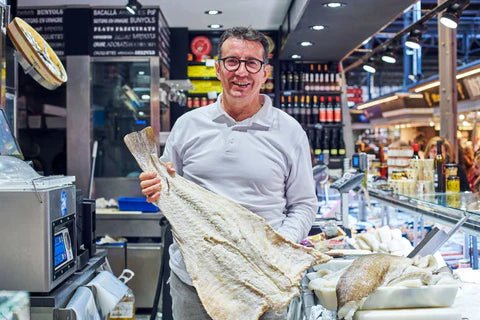
At Bacalalo, we have been working with seafood in Barcelona's Mercat del Ninot since 1990, and octopus is one of the products that generates the most inquiries from hospitality professionals.
Octopus Sizes: What They Mean
Octopus is classified by live weight (or pre-cooking) into categories:
| Size | Weight per unit | Recommended use |
|---|---|---|
| Baby / Mini | Less than 500g | Grilled, whole, individual tapas |
| Small | 0.5-1 kg | Grilled, tapas, cooked in portions |
| Medium | 1-2 kg | Pulpo a feira, full dishes |
| Large | 2-3 kg | Pulpo a feira, volume cooking |
| Extra large | 3-5 kg | Volume cooking, large formats |
| Giant | +5 kg | Specific use (stews, large volumes) |
Octopuses under 1 kg are ideal for serving whole grilled or in individual presentations. They cook faster, and the visual result is striking.
Octopuses over 3 kg have a price advantage per kilo (higher volume = better price) but require longer cooking and are best handled in establishments with large-capacity cooking equipment.
Fresh vs. Cooked: The Most Important Decision
This is the first decision any restaurant must make when adding octopus to its menu.
Fresh Octopus (uncooked)
Advantages:- Maximum versatility: can be cooked in any way
- The cooking "doneness" is in the chef's hands
- Lower price per kilo than cooked
- Allows for making cooking broth (which can be reused)
- Requires cooking time (30-50 minutes depending on size)
- Requires experience to achieve the correct doneness
- Higher shrinkage: octopus loses between 40-55% of its weight when cooked
- Requires prior freezing to tenderize (fresh, unfrozen octopus can be tough)
Recommended for: restaurants with kitchen staff, cooking capacity, and daily or weekly production planning.
Cooked Frozen Octopus
Advantages:- Already tender, no risk of it being tough
- Saves cooking time and equipment
- Net cooked weight = what you serve (no cooking shrinkage)
- Consistency between batches
- Higher price per kilo (already includes the cost of cooking)
- Less versatility for some preparations
- The chef does not control the prior cooking doneness
Recommended for: tapas bars, restaurants without a full staff, high-volume establishments, kitchens where octopus is one of many products and there is no time to manage cooking.
Chilled Cooked Octopus (unfrozen)
Some suppliers offer cooked and chilled (not frozen) octopus, with a shelf life of 3-5 days. It is the most practical option for high-volume establishments near distribution points. Superior texture and flavor to frozen.
The Origin of Octopus: What to Buy
Galician Octopus (Octopus vulgaris)
Octopus from the Galician Rías is the most prestigious in Spain. It grows in the cold, rich waters of the Galician Atlantic, with a texture and flavor that connoisseurs recognize. The ria provides quality food (crabs, bivalves) which is reflected in the flavor.
Market reality: Galician octopus is scarce and expensive. Most of what is sold as "Galician octopus" is not strictly so: the Spanish market imports large quantities of octopus from Morocco, Mauritania, and other African Atlantic coasts.
Octopus from Morocco and African Coasts
This is the main source of octopus for the Spanish market. Octopus from the African Atlantic (Octopus vulgaris, the same species) is of good quality when well managed. Prices are significantly lower than Galician.
For high-volume hospitality: well-selected Moroccan octopus (good size, correct cold chain) is perfectly acceptable. The flavor differences with Galician are real but do not always justify the price difference in a commercial hospitality environment.
Mediterranean Octopus
Smaller volume, variable quality. Some restaurants on the Mediterranean coast work with local octopus from the Catalan, Valencian, or Balearic coasts. Local product with its own characteristics.
Octopus from Argentina and Japan
For very specific formats (Japanese octopus, larger and with a different texture, widely used in sushi). Niche market.
Related Products from Bacalalo


Recommended Products

Fresh Coastal Sardines - Pack of 4 Pieces | ...
€2.95

Whole Tuna Mojama Gourmet Extra Central Lo...
€95.00

Natural Cockles 30/40 Pieces - 111g | Ba...
€7.95

Northern White Tuna Loins in Olive Oil Ja...
€13.95
Refrigerated shipping 24-48h throughout the Peninsula
How to Calculate the Real Price: Shrinkage
This calculation is fundamental for correctly setting menu prices.
A fresh 2 kg octopus loses between 40% and 55% of its weight when cooked. The range depends on size, species, and cooking method.
Calculation example:
- Purchase price of fresh octopus: €8/kg
- Raw weight: 2 kg → cost €16
- Weight after cooking (assuming 45% shrinkage): 1.1 kg cooked
- Real cost per cooked kg: €16 / 1.1 kg = €14.55/kg cooked
- Cost of octopus per portion: 200g × €14.55/kg = €2.91
- Adding other costs (potato, oil, paprika, labor, energy): easily €4-5 total cost
- Recommended selling price with 70% margin over cost: €13-17
When buying cooked octopus (already without shrinkage): if it costs €12/kg cooked and 200g are served, the cost is €2.40. The purchase price is higher per kg, but the cost per portion is similar or lower.
General rule: Always compare the price per cooked kilo, not per raw kilo.
Professional Octopus Cooking
The myth of "frightening" the octopus
The technique of "frightening" the octopus —dipping it in and out of boiling water three times before final cooking— has a real basis: it helps the tentacles curl more elegantly. It is not strictly necessary for it to be tender, but it improves presentation.
Prior freezing to tenderize
Fresh octopus (unfrozen) can be tough due to muscle proteins. Freezing for 24-48 hours and slowly thawing breaks down muscle fibers and tenderizes the tissue. In hospitality, most fresh octopus purchased has already gone through a freezing cycle.
If buying fresh unfrozen octopus: freeze for at least 48 hours before cooking.
Cooking in unsalted water
Octopus is cooked in unsalted water (or with minimal salt). Excessive salt hardens the muscle. If you want to add flavor to the broth: bay leaf, whole black peppercorns, onion. Doneness is checked by piercing the thickest part of the tentacle with a toothpick or skewer: it should go in without resistance.
Approximate cooking times:- Octopus 0.5-1 kg: 20-25 minutes
- Octopus 1-2 kg: 30-40 minutes
- Octopus 2-3 kg: 40-50 minutes
- Octopus 3-5 kg: 50-70 minutes
After cooking: rest in the cooking broth for at least 15 minutes before removing. Resting is essential for the final texture.
Grilling after cooking (restaurant-style pulpo a feira)
For classic pulpo a feira or pulpo a la gallega:- Cook until the correct doneness.
- Cut into 1-1.5 cm slices with scissors (the traditional method) or a knife.
- On a very hot griddle (200-220°C), sear the slices for 1-2 minutes per side. The goal is exterior caramelization, not additional cooking.
- Serve on a wooden board or clay plate: paprika from La Vera (sweet + spicy), coarse salt, extra virgin olive oil.
Grilled Octopus (whole or in pieces)
For small octopuses (baby or under 1 kg): pre-cook or grill directly over medium-high heat, with constant pressure so the suckers are in contact with the griddle. 3-5 minutes per side. It will be slightly crispy on the outside and tender on the inside.
For hospitality orders —cooked, frozen, or fresh octopus subject to availability— contact Bacalalo. We work with restaurants and bars in Barcelona and the surrounding areas. Contact us here or visit us at the Mercat del Ninot.
Supply Formats for Hospitality
Bulk frozen octopus (IQF)
IQF (Individually Quick Frozen): each octopus is frozen separately, allowing individual units to be removed without thawing the entire batch. Ideal for establishments that serve octopus irregularly.
Standard format: 5-10 kg boxes with homogeneous size octopuses.
Cooked frozen octopus in bags
Pre-cooked octopuses, packaged in 1-2 kg bags per unit. Thaw in the refrigerator or in cold water. Very practical for medium volumes.
Vacuum-packed chilled cooked octopus
The highest quality and convenience. Cooked octopuses, vacuum-packed, chilled. Shelf life of 3-7 days depending on the supplier. For establishments with frequent distribution.
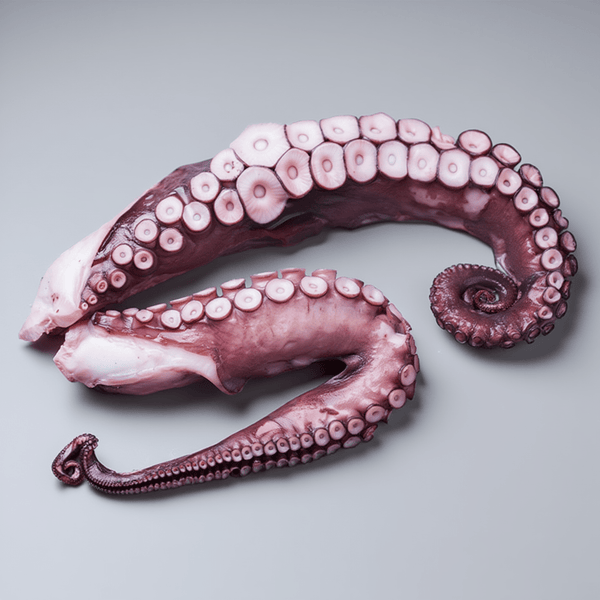
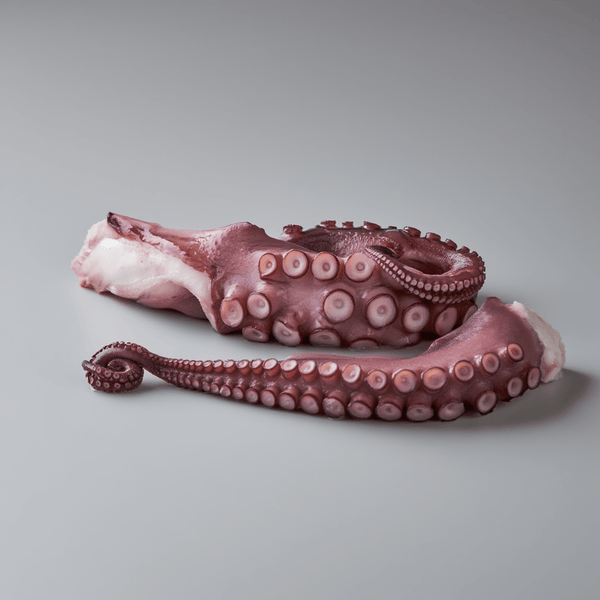
Cooked octopus legs
For those who only want the tentacles (without the mantle), some suppliers sell loose cooked legs. More expensive per kilo, but zero waste: they are cut and served directly.
How to Order from Bacalalo for Hospitality
At Bacalalo, we manage hospitality orders for restaurants, bars, and catering services. For octopus and other seafood products:
- Contact us through our contact page indicating:
- You can also visit us at the Mercat del Ninot to see the available products
- For recurring orders, we can discuss terms
🛒 Products mentioned in this article
⭐ 4.9/5 · Cold delivery 24-48h · Since 1990 at Mercat del Ninot
Frequently Asked Questions about Octopus for Horeca
1. How much cooked octopus do I need per serving? For an octopus tapa "a feira" style: 150-180g of cooked octopus. For a main course: 250-300g. As a reference, a 2 kg cooked octopus yields approximately 8-10 tapas or 6-7 main courses.
2. Is it better to buy fresh or cooked octopus for a tapas bar? For a high-volume tapas bar with an agile kitchen, cooked octopus (frozen or refrigerated) greatly simplifies operations. For a restaurant with a more refined menu and kitchen staff, fresh octopus allows for more control. There is no universal answer.
3. What distinguishes Galician octopus from Moroccan octopus on the plate? Galician octopus is renowned for its superior flavor and firmer texture, possibly due to its diet in the Rías. The difference is real but variable: it depends on the supplier, the process, and the size. For a high-volume tapas bar, Moroccan octopus of good size and processed well is perfectly acceptable.
4. How long can cooked octopus be stored in the refrigerator? Refrigerated cooked octopus: 3-5 days in the refrigerator at 2-4°C, well covered. Frozen cooked octopus: up to 6-12 months in the freezer at -18°C.
5. What is the most demanded octopus size in the hospitality industry? The 2-3 kg size is the most common for octopus "a feira" style. Baby octopus (<500g) for grilled whole octopus. The >3 kg size is for high-volume establishments seeking the best price per cooked kilo.
6. How do I calculate how much octopus to buy for a week? Calculate the expected weekly number of servings × grams per serving × 2.2 (to compensate for the 55% shrinkage if you buy raw). If you buy cooked, multiply only by the net weight per serving. Add a 10-15% safety margin.
7. Can octopus be reheated well? Yes, with the correct technique. On a hot griddle (the most effective way, which also creates a caramelized outer layer). Not in the microwave (texture suffers). In hot water (not boiling) for 2-3 minutes also works to regenerate without drying out.
8. What paprika should be used for octopus "a feira" style? Paprika from La Vera (Cáceres) is the quality standard: smoked, intense, with a depth of flavor that generic paprika lacks. Sweet and spicy can be mixed to taste. The usual proportion in Galician taverns is 2/3 sweet + 1/3 spicy.
9. Can I buy octopus from Bacalalo for a restaurant outside Barcelona? Yes, we manage refrigerated shipments to all of Spain for hospitality orders. For logistics and volume inquiries, please contact us directly.
10. Does baby octopus require the same preparation as large octopus? Baby octopus (<500g) cooks much faster (10-15 minutes in water) and can also be grilled directly without pre-cooking if it's tender. It does not need the "shocking" process in the same way as large octopuses.
At Bacalalo, we have been working with the best seafood products at Mercat del Ninot in Barcelona since 1990. If your restaurant or bar is looking for quality octopus —fresh, cooked frozen, or in legs— with guarantees of origin and cold chain, contact us or visit us at Mercat del Ninot. We manage orders for the hospitality industry with conditions adapted to volume.