Summary
Anyone who has tasted a well-made gilda in a Basque Country bar knows that distance shouldn't prevent them from having another. In this guide: What a Real Gilda Should Have, Artisanal vs. Industrial: The Difference That Matters, How to Read Labels When Buying Gildas.
Buying Gildas Online: How to Choose the Best
Anyone who has tasted a well-made gilda in a Basque Country bar knows that distance shouldn't prevent them from having another. At Bacalalo, from Barcelona's Mercat del Ninot, we prepare handmade artisanal gildas and ship them refrigerated across the entire Peninsula. Over the years, we've learned exactly what distinguishes a gilda that's worth the trip from one that just takes up space on the plate. This guide is practical and direct: everything you need to know before buying gildas online.
What a Real Gilda Should Have
The gilda was born in the 1940s at the Vallés bar in San Sebastián, when José Ramón "Txepetxa" Aramburu began skewering a guindilla pepper, an olive, and an anchovy onto a toothpick. Legend has it that someone called it "gilda" because, like the movie starring Rita Hayworth, it was "salty, green, and a little spicy."
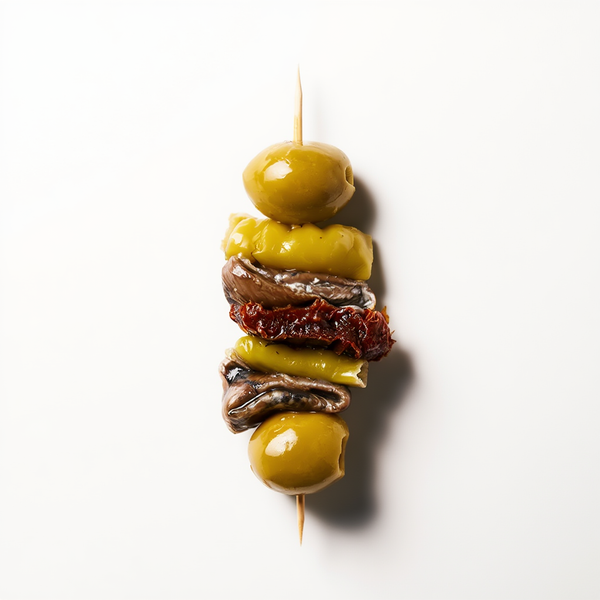
An authentic gilda has exactly three components in balance:
- The guindilla: It must be Basque guindilla pepper in vinegar, specifically the "piparras" variety. Not just any pickled guindilla will do: the piparra has its own herbaceous flavor, mildly spicy, and with a clean acidity that doesn't overpower the other flavors.
- The olive: Green, pitted, usually Manzanilla or Gordal. The pit provides structure, and the olive should have a bite, not be soft or over-vinegared.
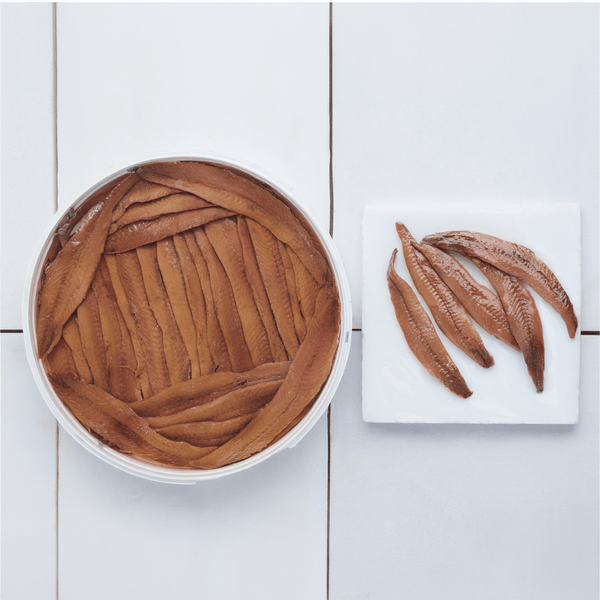
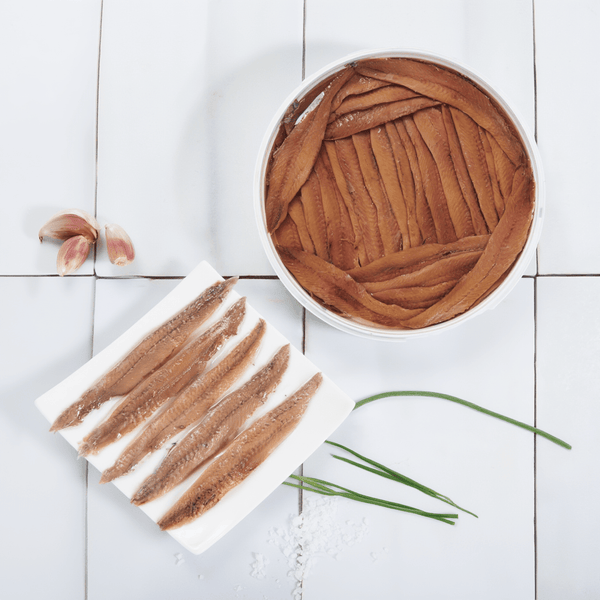
- The anchovy: This is key. A quality Cantabrian anchovy, in olive oil, with the right degree of curing and saltiness. The anchovy is the soul of the gilda.
Modern variations incorporate pickled boquerón (instead of cured anchovy), Manchego cheese, sun-dried tomato, caper berries, or piquillo pepper. All are valid as variations, but if you're looking to buy gildas for someone unfamiliar with them, the classic anchovy version is the benchmark.
Artisanal vs. Industrial: The Difference That Matters
The online gilda market has two very distinct categories in terms of quality and price:
Industrial Gildas
Produced in factories with assembly lines, they use lower-cost ingredients: generic guindilla peppers of various origins, low-grade olives, and the biggest trap, anchovies with more than 20% salt content and low maturation. They are preserved in airtight jars or shrink-wrapped plastic at room temperature for months thanks to preservative additives. Typical price: 3-6 euros per jar with 6-8 units.
Artisanal Gildas
Hand-made, with individually selected ingredients. The anchovy is usually from the Cantabrian Sea with a minimum curing of 12-18 months. The guindilla is authentic Basque piparra. The assembly is done by a person who controls the order and balance of each unit. They require refrigeration for preservation. Typical price: 9-15 euros per serving of 4-6 units, plus the cost of refrigerated shipping.
The difference on the plate is immediate: artisanal anchovy has a buttery texture and a deep flavor that has nothing to do with industrial anchovies, which are usually fibrous and excessively salty. Authentic piparra has a clean crunch and a fruity acidity that generic guindilla peppers do not reproduce.
How to Read Labels When Buying Gildas
Before clicking "add to cart," check these points in the product description:
- Anchovy origin: It should state "Cantábrico" or "Costera del Cantábrico". If it just says "anchovy in oil" without specifying origin, it's probably Moroccan or from other lower-quality sources.
- Guindilla type: Look for "piparra vasca" or "guindilla de Ibarra". If it only says "pickled guindilla", it's a generic variety.
- Preservation: Quality artisanal gildas require refrigeration (2-8 °C). If they are stored at room temperature for more than 6 months, something is wrong with the quality of the ingredients.
- Ingredients on the label: A short list is a good sign. Guindilla, olive, anchovy, olive oil, salt. If there are thickeners, colorants, or flavor enhancers, it's an industrial product.
- Shipping: Transport must be refrigerated. An artisanal gilda shipped without refrigeration at 20 °C for 48 hours will arrive in poor condition.
Bacalalo Products

Artisanal Cheese Gilda Handmade Gou...
€9.75

Caper Berries in Vinegar - 1400g (600g Drained)
€9.95

Artisanal Pickled Onions - 1.4 kg
€9.90

Artisanal Boquerón Gilda Handmade ...
€9.90
Refrigerated shipping 24-48h throughout the Peninsula
How Much Do Gildas Cost Online: Fair Price vs. Trap
The price of artisanal gildas online has a specific logic. A quality gilda with real Cantabrian anchovy costs between 1.50 and 2.50 euros per unit in terms of ingredients, before counting preparation, packaging, and refrigeration. That's why, when you see packs of "artisanal gildas" at 4 euros for 10 units, something doesn't add up.
The reasonable price range for buying gildas online in 2026:
- Classic quality gilda: 1.50-2.50 euros per unit
- Gourmet gilda (00 anchovy, organic piparra): 2.50-4 euros per unit
- Pack of 4-6 units: 8-15 euros before shipping
- Refrigerated shipping: 5-10 euros, can be offset by making a larger order
The trick to making the order profitable: combine gildas with other refrigerated products (anchovies, preserves) to amortize the cost of cold shipping.
Gildas as a Gourmet Gift
Gildas have a huge advantage as a gift: they are a product with history, with a Basque cultural identity, visually attractive, and with a unique selling point compared to the sausage boxes that everyone already knows. They work especially well for:
- Tapas and pintxos enthusiasts: For those who already know the Donostiarra Pintxo Pote, receiving gildas at home is a wave of nostalgia.
- Wine and vermouth lovers: The gilda is the perfect accompaniment to a cold glass of Txakoli, Basque cider, or red vermouth.
- Corporate gourmet baskets: Artisanal gildas in careful packaging elevate any corporate basket, especially when combined with quality anchovies and preserves.
When buying gildas as a gift, check that the packaging is appropriate: a glass jar with an artisanal label says more about the product than a heat-sealed plastic bag.
How to Serve Gildas to Make Them Shine
Artisanal gildas received refrigerated should be served cold, between 8 and 14 °C. Don't take them out of the fridge too long before consuming them: the anchovy loses texture at room temperature. The toothpick should be vertical or slightly inclined, never lying horizontally on a flat plate: the vertical presentation with the toothpick pointing upwards is the traditional way and best showcases the product.
The classic accompaniment is a glass of very cold white Txakoli or a beer. If you are going to serve an appetizer with several types of gildas, starting with the mildest (with boquerón or cheese) and finishing with the classic anchovy allows for a better appreciation of the differences.
Storing Gildas Purchased Online
Artisanal gildas received by refrigerated shipping should be stored in the refrigerator between 2 and 8 °C. If they come in a vacuum-sealed jar, they last several weeks. Once the jar is opened, consume within 5-7 days. If you only receive individual units, consume within 3-4 days.
Never freeze gildas: the olive and anchovy irrevocably change texture when thawed. And never store them at room temperature once opened: they are fresh products that need refrigeration.
Bacalalo Products
Artisanal Cheese Gilda Handmade Gou...
€9.75
Caper Berries in Vinegar - 1400g (600g Drained)
€9.95
Artisanal Pickled Onions - 1.4 kg
€9.90
Artisanal Boquerón Gilda Handmade ...
€9.90
Refrigerated shipping 24-48h throughout the Peninsula
🛒 Products mentioned in this article
⭐ 4.9/5 · Cold shipping 24-48h · Since 1990 at Mercat del Ninot
Frequently Asked Questions about Buying Gildas Online
Are gildas bought online as good as those from a bar?
It depends on the supplier. An artisan gilda made with first-quality Cantabrian anchovies and authentic piparra can be as good as or better than those from many bars, which also use mid-range ingredients. The key is the quality of the anchovy: a "00 Selección" Cantabrian anchovy cured for 18 months is hard to find in your local bar.
How many gildas do I need for a party of 10 people?
Estimate 3-4 gildas per person for an appetizer, 5-6 if they are the only tapa. For 10 people, an order of 40-50 units is sufficient. If you also have other tapas, 30 units will be more than enough.
Are boquerón gildas and anchovy gildas the same?
No. Boquerón en vinagre (vinegared anchovy) is the same fish (Engraulis encrasicolus) but cured in acetic acid (vinegar), which gives it a white color and a fresher, more acidic flavor. Anchovies are salt-cured for months, developing a reddish color and a much deeper, umami, and less acidic flavor. They are two completely different profiles: a boquerón gilda is softer and fresher, while an anchovy gilda is more intense and robust.
Can gildas be bought to send as a gift to someone else?
Yes, many specialized stores like Bacalalo allow shipping to a different address. Indicate the recipient's address and ensure someone will be home to receive the refrigerated shipment: it's not a package that can be left in the mailbox or in the sun.
Are gildas suitable for celiacs?
The basic ingredients of a gilda (guindilla pepper, olive, anchovy, olive oil) do not contain gluten. However, always check the label of the specific product you are buying, especially if there are additional ingredients such as toasted bread or sauces. Boquerón gildas also do not contain gluten by themselves.
Where did the gilda originate?
At the Vallés bar in Donostia-San Sebastián, in the mid-1940s. The pincho was named "gilda" in reference to Charles Vidor's 1946 film starring Rita Hayworth: just like the character, the gilda was "spicy, salty, and a little green." Today, it is the most recognizable pintxo in the Basque Country and a hallmark of Basque gastronomic culture.
Is it worth making gildas at home?
If you can get quality ingredients, yes. Assembling them at home allows you to precisely control the balance: more or less guindilla pepper, type of olive, size of anchovy. The problem is usually finding quality Basque piparra outside the Basque Country and first-selection Cantabrian anchovies. That's why buying artisan-made gildas is often more convenient than assembling them with mediocre ingredients.