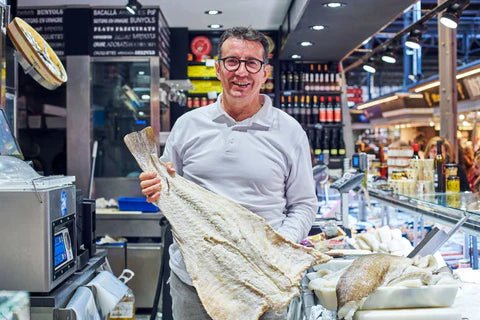
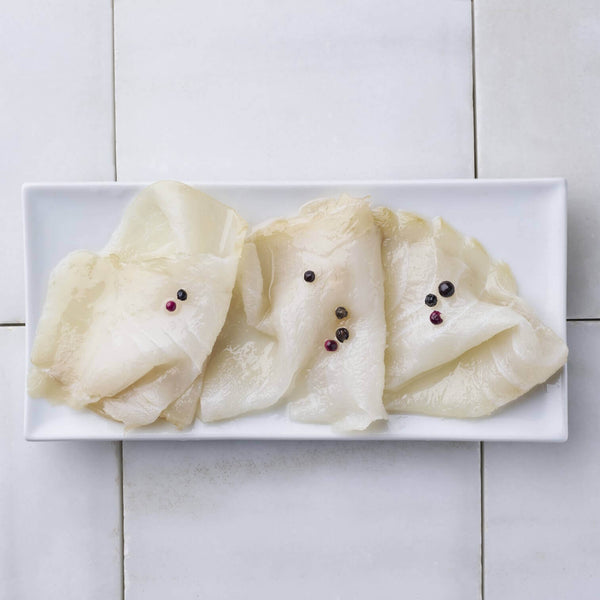
Summary: In the world of cod, terms accumulate and get confused: cured, salted, desalted, smoked. At Bacalalo, we've been in Barcelona's Mercat del Ninot since 1990, helping our customers understand exactly what's in front of them. And the question of what cured cod is comes up with surprising frequency, because there's real confusion: Is it the same as salted cod? Is it different from desalted? What does "cured at source" mean?
This guide clarifies all those questions and helps you understand what to buy based on what you're going to cook.
Contents
What is cured cod
Cured cod is cod (Gadus morhua or other species of the genus Gadus) that has undergone a curing process using salt. In essence, cured cod and salted cod are the same product: the technical term is "salt cod," and curing is the process by which salt acts on the fish for weeks or months.
However, there are important nuances:
- "Salted" cod: popular term for cod in salt, with the connotation of a product without additional processing
- "Cured" cod: a more technical term describing the complete process of fish transformation by the action of salt and time
- "Salao" cod: colloquial name in southern Spain, perfectly valid as a synonym for the above
When we talk about cured cod in the strict sense, we are referring to cod that has completed its salt-maturation process: the protein has changed its structure, the texture has been modified, the flavors have been concentrated, and the resulting product is completely different from the fresh cod it started as.
The cod curing process step by step
Cod curing is one of humanity's oldest preservation techniques. The Vikings were already curing cod in the 9th century; the Basques turned salted cod trade into an industry in the 15th century.
1. Catching and eviscerating
Cod is caught in the North Atlantic (mainly in the waters of Norway, Iceland, and the Faroe Islands) and eviscerated on board the vessel, usually within hours of being caught.
2. Opening and preparation
The cod is opened "butterfly" style (a ventral cut that flattens it) or filleted, often removing the backbone but retaining the skin. This preparation determines subsequent formats (whole bacalao, loins, half pieces, chunks).
3. Salting
The fish is stacked in layers alternating with coarse sea salt. The amount of salt, the type of salt, and the duration of this initial process largely determine the final quality.
Salt extracts moisture from the fish by osmosis: water leaves the muscle tissue and salt enters. This initial process lasts between 2 and 4 weeks.
4. Maturing
After initial salting, the cod undergoes a maturation period under controlled conditions. It is during this phase that the true "curing" occurs: the natural enzymes of the fish, now in a low-water but salt-present environment, modify the proteins and create the characteristic flavor compounds of cured cod.
This process can last from 3 months to over a year in cases of longer curing.
5. Drying (klippfisk vs. stockfisk)
Here the great divergence in the world of cured cod occurs:
- Klippfisk (salt cod): the cod is cured exclusively in salt and stored with it. It is the most common in the Spanish market
- Stockfisk (dried cod or palo): the cod is air-cured, with no salt or very little, drying for months in the Norwegian fjords. The final texture is completely different (hard as wood) and requires prolonged rehydration
The cod found in Spain is almost always klippfisk.
Cured cod vs. salted cod vs. smoked cod
| Characteristic | Cured/salted cod | Smoked cod | Fresh cod |
|---|---|---|---|
| Process | Salt + time | Smoke ± salt | None |
| Requires desalting | Yes (24-48h) | No (generally) | No |
| Texture before cooking | Hard, compact | Soft or firm (depending on type) | Soft |
| Concentrated flavor | Yes, intense | Yes, smoky | No, mild |
| Preservation | Months to years | Days to weeks | Days |
| Main use | Stews, pil-pil, brandade | Raw, salads | Simple cooked dishes |
Related Products from Bacalalo


Recommended Products

Natural Cod Liver Foie Gras - 120g | Smoked C...
€3.90

CHATKA Wild King Crab 60% Legs 40% Shredded | ...
€95.00

Smoked Cod Carpaccio Artisanal Cut | 1 Tray Pack
€15.90

Dried Cod Kokotxas (1 tray) - 500g
€19.95
Refrigerated shipping 24-48h to the entire Peninsula
Cured at source: Norway, Iceland, and Portugal
The quality of cured cod begins at the source. The three major producers have distinct profiles:
Norway
Norwegian cod (primarily Gadus morhua from the Northeast Atlantic) is the historical benchmark. The climatic conditions—cold temperatures, low humidity—favor slow and homogeneous curing. Norwegian producers have been perfecting the process for centuries.
Characteristics of cured Norwegian cod:- Clean, intense flavor
- Firm texture after desalting
- White or yellowish-white color
- Strong tradition of quality control (Norwegian klippfisk standard)
Iceland
Icelandic cod shares Atlantic origin but has slight differences in the fish's diet (colder waters, different plankton) which translate into a slightly distinct flavor profile: somewhat more iodized, with more marine character.
The Faroe Islands, between Norway and Iceland, also produce high-quality cured cod with their own tradition.
Portugal
Portugal has a historical and emotional relationship with cured cod (or "bacalhau") that goes beyond gastronomy. The Portuguese refined the technique over centuries of Atlantic trade and developed their own quality standards.
Cured cod of Portuguese origin tends to have a more pronounced salt point and a texture that, after desalting, is slightly softer than Norwegian cod.
Premium cured cod at Bacalalo: selected directly in Barcelona's Mercat del Ninot with over 30 years of experience. Controlled origin, perfect salt point. View cured cod in our store
How to identify the quality of cured cod
Not all cured cod is equal. These are the signs of a quality product:
For a whole piece or undessalted loin
Color: Uniform white or slightly yellowish is positive. Intense yellow, gray, or uniform brownish color can indicate oxidation or excessive curing.
Smell: It should smell intensely of cured cod, a characteristic aroma that concentrates the sea and salt. It should not smell rancid, ammoniacal, or acidic.
Surface texture: The outer layer should be well dried and slightly crystallized (salt crystals are visible). Excessive moisture on the surface can indicate poor preservation.
Thickness: For the same weight, a thicker piece is usually of better quality—it comes from larger, meatier cod.
After desalting
Color: Pearly white, uniform. Well-desalted cod should not be completely bland but should have a clean color.
Texture: Firm but with some elasticity. Neither rubbery (excess residual salt) nor soft (low-quality or poorly cured cod).
Taste: The ultimate test. It should taste of the sea, with a mild saltiness. No bitterness, no acidic aftertaste.
The salt point: the key concept of cured cod
The "salt point" of cured cod is one of the most important and least explained aspects of the cod world. How much salt should remain after desalting?
The traditional answer: well-desalted cod should not be bland. It should retain a mild saltiness that balances the flavors of the dish without dominating it.
Completely bland cod has lost some of its character. Cod that is still too salty will overpower the dish.
The standard desalting time for an average loin (24-36 hours with water changes every 8 hours, in the refrigerator) usually provides the correct point. Adjust according to the thickness of the piece and the recipe.
Types of cured cod by format
Whole bacalao (with bone)
The complete piece, butterfly-cut with the central bone. It is the most traditional format, the one that hangs in classic fishmongers. It requires more preparation (separating the loins, removing bones) but is often the highest quality because it allows you to see the condition of the entire piece.
Loins
The prime part of the cod, without the central bone. The most practical format for cooking because it requires minimal preparation after desalting.
Flakes and shredded
Irregular and small pieces of cured cod, from different parts of the fish. More affordable and perfect for recipes where cod is shredded (brandade, croquettes, fritters, rice dishes).
Kokotxas (cheeks)
The jowl of the cod, the area under the jaw. Rich in collagen, ideal for pil-pil. A distinct product within the universe of cured cod.
Belly
The belly of the cod, fattier and more gelatinous than the loin. Ideal for confits and recipes where richness is desired.
Essential recipes with cured cod
Bacalao al pil-pil (with cured Norwegian cod)
The most technical dish and the one that best reveals the quality of the cod. The pil-pil sauce is formed with the gelatin and oil from the cod by moving the casserole.
Ingredients (4 servings):- 4 cured desalted cod loins (150-180g each)
- 300 ml extra virgin olive oil
- 4 cloves garlic
- 1 optional chili pepper
- Confit the garlic in the oil over very low heat. Set the garlic aside.
- Lower the heat to a minimum. Place the cod skin-side up.
- Cook for 8-10 minutes over very low heat—the cod should not fry.
- Remove the cod and pour the oil through a fine strainer.
- Return to the casserole with the oil and stir in circles to emulsify the gelatin.
- The sauce will form: white, creamy, dense.
Bacalao a la llauna (Catalan recipe)
A classic of Catalan cuisine where cured cod is cooked in an earthenware casserole with garlic and paprika.
Ingredients (4 servings):- 4 cured desalted cod loins
- 4 cloves garlic
- Sweet paprika or Pimentón de la Vera
- Olive oil
- Parsley
- Dry the cod well. Lightly flour it.
- Fry in abundant oil until golden. Set aside.
- In the same casserole dish (earthenware, if possible), sauté the garlic
- Add the paprika off the heat. Immediately add a little water and the cod
- Cook for 5 minutes over low heat. Serve with chopped parsley
Frequently Asked Questions about Cured Cod
1. What is the difference between cured cod and salted cod?
They are the same product. "Cured" is the technical term to describe the process; "salted" is the popular term. Both refer to cod that has undergone salt curing.2. Are cured cod and "bacalao salao" the same?
Yes. "Salao" is simply the colloquial pronunciation of "salado" (salted), predominant in southern Spain and in popular speech. The product is identical.3. How long does it take to cure cod?
The complete process ranges from 3 months to over a year, depending on the desired degree of curing. The initial salting period lasts 2-4 weeks; the subsequent maturation is longer.4. Which is better, Norwegian or Icelandic cured cod?
Both are excellent. Norwegian cod has a more balanced and clean profile; Icelandic cod is slightly more iodized and intense. It depends on personal preference and the recipe.5. Why does cured cod smell so strong?
The intense smell of cured cod comes from the concentration of flavor compounds (amines, fatty acids) produced during maturation. It is completely normal and desirable in a well-cured cod.6. How do I know if cured cod is spoiled?
Properly cured cod has a very long shelf life (months when refrigerated, weeks at room temperature if dry). Signs of spoilage are: a very pronounced rancid or ammonia-like smell, uniform brownish color, slimy texture on the surface.7. Can I eat cured cod without desalting?
Technically yes, but the salt level is extreme. It is not recommended as part of a dish. Some artisanal producers offer smoked or marinated cured cod ready to eat, but these are already prepared products.8. Does cured cod have less protein than fresh cod?
No. The curing process removes water, which concentrates the protein. Desalted cured cod has more protein per 100 grams than fresh cod.9. Can frozen cured cod be used?
Yes. Cured cod can be frozen (already desalted or not desalted) without problems. The texture after thawing is practically the same.10. What is the difference between cured cod and stockfish (dried cod)?
Cured cod or klippfisk is preserved in salt. Stockfish or dried cod is air-dried (Norwegian fjords, natural drying). Stockfish requires hydration for 3-5 days before use and has a different texture after rehydration.Conclusion
Cured cod is a product with over a thousand years of history and a complexity that goes far beyond "salted fish." Understanding the curing process, origin, and salt level allows for informed purchasing and confident cooking.
At Bacalalo, since 1990, we have been selecting quality cured cod at Mercat del Ninot in Barcelona, with trusted suppliers in Norway and Iceland and a well-trained eye for recognizing the correct piece. If you have questions about which format or curing point best suits your recipe, consult us.
Buy premium cured cod at Bacalalo — shipping throughout the Peninsula
Discover more