Summary: Santoña is not a geographical accident in the history of anchovies — it is where the Spanish anchovy industry as we know it was born. In this guide, we explain when the first Italian master canners arrived in Santoña, how the industry developed throughout the 20th century, what specifically makes Santoña anchovies different from those from Laredo or Bermeo, and what are the quality standards that determine whether an anchovy labeled "from Santoña" truly is. With 35 years of experience selecting anchovies at Barcelona's Mercat del Ninot.
The origin: when the Italians arrived in Santoña
Updated March 2026. What we tell you here comes from serving thousands of customers in Barcelona.
The history of Santoña anchovies begins in the second half of the 19th century with a migration that had permanent gastronomic consequences. At that time, European anchovies were abundant in the Cantabrian Sea, but local fishermen only caught them for fresh consumption or as bait. There was no tradition of preserving them in salt.
The technique of salting anchovies comes from southern Italy, specifically from the coasts of Campania and Sicily, where master canners — called "acciugai" — had been preparing anchovies in wooden barrels for centuries using methods inherited from the Roman tradition of garum. In the 1880s and 1890s, some of these master canners — with surnames like Vella, Revello, and Giovanni, which are still traced in the industrial history of the area — arrived in Santoña seeking new fishing grounds and quality raw material.
They found what they were looking for. The Bay of Biscay offered European anchovies in enormous quantities during the spring fishing season, with superior flesh quality compared to the Mediterranean thanks to colder waters and more abundant plankton. They established the first canneries in Santoña, taught salting techniques to local workers, and created an industry that within a few decades became the world's leading producer of cured anchovies.
Santoña's debt to the Italian tradition is explicit and recognized. Many technical terms in the sector — "sobado" (filleting), "la costera" (fishing season), the barrel systems — originate from Italian nomenclature adapted to Spanish. The know-how that makes Santoña unique is a synthesis of Neapolitan technique applied to Cantabrian raw material.
The 20th century: consolidation of an industry
Throughout the first half of the 20th century, Santoña's anchovy industry grew steadily. Family canneries multiplied: in the 40s and 50s, there were dozens of small operations scattered throughout the municipality and surrounding towns. The Ortiz, Revello, Cuca, and many other families established the canneries that are now benchmarks in the sector.
The "sobadoras" — the manual workers who fillet the anchovies — became the human heart of the industry. In the decades of greatest activity, hundreds of women from Santoña and neighboring towns worked in the canneries during the salting and filleting season. Their skill, passed down from mothers to daughters, determined the quality of the final product. No machine can replicate the precision and touch of an experienced sobadora in identifying the exact curing point of each fillet.
The industry crisis arrived in the 80s and 90s with the globalization of anchovy production. Competition from cheaper, but lower-quality, Moroccan and Argentinian anchovies threatened artisan canneries. Many closed. Those that survived did so by betting on premium quality and differentiating themselves through the verified origin of the anchovy and artisanal processes.
The production process in Santoña
The artisanal process in Santoña follows the same principles brought by the Italian masters in the 19th century, albeit with technical improvements in the cold chain and quality control systems.
The fishing season (April-June) marks the beginning of everything. Cantabrian anchovy arrives at its optimal fat content — just before spawning, when all energy is stored in the muscle. Canneries work with trusted boats that guarantee the cold chain from catch to factory.
In the factory, fresh anchovy is gutted and placed in barrels, alternating layers of fish and coarse sea salt. The barrels are covered and pressed. Over the following months — between 8 and 18 months depending on the cannery and batch — the fish's natural enzymes transform the raw material. Proteases break down proteins, generating the glutamate that gives umami. Lipases transform fats, generating the compounds responsible for the coppery color and buttery nuances.
Maturation is the stage that has no shortcuts. An anchovy cured for 8 months is a different product from one cured for 14 months — simpler, saltier, with less development. The best canneries in Santoña cure between 12 and 18 months. This time directly translates into price, and that price is justified.
Filleting is the last artisanal step. The "sobadoras" remove the central spine and residual bones from each cured anchovy, using their fingers and a small tool. Each fillet is inspected, classified by size, and packed in oil. The manual process ensures that each fillet reaches the consumer whole, with the uniform color that only complete curing provides.
Santoña vs Laredo, Bermeo and Ondarroa: real differences
Cantabrian anchovy is not just Santoña. Laredo, Colindres, Castro Urdiales, Bermeo, Ondarroa, and Getaria in the Basque Country also have an anchovy tradition with renowned canneries. The question is whether there are real differences between anchovies from these areas or if it's simply geographical branding.
The honest answer: the base raw material (Cantabrian anchovy from the spring fishing season) is the same throughout the coastal strip. The resulting differences are explained more by the specific practices of each cannery than by geographical location. An excellent cannery in Bermeo produces better anchovies than a mediocre cannery in Santoña.
What is different between areas is the historical tradition and the density of know-how. Santoña has more canneries with more generations of experience than any other municipality. The concentration of anchovy talent in Santoña is greater than anywhere else in the Cantabrian Sea. This does not mean that Santoña has all the best anchovies in the world, but it does mean that the probability of finding top-tier anchovies in Santoña is statistically higher.
Laredo has top-category canneries with a track record comparable to Santoña. Bermeo and Ondarroa in Euskadi work with anchovy that in some seasons is of comparable quality to Santoña's. The most practical difference for the buyer: look for canneries with a specific name and origin rather than trusting the municipality of origin as a guarantee of quality.
What "Santoña anchovy" really means on the label
This is where we need to be direct, because there is deliberate confusion in the market that harms the consumer.
There is no Protected Designation of Origin (PDO) for Santoña anchovies. Any cannery that produces anchovies in the municipality of Santoña can use "Santoña anchovy" on its label, regardless of the origin of the anchovy. This means it is perfectly legal to produce anchovies in Santoña with anchovy from Morocco, Argentina, or Chile and label them as "Santoña anchovies."
Artisan producers have been trying for years to obtain a protected geographical indication that guarantees not only the origin of the production but also that of the anchovy. As long as this recognition does not exist, buyers must look beyond "Santoña" on the label and seek specific information about the origin of the anchovy (Cantabrian, caught during the spring fishing season) and the curing time.
Real quality indicators to look for on the label: "Cantabrian anchovy," "caught in the Cantabrian Sea," "artisanal curing," number of months of curing if specified, and the fillet size. An artisan cannery in Santoña that works with genuine Cantabrian anchovy has no reason to hide this information — on the contrary, it is its main selling point.
The Cantabrian fishing season: the determining factor
The "costera" is the anchovy fishing season in the Cantabrian Sea. It lasts between 8 and 12 weeks, from April to June, when schools of Engraulis encrasicolus migrate through the Bay of Biscay at their optimal pre-spawning fat content.
For artisan canneries, the "costera" is the only time of year to source genuine raw material. There is no Cantabrian anchovy outside this window. Canneries that want to work with the authentic product must catch (or buy directly from boats) all the anchovy they will need during those weeks and store it correctly in salt for the curing process.
The quality of the "costera" varies from year to year. Short fishing seasons or adverse weather conditions result in less anchovy and less uniformity in size. Abundant fishing seasons allow for more careful selection. Artisan canneries speak of "good years" and "bad years" for anchovies with the same seriousness that a winemaker speaks of vintages.
This variability is one reason why top-tier artisan anchovies have a price that can vary from year to year. A difficult "costera" reduces the availability of large anchovy, which drives up the price of superior sizes.
Santoña canneries and their legacy
Without going into comparisons of specific brands (which we develop in our complete guide to Cantabrian anchovies: sizes and brands), there are some surnames and names that have defined Santoña's artisan anchovy throughout the 20th century.
The Ortiz family is perhaps the best known internationally, with their "El Velero" brand recognized in European and American markets as a benchmark of quality. Other canneries with decades of history, such as Conservas Ría de Santoña or smaller producers with mainly local distribution, have maintained the original artisanal standards better than brands that have grown towards mass production.
The pattern that distinguishes the best Santoña canneries is not size or age — it is fidelity to the process: Cantabrian anchovy, long curing, manual filleting, individual selection by size. Canneries that have abandoned any of these principles to reduce costs or scale production show it in the product.
How to recognize a truly high-quality Santoña anchovy
Five signs that you are looking at a quality artisan anchovy, regardless of what the label says:
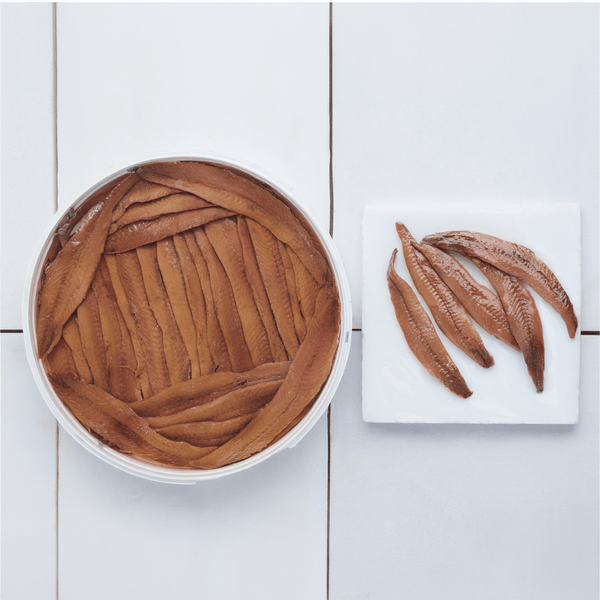
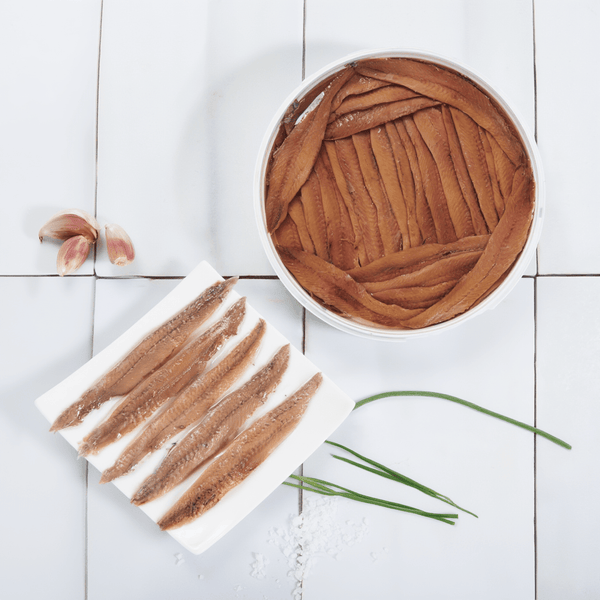
Color: Uniform coppery, between golden-brown and dark pink. No grayish areas (sign of insufficient curing) or very dark brown areas (sign of oxidation due to excessive curing or poor storage).
Texture: Firm but easily yielding to the touch. If the fillet breaks easily when removed from the can, it is over-cured or poorly handled. If it is rubbery and resists bending, the curing is insufficient.
Oil: The oil in the can should be clean, light yellow or slightly pink from contact with the anchovy. Very dark or opaque oil indicates oxidation.
Aroma: Marine, complex, with buttery notes. If the predominant smell is "saltiness" or "strong fish" without nuances, the anchovy is short-cured or made from low-quality anchovy.
Flavor: Balanced salinity, not aggressive. Texture that melts in the mouth. Flavor that lingers and develops for 5-10 seconds after swallowing. If the only flavor is salt and the aftertaste disappears immediately, the anchovy lacks the complexity of long artisanal curing.
To compare anchovies from different brands and sizes with criteria, also see our guide on anchovy or boquerón: how to distinguish them and what to choose.
Premium Seafood Products — Bacalalo
Since 1990, selecting the best from the sea at Mercat del Ninot, Barcelona. Refrigerated shipping 24-48h.
View Cantabrian Anchovies →🛒 Products mentioned in this article
⭐ 4.9/5 · Cold shipping 24-48h · Since 1990 at Mercat del Ninot
Frequently asked questions about Santoña anchovies
Are Santoña anchovies better than those from other places in the Cantabrian Sea?
Santoña has the highest concentration of quality artisan canneries in the entire Cantabrian Sea, but not all of its anchovies are superior, nor are all those from other areas inferior. An artisan cannery in Laredo or Bermeo can produce anchovies comparable to or superior to a mediocre cannery in Santoña. The geographical origin of production matters less than the process of the specific cannery.
Is there an official certification for Santoña anchovies?
There is no PDO (Protected Designation of Origin) or PGI (Protected Geographical Indication) for Santoña anchovies at the time of publication of this article. There are industry initiatives to obtain one, but the European recognition process is long and complex. Without official certification, the guarantee is provided by the reputation and transparency of each cannery.
Why are Santoña anchovies so expensive?
High-quality artisanal anchovies are expensive because they require specific raw material (Cantabrian anchovy from the coastal fishing season), a curing process of 10-18 months that ties up capital for more than a year, and manual labor that cannot be automated. The price reflects the true cost of producing this product. Cheap anchovies labeled "from Santoña" do not have the same origin or the same process.
How should Santoña anchovies be stored once opened?
In the refrigerator, covered with olive oil, in an airtight container. They last between 3 and 5 days in perfect condition. If the oil becomes cloudy or an unpleasant odor appears, discard them. See our complete guide on how to store anchovies correctly.
Do Santoña anchovies contain gluten?
Anchovies in olive oil are naturally gluten-free. The risk of cross-contamination depends on the cannery and its facilities. The quality canneries we work with at Bacalalo specify the absence of gluten in the product on their labels.