Sashimi is the ultimate test of respect for fish: no rice, no vinegar, no wrapping. Just the product, a sharp knife, and the chef's hand. That's why it's impossible to lie with sashimi: either the fish is excellent, or it's obvious. This guide honestly explains which fish to use, what "sashimi-grade" means, how to cut in the Japanese style, and how to make a safe version at home when you don't have access to quality raw fish.
Quick summary: Sashimi is raw fish cut in the Japanese style without rice. To make it safely at home, you need sashimi-grade fish and pre-freezing at -20°C for 72 hours (AESAN), or use cold-smoked salmon as a safe alternative without freezing.
What is sashimi? Differences from sushi and ceviche
Sashimi (刺身) is a Japanese preparation consisting of thin slices of raw fish or seafood, cut with precise technique and served without rice. It is the purest way to appreciate fish: without disguise.
It is not the same as:
- Sushi: it has rice seasoned with vinegar. Includes nigiri, maki, uramaki, temaki, chirashi. If it has rice, it's sushi. If it doesn't have rice, it's sashimi. To see the difference in practice, check out our guide to smoked salmon nigiri.
- Ceviche: the fish is chemically "cooked" in citric acid (lemon or lime) for 5-30 minutes. The protein denatures and the fish changes from raw to opaque. South American origin (Peru, Ecuador).
- Tataki: the fish is lightly seared on the outside with heat or a blowtorch (1-2 seconds) and then cut. The inside remains raw.
- Italian crudo (fish carpaccio): thin raw slices seasoned with olive oil, citrus, and salt. More Mediterranean than Japanese.
Ideal fish for sashimi
Not all fish are suitable. These are the most commonly used and why:
| Fish | Characteristics | Recommended cut |
|---|---|---|
| Bluefin tuna | Intense flavor, fatty texture (toro: belly), deep red color | Hira-zukuri (thick rectangular 7-10 mm) |
| Albacore tuna (bonito del Norte) | Softer than bluefin, buttery texture | Hira-zukuri or light tataki |
| Salmon | Orange color, strong flavor, abundant intramuscular fat | Sogi-giri (at a 45° angle) |
| Sea bass | Firm white flesh, delicate flavor | Usu-zukuri (thin, almost transparent slices) |
| Sea bream | White flesh, sweeter flavor than sea bass | Usu-zukuri |
| Butterfish / escolar | Ultra-creamy texture, neutral flavor | Hira-zukuri |
| Scallop | Marine sweetness, soft texture | Tagiri (small cube cut) |
| Cooked octopus | Firm texture, marine flavor | Thin slices |
Sashimi-grade: how to identify it and why it matters
"Sashimi-grade" is not an official label regulated by any organization. It is a commercial designation used by fishmongers and specialized suppliers to indicate that a fish meets minimum criteria for raw consumption. They can lie to you.
Real indicators of sashimi quality:
- Clear and traceable origin: fish market, catch day, vessel.
- Ikejime processing or equivalent: Japanese technique of immediate slaughter that preserves texture and flavor (quick brain cut + bleeding).
- Rapid freezing on board at -35 °C or below within the first few hours after capture. This destroys anisakis and preserves quality.
- Impeccable color, shine, and smell: fresh fish smells like clean sea, not "fishy." The color should be vibrant, not dull.
- No visible parasites: the fishmonger should clean and inspect it in front of you.
The problem of anisakis (and why freezing is mandatory)
Anisakis simplex is a parasitic nematode present in many marine fish (hake, sardine, anchovy, bonito, horse mackerel, wild salmon). If you ingest a live larva, it can cause anisakiasis: severe abdominal pain, a serious allergic reaction, or gastrointestinal symptoms.
Spanish regulations (RD 1420/2006 and AESAN) require:
- Freezing fish at -20 °C for at least 24 hours before serving raw or marinated.
- Or -35 °C for 15 hours (industrial freezing).
- AESAN, for safety margin, recommends 72 hours at -20 °C.
Three-star domestic freezers (***) reach -18 °C and comply with a margin. Four-star freezers (****), -24 °C, are ideal.
Cutting technique: yanagiba knife, angle and thickness
The knife matters more than it seems. A dull knife tears the fish fibers instead of cutting them cleanly, resulting in a rubbery texture that is not appreciated.
Knives by need
- Yanagiba: long Japanese knife (24-30 cm), single-sided edge (asymmetrical blade), specific for sashimi. Allows cutting with a single pulling motion. Price: €80-500.
- Santoku: multi-purpose Japanese knife. Shorter (17-20 cm), double-edged. Works well for homemade sashimi. Price: €40-150.
- German chef's knife (Wüsthof, Zwilling): acceptable if very sharp. You will need to cut with several movements.
The 3 main cuts
- Hira-zukuri (平作り): thick rectangular cut of 7-10 mm. The most versatile. Rest the tip of the knife at the furthest end of the fish and pull towards you in a single fluid motion. Ideal for tuna, firm salmon.
- Sogi-giri (削ぎ切り): cut at a 45° angle. The slices are wider and thinner (3-5 mm). Ideal for sea bass, sea bream, salmon.
- Usu-zukuri (薄作り): ultra-thin, almost transparent cut (2 mm). For firm white fish served on a visible plate (sea bass, sea bream, fugu).
Accompaniments: wasabi, soy sauce, ginger
- Real wasabi (Wasabia japonica): fresh rhizome grated with a sharkskin grater (oroshi) or fine grater. "Clean" pungent flavor that goes up the nose but dissipates quickly. €100-300/kg. Difficult to find outside Japan.
- Tube "wasabi": mix of European horseradish + mustard + food coloring. Suitable for home use. Harsher, more persistent pungency.
- Soy sauce: use a low-salt or "tamari" type (wheat-free). Kikkoman less salt works well. Authentic Japanese (shoyu) is more balanced than industrial ones.
- Gari (pickled ginger): pink (naturally from contact with umeboshi vinegar). Eaten between sashimi pieces to cleanse the palate, not as a condiment on the fish.
- Grated daikon: Japanese white radish grated into fine threads. Accompanies some white fish sashimi.
- Shiso (perilla): aromatic Japanese leaf served under sashimi.
Recipes: classic sashimi (safe version) + variations
Main recipe: Safe smoked salmon and Cantabrian tuna sashimi
Ingredients (2 people):
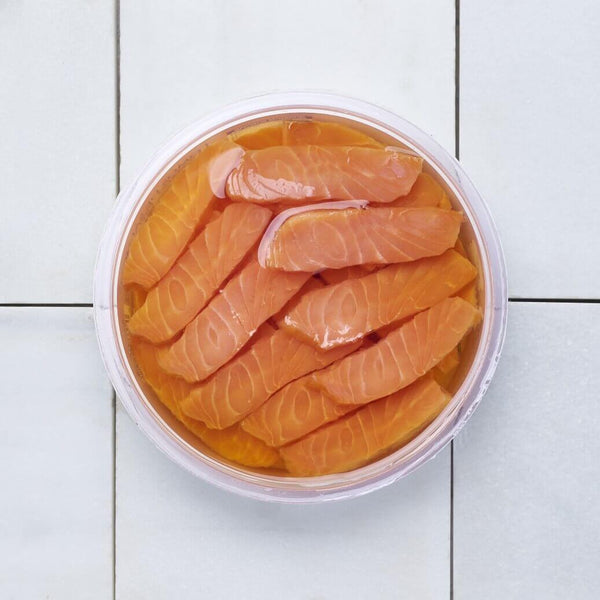
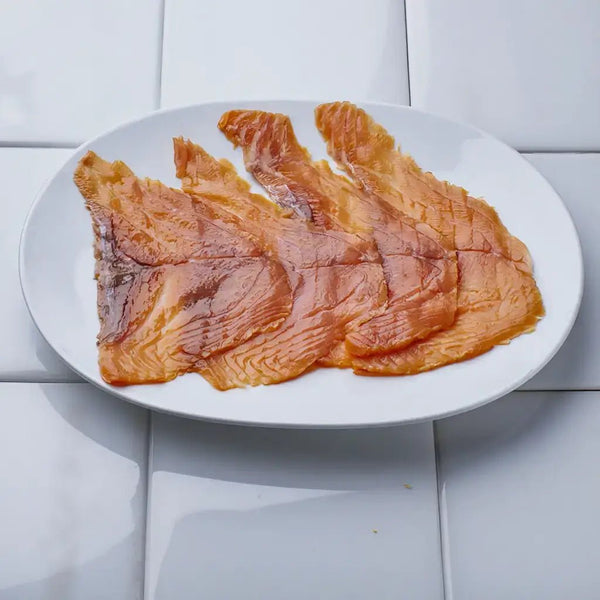
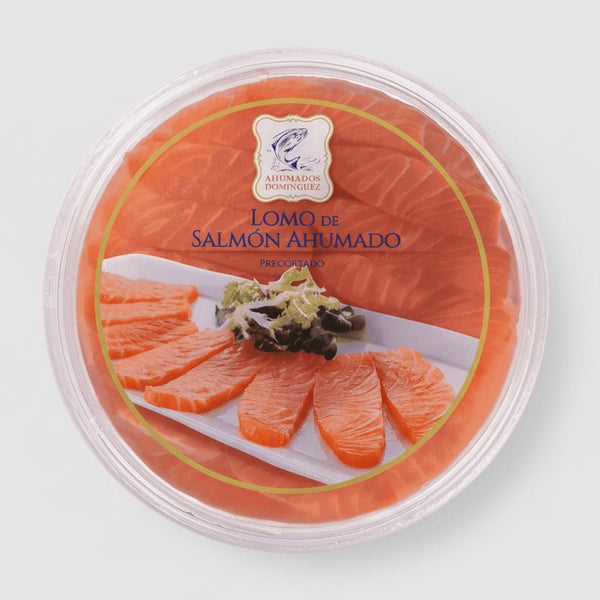
- 100g of Domínguez smoked salmon slices (or loins for thick cut)
- 120g of Olasagasti Cantabrian tuna loin, drained
- Wasabi (real if possible, or from a tube)
- Low-salt soy sauce
- 40g of pickled ginger (gari)
- Fresh chopped chives
- Maldon salt (optional)
- Toasted sesame oil (optional)
Steps:
- Prepare the tuna. Remove the Olasagasti tuna from the oil and let it drain on paper towels for 5 minutes. The olive oil is of quality to reserve 2 tablespoons and use later.
- Cut the tuna. With a very sharp knife, cut the loin into 7-8 mm slices against the visible grain. They should be clean rectangles without tears.
- Cut the salmon. If using Domínguez loins, cut into 5 mm slices at a 45° angle (sogi-giri). If using pre-sliced thin slices, fold them into a 3-layer fan to gain volume and simulate a thick cut.
- Plate. Arrange the slices on a dark rectangular plate, alternating tuna and salmon. Leave an empty area for wasabi, ginger, and a small soy sauce bowl.
- Decorate. Brush the tuna with sesame oil (optional). Sprinkle fine chives over the salmon. A pinch of Maldon salt on the tuna.
- Serve. Immediately. To eat: a pinch of wasabi on the slice, dip only one edge in the soy sauce, eat in one bite. Between pieces, pickled ginger.
Variation 1: Tuna sashimi with sesame (light tataki)
Remove the Olasagasti loin from the oil, pat dry. Coat it in toasted black and white sesame seeds, pressing firmly. Cut into 8 mm slices. Serve with soy sauce and yuzu (if you have it) or lemon.
Variation 2: Smoked salmon carpaccio Japanese style
Domínguez salmon slices spread on a plate. Drizzle with diluted soy sauce + sesame oil + yuzu or lemon zest. Chopped chives and tobiko or salmon roe.
Common mistakes
- Cutting with a dull knife. Tears the fibers. Result: rubbery texture. Solution: sharpen before each use.
- Cutting parallel to the fibers. The fish becomes fibrous. Identify the fibers and cut perpendicularly.
- Serving sashimi cold from the fridge. Take the fish out 5-10 minutes before so it's at a "fresh" but not icy temperature.
- Drowning the slice in soy sauce. Only dip one edge with a touch. If you soak it, you lose the fish's flavor and it only tastes like soy sauce.
- Piling up slices on the cutting board before plating. Sashimi loses texture when exposed to air. Plate them as you cut them.
- Using fresh fish without freezing. Real risk of anisakis. Only safe if from a specialized supplier with certified industrial freezing.
- Confusing tube wasabi with real wasabi. They taste different. If the recipe calls for it, buy the real one.
Related links from the Japanese cluster
If you want to explore more Japanese cuisine with premium seafood products:
- Smoked salmon nigiri step by step
- Varied makis with smoked salmon
- Uramaki step by step
- Perfect sushi rice
- Complete guide to smoked salmon
Discover our premium selection
Seafood products carefully selected since 1990 at Mercat del Ninot, Barcelona. Refrigerated delivery in 24-48h.
Conclusion
Sashimi is the most demanding test for a chef: just the fish, without hiding. At home, honesty matters: NOT just any supermarket fish will do. You need either sashimi-grade fish from a specialized supplier with prior industrial freezing, or use safe alternatives like cold-smoked salmon or premium preserved Cantabrian tuna, which provide the format and flavor without the risk of anisakis.
The sharp knife, cutting angle, and thickness are three times more important than any accompaniment. Master the technique before investing in real wasabi or a yanagiba.
Since 1990 at Mercat del Ninot, we tell you what matters with discernment, not slogans.