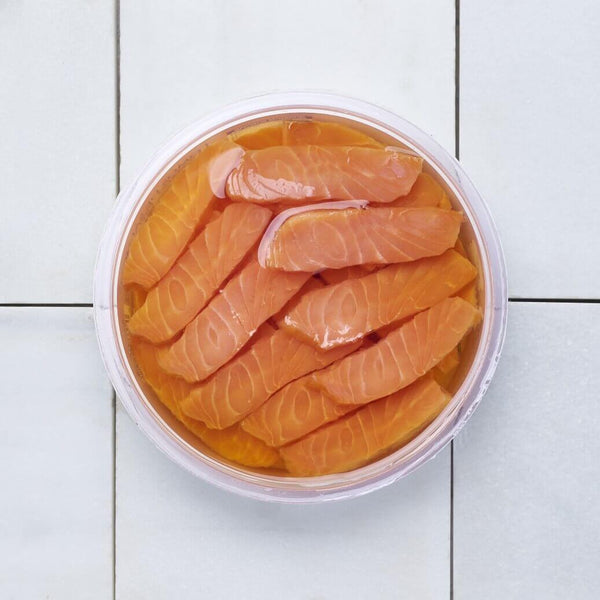
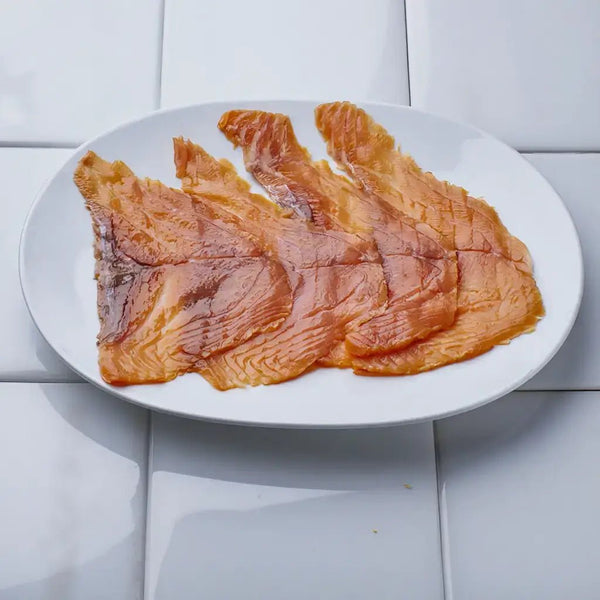
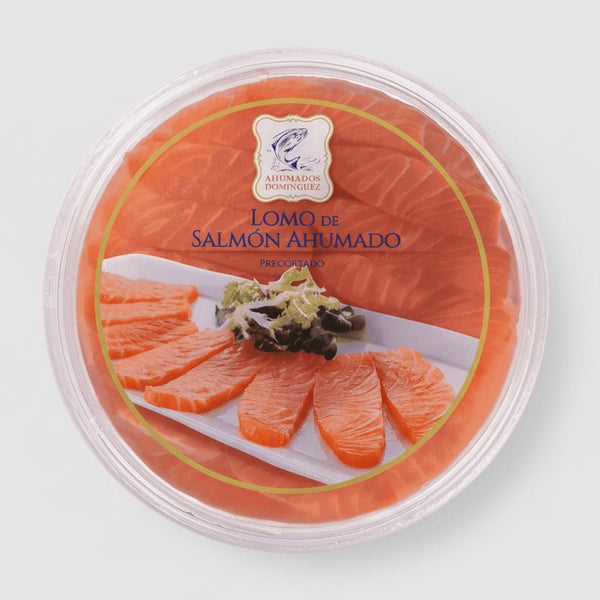
Nigiri is the most essential form of sushi: seasoned rice, a dab of wasabi, and a slice of fish. No nori, no rolling, no tricks. This simplicity demands that each ingredient shines. That's why choosing the right salmon is paramount: for making nigiri at home, cold-smoked salmon is the safest and most intensely flavored option.
Quick Summary: Form 15-18g oval-shaped seasoned rice, add a dab of wasabi, and cover with a 6x3 cm slice of smoked salmon. Serve with soy sauce, wasabi, and ginger. Ready to serve immediately.
What is nigiri and why this cut works
Nigiri-zushi (握り寿司, "pressed sushi") originated in Edo (Tokyo) in the 19th century as fast street food: a ball of seasoned rice with a piece of fish on top, easy to eat standing up with one's hand. Today it is the most respected form in Japanese haute cuisine because there is no place to hide: the quality of the fish and the temperature of the rice are everything.
Making nigiri with smoked salmon has three clear advantages over raw:
- Guaranteed food safety without the need for freezing.
- Deeper, fattier flavor: cold smoking enhances the aromas.
- Easier handling: the buttery texture doesn't break when placed on the rice.
Ingredients (12 pieces · 3-4 people)
- 200 g cooked and seasoned sushi rice (see sushi rice technique)
- 150 g Domínguez smoked salmon slices
- 10 g authentic wasabi or wasabi paste
- Low-sodium soy sauce (Kikkoman less salt)
- Pickled ginger (gari)
- Finely chopped fresh chives
- 10 g TANIT salmon roe (optional, for premium version)
Necessary utensils
- Sharp knife (ideally Japanese yanagiba, alternatively santoku).
- Bowl with water and a splash of vinegar to moisten hands.
- Clean, dry cutting board.
- Tray or rectangular plate for plating.
Step-by-step technique
- Cut the salmon at the correct angle. Place the slice on the board. With the knife at a 45° angle, cut rectangles measuring 6 cm × 3 cm × 4-5 mm. If the slices are large, one per nigiri; if small, overlap two.
- Moisten your hands. Dip your hands in the water with vinegar and shake them off. This prevents the rice from sticking to your fingers during shaping.
- Take the right amount of rice. About 15-18 g (a heaped tablespoon). If you put too much, it will be disproportionate and fall apart. If you put too little, it won't hold the fish.
- Form the oval. Press the rice between your index and middle fingers on the palm of your other hand, shaping it into a rectangular-oval of 5 cm × 2.5 cm × 2 cm. The top should be flat, the sides gently curved.
- Add a dab of wasabi. With your fingertip or a toothpick, spread a small dab (2-3 mm in diameter) in the center of the top face. Japanese tradition never uses excessive wasabi.
- Place the salmon. Put the slice with the wasabi side touching the rice. Gently press with two fingers for 2 seconds so it adheres and the salmon hugs the curve of the rice.
- Garnish. Sprinkle with chives. For a premium version, crown with half a teaspoon of salmon roe at the end.
- Serve immediately. Accompany with a bowl of soy sauce, pickled ginger, and a little more wasabi for those who wish to add it.
Chef's tips and common mistakes
- Fish that doesn't stick: too little pressure when placing, or salmon too cold directly from the fridge.
- Rice that falls apart: you didn't press enough, or you have too much water on your hands.
- Slice that tears: knife not sharp enough or slices too thin (less than 3 mm).
- Bland flavor: low-quality salmon. The difference between good smoked salmon and mediocre is immediately noticeable in nigiri because there's nothing to mask it.
Variations with other fish and toppings
| Variation | Topping | Notes |
|---|---|---|
| Classic Nigiri | Just salmon + wasabi | The pure version. Ideal for appreciating the smoking. |
| Nigiri with ikura | Salmon roe on top | Pure luxury: two forms of salmon in one bite. |
| Aburi nigiri | Blowtorch + Maldon salt + lemon | Smoking is intensified with torch-searing. |
| With cream cheese | Dab of cream cheese between rice and fish | Very popular Westernized version. |
| With caviar | Osetra caviar on top | For celebrations. Pairs with brut nature cava. |
| Cold Hosomaki | Replace nigiri with a thin roll | If you prefer a wrapped format, check out homemade makis. |
Pairings
- Cold junmai daiginjo sake: the classic for nigiri.
- Brut champagne or brut nature cava: the bubbles cleanse the palate of the smoky flavor.
- Albariño Rías Baixas: Atlantic salinity that pairs well with salmon.
- Matcha green tea: non-alcoholic option.
- Dry German Riesling: fresh acidity to cut through the fat.
If you liked this nigiri, try the step-by-step smoked salmon uramaki and the varied makis. The key to success is the rice: check out our complete sushi rice technique. And if you want to delve deeper into the ingredient, the smoked salmon ranking by origin and the complete guide will help you choose better.
Discover our premium selection
Seafood products carefully selected since 1990 at Mercat del Ninot, Barcelona. Refrigerated shipping in 24-48h.
Conclusion
Nigiri is the ultimate test of homemade sushi: if the rice is well-seasoned and the fish is high quality, it turns out spectacular without the need for sophisticated tools. Domínguez cold-smoked salmon solves the most serious problem of making sushi at home —food safety— and provides a flavor that raw salmon does not.
Start with the classic version, master the molding pressure, and then play with toppings: roe, a blowtorch, or caviar for celebrations. Since 1990 at Mercat del Ninot, with discernment.