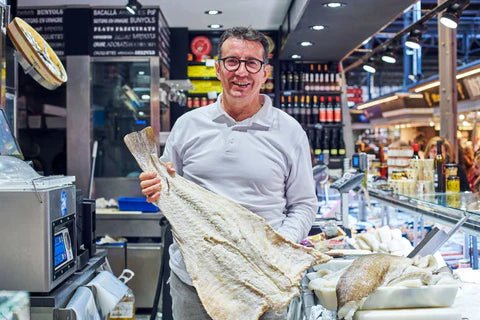
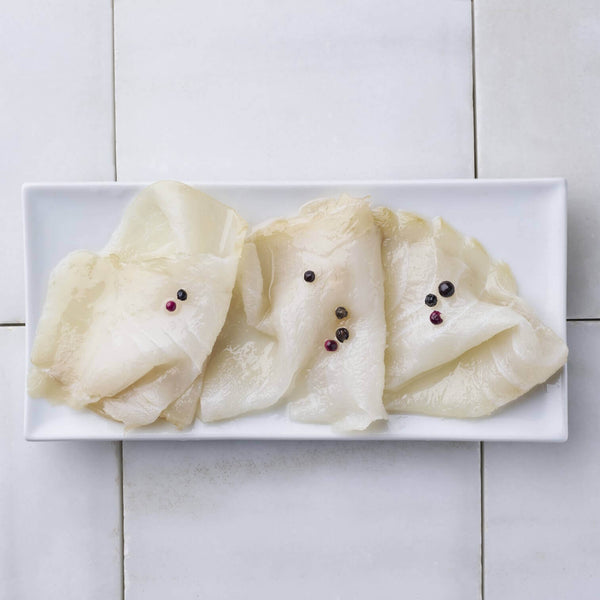
Summary: At Bacalalo, we have been working with every part of the codfish since 1990 in Mercat del Ninot in Barcelona. And if there's one cut that arouses more curiosity than any other — and more satisfaction in those who dare to buy it — it's the "morro" (cod jowl).
Cod jowl is one of those cuts that connoisseurs know and appreciate, but that still raises questions in the general market: "What exactly is it?", "Where is it located?", "Does it taste different?", "How do you cook it?"
This guide answers all those questions.
Contents
What is Cod Jowl
Cod jowl is the anterior part of the loin, the area corresponding to the fish's head. Anatomically, it is the area from where the head ends to where the central loin begins, on the dorsal side of the cod.
Visually, when you see a boneless, open cod, the jowl is the triangular or trapezoidal portion that precedes the upper loin. It is a more irregular piece than the center loin, with more skin and a different proportion of muscle and connective tissue.
Anatomical Position
Imagining the whole cod:
The jowl is not the head (which has few usable edible parts, although it is used for stocks). It is the first piece of the cod's body, the one that connects to the cephalic region.
Why does it have so much connective tissue? The muscles in the anterior part of the cod work more intensely to control head movements, which generates more connective tissue and, consequently, more collagen. That collagen is responsible for the characteristic gelatinous texture.
How to Distinguish It at the Counter
If you buy from a specialized fishmonger:- The jowl is usually a thicker piece at the top and more irregular at the edges.
- The skin has more folds and is thicker than that of the loin.
- The color may be slightly darker than the loin.
- If it's salted, the jowl absorbs salt differently — it may appear wetter or drier depending on the curing process.
Why It's So Gelatinous: The Science of Collagen
Collagen is the structural protein that gives tissues their firmness and, when cooked correctly, their melting, gelatinous texture.
Cod jowl has an especially high proportion of collagen for several reasons:
- Muscular connective tissue: The anterior area has more fascia and connective tissues between muscle groups.
- Thick skin: Cod skin is rich in collagen by itself. The jowl has more skin surface relative to muscle mass than the loin.
- Adjacent cartilage: In the transition between the cephalic area and the trunk, there are cartilaginous structures that provide more gelatinizable collagen.
What happens to collagen during cooking? At 60-70°C, collagen begins to convert into gelatin. With moderate time and heat (long, low-temperature cooking or slow stewing), all the collagen transforms, and the piece acquires a melting, almost buttery texture that is impossible to achieve with a loin.
This transformation is exactly what happens in pil pil and slow-cooked stews.
Cod Jowl vs. Other Premium Cuts: A Comparison
| Cut | Collagen | Flavor | Cooked texture | Relative price |
|---|---|---|---|---|
| Upper loin | Low-medium | Elegant, delicate | Firm flakes | High |
| Belly | Medium | Intense, fatty | Melting, juicy | High |
| Jowl | High | Intense, deep | Gelatinous, melting | Medium-high |
| Cheeks | Very high | Very intense | Extremely gelatinous | Very high |
| Tail | Low | Mild, delicate | Firm, somewhat dry | Low |
For long stews and pil pil, the jowl can even be superior to the loin because the final gelatinous texture is more satisfying and the flavor more complex.
Related Bacalalo Products


Recommended Products

Natural Cod Liver Foie Gras - 120g | Smoked C...
€3.90

CHATKA Wild King Crab 60% Legs 40% Shredded ...
€95.00

Smoked Cod Carpaccio Artisanal Cut | P...
€15.90

Dried Cod Cheeks (1 tray) - 500g
€19.95
Refrigerated shipping 24-48h throughout the Peninsula
Most Suitable Recipes for Cod Jowl
1. Cod Jowl Pil Pil
Pil pil with cod jowl is different from loin pil pil. The higher amount of collagen means that:- It binds faster and more easily
- The sauce is thicker and creamier
- The flavor is more intense
- Desalt the jowl for 48-72h (it's thicker, needs more time)
- Oil, garlic, chili — gently confit the garlic
- Jowl skin-side down in the oil at 65-70°C
- Gentle circular motion: the jowl will make the pil pil almost effortlessly
- The thick skin acts as a collagen reservoir that slowly dissolves
2. Cod Jowl Stew with Piquillo Peppers
The gelatinous texture of the jowl turns any stew into something richer.
Ingredients: Desalted jowl, roasted piquillo peppers, onion, garlic, tomato, white wine, fish stock.
Technique:- Lightly brown the jowl on the skin side in oil. Set aside.
- Deep sofrito: onion, garlic, concentrated tomato.
- White wine, let evaporate. Piquillo peppers, blend half and slice the rest.
- Add the jowl. Just enough broth to almost cover.
- Low heat, 20-25 minutes covered. The jowl will release its collagen and thicken the sauce.
3. Confit Cod Jowl with All i Oli
Confit cod jowl in olive oil at a low temperature (60-65°C) produces a spectacular melting texture that can be cut with a spoon.
Technique:- Mild olive oil, garlic, thyme, bay leaf. Temperature 62-65°C (kitchen thermometer).
- Submerged jowl, skin-side down, for 18-22 minutes. The time is longer than for loin due to its greater thickness.
- The jowl will be ready when, gently pressed, it yields without resistance.
- Serve with classic all i oli and some roasted vegetables.
4. Mild Pickled Cod Jowl
Pickling is a traditional technique that particularly benefits gelatinous cuts: the acidity of the vinegar balances the richness of the collagen.
Ingredients: Desalted jowl, olive oil, Sherry vinegar, julienned onion, bay leaf, peppercorns, carrot.
Mild pickling (3:1 oil:vinegar ratio) works very well served warm or cold.
How to Desalt Cod Jowl Correctly
The jowl, being a dense and thick piece, requires more desalting time than standard loin.
Recommended times:- Large jowl (more than 4 cm thick): 60-72 hours
- Medium jowl: 48-60 hours
- In all cases: cold water, refrigerator, changes every 8 hours
Desalting test: Cut a small piece from the thickest part and eat it raw. It should taste like cod with a pleasant saltiness, without being overly salty. If it still tastes salty, continue desalting with more frequent water changes.
Common mistake: The jowl may appear desalted on the surface but be salty inside due to its thickness. That's why it's important to test the inside, not just the edges.
Comparison with Cod Belly
Cod belly is another premium cut with high gelatinousness. It's useful to know its differences:
Belly:- Ventral area (underside of the cod)
- Higher muscle fat content
- Richer, almost unctuous flavor
- Softer and more melting texture (less muscle fiber)
- Ideal for confit, pil pil, cod carpaccio
- Anterior area (part connecting head and loin)
- More structural collagen (not fat)
- More intense and profound flavor, less fatty
- Gelatinous texture but with some bite
- Ideal for stews, pil pil, escabeche (pickled)
In summary: cod belly is fattier and softer; cod jowl is more gelatinous and firm. They are two distinct experiences.
Comparison with Cod Cheeks
If the jowl is the first cut of the body, cod cheeks are the chin. Which is better?
Cheeks:- Extreme collagen (the highest in cod)
- Very small portion per animal
- Very high price
- Very intense flavor
- Almost liquid texture when cooked well in pil pil
- High collagen (second only to cheeks)
- Greater availability and quantity per animal
- More accessible price
- Equally intense flavor but with more "body"
- Gelatinous texture but with a bit more structure
For everyday use, cod jowl is the best substitute for cheeks when they are not available. And in stews where you need the cut to maintain some shape (unlike cheek pil pil, where they fall apart), jowl is superior.
Where to Buy Cod Jowls in Barcelona
Cod jowls are not easy to find in every fishmonger. It's a cut that requires butchering work and not all distributors have it regularly available.
At Bacalalo, we offer cod jowls when the season and quality allow. It's a cut we especially value because it encapsulates everything we love about cod: intense flavor, extraordinary texture, and a use that challenges (and rewards) culinary technique.
Check availability of jowls and special cuts at Bacalalo
🛒 Products mentioned in this article
⭐ 4.9/5 · Chilled delivery 24-48h · Since 1990 at Mercat del Ninot
Frequently Asked Questions
Are cod cheeks and cod head the same thing?
No. Cod head (with eyes, jaw, and bones) has little direct edible use, although it is excellent for stocks and broths. The cheek is the first part of the body — the muscular piece that connects the cephalic area to the loin. It is edible and of high gastronomic value.
Why are cod cheeks more gelatinous than the loin?
Due to their higher structural collagen content. The anterior part of the cod has more connective tissue and thick skin relative to muscle mass. This collagen, when cooked with gentle, prolonged heat, turns into gelatin, giving it its characteristic texture.
Can pil pil be made with cod cheeks?
Yes, and in fact, cheek pil pil is easier to make than loin pil pil because it releases more gelatin. The sauce thickens faster and becomes creamier. The flavor is more intense and just as good.
How long do cod cheeks need to be desalted?
Due to their thickness, between 48-72 hours. This is longer than standard loin. Follow the protocol of cold water in the refrigerator, changing the water every 8 hours, and taste the innermost part before cooking.
Do cod cheeks have many bones?
They have some rib bones in the transition area with the loin, but they are easy to locate with your fingers and remove. It is not as clean a cut as the top loin, but the bones are not a serious problem either.
Are cod cheeks a more economical cut than the loin?
Generally, yes. Being a less regular piece and less appreciated by the general public (who prefer the loin for its presentation), the cheek usually has a slightly lower price. However, the difference has been narrowing as gastronomic knowledge of cod has grown.
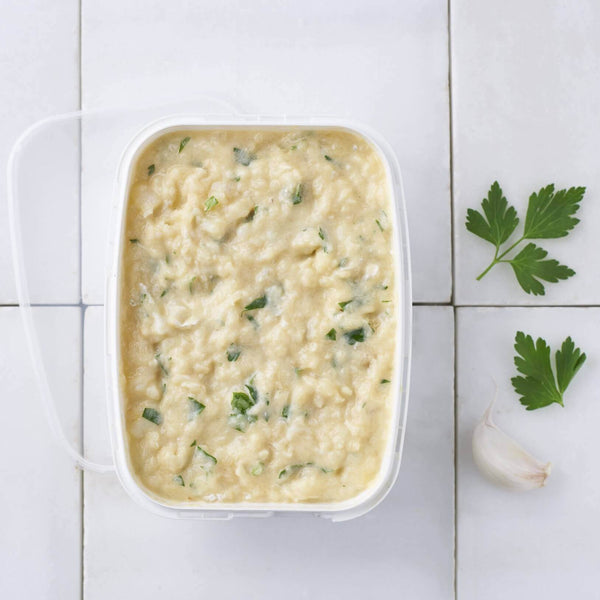
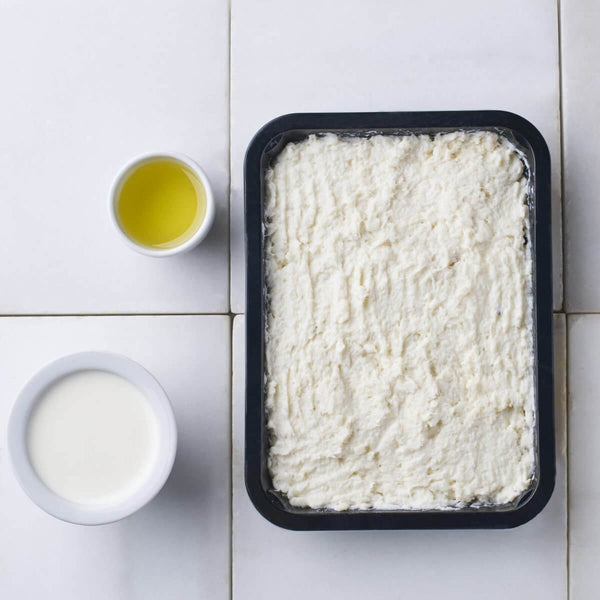
Can I make brandade with cod cheeks?
Yes. The extra gelatin from the cheek gives the brandade an even creamier texture than that of the loin. The result is excellent, although higher in calories (gelatin adds body). If you make brandade with cheeks, you will probably need less oil to achieve the creamy texture.
What is the difference between cheek and cheek with skin?
Cheek "with skin" retains the thick skin, which is where most of the collagen is concentrated. For pil pil and stews, cheek with skin is preferable. Some chefs remove the skin for cleaner presentations and use it separately (fried crispy skin is an excellent crunchy accompaniment).
How many servings of cheek are needed per person?
As a main course, 150-180g of desalted cheek per person. Remember that the cheek loses some weight during cooking (water loss). If you start with salted cheek, calculate 20-25% more.
Where else is cod cheek called "morro"?
In the Basque Country, it is also called "morros" and is part of traditional recipes. In Catalonia, it is known as "morro de bacallà". In Portugal, the equivalent part is used in traditional stews. In general, it is a cut more recognized in the cod culture of coastal regions than inland.
At Bacalalo, since 1990, we have been advocating that whole cod is better than just the loin. The cheek, the belly, the throats—each part has its raison d'être and its perfect recipe. If you want to know what we have available today, visit us at Mercat del Ninot or check our online store.