Summary
At Bacalalo's counter in Mercat del Ninot, we receive orders for gildas every week from people who discovered them on holiday in San Sebastián or at a pintxo bar in Barcelona. In this guide: The origin of the gilda: Bar Casa Vallés, San Sebastián, 1946, Why the gilda became the most famous tapa in the Basque Country, Where to eat the best gilda tapas in Spain.
The Gilda: History of the Pintxo and Where to Eat It
At Bacalalo's counter in Mercat del Ninot, we receive orders for gildas every week from people who discovered them on holiday in San Sebastián or at a pintxo bar in Barcelona. There's something about gilda tapas that's addictive: they're small, concentrated, balanced, and have a backstory that few Spanish tapas can match. This article explains where they come from, why they're called that, where to eat good ones, and how to replicate them at home with guaranteed quality.
The origin of the gilda: Bar Casa Vallés, San Sebastián, 1946
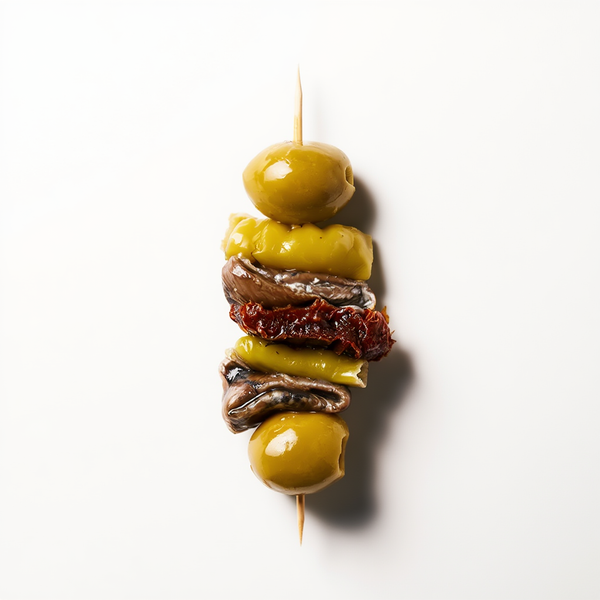
The history of the gilda has a specific date, place, and protagonists. In 1946, at Bar Casa Vallés on Fermín Calbetón street in San Sebastián (also known as "pintxo street"), the bar manager, Joaquín Aranburu, began serving pickled Ibarra chillies accompanied by olives and premium Cantabrian anchovies on a toothpick.
At that time, it was common in San Sebastián bars to place pickles (chillies, olives, capers) on the counter for customers to enjoy while drinking their wine or txakoli. What Aranburu did was skewer these ingredients together on a single toothpick, creating a unified bite, easy to pick up and eat, that combined the three dominant flavours: salty (anchovy), acidic (chilli), and fatty-vegetable (olive).
The name came later and from an unexpected source: the movie Gilda (1946), starring Rita Hayworth. The film was released in Spanish cinemas that same year and caused a sensation. Someone in the bar made the association: the skewer was, like Rita Hayworth's character, "salty, spicy, and a little green." The name stuck and spread throughout the Basque Country.
Why the gilda became the most famous tapa in the Basque Country
The success of gilda tapas was neither immediate nor planned. For decades it was a local, very San Sebastián tapa, served mainly in the old town bars of San Sebastián. Its expansion came with gastronomic tourism: from the 80s and 90s, when San Sebastián began to receive visitors specifically attracted by its cuisine, the gilda travelled with them.
The factors explaining its success are simple but powerful:
- Simplicity: Three ingredients, one toothpick. It requires no technical preparation or special tools.
- Balance of flavours: The combination of salty, acidic, and fatty is calculated so that no single ingredient dominates the others.
- Versatility: It works as an appetizer before a meal, as an accompaniment to a beer or a glass of wine, as a stand-alone tapa, or as part of a varied platter.
- Accessible price: In Basque bars, a gilda costs between 1.50 and 3 euros. For the price, the organoleptic quality is exceptional if the ingredients are good.
Bacalalo Products

Artisan Cheese Gilda Handmade Gourmet...
9,75 €

Caper Berries in Vinegar - 1400g (600 g Drained)
9,95 €

Artisan Pickled Onions - 1.4 kg
9,90 €

Artisan Boquerón Gilda Handmade...
9,90 €
Refrigerated shipping 24-48h throughout the Peninsula
Where to eat the best gilda tapas in Spain
The Basque Country, and especially San Sebastián, remains the benchmark territory for gilda tapas. But in recent years, pintxo culture has travelled to other cities, and quality gildas can now be found in more places.
San Sebastián (Donostia)
The epicentre. The pintxo street par excellence is the Old Town (Parte Vieja), where bars like Bar Casa Vallés (the original bar), Bar Txepetxa, Bar La Cepa or Bar Borda Berri maintain the standard that has made the city famous. Prices range from 1.50 to 2.50 euros per gilda.
The ritual is to go from bar to bar, have one or two gilda tapas in each with a glass of txakoli, and move on. It's called "txikiteo" and it's a social experience as important as it is gastronomic. In summer, the Parte Vieja can be very crowded; the autumn and winter months are quieter and the bars are at their best.
Bilbao
Bilbao has its own version of txikiteo, more linked to the bars of the Old Town. The quality of the gildas is excellent and pintxo culture is deeply rooted. Prices are similar to San Sebastián, sometimes a little cheaper.
Vitoria-Gasteiz
The Alavese capital has its own very solid pintxo scene, somewhat less known than those of Bilbao and San Sebastián but of comparable quality. Vitoria's gilda tapas are usually more generous in size.
Barcelona
Basque influence on Barcelona's gastronomy has grown significantly in the last decade. In the Eixample and Born districts, there are several bars specializing in pintxos and gildas. At Mercat del Ninot, Bacalalo makes artisan gildas available for takeaway. The quality of the ingredients determines everything: a gilda with 12-month Cantabrian anchovy is a different experience from one with supermarket anchovy.
Madrid
In Madrid, pintxo culture is imported but has taken deep root. Calle Cava Baja and the La Latina neighbourhood have several specialized establishments. Quality gildas of varying degrees can also be found at Mercado de San Miguel and Mercado de San Antón.
How to make gilda tapas at home: the recipe
Making gildas at home presents no technical difficulty. The key lies in the ingredients, not the preparation.
Ingredients for 12 gildas:
- 12 Cantabrian anchovy fillets in olive oil (anchovies cured for at least 12 months, from Santoña or the Rías)
- 12 green Manzanilla olives (pitted or unpitted)
- 12 Basque pickled chillies (from Ibarra or similar, long)
- Extra virgin olive oil to finish (optional)
Assembly:
- Lightly drain the chillies from the vinegar without drying them completely. The vinegar is part of the flavour.
- Take the anchovy fillet and fold or roll it slightly so it has body on the skewer.
- Skewer on the toothpick: first the olive, then the chilli folded into an "S" shape, finally the rolled anchovy fillet. The order may vary depending on aesthetics.
- Place on a platter and add a drizzle of extra virgin olive oil on top if desired.
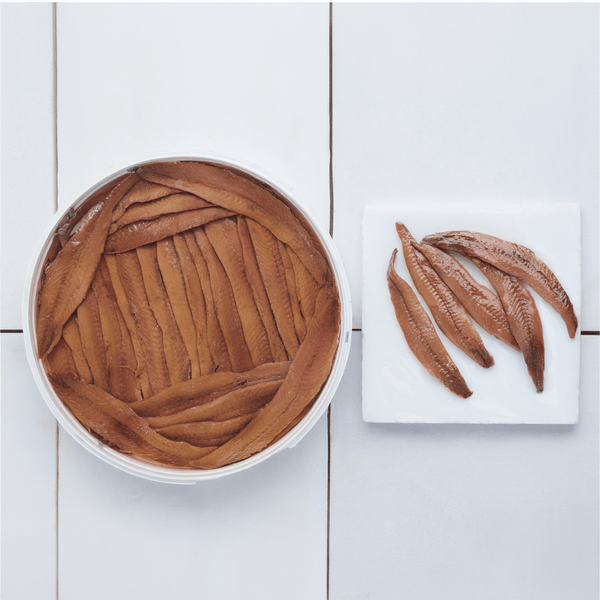
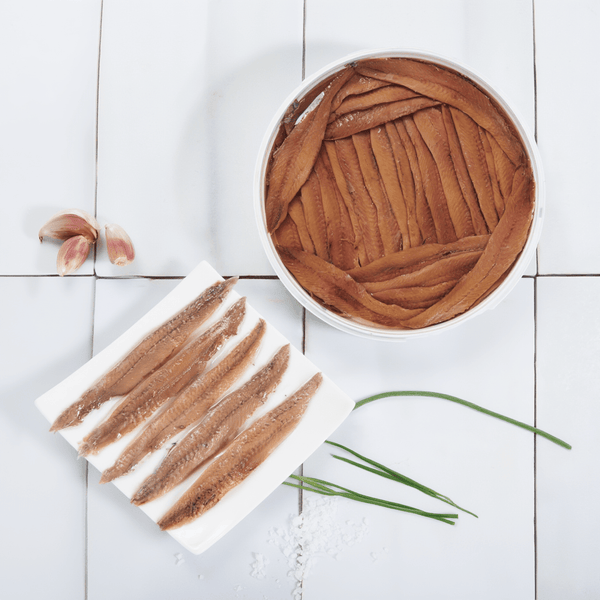
The key is the anchovy. A correctly cured Cantabrian anchovy has a firm but not hard texture, a reddish-brown colour, and a deep umami flavour without being aggressive. A low-quality anchovy is darker, soft, and very salty. The difference in the final result is radical.
The gilda as a gourmet product: recent evolution
In recent years, gilda tapas have undergone a dual evolution. On the one hand, high-end Basque restaurants have created author's versions with top-quality ingredients (long-cured Santoña anchovies, first-press arbequina olives, fresh chillies pickled in-house). On the other hand, the format has expanded to new audiences through gourmet e-commerce.
Bacalalo has been part of this second wave: we make artisan gildas that can be ordered online and delivered to your home within 24-48 hours with refrigerated shipping. The concept of quality artisan gilda delivered to your door meets a real demand: people who have discovered gildas in the Basque Country and want to reproduce that experience without compromising on quality ingredients.
Bacalalo Products
Artisan Cheese Gilda Handmade Gou...
9,75 €
Caper Berries in Vinegar - 1400g (600 g Drained)
9,95 €
Artisan Pickled Onions - 1.4 kg
9,90 €
Artisan Boquerón Gilda Handmade ...
9,90 €
Refrigerated shipping 24-48h throughout the Peninsula
🛒 Products mentioned in this article
⭐ 4.9/5 · Cold shipping 24-48h · Since 1990 at Mercat del Ninot
Frequently asked questions about gilda tapas
When exactly was the gilda invented?
The reference year is 1946, at Bar Casa Vallés in San Sebastián. That year, the film Gilda starring Rita Hayworth was released, and it is also the year the skewer with chilli, olive, and anchovy began to be served in that bar. The connection between the name and the film is documented and is part of San Sebastián's popular history.
Does the gilda always contain anchovy, or can it be boquerón?
Both options are valid and coexist in Basque bars. The gilda with Cantabrian anchovy in oil is the version with the most intense flavor. The gilda with pickled anchovy is milder and more acidic. Many bars offer both. At home, you can make it with either, depending on your preference.
Why do bar gildas taste better than supermarket ones?
Mainly because of the ingredients. Reputable Basque bars use long-cured anchovies (12-24 months), olives with a firm texture, and pickled guindilla peppers with just the right amount of acidity. Industrial supermarket products use lower quality ingredients and often preservatives that alter the flavor. Additionally, the bar serves the gilda freshly prepared; the supermarket one has been in its packaging for weeks.
How long do homemade gildas last?
Homemade gildas made with fresh ingredients last between 24 and 48 hours in the refrigerator if stored in an airtight container or covered with plastic wrap. After that time, the anchovy starts to lose texture, and the guindilla pepper releases too much vinegar into the mix. It's best to assemble them the same day or a few hours before serving.
What drink pairs best with gilda tapas?
The classic Basque pairing is txakoli, the young, slightly sparkling white wine from the Basque Country (Getariako Txakolina, Bizkaiko Txakolina). Its fresh acidity and low alcohol content cleanse the palate between gildas. Natural Asturian or Basque cider also works very well. If you prefer beer, a light lager without too much bitterness is a good choice. Vermouth is also a classic accompaniment in the more Mediterranean versions of this appetizer.
Can vegetarian gildas be made?
Yes. The anchovy is replaced with a vegetable ingredient with a pronounced flavor: cured cheese (Idiazabal, Manchego), sun-dried tomato in oil, large caper, or strips of piquillo pepper. The guindilla pepper and olive are already naturally vegetarian. The result is a gilda with a different flavor but equally balanced and satisfying.