Quick answer: Cantabrian anchovies are produced in six phases: 1) purse seine fishing between March and June (the "fishing season"), 2) heading, gutting, and cleaning, 3) salting in barrels under pressure for 6 to 24 months, 4) washing and drying, 5) manual filleting by removing skin and bone, and 6) packing in olive oil. The entire premium process takes between 12 and 24 months. Industrial production is completed in 4-6 months. The difference is noticeable in every fillet.
The raw material: the European anchovy
Before delving into the process, it's worth clarifying the raw material. Cantabrian anchovies are made from European anchovy (Engraulis encrasicolus), a small oily fish that lives in schools in temperate North Atlantic waters. In the Cantabrian Sea, schools move seasonally: they spend the winter in the Bay of Biscay and come to the Spanish coast between March and June to spawn.
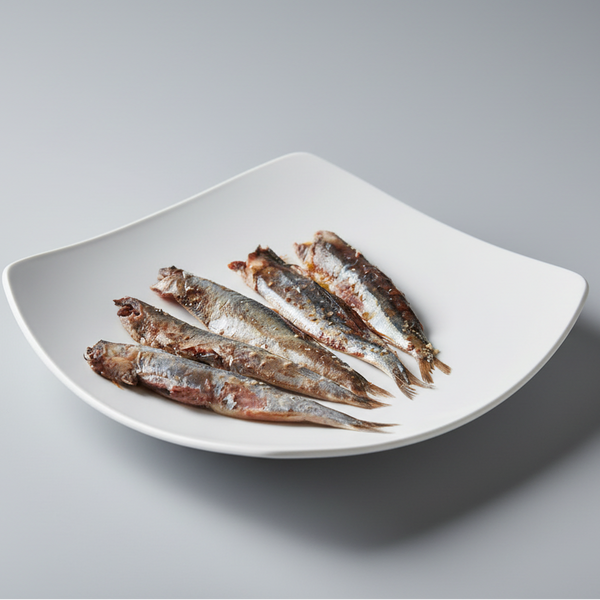
It is exactly the same fish as the "boquerón" of the Mediterranean. The difference between the two lies in the processing, not the species. When cured in salt for months, it is called an anchoa (anchovy). When marinated in vinegar, it is called boquerón en vinagre (vinegared anchovy). When fried whole, it is called boquerón frito (fried anchovy). Same raw material, completely different products.
The Cantabrian anchovy has a characteristic that makes it special: its fat content. The spring season coincides with the pre-spawning phase, when the fish accumulate fat for reproduction. This fat, when cured in salt, produces the aromatic compounds of classic umami. A lean anchovy from winter or warmer waters does not yield the same quality anchovy.

Phase 1 — Fishing and fishing season
The anchovy fishing season is called "la costera". It lasts from March to June, with peaks in April-May. During these months, the Cantabrian fleet (Castro Urdiales, Santoña, Laredo, Bermeo, Ondarroa, Getaria) goes out to fish for anchovy using two main methods:
- Purse seine: the traditional method. A net encircles the school of fish and closes underneath, forming a "bag." This is how most Cantabrian anchovy is caught. It is selective by seine size.
- Pair trawling for tuna: less common for anchovy. Two boats drag a net between them.
The anchovy is unloaded at the fish market the same day (in Santoña, auctions are in the late afternoon/evening). From there, it goes directly to the salting factories, in iced boxes, in less than 6 hours. This speed is critical: the fish is very oily and oxidizes quickly. Any delay of more than 24 hours significantly degrades the final quality.
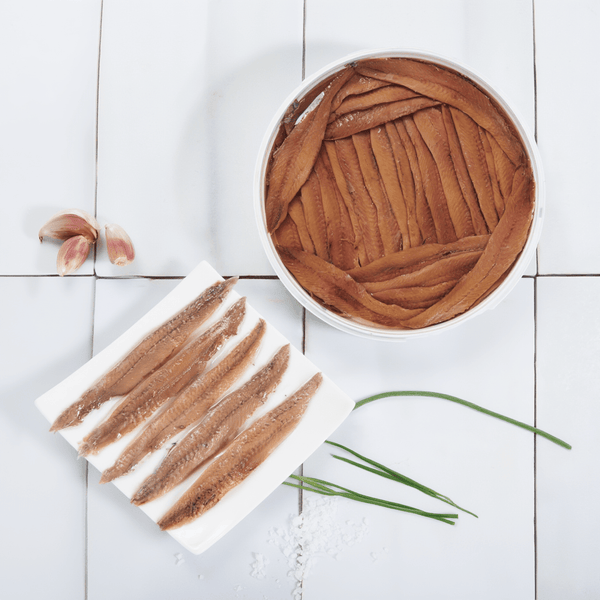
Anchovies in olive oil — Leonardo Gourmet
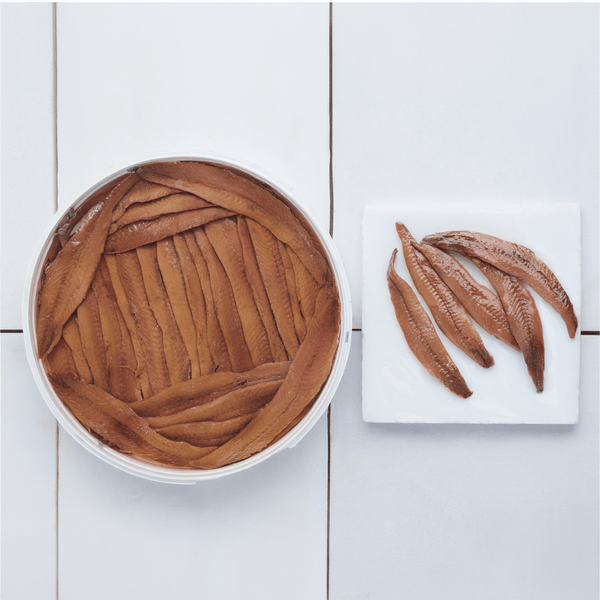
Full traceability of the process: Cantabrian anchovy, salted in Castro Urdiales, traditionally packed. €6.95 per 100g tin.
Phase 2 — Heading and gutting
Once at the salting factory, manual work begins. The anchovies are headed and gutted. This is done on long tables with many workers working in parallel. Each worker heads between 800 and 1,500 pieces per hour, depending on the size of the fish.
Heading is done manually for a technical reason: a clean cut is sought where the fish's "guts" are exposed so that the salt can penetrate directly from that side. Mechanical heading damages tissue and results in irregular salting.
After heading, the guts are removed and the fish is lightly rinsed. The headed anchovy is then called, in trade jargon, "morrillo".
Phase 3 — Salting and maturation (the key)
This is where the final quality of the anchovy is decided. The "morrillos" are placed in wooden or plastic barrels, forming alternating layers with sea salt:
- Salt layer at the bottom (2-3 cm)
- Layer of "morrillos" placed in a herringbone pattern, all in the same direction
- Another layer of salt completely covering them
- Another layer of "morrillos" in a perpendicular direction (so that the weight is distributed)
- And so on until the barrel is full (they usually have a capacity of 70 to 100 kg)
On top of the last layer of salt, a wooden lid with weights is placed: between 30 and 80 kg, depending on the size of the barrel. This weight is essential. It compresses the anchovies, expels liquids, and compacts the mass.
The barrels are then moved to maturation chambers, warehouses with controlled temperature (14-22°C). For weeks, the liquid released by the anchovies must be drained—initially a highly concentrated brine, then a mixture with fats and hydrolyzed proteins. Each barrel is "purged" several times.
During maturation, three biochemical processes occur:
- Partial dehydration: the fish loses water. The flesh becomes denser and firmer.
- Proteolysis: proteins are hydrolyzed into free amino acids. Free glutamate is responsible for umami. The longer the curing, the more glutamate.
- Controlled oxidation of fats: lipids slowly break down, generating aromatic compounds. If done poorly, it tastes rancid. If done well, it tastes like aged cheese.
Salting lasts between 6 and 24 months. Industrial anchovies are completed in 4-6 months (linear flavor, dominant saltiness). Premium ones spend 12-18 months. Top Santoña ones, 18-24 months (complex flavor, deep umami, aroma of aged cheese).
Phase 4 — Washing and drying
When the salting master decides the barrel is "ready," it is opened. The salted anchovies are taken out, broken one by one by hand (because they are completely compacted), and rinsed with water to remove excess external salt.
Then they go to drying: they are placed on cotton cloths or mesh and left to drain for 12 to 48 hours. The cloth absorbs surface moisture. This phase is crucial because, if they remain too wet, the fillet softens and breaks during filleting.
Phase 5 — Manual filleting
This is the most visible phase, the one that has made the Santoña trade famous. Each anchovy is filleted by hand, one by one, by female workers with decades of experience.
The complete filleting process, per anchovy:
- Remove the skin with a knife or by pressing with the thumb
- Open the fish along its back
- Extract the central bone in a single movement
- Remove the side bones with tweezers or a fingernail
- Trim the edges (tail, scraps)
- Place the two fillets in the tin or jar
An expert worker cleans between 600 and 1,000 anchovies a day. The fastest piecework rates speak of up to 1,500/day, but the quality of the cut decreases. The final price of the product almost always reflects the degree of mechanization (zero in premium, partial in mid-range, high in industrial).
Industrial producers use pressure deboning machines: the bone is extracted by suction. This is fast and cheap, but it leaves skin residues and sometimes small bones. That's why an expensive anchovy should be able to be eaten in one bite without noticing anything in the mouth.
Phase 6 — Packing in oil
The fillets are placed in the tin or glass jar in geometric layers (they call it "presentation"). The aim is to have the same number of fillets in each format, with the back on one side and the tail on the other.
Once placed, they are filled with oil. Here there are three clear levels:
- Extra virgin olive oil (EVOO): premium. Adds flavor, preserves better, does not overpower the fish's flavors.
- Olive oil (refined): mid-range. Neutral, preserves well, adds no flavor.
- Sunflower or vegetable oil: industrial. The cheapest option. Preserves but nullifies the anchovy's flavor.
After packing, the tin is hermetically sealed. Some canneries do a brief pasteurization, others send directly without heat treatment (salting is the real preservative). Anchovies in tins or jars can last for months without problem in a cool, dark place.
Actual times for premium vs industrial process
| Phase | Premium | Industrial |
|---|---|---|
| Fishing to salting factory | < 6 h | 12-24 h |
| Salting | 18-24 months | 4-6 months |
| Filleting | 100% manual | Mixed / mechanical |
| Oil | EVOO | Sunflower / refined olive |
| Labor cost/tin | 3-8 € | 0.30-0.80 € |
| Selling price (100g) | 18-35 € | 3-7 € |
How to verify the process on the label
- Species: Engraulis encrasicolus (yes), Engraulis anchoita or japonicus (no, not Cantabrian).
- FAO area: 27.VIII (yes, it's Cantabrian). 41, 81, 87 (no).
- Producer: specific location and company name. "Made in Spain" without further detail is suspicious.
- Oil: "Extra virgin olive oil" (premium), "olive oil" (mid-range), "vegetable oil" (industrial).
- Curing time: premium ones declare it ("Salting 24 months"). Industrial ones conceal it.
- Caliber: 00, 0, 1, 2. If not listed, it's industrial.
"00" Premium Cantabrian Anchovy
Caliber 00 (the largest fillets), 18-24 months salting, manual filleting, EVOO. This is the anchovy eaten by restaurants that come to El Ninot.
Frequently Asked Questions
How long does a good anchovy need to be salted?
Minimum 12 months for a good anchovy, 18-24 months for a premium one. Industrial ones are completed in 4-6 months. Umami concentrates over time: the longer the curing, the more aromatic complexity.
Can you make anchovies at home?
Technically yes, but it's complicated. You need very fresh anchovies, sea salt, a temperature-controlled area (14-22°C), constant weight, patience (minimum 6 months), and careful hygiene. Homemade results rarely achieve the quality of a professional cannery.
Why do some anchovies taste spicy or metallic?
If it tastes spicy or metallic, it usually indicates poor preservation after opening the tin: the fillet has been in contact with the metal and oxidized. It could also be a defective curing with oxidized fats. A good anchovy should never taste spicy.
Are Moroccan anchovies from the Cantabrian Sea?
No. Anchovies prepared in Morocco are usually from local catches or imported stocks. Although they can be of good quality, they are not Cantabrian anchovies. Always read the FAO area on the label.
What temperature should the maturation chamber be?
Between 14 and 22°C. Above this, fats oxidize too quickly and give a rancid taste. Below this, fermentation slows down and curing is incomplete. Santoña salting factories have climate-controlled chambers all year round.
Can an anchovy last 5 years?
In pure salt ("anchovies for cleaning"), yes — up to 3-5 years. Once filleted and packed in oil, the usual best-before date is 18-24 months. Some premium ones evolve positively in sealed tins during the first year.
What is the difference between anchovy "in oil" and "in salt"?
"In oil" is the final product: clean fillet in a tin with oil. "In salt" is the intermediate step: whole or raw anchovy still in salt, unwashed and unpackaged. Salted anchovies are bought in bulk for catering or to be "worked" at home.
Why is the fishing season only from March to June?
For two reasons. One biological: anchovies concentrate on the coast to spawn during these months and are fatter. And one regulatory: fishing is limited to avoid depleting stocks. When the annual TAC quota is met, the fishing season closes even if it's May.
Conclusion
The complete process of a premium Cantabrian anchovy goes from a fresh fish unloaded at the port to an olive oil fillet ready to eat, involving two years of patience, salt, and labor. There are no shortcuts. Every stage influences the final flavor: the initial freshness, the purity of the salt, the discipline of the weight on the barrel, the months of maturation, and the precision of the filleting.
When you pay for a good anchovy, you pay for all of that. And when you buy a bad one, it's also for a verifiable reason: haste, machinery, out-of-season bocarte, cheap oil. It's not marketing — there are real factors. Since 1990 at El Ninot, we've seen many anchovies come and go. The ones that last are those that respect the process.
— Lalo González Rodríguez
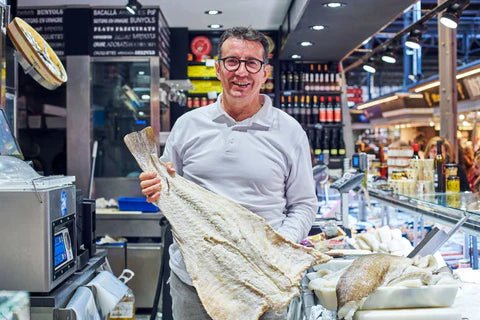
Third generation at Mercat del Ninot. Selects anchovies from canneries in Cantabria since 1990.