

Quick Answer: "Anchoa del Cantábrico" (Cantabrian anchovy) is a geographical denomination (any anchovy caught in the Cantabrian Sea—the northern coast of Spain and southwestern France). "Anchoa de Santoña" (Santoña anchovy) is a sub-denomination indicating that it has been processed in Santoña (Cantabria), the historical epicenter of anchovy salting since 1883. Not all Cantabrian anchovies are from Santoña, but almost all Santoña anchovies are from the Cantabrian Sea. The real difference is not in the fish but in who cures it. We explain it without marketing.
Origin: what each denomination means
Let's start with the basics, because the confusion between "Santoña anchovy" and "Cantabrian anchovy" has been circulating in bars, markets, and supermarkets for decades. And most people who use it can't even explain it well.
The Cantabrian Sea is a sea: the maritime strip that stretches from western France to the tip of Galicia, passing along the entire northern coast of Spain (Basque Country, Cantabria, Asturias). In this sea lives Engraulis encrasicolus, the European anchovy. When caught in these waters and processed in salt, it is called Cantabrian anchovy.
Santoña is a specific town in Cantabria. A fishing port with just over 11,000 inhabitants that, at the end of the 19th century, experienced a small industrial revolution: in 1883, the Italian salting specialist Giovanni Vella Scaliota settled there, fleeing a fishing crisis in Sicily, and applied the Italian technique of pressing and maturation to the Cantabrian anchovy. The rest is history: Santoña became the world center for anchovy salting, and the word "Santoña" became synonymous with quality.
Today, "Santoña anchovy" is a geographical indication of processing (not fishing), recognized by the Protected Geographical Indication "Anchoa del Cantábrico" which the EU approved in its processing. An anchovy can be from the Cantabrian Sea (caught there) and processed in Asturias, Bilbao, or Galicia. Only if it is processed in Santoña and under certain standards can it bear the indication "de Santoña."
Process: why Santoña made a difference
The difference between a correct anchovy and an exceptional anchovy lies in the process, not the fish. In 1883, Vella Scaliota introduced something seemingly simple yet radical: prolonged pressing under weight and precise temperature control during maturation.
The classic Santoña process, now inherited by major canneries (Codesa, Don Bocarte, Catalina, Solano, Hoya, La Cántabra, etc.), follows three phases:
- Reception and initial salting: the anchovy arrives from the port, is beheaded, gutted, and placed in barrels with sea salt in layers. One layer of anchovy, one layer of salt. Repeated until the barrel is full.
- Pressing and curing: weight (between 50 and 80 kg) is placed on each barrel. For 6 to 24 months, the pressure and salt work: they dehydrate the fish, concentrate proteins, generate free amino acids (responsible for umami), and controllably oxidize fats. The temperature must fluctuate between 14 and 22°C.
- Manual filleting: this is where the skill lies. After salting, the anchovies are washed, dried with a cloth, descaled, the central bone is removed, and each fillet is trimmed. A good filleter cleans between 600 and 1,000 fillets a day. An experienced worker takes 60 seconds per anchovy.
What differentiates Santoña is not the recipe—the recipe has been copied along the entire Cantabrian coast. It is the concentration of specialized labor (more than 60 canneries in a single town), the traceability of batches, and the discipline in curing times. An entire town has been living by doing the same thing well for over a century.
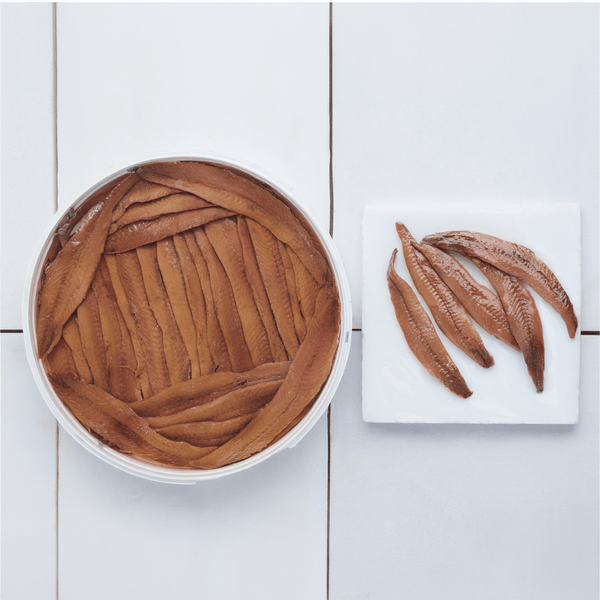
Cantabrian Anchovies "00" Premium
The anchovies we carry at Mercat del Ninot. Caliber 00 (the largest), 18-24 months salting, manual filleting. It's not marketing — there are verifiable factors.
Quick comparative table
| Aspect | Cantabrian (generic) | Santoña |
|---|---|---|
| Fishing area | Cantabrian Sea | Cantabrian Sea (usually) |
| Processing area | Any point on the north coast | Santoña (Cantabria) |
| Tradition | Varies by cannery | Since 1883 |
| Typical curing | 6-12 months | 12-24 months (premium) |
| Common calibers | 0, 1, 2 | 00, 0, 1 (selection) |
| Price /kg | 120-250€ | 200-450€ |
| Availability | High | Limited |
Real quality differences
Here's the important part: not all Santoña anchovies are better than all Cantabrian anchovies. There are canneries in Galicia, Asturias, and the Basque Country that produce extraordinary anchovies. And there are small canneries in Santoña that barely meet the minimum standards.
The "Santoña" distinction functions as a statistical guarantee: on average, a Santoña anchovy is more likely to meet three verifiable factors:
- Superior caliber: Santoña selects the largest anchovies from the fishing season. Fillets of 14-16 cm (caliber 00) are common. In other areas, calibers 1 and 2 dominate.
- Longer curing time: premium Santoña anchovies spend 18-24 months in salt. Industrial ones are packaged in 6-9 months. The difference is noticeable in the "cured cheese" aroma and the concentration of umami.
- More precise filleting: Santoña has more workers with 20+ years of experience. The cleaning of the bone and the presentation of the fillet are better. Fewer scraps, less skin, uniform reddish-brown color.
The smell reveals everything: a good cured Santoña anchovy smells like aged Parmesan cheese, not salty fish. If you open a can and it smells intensely of fish, it's not well cured.
Price: what exactly you pay for
The price per fillet is the honest metric — €/kg is misleading because salt adds weight. These are the real market ranges in 2026:
- Generic Cantabrian anchovy (caliber 1-2): 0.30-0.50€ per fillet. White labels and supermarkets.
- Cantabrian anchovy caliber 0 (not Santoña): 0.50-0.80€ per fillet. Brands like Leonardo Gourmet, Olasagasti.
- Santoña anchovy caliber 0: 0.80-1.20€ per fillet. Traditional canneries in the mid-range.
- Santoña anchovy caliber 00 premium: 1.30-2.50€ per fillet. Codesa, Don Bocarte, La Cántabra in the high-end.
Is 2€ per fillet justified? It depends on the use. For a canapé where the anchovy is the absolute star, yes. For a pizza, no. And here comes the honest economics of the product: if you pay 30€ for a 100g can, you should be buying something that approaches a complete gastronomic experience.
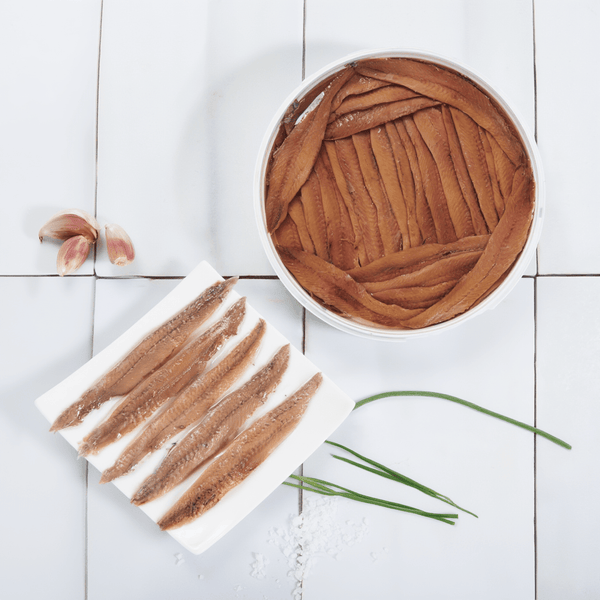
Cantabrian Anchovies "0" Gourmet Selection
Our top seller (€38.90). Caliber 0, long curing, premium olive oil. This is what restaurants buy when they come to Ninot.
How to read the label without being fooled
The anchovy market is full of half-truths. Brands that put a map of Cantabria on the can but process in Morocco. "Santoña style." "Cantabrian tradition." Learn to read:
- Species: It should say Engraulis encrasicolus. If it only says "anchoa" or shows Engraulis anchoita (Argentine anchovy) or Engraulis japonicus, it is not Cantabrian.
- FAO capture zone: 27.VIII.c, 27.VIII.b or 27.VIII.a = real Cantabrian waters. If it says 81, 87, 41, it is not Cantabrian.
- Processed in: It should specify a particular location (Santoña, Castro Urdiales, Laredo, Bermeo, Avilés...). If it just says "processed in Spain," be suspicious.
- Curing time: Premium brands indicate it (18 months, 24 months). Industrial ones hide it.
- Oil: EVOO > olive oil > sunflower oil > vegetable oil. The last option is the cheapest but it cancels out the anchovy's flavor.
Which one to choose depending on the use
- For toast with butter: Santoña caliber 00. No argument.
- For homemade Gilda: Cantabrian caliber 0 — ideal mouthfeel with the gherkin.
- For salad or pizza: Cantabrian caliber 1-2. No sense in spending more when other flavors compete.
- For a gift: Santoña in a 50-100g box from an identifiable cannery.
- For weekly home use: the balance is found in a good Cantabrian caliber 0 from a well-known brand (Leonardo, Olasagasti, Don Bocarte standard range).
Frequently asked questions
Is every Santoña anchovy from the Cantabrian Sea?
Almost always, but not obligatorily. The "de Santoña" denomination refers to the place of processing. Although the common practice is to work with anchovies from the Cantabrian Sea, technically a Santoña cannery could process anchovies from other origins. That's why it's important to also read the FAO capture zone.
Why are Santoña anchovies more expensive?
Three factors: selection of superior caliber (larger = more expensive), longer curing (more immobilized inventory time), and specialized labor in manual filleting. It's not an inflated price due to branding — it's a verifiable real cost.
Which is the best Santoña anchovy?
There is no absolute "best." Codesa, Don Bocarte, Catalina, Solano, and La Cántabra produce excellent high-end products. Quality varies by batch and season. More important than the brand is to buy from a recent season (when it has been in salt for 18-24 months) and of a known caliber.
Does Santoña anchovy have a designation of origin?
There is an ongoing PGI (Protected Geographical Indication) "Anchoa del Cantábrico." Specifically, "de Santoña" as an independent protected designation is not yet consolidated as a PGI. The name functions more as a geographical reference for processing recognized by the market.
Anchovy or boquerón? Is it the same?
It's the same fish (Engraulis encrasicolus) but a different product. Anchovy = cured in salt for months, reddish-brown color, potent flavor. Boquerón en vinagre = fresh fillet marinated in vinegar, white color, acidic flavor. Radically different salt content and process.
What do calibers 00, 0, and 1 mean?
It's the size of the fillet. 00 is the largest (8-9g, 14-16cm). 0 is medium (6-7g, 12-14cm). 1 is small (4-5g, 10-12cm). The caliber depends on the size of the anchovy and the fishing season. The larger the caliber, the higher the price.
How to store an opened can of anchovies?
After opening: transfer to a glass container, cover completely with olive oil, seal, and refrigerate. Lasts 3-4 weeks. Never leave the metal can open in the refrigerator — contact between the metal and acid oxidizes the fillet and produces a metallic taste.
How long do unopened salted anchovies last?
Anchovies in olive oil in a sealed can: 12-18 months from filleting (check best-before date). Anchovies in pure salt (to be cleaned): up to 3-5 years. Always store in a cool, dark, and dry place.
Conclusion
The difference between "Cantabrian anchovy" and "Santoña anchovy" is not invented marketing. It is a real distinction between a geographical denomination (where it's caught) and a processing denomination (where it's cured). Santoña offers a century and a half of expertise concentrated in a small port. This translates, on average, to larger calibers, longer curing times, and finer filleting. It's not magic—it's hours of work and selection reflected in the final price.
If you buy premium anchovies once a year for a special occasion, Santoña caliber 00. If you consume them weekly, a good Cantabrian anchovy caliber 0 gives you 80% of the experience at 50% of the price. We carry both at Ninot because both have their place.
— Lalo González Rodríguez
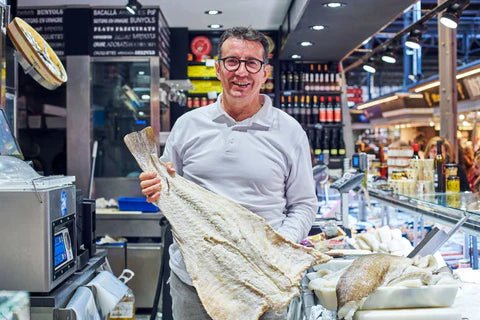
Third generation at Mercat del Ninot. Since 1990, he has been selecting cod, anchovies, and preserves with producers from the Cantabrian Sea.