

Summary: Cod cheeks in green sauce is one of those dishes where technique is everything. It's not difficult: it has no more than five ingredients. But there's one thing that must be done well, or the dish won't work: the circular motion of the pan that binds the gelatin from the cod cheeks with the oil and broth to create a silky, green, and shiny sauce.
At Bacalalo, we have been working with the best cod in Barcelona's Mercat del Ninot since 1990. Cod cheeks—that gelatinous part from the lower jaw of the cod—are one of the most sought-after cuts by connoisseurs. This guide explains how to make cod cheeks in green sauce just like they do in the Basque Country: unhurried, without shortcuts.
What Are Cod Cheeks (Kokotxas)?
Cod cheeks—or kokotxas in Basque—are the fleshy, gelatinous part found in the chin or lower jaw area of the cod. It's a small piece: an adult cod yields barely 60-100g of cheeks. This is why they are scarce and prized.
Their main characteristic is their very high natural collagen content, which, when cooked with the correct technique (gentle and constant movement at low temperature), releases a gelatin that emulsifies with the oil and parsley broth, creating the characteristic sauce.
Cod cheeks can be:- Fresh: seasonal (winter-spring), better flavor, more delicate
- Frozen: available year-round, very good if the freezing process is correct
- Canned: pre-cooked, useful for those who want the dish without prior preparation
For a well-executed green sauce recipe, fresh or quality frozen cod cheeks are the best option. At Bacalalo, you will find cod cheeks in the formats you need.
The Fundamental Difference: Green Sauce vs. Pil Pil
This is the question that causes the most confusion. They are two distinct preparations:
| Green Sauce | Pil Pil | |
|---|---|---|
| Sauce | Green, with broth and parsley | White/golden, only oil and gelatin |
| Extra Ingredients | Garlic, parsley, fish broth, peas (optional) | Only garlic, oil, salt |
| Technique | Circular motion + broth | Pure circular motion |
| Result | More liquid, parsley flavor | Denser, pure cod flavor |
| Difficulty | Medium | Medium-high |
If you're also interested in learning the pil pil technique, we have a separate guide for cod cheeks al pil pil.
Ingredients for Cod Cheeks in Green Sauce (4 servings)
- 600g cod cheeks (fresh or thawed)
- 4 cloves of garlic
- 1 bunch fresh parsley (generous amount)
- 150ml extra virgin olive oil (mild, not too fruity)
- 200ml fish broth or cod soaking water if salted
- 100g peas (optional, but very common in the classic version)
- Salt
- 1 small chili pepper (optional, for a hint of mild spice)
About cod cheeks: fresh or frozen
If fresh: clean under cold water, remove any remaining membranes or blood. Pat dry thoroughly with paper towels. Lightly salt 30 minutes before if unsalted.
If frozen: thaw in the refrigerator for 12-24 hours. Never in hot water or the microwave. Drain and pat dry thoroughly. Excess moisture hinders emulsion.
If salted cod cheeks: desalt in cold water in the refrigerator for 24-36 hours, changing the water 3 times. The final soaking water can be used as part of the broth.
Related Products from Bacalalo


Recommended Products

Natural Cod Liver Foie - 120g | Smoked Cod Liver from I...
€3.90

CHATKA Wild King Crab 60% Legs 40% Shredded | Lar...
€95.00

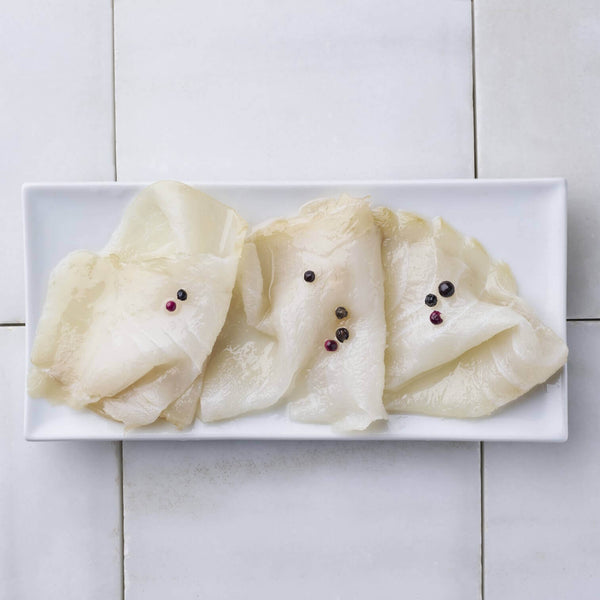
Smoked Cod Carpaccio Artisanal Cut | 1 Tray Pack
€15.90

Dried Cod Cheeks (1 tray) - 500g
€19.95
Refrigerated shipping 24-48h to all of mainland Spain
The Technique: Circular Motion
Before the step-by-step recipe, it's important to understand what the circular motion aims to achieve:
Cod cheeks contain collagen that, at temperatures between 60°C and 75°C, turns into soluble gelatin. This gelatin acts as a natural emulsifier, allowing the oil and broth to combine into a stable emulsion without separating.
The circular motion of the pan (or stirring gently with a wooden spatula) facilitates this emulsion. The temperature must be gentle: if the oil boils vigorously, the gelatin is destroyed, and the sauce becomes oily and breaks.
A sign that it's going well: the sauce thickens and takes on an intense green color. A sign that something is wrong: the oil floats on top, not integrating.
Step-by-Step Recipe: Cod Cheeks in Green Sauce
Step 1: Prepare the garlic oil
In an earthenware casserole dish or a wide pan (earthenware retains uniform heat better), heat the olive oil over very low heat. Add the sliced or crushed garlic cloves, and the chili if using. The goal is to flavor the oil without browning the garlic too much (which would make the sauce bitter). Cook on minimum heat for 5-7 minutes. The garlic should be soft and translucent, not golden.
Remove the garlic and chili from the oil. Set aside.
Step 2: Sear the cod cheeks
Increase the heat slightly (medium-low). Add the cod cheeks with the gelatinous side down. Leave for 1 minute without moving. Carefully flip them over (they are delicate). Another minute.
They should not be fully cooked at this point: only seared on the outside.
Step 3: Add the broth and begin the emulsion
Reduce the heat to minimum. Add 100ml of hot fish broth (it's important that it's hot: temperature contrast would hinder the emulsion).
Begin the gentle, constant circular motion of the pan. If using a spatula, use slow, wide movements. The goal is for the broth, oil, and gelatin from the cod cheeks to integrate.
Add the rest of the broth gradually, continuing to stir.
Step 4: Add the parsley (and peas)
When the sauce begins to gain body and a whitish color (the emulsion is forming), add the finely chopped parsley. Stir to integrate.
If using peas, add them at this point (they can be fresh, frozen, or canned; if canned, drain them well first).
Step 5: Final cooking and adjustment
Maintain on minimum heat for another 5-8 minutes, with gentle movement. The sauce should be silky, an intense green color, and lightly coat a spoon. Not too thick (it's not béchamel) nor too liquid.
Taste and adjust salt. Keep in mind that cod cheeks, even desalted, can add salt.
Step 6: Serve
Cod cheeks in green sauce are served in the same earthenware casserole dish if possible (the visual contrast of green against the earthenware is part of the presentation). Serve with dense-crumbed bread for dipping in the sauce. A Basque white wine (Txakoli) or an Albariño makes a good accompaniment.
Recipe Variations
Cod Cheeks in Green Sauce with Clams
One of the most popular variations: add 200-300g of clams (fresh, well-cleaned) in step 4, before the parsley. Clams add more marine salinity and more gelatin to the dish. The result is more complex and visually more striking.
Cod Cheeks in Green Sauce with Prawns
Less traditional but very effective: add some peeled prawn tails in the last minute of cooking. The residual heat cooks them without making them rubbery.
Gluten-Free Cod Cheeks in Green Sauce
The base recipe is naturally gluten-free. Just verify that the fish broth does not contain gluten-based thickeners.
Hake Version
For those who cannot find cod cheeks or want a more economical version, hake collars or hake supreme fillets follow the same technique. The result is different (less gelatin, so the emulsion is more difficult) but equally tasty.
Common Mistakes and How to Avoid Them
The sauce breaks (oil floats separately): The heat was too high, or the movement was too abrupt. To "rescue": remove from heat, let cool for 2 minutes, add 1-2 tablespoons of cold broth, and resume gentle stirring at very low temperature.
The cod cheeks are tough: Temperature too high or cooking time excessive. The cod cheeks should be tender but not falling apart. This is avoided by using minimum heat and short cooking times.
The sauce is too liquid: Not enough emulsion time or too much broth added at once. Add the broth little by little and allow more time for circular motion.
The parsley turns dark or bitter: Added too early and at a high temperature. Always add parsley when the heat is minimal and the sauce has already emulsified.
Taste is too salty: The cod was not sufficiently desalted, or the fish broth was already very salty. Emergency solution: add more unsalted broth to dilute.
🛒 Products mentioned in this article
⭐ 4.9/5 · Cold shipping 24-48h · Since 1990 at Mercat del Ninot
Frequently Asked Questions about Cod Cheeks in Green Sauce
1. Cocochas or kokotxas? Is it the same? Yes, it is exactly the same. Kokotxa is the word in Basque; cococha is the adaptation into Spanish. Both refer to the same cut of cod.
2. Can I make cod cheeks in green sauce with frozen cod cheeks? Absolutely yes. The key is to thaw them correctly: in the refrigerator, slowly, for 12-24 hours. Pat dry thoroughly before using. The final result, with good quality frozen cod cheeks, is excellent.
3. What type of olive oil is best for this recipe? A mild-flavored extra virgin oil, with a fruity profile but without excessive bitterness or spiciness. Arbequina oils or some mild Castilian oils work well. A very intense oil can overpower the flavor of the hake cheeks.
4. Is a clay pot mandatory? Not mandatory, but highly recommended. Clay distributes heat more evenly and retains it better at a low temperature, which favors emulsion. It can also be made in a non-stick or thick-bottomed stainless steel pan.
5. Can it be prepared in advance? With care. The emulsion is delicate: reheat over very low heat, with gentle movement, adding a little broth if it has thickened too much at rest. Do not microwave: it would destroy the emulsion and the hake cheeks would lose texture.
6. How many hake cheeks per person? Between 120-150g is a generous first-course serving. As a main course with bread, 180-200g per person.
7. What wine to pair with hake cheeks in green sauce? Txakoli from the Basque Country is the classic and perfect pairing: its acidity, slight effervescence and low alcohol content perfectly complement the dish. Alternatives: Albariño, Godello, Chablis, Muscadet. Avoid red wines with tannins that would clash with the gelatin.
8. Why is circular motion so important? Because it facilitates the emulsion of the cod gelatin with the oil. Gelatin acts as a natural emulsifier: it binds oil and water (broth). Without movement, the oil would float separately. Circular motion is gentler and more effective than stirring in a straight line.
9. Do hake cheeks in green sauce have a lot of calories? It is a relatively caloric dish due to the oil (approximately 350-450 kcal per serving), but very nutritious: high in protein and collagen from the hake cheeks, healthy fats from olive oil. It is not a diet dish, but as part of a balanced diet, it is perfectly reasonable.
10. Where can I buy quality cod hake cheeks? At Bacalalo, in the Mercat del Ninot in Barcelona, or in our online store. We work with both fresh (in season) and top-quality frozen hake cheeks.
11. Does green sauce use flour for thickening? Not in the traditional version. The natural gelatin of the hake cheeks is the thickener. Some modern recipes add a teaspoon of flour or cornstarch if the emulsion doesn't bind, but in the authentic version, it is not used.
12. What is the season for fresh hake cheeks? The main season for fresh cod is from autumn to spring (October-May), with the peak between November and March. In summer, fresh hake cheeks are harder to find; frozen ones are available all year round.
At Bacalalo, we have been working with the best cod hake cheeks since 1990 at the Mercat del Ninot in Barcelona. If you want to prepare this recipe with top-quality hake cheeks, visit our online store or stop by the stall. We will advise you on the most suitable format for your preparation.
Discover more
Discover our premium selection
Carefully selected seafood products since 1990 in Mercat del Ninot, Barcelona. Refrigerated shipping 24-48h.